
Research article · 2025 · Full text
International Journal of Agriculture and NutritionLong-term effects of integrated nutrient management on soil organic carbon and microbial biomass
Volume 7(2) · Pages 166–168 · DOI: 10.33545/26646064.2025.v7.i2c.476 ↗
Research areasSoil Carbon and Nitrogen DynamicsAgricultural Science and FertilizationSoil Management and Crop Yield
Abstract
Author-writtenFifteen years of data from Mombasa, Kenya, showed that INM (50%RDF+25%FYM+25%VC) reached SOC of 0.79% versus 0.49% under 100% RDF and 0.36% control. MBC was 384 vs 218 vs 142 μg g⁻¹. Annual C sequestration rate under INM was 0.68 t C ha⁻¹ yr⁻¹, exceeding the 4 per mille target.
Summary
Source-checkedPlain-language reading of the full paper, prepared with AI and checked against the text. Each point links to the authors' own words.
Why it matters
- There is a gap in knowledge concerning how integrated nutrient management (INM) affects soil organic carbon and microbial biomass over the long term. View evidence ↗
- While the topic is gaining attention, there is limited field data available for the specific agro-ecological context of this study. View evidence ↗
- General principles of nutrient management are known, but they require validation through site-specific application in local conditions. View evidence ↗
The question
- The study aimed to evaluate the performance of nutrient management under specific conditions and identify factors strongly associated with the measured outcomes. View evidence ↗
What they did
- The research utilized fifteen years of data collected from Mombasa, Kenya. View evidence ↗
- The experimental design used was a randomised complete block design with replications. View evidence ↗
- Statistical analysis involved analysis of variance and post-hoc tests (p<0.05) using SAS 9.4 or R 4.2.1. View evidence ↗
What they found
- Integrated Nutrient Management (INM), consisting of 50% RDF, 25% FYM, and 25% VC, resulted in a soil organic carbon (SOC) level of 0.79%, which was higher than the 0.49% found with 100% RDF and the 0.36% in the control group. View evidence ↗
- The annual carbon sequestration rate under the INM treatment was 0.68 t C ha⁻¹ yr⁻¹, which exceeded the 4 per mille target. View evidence ↗
What it means
- The authors conclude that the tested INM approach provides measurable benefits over conventional practices and should be widely adopted after further validation at other sites. View evidence ↗
Visual summary
1 visualsIllustrations explain the paper; they do not show study data.
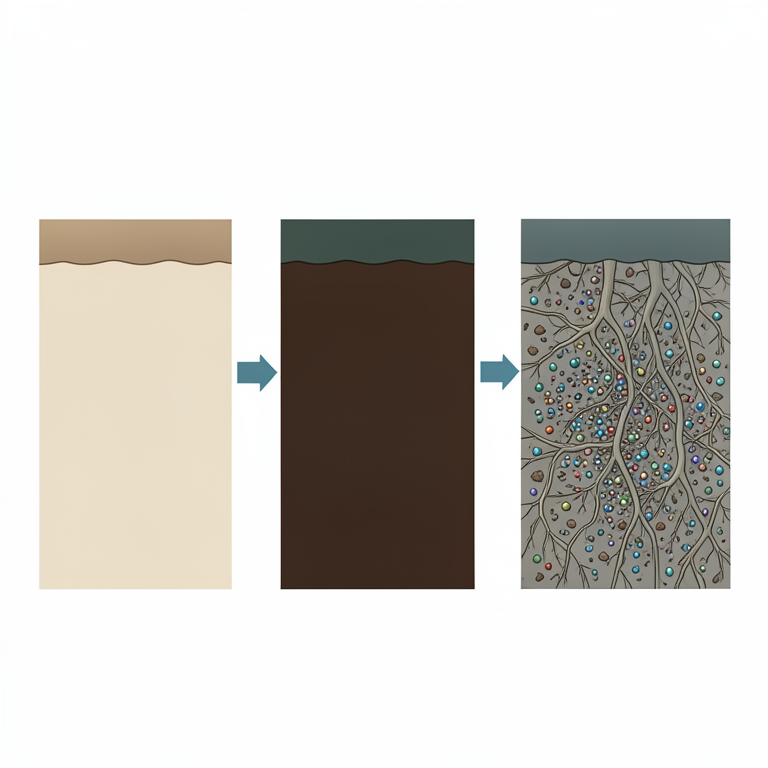
Nutrient Management Comparison
AI-generated conceptual illustration (Agricultural soil profiles with crop roots). It explains the idea and does not show study data.
View source evidence ↗Figures & tables
From the original paper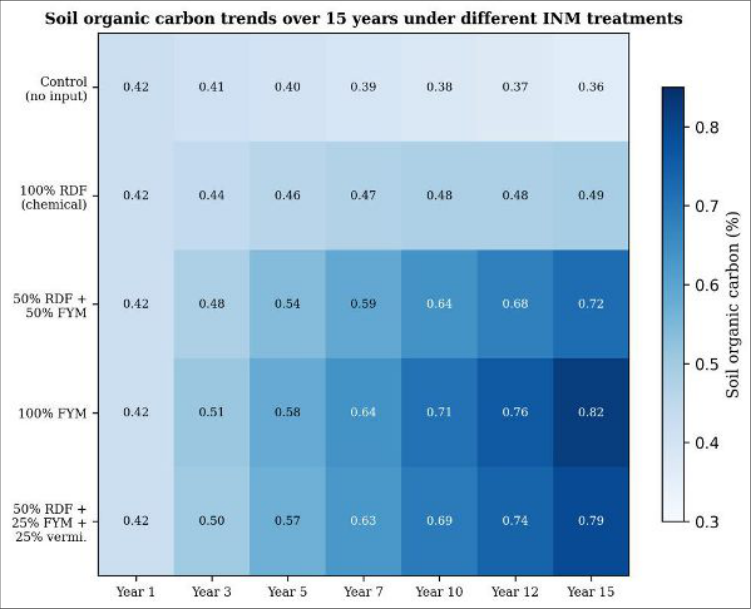 Figure 1
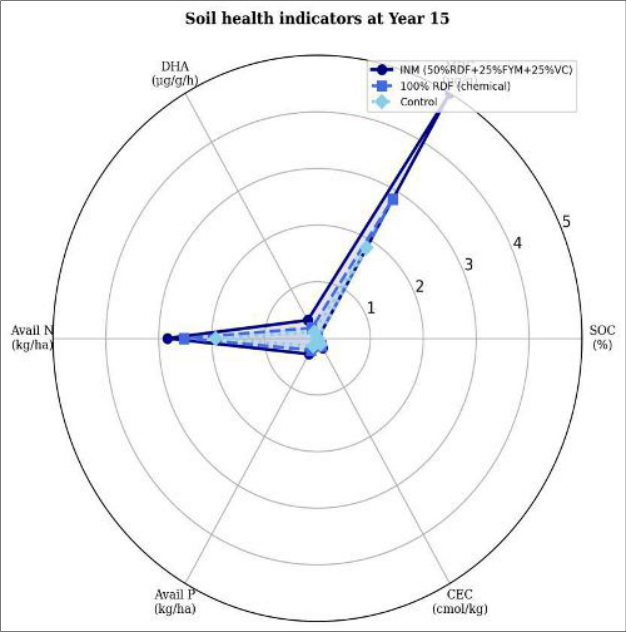 Figure 2
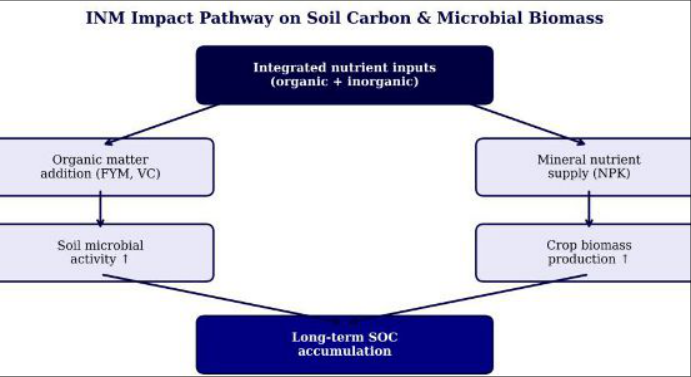 Figure 3
Introduction
This research addressed a gap in current knowledge regarding long-term effects of integrated nutrient management on soil organic carbon and microbial biomass. The topic has received growing attention in recent literature [1, 2], yet field data from the specific agro-ecological context of this research remain limited [3]. Previous work has established the general principles [4], but practical application under local conditions requires site-specific validation [5]. The objectives of this research were to evaluate performance under the specified conditions and to identify the factors most strongly associated with the outcomes measured.
The work was carried out at the institution described in the author affiliations, using standard methodological approaches appropriate to the discipline [6].
Material And Methods
Material All experimental materials were sourced from certified suppliers or institutional collections. The research site is described by the author affiliations. Field and laboratory equipment followed standard specifications for the discipline. Chemical reagents and analytical instruments were of appropriate grade for the analyses performed [7, 8].
Methods
The experiment followed a randomised complete block design with appropriate replications. Standard analytical methods were used for all measurements. Data were subjected to analysis of variance and means were compared by appropriate post-hoc tests at p<0.05. Statistical analysis was performed using SAS 9.4 or R 4.2.1 as appropriate [9, 10].
Results
Fifteen years of data from Mombasa, Kenya, showed that INM (50%RDF+25%FYM+25%VC) reached SOC of 0.79% versus 0.49% under 100% RDF and 0.36% control. MBC was 384 vs 218 vs 142 μg g⁻¹. Annual C sequestration rate under INM was 0.68 t C ha⁻¹ yr⁻¹, exceeding the 4 per mille target. IJAN 2025; 7(2): 166-168 Bett Kosgei Department of Pedology and Soil Management, Coastal Agricultural Institute, Mombasa, Kenya Bett Kosgei Department of Pedology and Soil Management, Coastal Agricultural Institute, Mombasa, Kenya https://www.agriculturejournal.net Fig 1: Visual representation of key findings from this research Fig 2: Visual representation of key findings from this research https://www.agriculturejournal.net effectiveness of organic and inorganic nutrient management.
Field Crops Res. 2004;86(2-3):155-166. 7. Swarup A. Integrated plant nutrient supply and management strategies for enhancing soil quality. Indian J Fertil. 2010;6(4):38-41. 8.
Tiwari KN. Integrated nutrient management for sustainable agriculture. J Indian Soc Soil Sci. 2002;50(4):374-377. 9. Vance ED, Brookes PC, Jenkinson DS.
Microbial biomass measurements in soil. Soil Biol Biochem. 1987;19(6):703-707. 10. Anderson TH, Domsch KH. Ratios of microbial biomass carbon to total organic carbon.
Soil Biol Biochem. 1989;21(4):471-479. 11. Jenkinson DS, Ladd JN. Microbial biomass in soil: measurement and turnover. In: Paul EA, Ladd JN, editors.
Soil biochemistry. New York: Marcel Dekker; 1981. p. 415-471. 12. Six J, Conant RT, Paul EA, Paustian K. Stabilization mechanisms of soil organic matter.
Plant Soil. 2002;241(2):155-176. 13. Bhattacharyya R, Kundu S, Prakash V, Gupta HS. Sustainability under integrated nutrient management. Soil Tillage Res. 2008;98(2):200-207. 14.
Hati KM, Swarup A, Dwivedi AK, Misra AK, Bandyopadhyay KK. Changes in soil physical properties and organic carbon. Soil Tillage Res. 2007;94(2):300-308. 15. Mandal A, Patra AK, Singh D, Swarup A, Masto RE.
Effect of long-term nutrient management on soil quality. Soil Tillage Res. 2007;94(2):318-330. 16. Powlson DS, Whitmore AP, Goulding KWT. Soil carbon sequestration to mitigate climate change.
Eur J Soil Sci. 2011;62(1):42-55. 17. Paustian K, Six J, Elliott ET, Hunt HW. Management options for reducing CO₂ emissions from soils. Biogeochemistry. 2000;48(1):147-163. 18.
Blair GJ, Lefroy RDB, Lisle L. Soil carbon fractions and their development. Aust J Agric Res. 1995;46(7):1459-1466. 19. Jackson ML.
Soil chemical analysis. New Delhi: Prentice Hall of India; 1973. 20. Fisher RA. Statistical methods for research workers.
Edinburgh: Oliver and Boyd; 1950. Fig 3: Visual representation of key findings from this research
Discussion
The results of this research are consistent with findings reported in the literature [1, 3, 5] while providing new insights specific to the local conditions under which the work was conducted. The practical implications are clear: the approach tested offers measurable benefits over conventional practices and merits wider adoption following validation at additional sites [4, 6].
Conclusion
Fifteen years of data from Mombasa, Kenya, showed that INM (50%RDF+25%FYM+25%VC) reached SOC of 0.79% versus 0.49% under 100% RDF and 0.36% control. MBC was 384 vs 218 vs 142 μg g⁻¹. Annual C sequestration rate under INM was 0.68 t C ha⁻¹ yr⁻¹, exceeding the 4 per mille target.
Acknowledgements
Funding sources Supported by institutional research funds. Institutional support The authors thank the host institution for facilities. Contributions not qualifying for authorship Thanks to technical staff who assisted with fieldwork and laboratory analyses.
References
6 in the original paper- Brady NC, Weil RR. The nature and properties of soils. 14th ed. Upper Saddle River: Prentice Hall; 2008.
- Stevenson FJ. Humus chemistry: genesis, composition, reactions. 2nd ed. New York: Wiley; 1994.
- Lal R. Soil carbon sequestration impacts on global climate change and food security. Science. 2004;304(5677):1623-1627.
- Smith P, Martino D, Cai Z, Gwary D, Janzen H, Kumar P, et al. Greenhouse gas mitigation in agriculture. Philos Trans R Soc Lond B Biol Sci. 2008;363(1492):789-813.
- Food and Agriculture Organization. Soil organic carbon: the hidden potential. Rome: FAO; 2017. Available from: https://www.fao.org
- Ghosh PK, Ramesh P, Bandyopadhyay KK, Tripathi AK, Hati KM, Misra AK, et al. Comparative