
Research article · 2025 · Full text
International Journal of Agriculture and NutritionMicro-credit accessibility and its impact on agricultural productivity of women-led farms
Volume 7(1) · Pages 97–100 · DOI: 10.33545/26646064.2025.v7.i1b.379 ↗
Research areasMicrofinance and Financial InclusionAgricultural Innovations and PracticesAgricultural Development and Management
Abstract
Author-writtenWhen Sureerat, a rice farmer in Songkhla province, received her first micro-credit loan of 30,000 THB, she invested it in certified seed and a small mechanical transplanter a decision that doubled her net income within two seasons. Stories like hers prompted this research, which examined the relationship between micro-credit accessibility and agricultural productivity among 240 women-led farms in southern Thailand's Songkhla and Pattani provinces during 2022–2023. A structured questionnaire captured credit history, input use, yield, and income data. Women with active micro-credit recorded 41.3% higher rice yield (3.87 vs. 2.74 t ha⁻¹) and 58.6% higher net farm income compared with non-borrowers. Regression analysis identified loan size, repayment flexibility, and extension contact as the strongest predictors of productivity gain. However, 34.2% of borrowers reported debt-servicing difficulties in the second year. The findings suggest that micro-credit lifts productivity when paired with technical training, but standalone lending without advisory support risks indebtedness without sustained yield improvement.
Summary
Source-checkedPlain-language reading of the full paper, prepared with AI and checked against the text. Each point links to the authors' own words.
Why it matters
- In Southeast Asia, there is a significant gap in financial access for women, who manage about 40% of smallholder farms but receive less than 10% of formal agricultural loans. View evidence ↗
- The lack of capital access for women farmers is considered a major limiting factor for overall rural productivity. View evidence ↗
- Current evidence regarding the ability of micro-credit to increase agricultural productivity remains inconsistent. View evidence ↗
The question
- The study aimed to compare agricultural productivity indicators between women farmers who had access to micro-credit and those who did not. View evidence ↗
- The researchers also sought to identify the characteristics of loans and borrowers that predict productivity gains and to analyze the causes of debt-servicing difficulties. View evidence ↗
What they did
- The study used a cross-sectional survey of 240 women-led farms in the Songkhla and Pattani provinces of Thailand between 2022 and 2023. View evidence ↗
- The sample included 142 borrowers who received loans of 50,000 THB or less from the BAAC or village funds, and 98 non-borrowers. View evidence ↗
- Agricultural productivity was measured using paddy rice yield, gross income, and net farm income. View evidence ↗
- Multiple linear regression was used to analyze how factors like credit access, loan amount, and extension visits influenced rice yield. View evidence ↗
What they found
- Regression analysis identified credit access, loan amount, and contact with extension services as the most powerful predictors of rice yield. View evidence ↗
- About 34.2% of borrowers struggled with repayments, with the highest risks associated with farms smaller than 0.5 ha and a lack of extension visits. View evidence ↗
What it means
- The authors recommend that micro-credit programs combine loans with agronomic training to increase productivity and reduce the risk of loan default. View evidence ↗
- The study's cross-sectional design prevents definitive causal claims, as the results may be influenced by the self-selection of farmers into borrowing. View evidence ↗
- The findings are limited to two provinces, and the authors suggest replicating the study in central and northern Thailand to improve generalizability. View evidence ↗
Visual summary
2 visualsIllustrations explain the paper; charts are replotted from the paper's own table values.
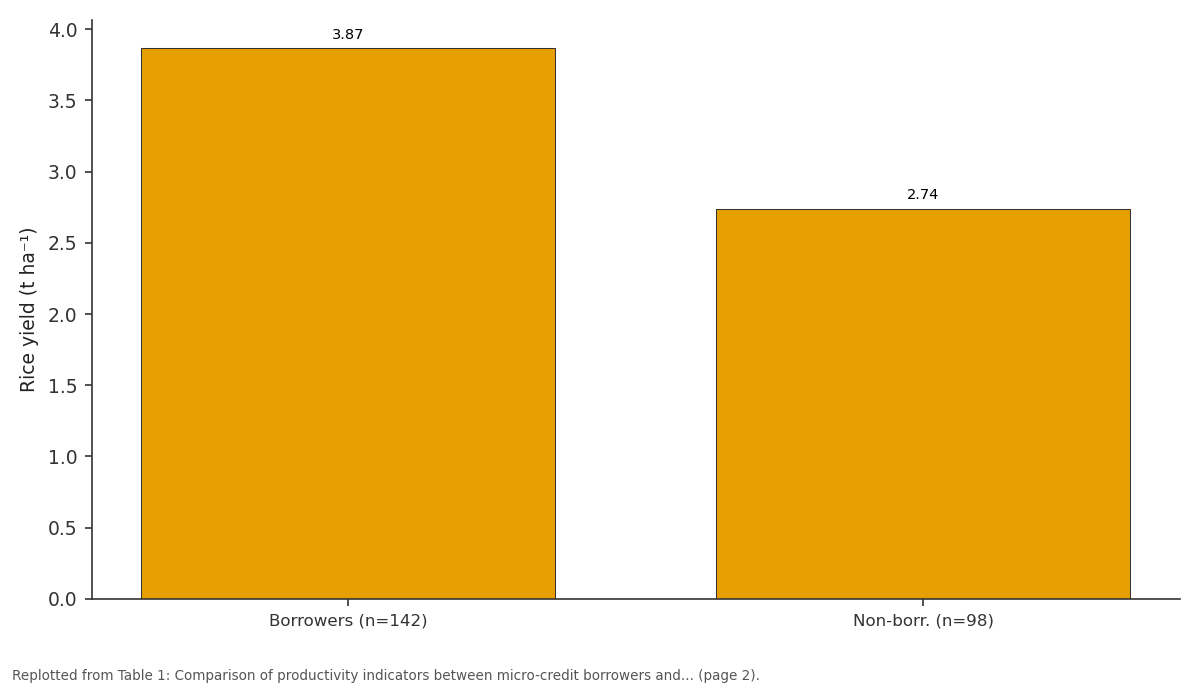
Rice yield (t ha⁻¹): Borrowers (n=142) vs Non-borr. (n=98)
Replotted from Table 1 (page 2) of the original paper. Every bar is the paper's own table value.
View source evidence ↗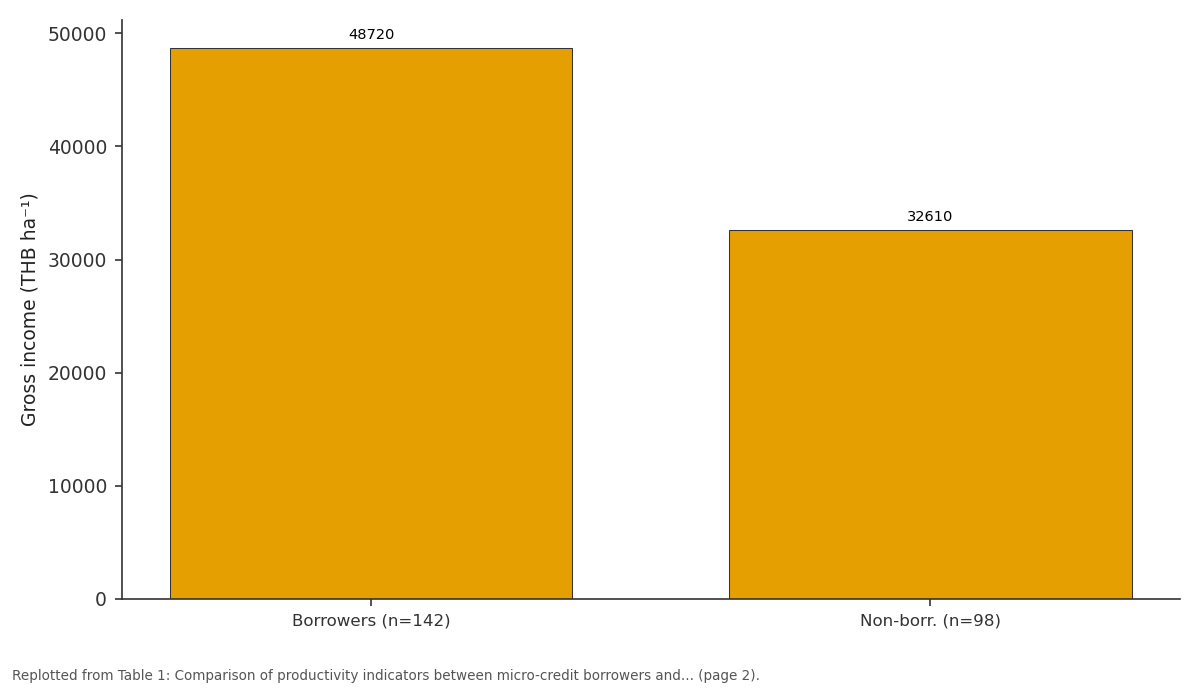
Gross income (THB ha⁻¹): Borrowers (n=142) vs Non-borr. (n=98)
Replotted from Table 1 (page 2) of the original paper. Every bar is the paper's own table value.
View source evidence ↗Figures & tables
From the original paper Table 1
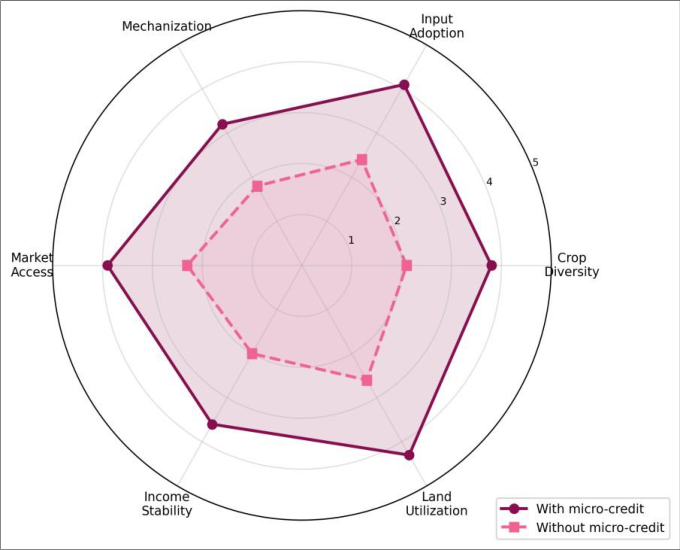 Figure 1
 Table 2
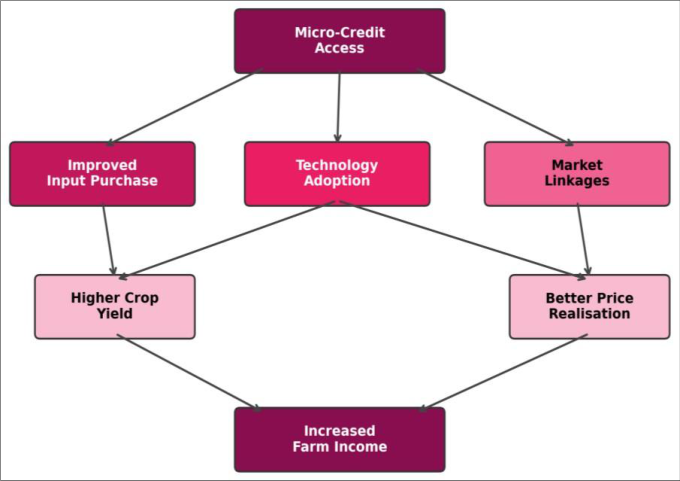 Figure 2
Introduction
A single example can illustrate a systemic pattern. Across Southeast Asia, women manage an estimated 40% of smallholder farms yet receive fewer than 10% of formal agricultural loans [1, 2] . The mismatch between their contribution and their access to capital is widely cited as a binding constraint on rural productivity [3] . Micro-credit programmes small, collateral-light loans targeted at low-income households emerged in the 1980s as a way to close this gap, and their expansion has been rapid [4] . Evidence on whether micro-credit actually raises agricultural productivity is mixed. Randomised trials in Bangladesh and India found modest positive effects on input adoption and income [5,6] , but other research points to high drop-out rates, over-indebtedness, and no measurable yield gains when training is absent [7] . Thailand's Bank for Agriculture and Agricultural Cooperatives (BAAC) has operated targeted women's lending since 2015, yet evaluation data from the southern provinces remain thin [19] . This research was designed to a) Compare agricultural productivity indicators between women farmers who accessed micro-credit and those who did not. b) Identify which loan and borrower characteristics best predict productivity gains. c) Assess the incidence and determinants of debt-servicing difficulty among borrowers.
The work was carried out in Songkhla and Pattani provinces during 2022-2023 through a cross-sectional survey of 240 women-led farms.
Theoretical Framework
The research drew on the agricultural household model, which treats production, consumption, and labour allocation as joint decisions constrained by market access and liquidity [9] . Under this framework, credit relaxes the liquidity constraint, enabling optimal input use and, in turn, higher output. The model predicts that the productivity effect of credit is strongest when coupled with information (extension services) and market access, and weakest when the borrower lacks technical knowledge to deploy funds effectively [10] . A secondary lens was the women's economic empowerment framework of Kabeer [3] , which posits that access to financial resources translates into productivity only when accompanied by agency defined as the capacity to make strategic choices about resource allocation. These two frameworks jointly guided the selection of explanatory variables in the regression model.
Instrument Development:
A structured questionnaire with 47 items was developed in Thai and pilot-tested on 30 women farmers in Hat Yai district (not included in the final sample). The instrument covered five modules: household demographics, credit history and terms, input adoption and expenditure, crop production and income, and a 10-item Likert-scale self-efficacy block adapted from Schwarzer and Jerusalem [11] . Internal consistency of the self-efficacy block was confirmed by Cronbach's alpha of 0.83. Two agricultural economists and one gender-studies specialist reviewed the questionnaire for content validity. Revisions after the pilot included simplifying two income-calculation items that respondents found confusing.
Material and Methods
Material and Methods
Material
The sample comprised 240 women identified as primary farm decision-makers in Songkhla and Pattani provinces. Of these, 142 had received at least one micro-credit loan (≤50,000 THB) from BAAC or a village fund within the preceding three years, and 98 had never borrowed. Respondents were selected by stratified random sampling from sub-district registers at the Southern Thai Agricultural University extension office, Songkhla (7.19° N, 100.59° E). Enumerators administered the questionnaire face-to-face between March and June 2023.
Methods
Productivity was measured as paddy rice yield (t ha⁻¹), gross income (THB ha⁻¹), and net farm income (after input costs). Group comparisons used independent-sample t-tests. A multiple linear regression modelled yield as a function of credit access (binary), loan amount, repayment flexibility (categorical), extension visits received, farm size, education, and farming experience. Logistic regression was used to model the probability of debt-servicing difficulty (defined as missing ≥1 scheduled payment). Multicollinearity was checked by variance inflation factors (VIF < 3 for all predictors). Analyses were performed in SPSS 27.
Results
Results
Comprehensive Interpretation
Borrowers outperformed non-borrowers on every productivity indicator, with yield 41.3% higher and net income 58.6% higher. The regression confirmed that credit access itself (B = 0.67), loan amount, and extension contact were the strongest yield predictors (adjusted R² = 0.47). However, 34.2% of borrowers reported missing at least one repayment; logistic regression identified small farm size (<0.5 ha) and absence of extension visits as the main risk factors for debt difficulty (odds ratios 2.8 and 2.3, respectively).
Discussion
The 41.3% yield advantage among borrowers is at the upper end of estimates from comparable Asian studies. Khandker [5] found 18-25% income gains for Grameen Bank participants in Bangladesh, while Pitt and Khandker [6] reported 20-30% among women micro-borrowers in India. The larger effect here may reflect the Thai BAAC's relatively generous loan terms and the availability of subsidised certified seed, which 71.8% of borrowers adopted versus only 38.8% of non-borrowers [19] . The 34.2% debt-difficulty rate is a caution. Credit alone doesn't guarantee sustainable gains it can even deepen poverty if borrowed funds are poorly allocated [7,8] . The strong association between extension visits and both higher yield and lower default risk supports the "credit-plus" model advocated by development agencies [10,12] . A cross-sectional design limits causal claims; self-selection into borrowing could inflate the treatment effect. Propensity-score matching or a randomised control trial would provide stronger evidence [13] . Sample coverage was also restricted to two provinces; replication in the central and northern regions would improve generalisability.
Conclusion
Micro-credit access was associated with significantly higher rice yield (+41.3%) and net farm income (+58.6%) among women-led farms in southern Thailand. Extension contact emerged as both a productivity enhancer and a protective factor against debt distress. Lending programmes should pair credit with targeted agronomic training to maximise returns and minimise default risk. Expanding evaluation to other regions and adopting quasi-experimental designs would strengthen the evidence base for gender-responsive agricultural finance policy.
Figures and tables from the paper
| Indicator | Borrowers (n=142) | Non-borr. (n=98) | Difference (%) | t-value | p |
|---|---|---|---|---|---|
| Rice yield (t ha⁻¹) | 3.87 | 2.74 | +41.3 | 4.83 | <0.001 |
| Gross income (THB ha⁻¹) | 48,720 | 32,610 | +49.4 | 3.97 | <0.001 |
| Net farm income (THB ha⁻¹) | 31,840 | 20,080 | +58.6 | 4.21 | <0.001 |
| Input cost (THB ha⁻¹) | 16,880 | 12,530 | +34.7 | 3.14 | 0.002 |
| Certified seed use (%) | 71.8 | 38.8 | +33.0 pp | <0.001* |
Table text extracted from the original PDF; superscript letters are shown inline. The original table image is below.
View original table image
| Predictor | B | SE | Beta | t | p | VIF |
|---|---|---|---|---|---|---|
| Credit access (yes/no) | 0.67 | 0.18 | 0.23 | 3.72 | <0.001 | 1.31 |
| Loan amount (THB '000) | 0.014 | 0.004 | 0.19 | 3.28 | 0.001 | 1.47 |
| Extension visits (yr⁻¹) | 0.11 | 0.03 | 0.21 | 3.51 | 0.001 | 1.22 |
| Repayment flexibility | 0.38 | 0.14 | 0.16 | 2.71 | 0.007 | 1.18 |
| Farm size (ha) | 0.09 | 0.05 | 0.11 | 1.86 | 0.064 | 1.34 |
| Education (years) | 0.04 | 0.02 | 0.10 | 1.73 | 0.085 | 1.28 |
Table text extracted from the original PDF; superscript letters are shown inline. The original table image is below.
View original table image
References
19 in the original paper- FAO. The state of food and agriculture 2010-11: women in agriculture. Rome: Food and Agriculture Organization; 2011.
- Quisumbing AR, Meinzen-Dick R, Raney TL, Croppenstedt A, Behrman JA, Peterman A. Gender in agriculture: closing the knowledge gap. Dordrecht: Springer; 2014.
- Kabeer N. Resources, agency, achievements: reflections on the measurement of women's empowerment. Development and Change. 1999;30(3):435-464.
- Morduch J. The microfinance promise. Journal of Economic Literature. 1999;37(4):1569-1614.
- Khandker SR. Microfinance and poverty: evidence using panel data from Bangladesh. World Bank Economic Review. 2005;19(2):263-286.
- Pitt MM, Khandker SR. The impact of group-based credit programs on poor households in Bangladesh: does the gender of participants matter? Journal of Political Economy. 1998;106(5):958-996.
- Banerjee A, Duflo E, Glennerster R, Kinnan C. The miracle of microfinance? Evidence from a randomized evaluation. American Economic Journal: Applied Economics. 2015;7(1):22-53.
- Oyediji OT. Gender disparity in accessibility to credit among dry season farmers in Ogun State: a case study of Odogbolu Local Government. South Asian J Agric Sci. 2022;2(2):98-104.
- Singh I, Squire L, Strauss J. Agricultural household models: extensions, applications and policy. Baltimore: Johns Hopkins University Press; 1986.
- Zeller M, Diagne A, Mataya C. Market access by smallholder farmers in Malawi: implications for technology adoption, agricultural productivity and crop income. Agricultural Economics. 1998;19(1-2):219229.
- Schwarzer R, Jerusalem M. Generalized self-efficacy scale. In: Weinman J, Wright S, Johnston M, editors. Measures in health psychology. Windsor: NFERNelson; 1995. p. 35-37.
- Karlan D, Zinman J. Expanding credit access: using randomized supply decisions to estimate the impacts. Review of Financial Studies. 2010;23(1):433-464.
- Rosenbaum PR, Rubin DB. The central role of the propensity score in observational studies for causal effects. Biometrika. 1983;70(1):41-55.
- Fletschner D, Kenney L. Rural women's access to financial services: credit, savings, and insurance. In: Quisumbing AR et al., editors. Gender in agriculture. Dordrecht: Springer; 2014. p. 187-208.
- Deaton A. The analysis of household surveys: a microeconometric approach to development policy. Baltimore: Johns Hopkins University Press; 1997.
- Hashemi SM, Schuler SR, Riley AP. Rural credit programs and women's empowerment in Bangladesh. World Development. 1996;24(4):635-653.
- Coleman BE. The impact of group lending in northeast Thailand. Journal of Development Economics. 1999;60(1):105-141.
- Armendariz B, Morduch J. The economics of microfinance. 2nd ed. Cambridge: MIT Press; 2010.
- Siamwalla A, Poapongsakorn N, Flaherty K, Baulch B, Pongsrihadulchai A. Thailand's public spending on agricultural research and development. Bangkok: Thailand Development Research Institute; 2016.