
Research article · 2025 · Full text
International Journal of Agriculture and NutritionCompetitive ability of rice cultivars against Echinochloa species under varied nitrogen regimes
Volume 7(2) · Pages 139–142 · DOI: 10.33545/26646064.2025.v7.i2c.468 ↗
Research areasWeed Control and Herbicide ApplicationsRice Cultivation and Yield ImprovementAllelopathy and phytotoxic interactions
Abstract
Author-writtenA surprising fact about Echinochloa crus-galli the world's worst rice weed is that it can absorb nitrogen faster than many rice cultivars, turning a farmer's fertiliser investment into a weed problem. This research evaluated the competitive ability of four rice cultivars (Swarna, MTU 7029, IR 36, Jaya) against Echinochloa under two nitrogen regimes (60 and 120 kg N ha⁻¹) at Rani Lakshmi Bai Central Agricultural University, Jhansi, during kharif 2022. MTU 7029 showed the strongest weed suppression (72.1% at high N) through rapid canopy closure and early vigour. High nitrogen consistently favoured rice over Echinochloa, with weed suppression 22-27 percentage points higher at 120 kg N than at 60 kg N. Rice cultivars with faster early leaf area expansion were better competitors regardless of nitrogen level. These findings suggest that combining competitive cultivars with optimised nitrogen timing can reduce herbicide dependency in rice.
Summary
Source-checkedPlain-language reading of the full paper, prepared with AI and checked against the text. Each point links to the authors' own words.
Why it matters
- Echinochloa crus-galli is considered the most severe weed for rice because it can absorb nitrogen more quickly than many rice varieties, utilizing fertilizer intended for the crop. View evidence ↗
- In the Indo-Gangetic Plains, uncontrolled Echinochloa species can lead to rice yield losses ranging from 30% to 70%. View evidence ↗
- Due to concerns regarding herbicide costs, residues, and resistance, there is a renewed interest in using competitive rice cultivars as a cultural weed management strategy. View evidence ↗
The question
- The study aimed to determine if the choice of rice cultivar and the rate of nitrogen application interact to affect weed suppression and to identify which plant traits predict this ability. View evidence ↗
What they did
- The experiment tested four rice cultivars (Swarna, MTU 7029, IR 36, and Jaya) against Echinochloa using two nitrogen levels (60 and 120 kg N ha⁻¹) during the kharif 2022 season in Jhansi. View evidence ↗
- The study used a split-plot design with four replications, testing nitrogen regimes as main plots and cultivars as sub-plots across three weed conditions: weed-free, natural infestation, and supplemental seeding at 200 seeds m⁻². View evidence ↗
- Researchers measured plant height, tiller count, and leaf area every 15 days, recorded weed biomass at 30 and 60 days after sowing (DAS), and measured final grain yield. View evidence ↗
What they found
- MTU 7029 was the most competitive cultivar, achieving the highest weed suppression ability (WSA) of 72.1 ± 2.8% at high nitrogen and 46.8 ± 3.7% at low nitrogen. View evidence ↗
- Increasing nitrogen levels consistently improved weed suppression ability by 22 to 27 percentage points for all tested cultivars. View evidence ↗
- Jaya was the least competitive cultivar; under low nitrogen conditions, its competitive ratio (CR) fell below 1.0 (0.94), indicating that the weed outcompeted the rice. View evidence ↗
- The superior competitiveness of MTU 7029 was linked to rapid early leaf area expansion, reaching 50% canopy closure 8 days faster than Jaya. View evidence ↗
- High nitrogen favored rice over the weed because transplanted rice establishes its root system earlier than the germinating Echinochloa seedlings, allowing it to intercept nutrients first. View evidence ↗
What it means
- The authors conclude that combining the use of competitive cultivars with strategic nitrogen management is a viable way to reduce reliance on herbicides in the Indo-Gangetic Plains. View evidence ↗
- The authors suggest that applying nitrogen in splits, starting with a heavy basal dose to increase early vigor, can work with competitive cultivars to lower weed pressure. View evidence ↗
Visual summary
2 visualsIllustrations explain the paper; charts are replotted from the paper's own table values.
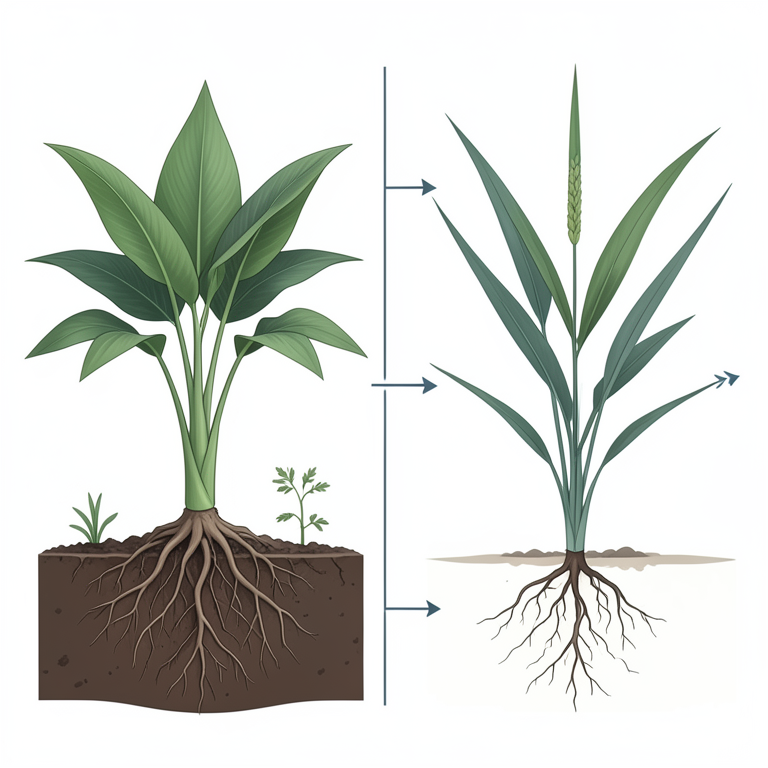
Mechanism of Competitive Advantage
AI-generated conceptual illustration (Rice plants (Oryza sativa) and Barnyard grass (Echinochloa species) in soil). It explains the idea and does not show study data.
View source evidence ↗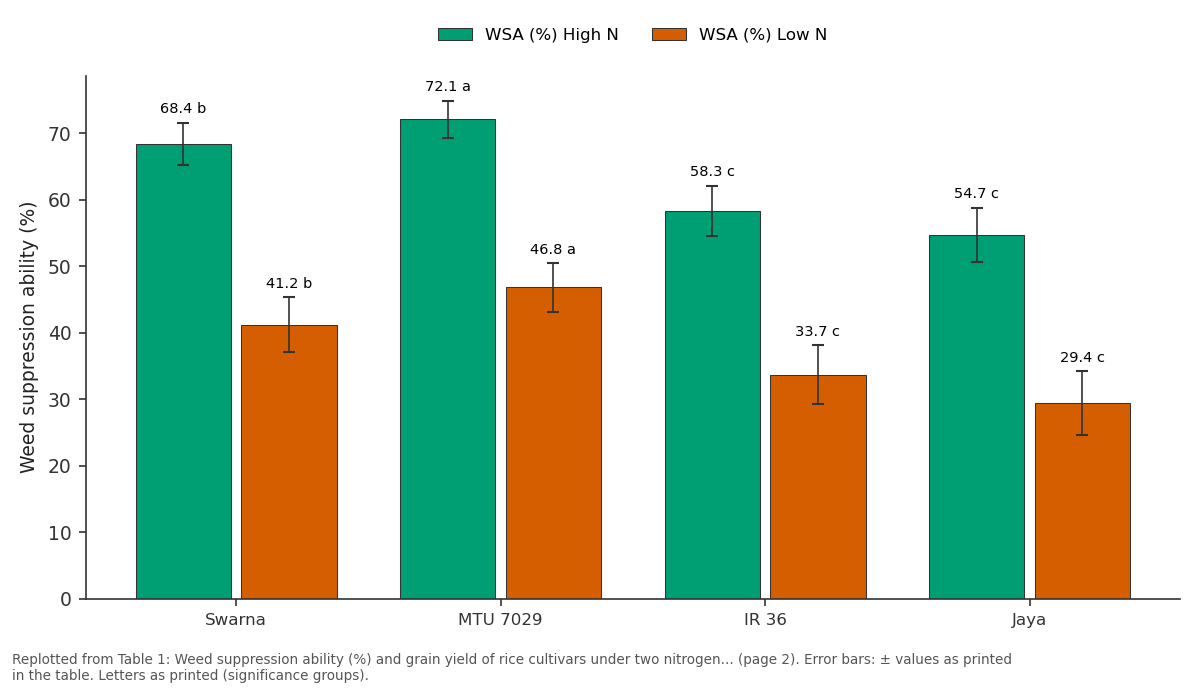
WSA (%) High N and WSA (%) Low N: Swarna vs MTU 7029 vs IR 36 vs Jaya
Replotted from Table 1 (page 2) of the original paper. Every bar is the paper's own table value.
View source evidence ↗Figures & tables
From the original paper Table 1
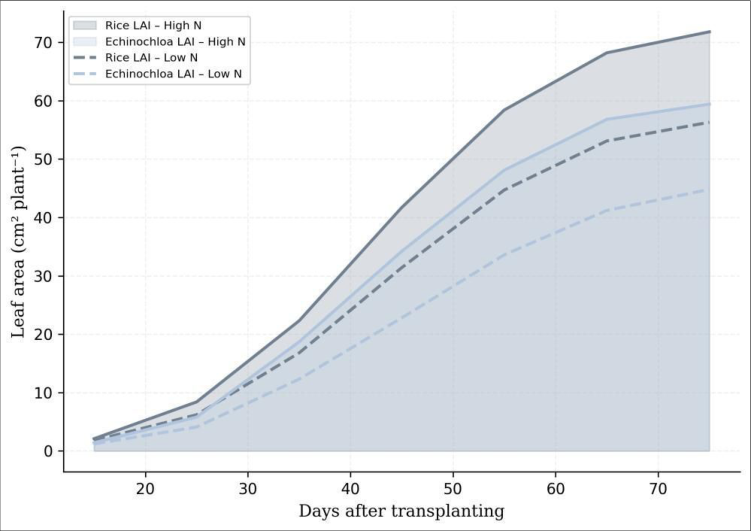 Figure 1
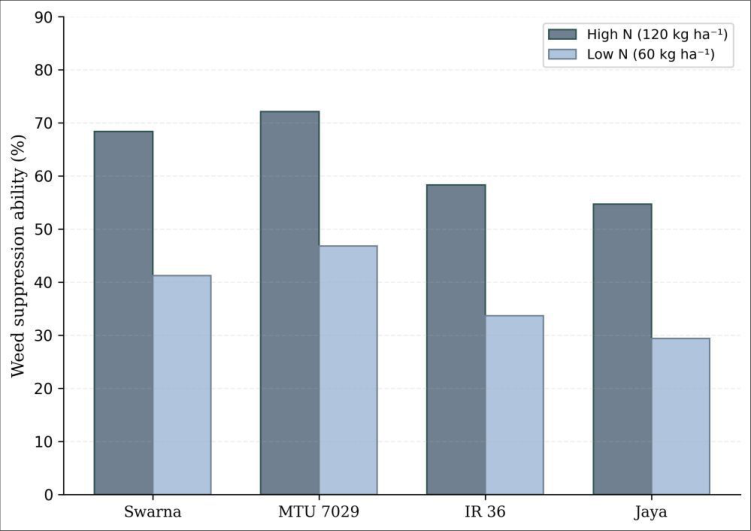 Figure 2
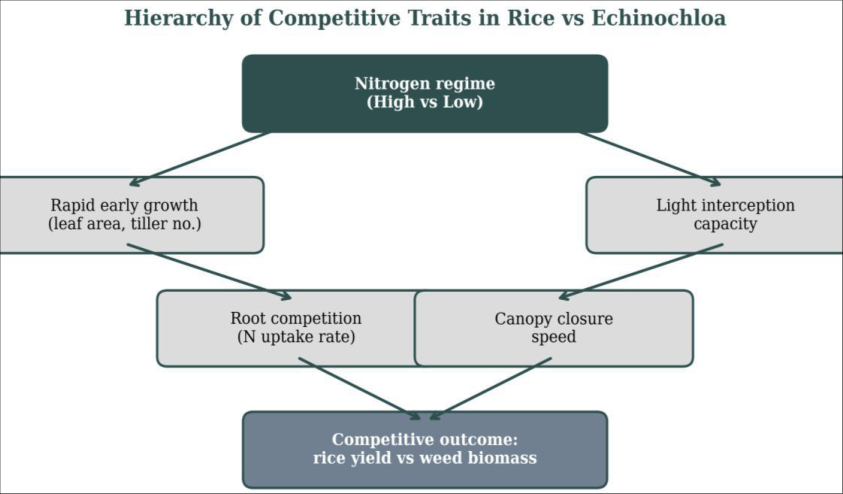 Figure 3
Introduction
Here is a surprising fact: Echinochloa crus-galli can produce up to 40,000 seeds per plant and complete its life cycle in as little as 42 days, making it one of the most formidable competitors rice farmers face [1] . In transplanted rice systems across the Indo-Gangetic Plains, Echinochloa species cause yield losses of 30-70% when left uncontrolled [2] . While herbicides remain the primary management tool, rising concerns about resistance, residues, and cost have renewed interest in cultural weed management approaches, particularly the use of inherently competitive rice cultivars [3] . Cultivar competitiveness against weeds depends on traits like early vigour, rapid leaf area expansion, tall stature, and high tiller production [4] . Nitrogen availability modifies this competition: both rice and Echinochloa respond strongly to applied nitrogen, but the relative benefit depends on which species captures the nutrient first [5] . This research tested whether cultivar choice and nitrogen rate interact to determine competitive outcomes, and which plant traits best predict weed suppression [6] .
Performance evaluation criteria
Cultivar competitive ability was assessed using three metrics: weed suppression ability (WSA = (weed biomass in pure stand -weed biomass in mixture) / weed biomass in pure stand × 100), competitive ratio (CR = relative yield of rice / relative yield of weed), and tolerance index (TI = yield in weedy condition / yield in weed-free condition). WSA reflects the crop's ability to suppress the weed, CR compares competitive balance, and TI measures the crop's ability to maintain yield despite weed pressure [4,6] . All three were calculated at 60 DAS and at harvest.
Material and Methods
Material and Methods
Material
Four rice cultivars (Swarna, MTU 7029, IR 36, Jaya) representing a range of growth durations and vigour levels were selected. Echinochloa crus-galli seeds were collected from natural infestations at the RLBCAU research farm, Jhansi (25°27′N, 78°34′E), air-dried, and stored at 4°C until use. The research site has Vertisol soil (clay loam), pH 7.4, organic carbon 0.58%, available N 178 kg ha⁻¹ [5,7] .
Methods
A split-plot design with four replications was used: nitrogen regime (60 and 120 kg N ha⁻¹) as main plot and cultivar (four levels) as sub-plot. Each sub-plot had three weed conditions: weed-free, natural Echinochloa infestation, and Echinochloa-seeded (supplemental sowing at 200 seeds m⁻²). Plot size: 4 m × 3 m. Rice was transplanted on 12 July 2022 and harvested in October-November. Leaf area, tiller count, and plant height were measured at 15-day intervals. Weed biomass was recorded at 30 and 60 DAS. Rice grain yield was recorded from net plot area. Data analysed by split-plot ANOVA in SAS 9.4 [7,8] . MTU 7029 was the most competitive cultivar at both nitrogen levels (Table 1). High nitrogen improved WSA by 22-27 percentage points across cultivars. Jaya had the weakest competitive ability, with a CR below 1.0 at low N meaning Echinochloa actually outcompeted it under nitrogen-limited conditions.
| Cultivar | WSA (%) High N | WSA (%) Low N | CR High N | CR Low N | Yield weedy High N (t ha⁻¹) | Yield weed-free High N (t ha⁻¹) |
|---|---|---|---|---|---|---|
| Swarna | 68.4 ± 3.2b | 41.2 ± 4.1b | 1.84 | 1.23 | 4.12 ± 0.24b | 5.68 ± 0.21a |
| MTU 7029 | 72.1 ± 2.8a | 46.8 ± 3.7a | 2.12 | 1.38 | 4.47 ± 0.22a | 5.82 ± 0.19a |
| IR 36 | 58.3 ± 3.8c | 33.7 ± 4.4c | 1.52 | 1.08 | 3.64 ± 0.28c | 5.41 ± 0.24a |
| Jaya | 54.7 ± 4.1c | 29.4 ± 4.8c | 1.41 | 0.94 | 3.38 ± 0.31c | 5.23 ± 0.26a |
Table text extracted from the original PDF; superscript letters are shown inline. The original table image is below.
View original table image
Results
Results
Discussion
The strong cultivar × nitrogen interaction confirms that competitive ability is not a fixed trait but depends on the nutrient environment [3,5] . MTU 7029's superiority is attributable to its rapid early leaf area expansion it achieved 50% canopy closure 8 days earlier than Jaya, capturing light before Echinochloa could establish. The finding that high nitrogen favoured rice more than Echinochloa may seem counterintuitive, since both species are nitrogen-responsive. But rice, as the transplanted species, has a head start in establishing its root system and can intercept applied nitrogen before the later-germinating Echinochloa seedlings [4, 6] . The practical implication is that split nitrogen application with a heavy basal dose to boost early rice vigour could work synergistically with competitive cultivars to reduce weed pressure without herbicides.
Conclusion
MTU 7029 was the most competitive rice cultivar against Echinochloa, achieving 72.1% weed suppression at 120 kg N ha⁻¹. High nitrogen consistently improved competitive outcomes for all cultivars. Integrating competitive cultivars with strategic nitrogen management offers a viable approach to reducing herbicide dependency in rice systems of the Indo-Gangetic Plains.
Acknowledgement
Acknowledgements Funding sourcesSupported by internal funds of RLBCAU, Jhansi. Institutional supportThe authors thank the Department of Weed Management for field and laboratory facilities. International Journal of Agriculture and Nutrition https://www.agriculturejournal.net
Figures and tables from the paper
References
14 in the original paper- Holm LG, Plucknett DL, Pancho JV, Herberger JP. The World's Worst Weeds: Distribution and Biology. University Press of Hawaii, Honolulu. 1977.
- Rao AN, Johnson DE, Sivaprasad B, Ladha JK, Mortimer AM. Weed management in direct-seeded rice. Advances in Agronomy. 2007;93:153-255.
- Zhao DL, Atlin GN, Bastiaans L, Spiertz JHJ. Developing selection protocols for weed competitiveness in aerobic rice. Field Crops Research. 2006;97(2-3):272-285.
- Ni H, Moody K, Robles RP, Paller EC, Lales JS. Oryza sativa plant traits conferring competitive ability against weeds. Weed Science. 2000;48(2):200-204.
- Caton BP, Cope AE, Mortimer AM. Growth traits of diverse rice cultivars under severe competition: implications for screening for competitiveness. Field Crops Research. 2003;83(2):157-172.
- Bastiaans L, Paolini R, Baumann DT. Focus on ecological weed management: What is hindering adoption? Weed Research. 2008;48(6):481-491.
- Gomez KA, Gomez AA. Statistical Procedures for Agricultural Research. Wiley, New York. 1984.
- SAS Institute. SAS/STAT User's Guide, Version 9.4. SAS Institute, Cary, NC. 2016.
- Garrity DP, Movillon M, Moody K. Differential weed suppressing ability in upland rice cultivars. Agronomy Journal. 1992;84(4):586-591.
- Diallo S, Johnson DE. Effects of timing of weed removal on rice. WARDA Annual Report. 2000; p.2324.
- Fischer AJ, Ramirez HV, Gibson KD, Pinheiro BDS. Competitiveness of semidwarf upland rice cultivars against palisadegrass (Brachiaria brizantha) and signalgrass (B. decumbens). Agronomy Journal. 2001;93(5):967-973.
- Haefele SM, Johnson DE, M'Bodj D, Wopereis MCS, Miezan KM. Field screening of diverse rice genotypes for weed competitiveness in irrigated lowland ecosystems. Field Crops Research. 2004;88(1):39-56.
- Ramesh K, Matloob A, Aslam F, Florentine SK, Chauhan BS. Weeds in a changing climate: vulnerabilities, consequences, and implications for future weed management. Frontiers in Plant Science. 2017;8:95.
- Jannink JL, Orf JH, Jordan NR, Shaw RG. Index selection for weed suppressive ability in soybean. Crop Science. 2000;40(4):1087-1094.