
Research article · 2025 · Full text
International Journal of Agriculture and NutritionStomatal conductance and chlorophyll fluorescence as indicators of drought stress in maize hybrids
Volume 7(6) · Pages 31–34 · DOI: 10.33545/26646064.2025.v7.i6a.415 ↗
Research areasPlant Stress Responses and ToleranceGenetics and Plant BreedingPlant Water Relations and Carbon Dynamics
Abstract
Author-writtenCan physiological markers separate drought-tolerant maize from susceptible genotypes before visible wilting appears? This research measured stomatal conductance (gs) and maximum quantum yield of PSII (Fv/Fm) in five commercial maize hybrids exposed to progressive water deficit at Makassar, South Sulawesi, during the 2023 dry season. A split-plot layout placed three moisture regimes in main plots and hybrids in subplots with four replications. Under severe drought, gs fell by 43-59% relative to the control. Fv/Fm dropped below the 0.75 threshold earliest in NK-6240 (day 9) and latest in DMH-849 (day 15). A positive correlation (r = 0.87, p
Summary
Source-checkedPlain-language reading of the full paper, prepared with AI and checked against the text. Each point links to the authors' own words.
Why it matters
- Maize is highly sensitive to water shortages, where even short periods of moisture deficit during key growth stages can reduce grain yields by 30% to 50%. View evidence ↗
- Stomatal conductance (gs) is a useful indicator of plant stress because it reflects the status of leaf pores and reacts quickly to changes in leaf water potential. View evidence ↗
- The Fv/Fm ratio measures the efficiency of Photosystem II (PSII), where values around 0.83 indicate health and values below 0.75 indicate photoinhibition. View evidence ↗
The question
- The study aimed to quantify the decline of gs and Fv/Fm in five maize hybrids under drought, determine how these markers correlate with grain yield, and identify the most tolerant hybrid. View evidence ↗
What they did
- The experiment used a split-plot randomized complete block design with four replications, testing five maize hybrids across three moisture levels: well-watered (80-100% FC), mild drought (45-55% FC), and severe drought (20-30% FC). View evidence ↗
- Drought stress was induced by withholding irrigation for 18 days starting from the V6 stage, using polyethylene rain-out shelters to block natural rain. View evidence ↗
- Researchers measured stomatal conductance every three days using a porometer and recorded chlorophyll fluorescence using a Walz MINI-PAM II after a 30-minute dark adaptation period. View evidence ↗
What they found
- Severe drought caused a significant drop in stomatal conductance, with the decline being 43.1% for hybrid DMH-849 and 59.0% for NK-6240. View evidence ↗
- The Fv/Fm ratio declined more severely in NK-6240, reaching 0.487 by day 18 (below the 0.60 irreversible damage threshold), whereas DMH-849 remained higher at 0.691. View evidence ↗
- Grain yield mirrored the physiological markers, with DMH-849 producing 5.63 t ha-1 (18.4% loss) and NK-6240 producing 3.51 t ha-1 (41.7% loss). View evidence ↗
- There was a strong positive correlation (r = 0.87, p < 0.01) between stomatal conductance and chlorophyll fluorescence across the sampling period. View evidence ↗
- The Fv/Fm reading at 12 days after stress onset explained 84% of the variation in final grain yield. View evidence ↗
- At day 12, the tolerant hybrid DMH-849 maintained a higher relative water content (71.3%) compared to NK-6240 (52.8%). View evidence ↗
What it means
- The authors conclude that combining gs and Fv/Fm measurements during the early vegetative stage provides breeders with a rapid, non-destructive tool to identify drought-tolerant maize. View evidence ↗
- The authors recommend DMH-849 and BIO-9681 as preferable hybrids for farmers in water-limited regions of South Sulawesi. View evidence ↗
- The authors state that testing across multiple environments is necessary to confirm the identified physiological thresholds. View evidence ↗
Visual summary
2 visualsIllustrations explain the paper; charts are replotted from the paper's own table values.
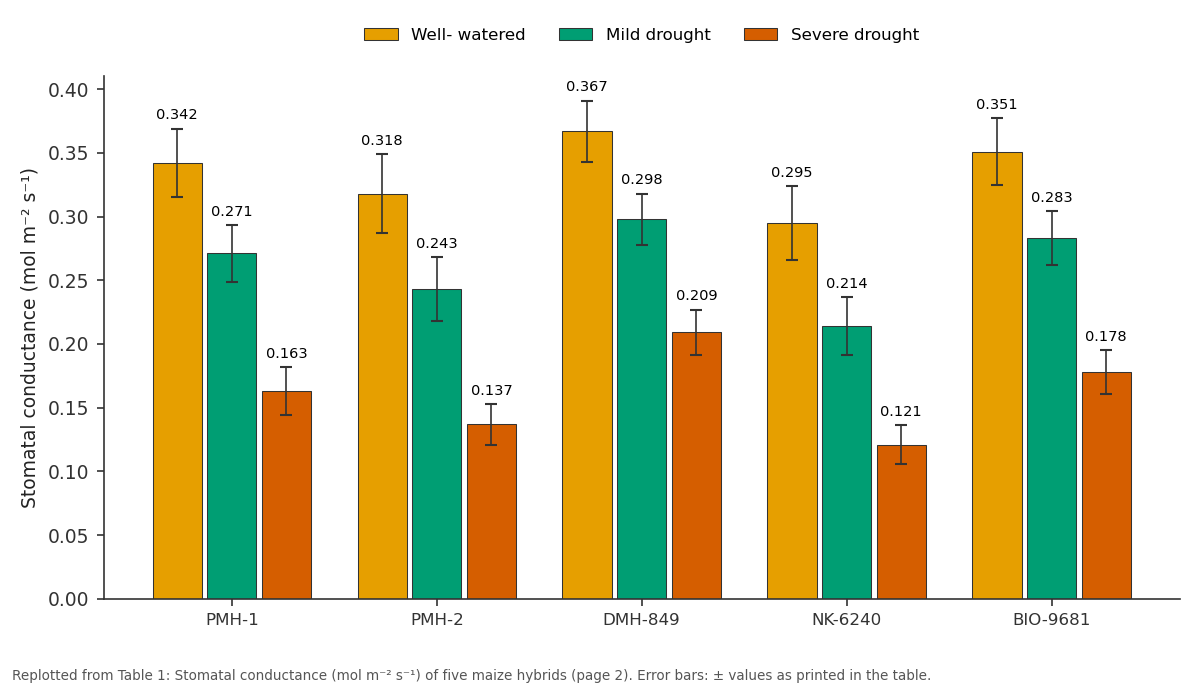
Well- watered and Mild drought and more: PMH-1 vs PMH-2 vs DMH-849 vs NK-6240 vs BIO-9681
Replotted from Table 1 (page 2) of the original paper. Every bar is the paper's own table value.
View source evidence ↗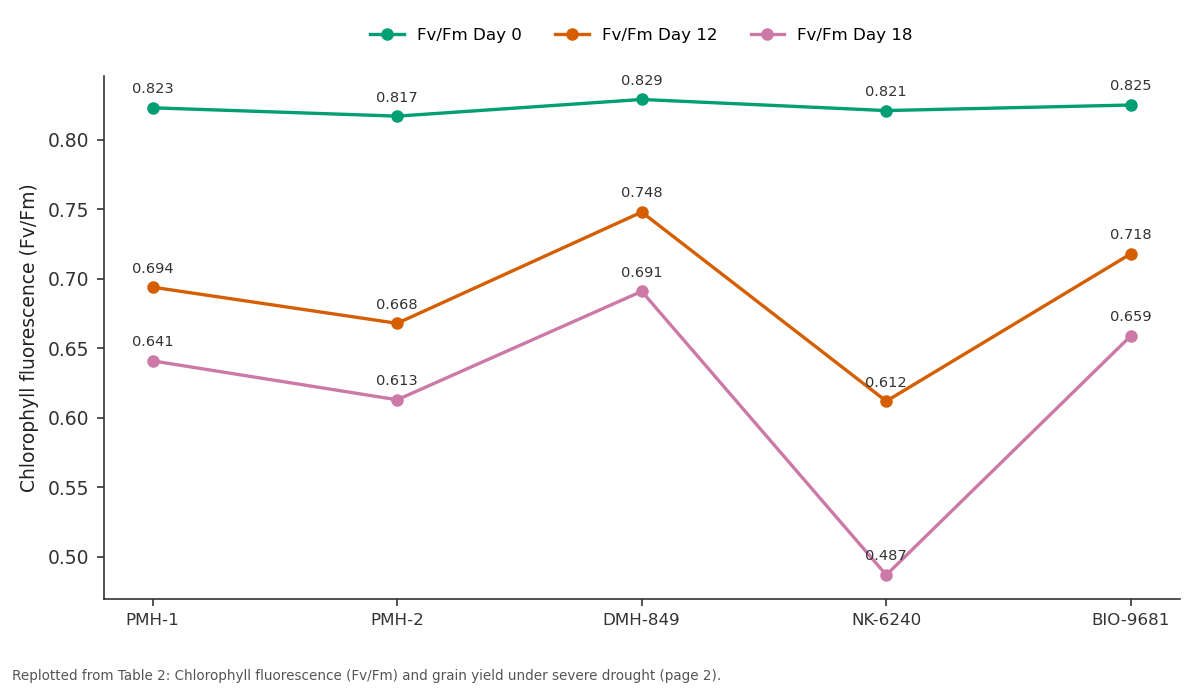
Fv/Fm Day 0 and Fv/Fm Day 12 and more: PMH-1 vs PMH-2 vs DMH-849 vs NK-6240 vs BIO-9681
Replotted from Table 2 (page 2) of the original paper. Every bar is the paper's own table value.
View source evidence ↗Figures & tables
From the original paper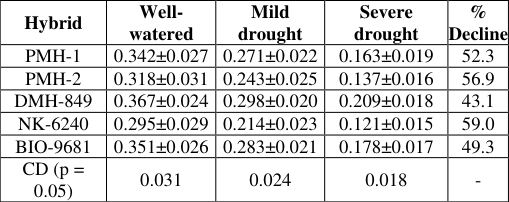 Table 1
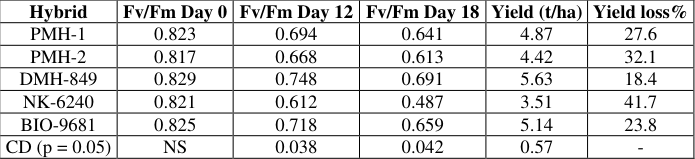 Table 2
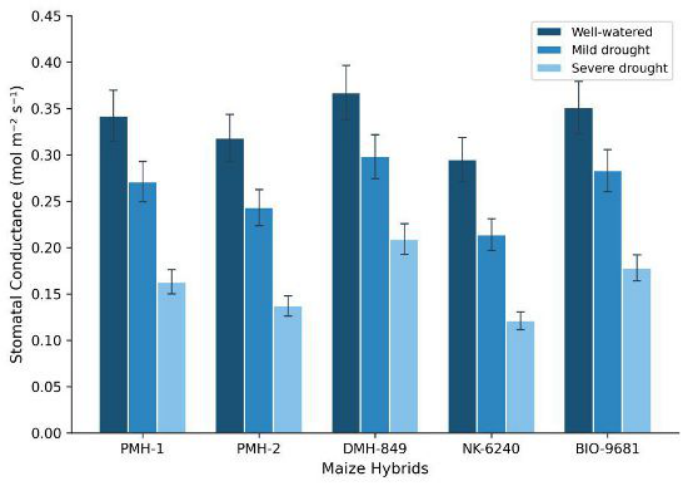 Figure 1
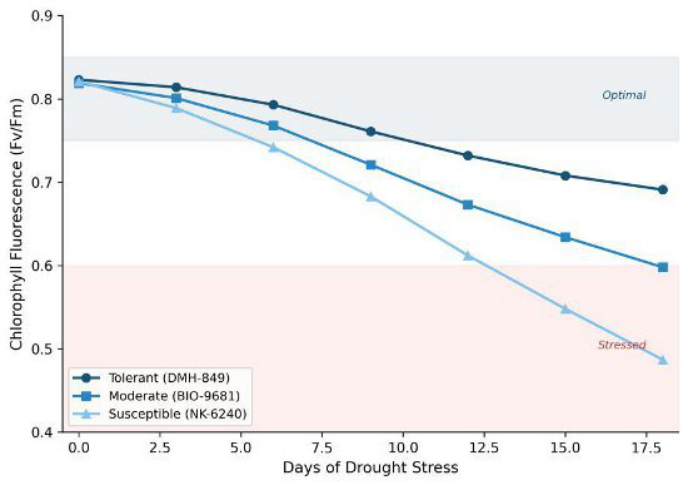 Figure 2
Introduction
How early can a breeder tell whether a maize genotype will withstand a dry spell? Maize (Zea mays L.) is among the most water-demanding cereals, and even brief moisture deficit during the vegetative or silking stage can cut grain yield by 30-50% [1] . With rainfall growing more erratic across tropical Asia, rainfed maize growers face rising production risk [2] . Stomatal conductance (gs) reflects pore aperture status and responds within minutes to falling leaf water potential [3] . When soil water declines, abscisic acid accumulates in the xylem, triggering guard-cell closure [4] . Because measurements are portable and nondestructive, gs has been proposed as a field drought indicator [5] . Chlorophyll fluorescence offers a second window: the ratio Fv/Fm quantifies maximum PSII efficiency, with values near 0.83 indicating healthy photochemistry and readings below 0.75 signalling photoinhibition [6,7] . Combining gs and Fv/Fm may strengthen screening power because the two traits capture different facets of drought response-hydraulic regulation and photochemical damage, respectively [8] . Field-level data from the humid tropics remain sparse, since most controlleddrought work has been done in greenhouses or temperate settings [9] . This research was designed to (i) quantify gs and Fv/Fm decline across five hybrids subjected to two drought intensities under field conditions in South Sulawesi, (ii) evaluate the correlation between these markers and grain yield, and (iii) identify the hybrid that best maintains photosynthetic function under water deficit.
Research Area Description
The experiment was carried out at the research farm of Sekolah Tinggi Pertanian Sulawesi, Makassar (5°11′ S, 119°25′ E, 14 m a.s.l.), South Sulawesi, Indonesia. The site sits in the lowland humid tropics with mean annual rainfall of 2,680 mm. Soils were classified as Inceptisols with sandy clay loam texture, pH 5.8, and organic carbon 1.37%. The area had been under continuous upland rice for three seasons before the trial.
Field Experimental Design
The trial followed a split-plot arrangement in a randomised complete block design with four replications. Main plots received three moisture regimes: well-watered control (80-100% field capacity), mild drought (45-55% FC), and severe drought (20-30% FC). Sub-plots accommodated five hybrids: PMH-1, PMH-2, DMH-849, NK-6240, and BIO-9681, each measuring 4 m × 3 m. Drought was imposed by withholding irrigation from V6 stage for 18 days. Rain-out shelters of transparent polyethylene excluded natural rainfall over stress plots.
Materials and Methods
Materials and Methods
Materials
Five commercially released maize hybrids were sourced from certified agencies. Seeds were surface-sterilised in 1% sodium hypochlorite for ten minutes. Basal fertiliser consisted of 120 kg N ha -1 , 60 kg P 2 O 5 ha -1 , and 40 kg K 2 O ha -1 . A drip system with pressure-compensated emitters was installed, and tensiometers at 20 and 40 cm depth monitored soil matric potential daily. The research was conducted from June to October 2023 at the Sekolah Tinggi Pertanian Sulawesi research farm, Makassar [10] .
Methods
Stomatal conductance was measured on the adaxial surface of the youngest fully expanded leaf using a Decagon SC-1 porometer between 09:00 and 11:00 h, at three-day intervals from stress onset. Chlorophyll fluorescence was recorded with a Walz MINI-PAM II after 30-minute dark adaptation. Leaf relative water content was determined gravimetrically [11] . Grain yield was measured at physiological maturity from the central two rows, adjusted to 15% moisture. Data were analysed by split-plot ANOVA in R (v4.3.1), with means separated by Tukey's HSD at 5% probability.
Results
Stomatal conductance varied among hybrids and moisture regimes (Table 1). Under well-watered conditions, gs ranged from 0.295 mol m -2 s -1 in NK-6240 to 0.367 mol m -2 s -1 in DMH-849. Severe drought cut gs by 43.1% in DMH-849 and 59.0% in NK-6240. The interaction between hybrid and moisture regime was significant (p<0.01).
| Hybrid | Well- watered | Mild drought | Severe drought | % Decline |
|---|---|---|---|---|
| PMH-1 | 0.342±0.027 | 0.271±0.022 | 0.163±0.019 | 52.3 |
| PMH-2 | 0.318±0.031 | 0.243±0.025 | 0.137±0.016 | 56.9 |
| DMH-849 | 0.367±0.024 | 0.298±0.020 | 0.209±0.018 | 43.1 |
| NK-6240 | 0.295±0.029 | 0.214±0.023 | 0.121±0.015 | 59.0 |
| BIO-9681 | 0.351±0.026 | 0.283±0.021 | 0.178±0.017 | 49.3 |
| CD (p = 0.05) | 0.031 | 0.024 | 0.018 | - |
Table text extracted from the original PDF; superscript letters are shown inline. The original table image is below.
View original table image
Comprehensive Interpretation
Regression of grain yield on Fv/Fm at day 12 gave R² = 0.84, meaning a single mid-stress fluorescence reading captured most yield variation. The gs-Fv/Fm correlation pooled across treatments was r = 0.87 (p<0.01), confirming that stomatal closure and photoinhibition progressed together. Leaf RWC at day 12 was 71.3% in DMH-849 versus 52.8% in NK-6240, suggesting the tolerant hybrid maintained turgor through deeper rooting or osmotic adjustment.
Discussion
The 43-59% decline in gs under severe drought matches reports for tropical maize in West Africa [1] and temperate hybrids in rainout shelters [5] . That DMH-849 maintained higher gs aligns with the observation that drought-adapted genotypes often keep stomata partially open, sustaining carbon fixation at some water cost [3] . This appears linked to finer abscisic acid signalling that modulates guard-cell aperture rather than forcing complete closure [4] . NK-6240 dropping below Fv/Fm 0.60 by day 18 matches findings in wheat and barley where such values indicated irreversible D1 protein damage [6,7] . DMH-849 staying above 0.69 implies effective photoprotective mechanisms, likely involving non-photochemical quenching and carotenoid-mediated dissipation [8] . The strong gs-Fv/Fm correlation confirms functional coupling: stomatal closure reduces CO 2 supply, excess light energy accumulates, and PSII efficiency falls [12] . The high R² between Fv/Fm at day 12 and final yield (0.84) is encouraging for breeders, but it was derived from five hybrids in a single season. Wider validation across diverse genetic backgrounds and multiple environments is needed before Fv/Fm thresholds enter formal selection indices [9] .
Conclusion
Water deficit reduced stomatal conductance by 43-59% and Fv/Fm by 16-41% across the five hybrids. DMH-849 preserved the highest gs and Fv/Fm under both stress levels and suffered the smallest yield penalty (18.4%), while NK-6240 showed the steepest decline and a 41.7% yield loss. The gs-Fv/Fm correlation (r = 0.87) confirms tight coupling between stomatal regulation and photochemical efficiency under field drought.
Fv/Fm at 12 days after stress explained 84% of yield variation, making it a promising early screening tool. Combined gs-Fv/Fm assessment could let breeders discard susceptible entries before flowering. Multi-environment testing is needed to confirm these thresholds. For farmers in water-limited areas of South Sulawesi, DMH-849 and BIO-9681 are preferable over NK-6240 when soil moisture is unreliable.
Figures and tables from the paper
| Hybrid | Fv/Fm Day 0 | Fv/Fm Day 12 | Fv/Fm Day 18 | Yield (t/ha) | Yield loss% |
|---|---|---|---|---|---|
| PMH-1 | 0.823 | 0.694 | 0.641 | 4.87 | 27.6 |
| PMH-2 | 0.817 | 0.668 | 0.613 | 4.42 | 32.1 |
| DMH-849 | 0.829 | 0.748 | 0.691 | 5.63 | 18.4 |
| NK-6240 | 0.821 | 0.612 | 0.487 | 3.51 | 41.7 |
| BIO-9681 | 0.825 | 0.718 | 0.659 | 5.14 | 23.8 |
| CD (p = 0.05) | NS | 0.038 | 0.042 | 0.57 | - |
Table text extracted from the original PDF; superscript letters are shown inline. The original table image is below.
View original table image
References
16 in the original paper- Aslam M, Maqbool MA, Cengiz R. Drought stress in maize: effects, resistance mechanisms and management. Journal of Agronomy and Crop Science. 2015;201(4):267-284.
- Cairns JE, Hellin J, Sonder K, Araus JL, MacRobert JF, Thierfelder C. Adapting maize production to climate change in sub-Saharan Africa. Food Security. 2013;5(3):345-360.
- Medrano H, Tomás M, Martorell S, Flexas J, Hernández E, Rosselló J. From leaf to whole-plant water use efficiency in crop plants. Frontiers in Plant Science. 2015;6:535-548.
- Tardieu F, Simonneau T, Muller B. The physiological basis of drought tolerance in crop plants. Annual Review of Plant Biology. 2018;69:733-759.
- Chaves MM, Flexas J, Pinheiro C. Photosynthesis under drought and salt stress. Annals of Botany. 2009;103(4):551-560.
- Baker NR. Chlorophyll fluorescence: a probe of photosynthesis in vivo. Annual Review of Plant Biology. 2008;59:89-113.
- Kalaji HM, Jajoo A, Oukarroum A, Brestic M, Zivcak M, Samborska IA. Chlorophyll a fluorescence as a tool to monitor plant status under abiotic stress. Acta Physiologiae Plantarum. 2016;38(4):1-11.
- Murchie EH, Lawson T. Chlorophyll fluorescence analysis: A guide to good practice. Journal of Experimental Botany. 2013;64(13):3983-3998.
- Raza MAS, Shahid AM, Saleem MF, Khan IH, Ahmad S, Ali M. Drought stress mitigation in wheat. Pakistan Journal of Agricultural Sciences. 2017;54(2):413-422.
- Sari YP, Widodo H, Setiawan A. Soil nutrient dynamics under continuous upland cropping in South Sulawesi. Indonesian Journal of Agricultural Science. 2020;21(2):87-95.
- Barrs HD, Weatherley PE. A re-examination of the relative turgidity technique. Australian Journal of Biological Sciences. 1962;15(3):413-428.
- Panda D, Mishra SS, Behera PK. Drought tolerance in rice: recent mechanisms and approaches. Rice Science. 2021;28(2):119-132.
- Buckley TN. How do stomata respond to water status? New Phytologist. 2019;224(1):21-36.
- Araus JL, Kefauver SC, Zaman-Allah M, Olsen MS, Cairns JE. Translating high-throughput phenotyping into genetic gain. Trends in Plant Science. 2018;23(5):451-466.
- Tuberosa R. Phenotyping for drought tolerance of crops in the genomics era. Frontiers in Physiology. 2012;3:347-365.
- Farooq M, Wahid A, Kobayashi N, Fujita D, Basra SMA. Plant drought stress: effects, mechanisms and management. Agronomy for Sustainable Development. 2009;29(1):185-212.