
Research article · 2025 · Full text
International Journal of Agriculture and NutritionMolecular marker-assisted introgression of submergence tolerance gene sub1 into popular rice varieties
Volume 7(2) · Pages 71–74 · DOI: 10.33545/26646064.2025.v7.i2b.457 ↗
Research areasPlant responses to water stressRice Cultivation and Yield ImprovementGenetic Mapping and Diversity in Plants and Animals
Abstract
Author-writtenSubmergence tolerance defined as the ability to survive complete submersion for 10-14 days is controlled primarily by the Sub1 locus on chromosome 9 of rice. This research used marker-assisted backcrossing to introgress the Sub1A gene from donor line FR13A into four popular rice varieties (IR64, Swarna, BR11, Samba Mahsuri) at Sri Konda Laxman Telangana Agricultural University, Warangal, during 2020-2023. Foreground selection was performed using Sub1A-specific markers RM8300 and RM23869, while background selection employed 72 genome-wide SSR markers. After three backcross generations, recurrent parent genome recovery ranged from 91.8% (Samba Mahsuri-Sub1) to 93.6% (IR64-Sub1). Submergence screening confirmed that all four introgressed lines survived 14-17 days of complete submersion, compared to 6-7 days for recurrent parents. Agronomic performance of introgressed lines was comparable to their recurrent parents under non-stress conditions, with no significant yield penalty. These Sub1-introgressed lines are ready for multi-location testing in flood-prone areas of Telangana and Himachal Pradesh.
Summary
Source-checkedPlain-language reading of the full paper, prepared with AI and checked against the text. Each point links to the authors' own words.
Why it matters
- Flash flooding is a major threat to food security in South and Southeast Asia, impacting roughly 22 million hectares of rice land annually. View evidence ↗
- The ability of rice to survive complete submersion for 10 to 14 days is primarily governed by the Sub1 locus located on chromosome 9. View evidence ↗
- Tolerant rice plants use a 'quiescence strategy,' suppressing growth and entering a metabolic holding pattern to survive until floodwaters recede. View evidence ↗
The question
- The study aimed to transfer the Sub1A gene into four popular rice varieties and assess their resulting agronomic performance and tolerance to submergence. View evidence ↗
What they did
- Between 2020 and 2023, researchers used marker-assisted backcrossing to move the Sub1A gene from the donor line FR13A into the varieties IR64, Swarna, BR11, and Samba Mahsuri. View evidence ↗
- The team used markers RM8300 and RM23869 for foreground selection of the target gene and 72 genome-wide SSR markers for background selection. View evidence ↗
- Submergence screening involved placing 21-day-old seedlings under 1.2 meters of water for 21 days, with survival measured 14 days after they were de-submerged. View evidence ↗
What they found
- By the third backcross generation (BC₃), the recovery of the recurrent parent genome exceeded 91% for all lines, ranging from 91.8% for Samba Mahsuri-Sub1 to 93.6% for IR64-Sub1. View evidence ↗
- The introgressed lines showed significantly higher survival (14.9 to 16.8 days) compared to the recurrent parents, which only survived 6 to 7 days. View evidence ↗
What it means
- The authors conclude that these Sub1-introgressed lines are suitable candidates for multi-location testing in flood-prone regions before being released to farmers. View evidence ↗
- The authors suggest that further phenotypic selection for grain quality traits may be needed to remove remaining donor parent segments. View evidence ↗
Visual summary
3 visualsIllustrations explain the paper; charts are replotted from the paper's own table values.
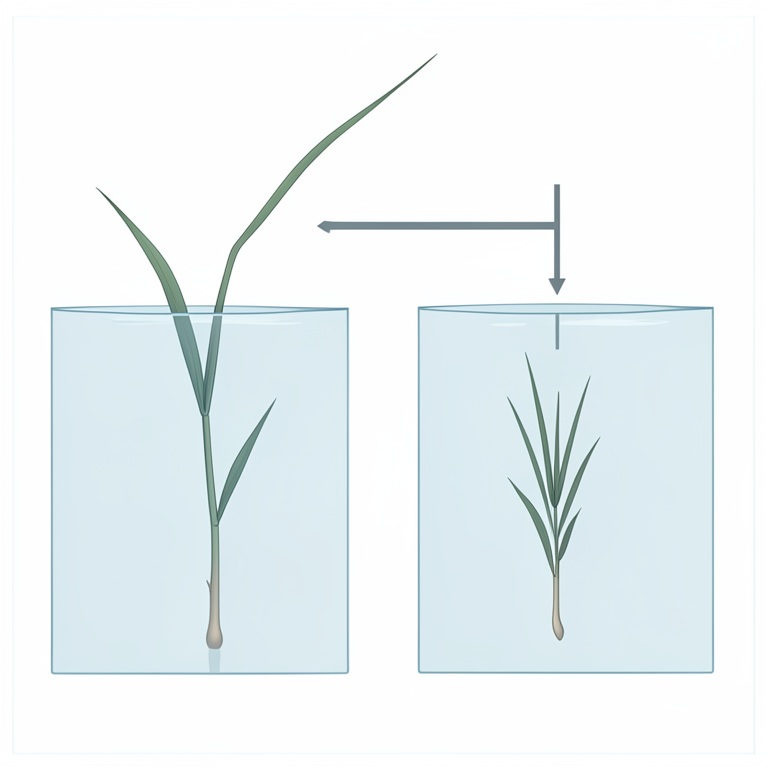
Quiescence Strategy vs. Susceptible Response
AI-generated conceptual illustration (Oryza sativa (rice plants)). It explains the idea and does not show study data.
View source evidence ↗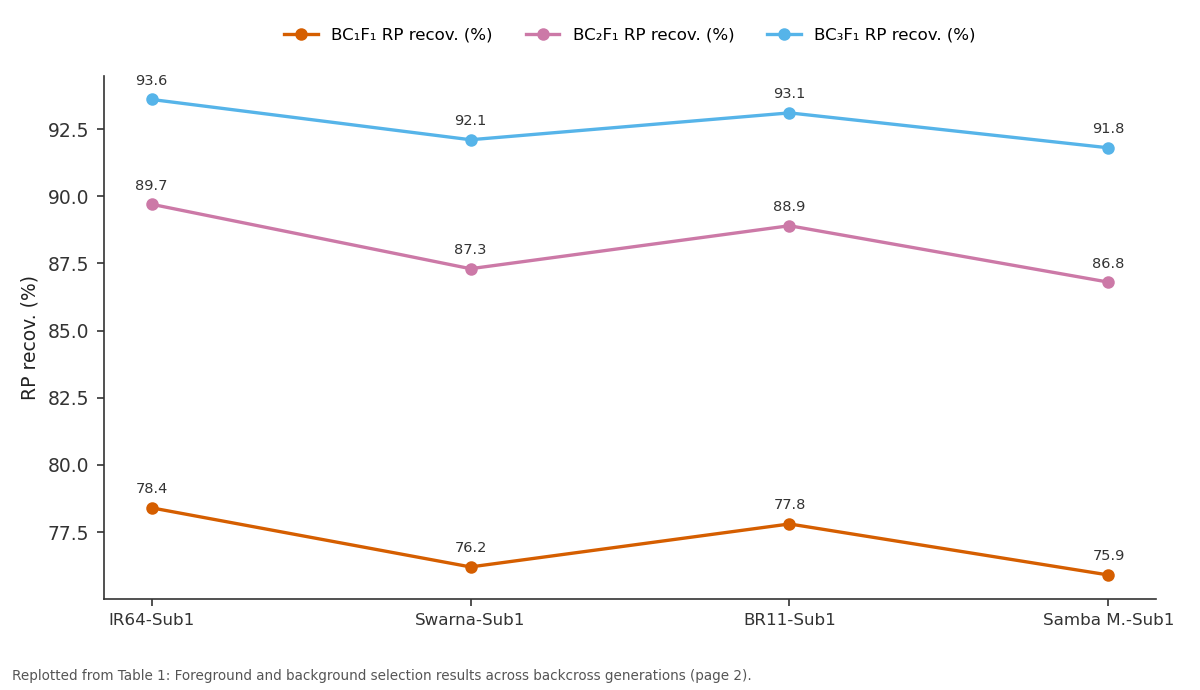
BC₁F₁ RP recov. (%) and BC₂F₁ RP recov. (%) and more: IR64-Sub1 vs Swarna-Sub1 vs BR11-Sub1 vs Samba M.-Sub1
Replotted from Table 1 (page 2) of the original paper. Every bar is the paper's own table value.
View source evidence ↗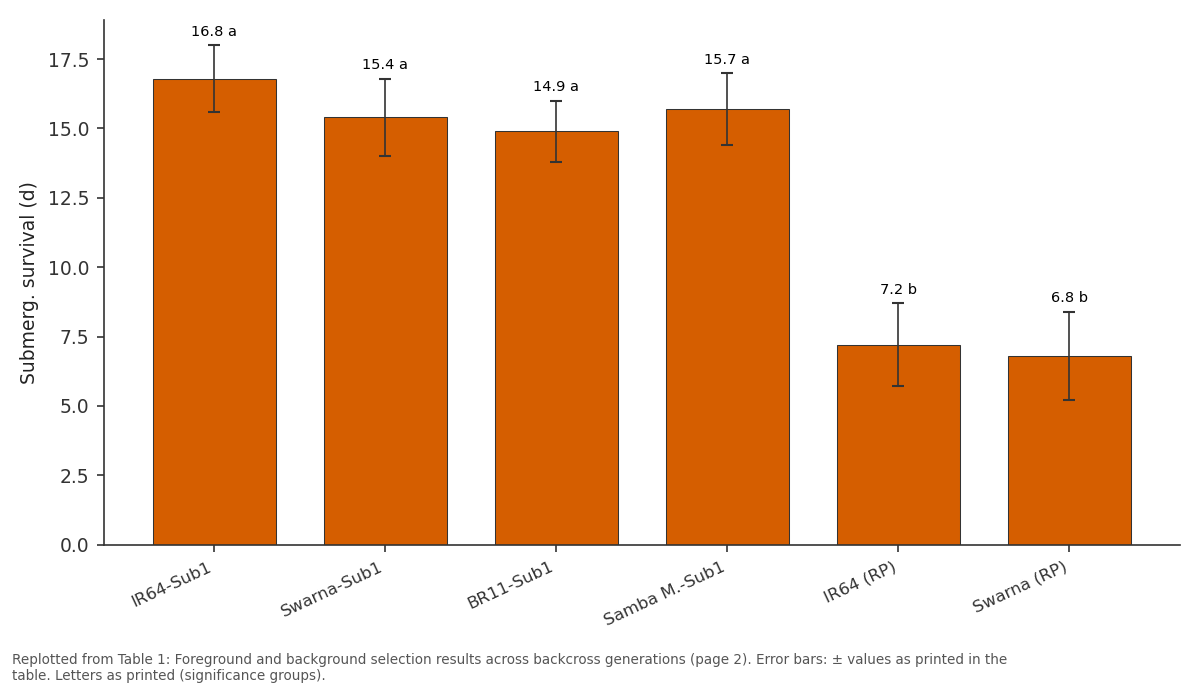
Submerg. survival (d): IR64-Sub1 vs Swarna-Sub1 vs BR11-Sub1 vs Samba M.-Sub1 vs IR64 (RP)
Replotted from Table 1 (page 2) of the original paper. Every bar is the paper's own table value.
View source evidence ↗Figures & tables
From the original paper Table 1
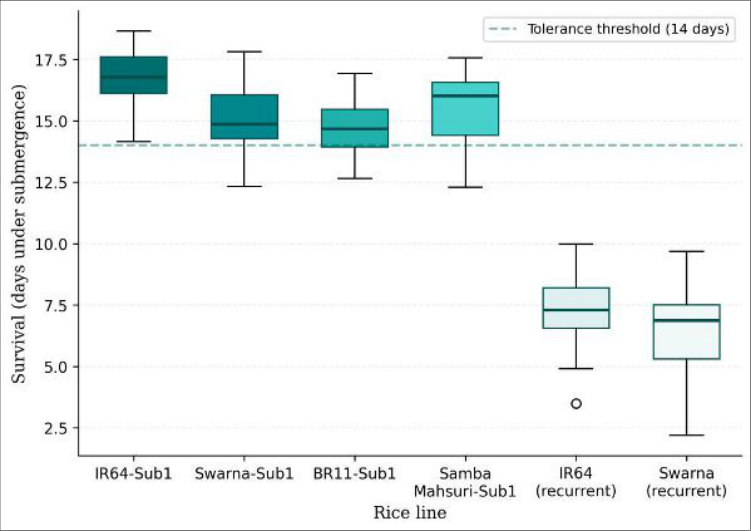 Figure 1
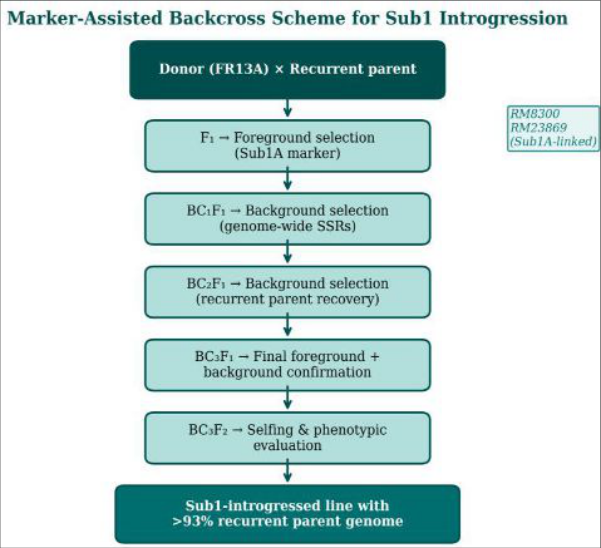 Figure 2
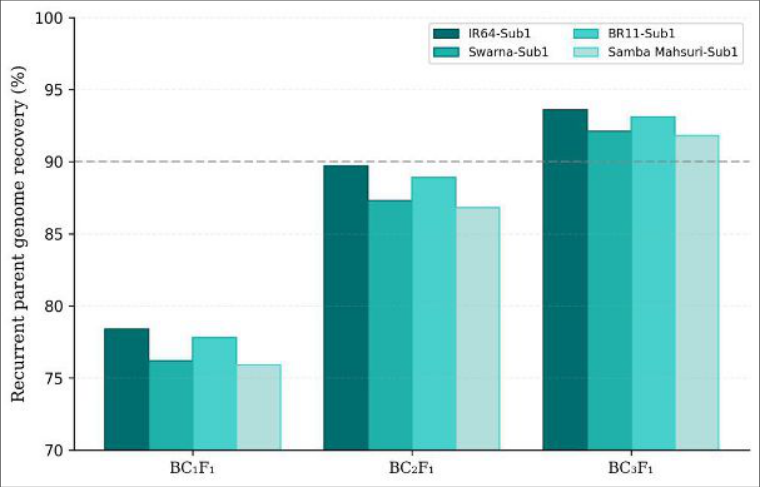 Figure 3
Introduction
Submergence tolerance in rice refers to the ability of a plant to survive complete inundation by water for an extended period and resume growth once floodwaters recede [1] . Flash flooding affects approximately 22 million hectares of rice land in South and Southeast Asia each year, causing yield losses that push millions of farming households into food insecurity [2] . The discovery of the Sub1 locus on rice chromosome 9 and particularly the Sub1A-1 allele from the tolerant landrace FR13A opened a direct route for transferring flood tolerance into popular but susceptible varieties through marker-assisted backcrossing (MABC) [3] . MABC works by crossing a donor carrying the target gene with a recurrent parent, then selecting backcross progeny that carry the target allele (foreground selection) while maximising recovery of the recurrent parent genome (background selection) [4] . The approach has been successfully applied to develop Sub1 versions of Swarna, IR64, and BR11 at the International Rice Research Institute [3,5] . However, local adaptation of these lines is often incomplete, and popular varieties grown in specific Indian states may not have been targeted [6] . This research aimed to introgress Sub1A into four widely cultivated varieties and evaluate their submergence tolerance and agronomic performance.
Theoretical background
The Sub1 locus contains a cluster of three Ethylene Response Factor (ERF) genes: Sub1A, Sub1B, and Sub1C. Sub1A is the primary determinant of tolerance; the tolerant allele (Sub1A-1) restricts ethylene-induced elongation under submergence, conserving carbohydrate reserves and allowing survival for up to three weeks [1,3] . Susceptible varieties carry a non-functional Sub1A-2 allele or lack Sub1A entirely. The gene operates through a quiescence strategy: rather than trying to outgrow floodwater, tolerant plants suppress elongation growth and enter a metabolic holding pattern until water recedes [5] .
Material and Methods Material
The donor parent was FR13A (Sub1A-1 carrier), obtained from IRRI. Recurrent parents were IR64, Swarna, BR11, and Samba Mahsuri, sourced from the rice gene bank at SKLTSAU, Warangal. SSR primer pairs for foreground selection (RM8300, RM23869) and 72 background markers were synthesised by Eurofins Genomics India. PCR reagents, Taq polymerase, and agarose were from Thermo Fisher Scientific [4,7] .
Methods
Crosses between FR13A and each recurrent parent were made during kharif 2020 at SKLTSAU, Warangal. F₁ plants were confirmed as heterozygous at Sub1A using markers RM8300 and RM23869. Three backcross generations (BC₁-BC₃) were advanced during 2021-2022, with foreground and background selection at each generation. Background selection used 72 polymorphic SSR markers distributed across all 12 chromosomes, with a minimum of 5 markers per chromosome [4] . BC₃F₂ plants homozygous for Sub1A-1 were selected and advanced to BC₃F₃ for phenotypic evaluation.
Submergence screening was conducted during kharif 2023 in a lowland screening facility at SKLTSAU. Twenty-oneday-old seedlings were completely submerged under 1.2 m of water for 21 days, then de-submerged. Survival was scored at 14 days post-de-submergence [3] . Agronomic evaluation under non-stress conditions followed standard protocols in an RCBD with three replications. Data were analysed by ANOVA in SAS 9.4; means compared by Tukey's HSD at p<0.05 [8] .
Results
Table Recurrent parent genome recovery exceeded 91% in all lines by BC₃ (Table 1). All four Sub1-introgressed lines survived 14.9-16.8 days of submergence, far exceeding the 6-7 days survival of recurrent parents. Grain yield under non-stress conditions showed no significant difference between introgressed lines and their recurrent parents.
| Line | BC₁F₁ RP recov. (%) | BC₂F₁ RP recov. (%) | BC₃F₁ RP recov. (%) | Sub1A status | Submerg. survival (d) | Yield (t ha⁻¹) |
|---|---|---|---|---|---|---|
| IR64-Sub1 | 78.4 | 89.7 | 93.6 | Homo | 16.8 ± 1.2a | 5.94 ± 0.22a |
| Swarna-Sub1 | 76.2 | 87.3 | 92.1 | Homo | 15.4 ± 1.4a | 5.68 ± 0.28a |
| BR11-Sub1 | 77.8 | 88.9 | 93.1 | Homo | 14.9 ± 1.1a | 5.42 ± 0.25a |
| Samba M.-Sub1 | 75.9 | 86.8 | 91.8 | Homo | 15.7 ± 1.3a | 5.81 ± 0.24a |
| IR64 (RP) | — | — | — | Null | 7.2 ± 1.5b | 6.08 ± 0.21a |
| Swarna (RP) | — | — | — | Null | 6.8 ± 1.6b | 5.83 ± 0.26a |
Table text extracted from the original PDF; superscript letters are shown inline. The original table image is below.
View original table image
Discussion
The genome recovery values of 91.8-93.6% after three backcross generations are consistent with theoretical expectations of ~93.75% and match results from IRRI's Sub1 introgression programme [3,5] . The absence of a yield penalty under non-stress conditions is important farmers won't adopt flood-tolerant varieties if they sacrifice yield in normal years [6] . The submergence survival range of 14.9-16.8 days exceeds the 14-day threshold considered sufficient for most flash-flood events in eastern India [2] . The slight variation in genome recovery among lines likely reflects differences in recombination rates and the distribution of polymorphic markers along chromosomes. Samba Mahsuri-Sub1 had the lowest recovery (91.8%), possibly because fewer markers were polymorphic between Samba Mahsuri and FR13A in chromosomal regions flanking the Sub1 locus, resulting in greater linkage drag [4] . Phenotypic selection for grain quality traits matching the recurrent parent could help address any remaining donor parent segments in these regions.
Conclusion
This research successfully introgressed the Sub1A submergence tolerance gene into four popular rice varieties using marker-assisted backcrossing. All introgressed lines survived 14-17 days of complete submergence while maintaining yields comparable to their recurrent parents under normal conditions. Genome recovery exceeded 91% in all lines. These lines are candidates for multi-location testing in flood-prone areas and eventual release to farmers who face recurrent flash flooding.
Acknowledgement
Acknowledgements Funding sourcesSupported by internal research funds of SKLTSAU, Warangal, and CSKHPAU, Palampur. Institutional supportThe authors thank both universities for laboratory and screenhouse facilities.
Figures and tables from the paper
References
15 in the original paper- Xu K, Xu X, Fukao T, Canlas P, Maghirang-Rodriguez R, Heuer S, et al. Sub1A is an ethylene-response-factorlike gene that confers submergence tolerance to rice. Nature. 2006;442(7103):705-708.
- Mackill DJ, Ismail AM, Singh US, Labios RV, Paris TR. Development and rapid adoption of submergencetolerant (Sub1) rice varieties. Advances in Agronomy. 2012;115:299-352.
- Neeraja CN, Maghirang-Rodriguez R, Pamplona A, Heuer S, Collard BCY, Septiningsih EM, et al. A marker-assisted backcross approach for developing submergence-tolerant rice cultivars. Theoretical and Applied Genetics. 2007;115(6):767-776.
- Hospital F. Selection in backcross programmes. Philosophical Transactions of the Royal Society B. 2005;360(1459):1503-1511.
- Septiningsih EM, Pamplona AM, Sanchez DL, Neeraja CN, Vergara GV, Heuer S, et al. Development of submergence-tolerant rice cultivars: the Sub1 locus and beyond. Annals of Botany. 2009;103(2):151-160.
- Singh S, Mackill DJ, Ismail AM. Responses of SUB1 rice introgression lines to submergence in the field: yield and grain quality. Field Crops Research. 2009;113(1):12-23.
- Collard BCY, Mackill DJ. Marker-assisted selection: an approach for precision plant breeding in the twenty-first century. Philosophical Transactions of the Royal Society B. 2008;363(1491):557-572.
- Gomez KA, Gomez AA. Statistical Procedures for Agricultural Research. Second edition. Wiley, New York. 1984.
- Iftekharuddaula KM, Newaz MA, Salam MA, Ahmed HU, Mahbub MAA, Septiningsih EM, et al. Rapid and high-precision marker assisted backcrossing to introgress the SUB1 QTL into BR11. Euphytica. 2011;178(1):83-97.
- Thomson MJ, de Ocampo M, Egdane J, Rahman MA, Sajise AG, Adorada DL, et al. Characterizing the Saltol quantitative trait locus for salinity tolerance in rice. Rice. 2010;3(2):148-160.
- Toojinda T, Siangliw M, Tragoonrung S, Vanavichit A. Molecular genetics of submergence tolerance in rice. Annals of Botany. 2003;91(2):243-253.
- Bailey-Serres J, Fukao T, Ronald P, Ismail A, Heuer S, Mackill D. Submergence tolerant rice: SUB1's journey from landrace to modern cultivar. Rice. 2010;3(2):138147.
- Das P, Nutan KK, Singla-Pareek SL, Pareek A. Understanding salinity responses and adopting 'omicsbased' approaches to generate salinity tolerant cultivars of rice. Frontiers in Plant Science. 2015;6:712.
- Fukao T, Xu K, Ronald PC, Bailey-Serres J. A variable cluster of ethylene response factor-like genes regulates metabolic and developmental acclimation responses to submergence in rice. The Plant Cell. 2006;18(8):20212034.
- Siangliw M, Toojinda T, Tragoonrung S, Vanavichit A. Thai jasmine rice carrying QTLch9 (SubQTL) is submergence tolerant. Annals of Botany. 2003;91(2):255-261.