
Research article · 2025 · Full text
International Journal of Agriculture and NutritionPhysiological and biochemical changes during seed maturation and desiccation in soybean
Volume 7(2) · Pages 30–33 · DOI: 10.33545/26646064.2025.v7.i2a.453 ↗
Research areasSeed Germination and PhysiologyPlant Stress Responses and ToleranceSoybean genetics and cultivation
Abstract
Author-writtenRoughly 60% of soybean seed dry weight accumulates during the final three weeks before physiological maturity. The present research tracked physiological and biochemical changes from early seed fill (R5) through full maturity (R8) and post-maturity desiccation in two soybean cultivars, Awassa-95 and Belessa-95, grown at the Oromia Institute of Agricultural Sciences, Jimma, Ethiopia, during 2022. Moisture content declined from 57.3% at R5 to 12.8% at R8, while protein and lipid rose by 74% and 68%, respectively. ABA peaked at R7 and preceded sharp increases in LEA proteins, dehydrins, and antioxidant enzyme activities. SOD activity at R8 was 2.6-fold higher than at R5. Desiccation tolerance was acquired between R7 and R8, coinciding with maximum LEA protein accumulation. The findings confirm that the ABA-mediated protective pathway is central to desiccation tolerance acquisition in soybean seeds.
Summary
Source-checkedPlain-language reading of the full paper, prepared with AI and checked against the text. Each point links to the authors' own words.
Why it matters
- Soybean is the world's most significant oilseed crop, with global production reaching approximately 353 million tonnes in 2022. View evidence ↗
- Harvesting soybean seeds before they reach full maturity leads to decreased germination rates and a shorter overall storage life. View evidence ↗
- There is a lack of detailed time-course data regarding seed maturation in tropical soybean cultivars, especially those from the East African highlands. View evidence ↗
The question
- The study aimed to document the biochemical and physiological changes from early seed fill to post-maturity desiccation and determine how these relate to the acquisition of desiccation tolerance. View evidence ↗
What they did
- The study tracked two soybean cultivars (Awassa-95 and Belessa-95) grown in Jimma, Ethiopia, in 2022, from the R5 stage through R8 and post-maturity. View evidence ↗
- The experiment used a randomized complete block design with five replications in 4m x 3m plots, with sampling occurring at five specific dates from September 14 to November 9, 2022. View evidence ↗
- Desiccation tolerance was measured by drying seeds to 8% moisture using silica gel and then testing their germination at 25°C. View evidence ↗
What they found
- Between stages R5 and R8, seed moisture dropped from 57.3% to 12.8%, while protein and lipid levels increased by 74% and 68% respectively. View evidence ↗
- The ability of seeds to germinate after controlled desiccation increased significantly from 8.3% at the R5 stage to 92.7% at the R8 stage. View evidence ↗
- Abscisic acid (ABA) levels reached their maximum at the R8 stage and then decreased during the post-R8 period. View evidence ↗
- Antioxidant enzyme activities increased from R5 to R8, with SOD rising 2.6-fold, CAT 3.1-fold, and APX 4.3-fold. View evidence ↗
- LEA proteins showed a massive increase during maturation, reaching 16.6 times the levels found at the R5 stage by the time the seeds reached R8. View evidence ↗
- Because LEA proteins remained high even after ABA levels declined post-R8, the authors conclude that ABA acts as a temporary signal to trigger protection rather than providing structural protection itself. View evidence ↗
What it means
- The authors conclude that the shift from desiccation sensitivity at R5 to tolerance at R8 is driven by ABA, which induces the production of antioxidant enzymes, dehydrins, and LEA proteins. View evidence ↗
- The study recommends that farmers delay harvesting until the R8 stage to avoid severe losses in seed viability. View evidence ↗
Visual summary
3 visualsIllustrations explain the paper; charts are replotted from the paper's own table values.
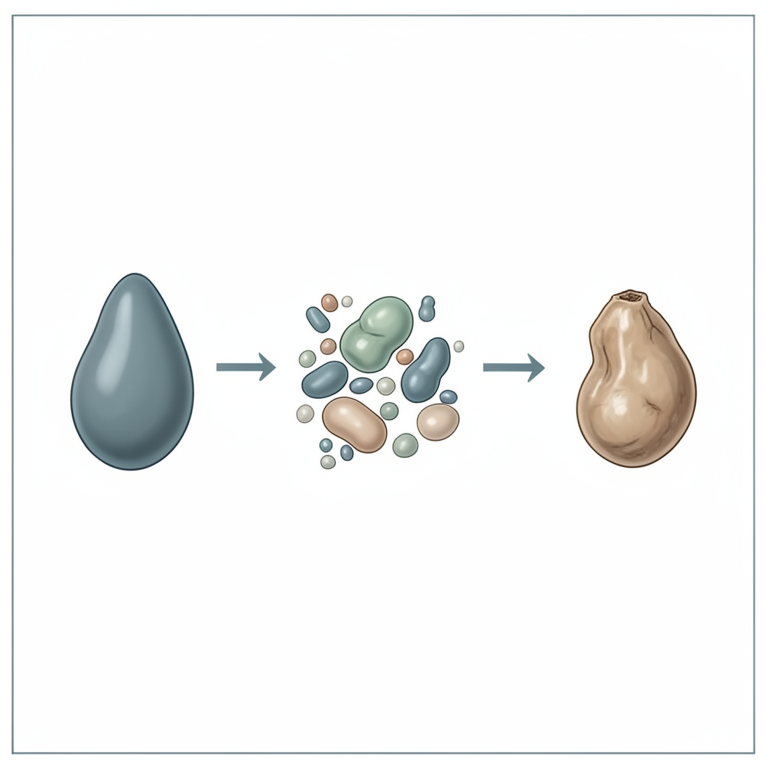
Desiccation Tolerance Pathway
AI-generated conceptual illustration (soybean seeds). It explains the idea and does not show study data.
View source evidence ↗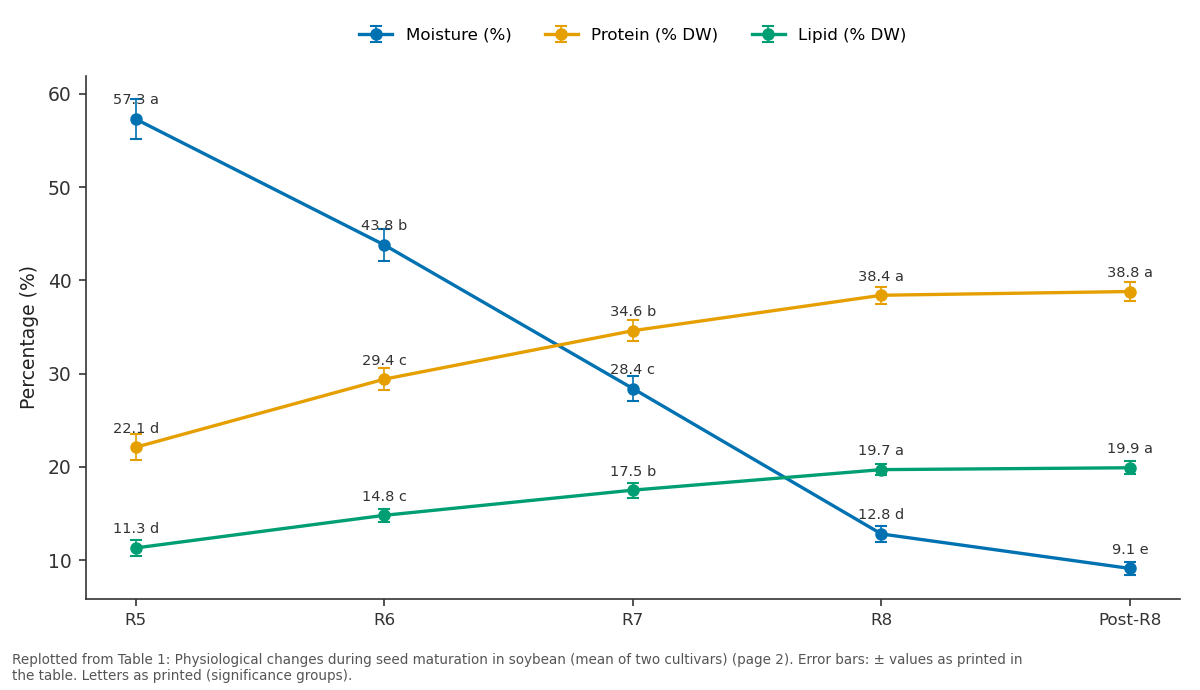
Moisture (%) and Protein (% DW) and more: R5 vs R6 vs R7 vs R8 vs Post-R8
Replotted from Table 1 (page 2) of the original paper. Every bar is the paper's own table value.
View source evidence ↗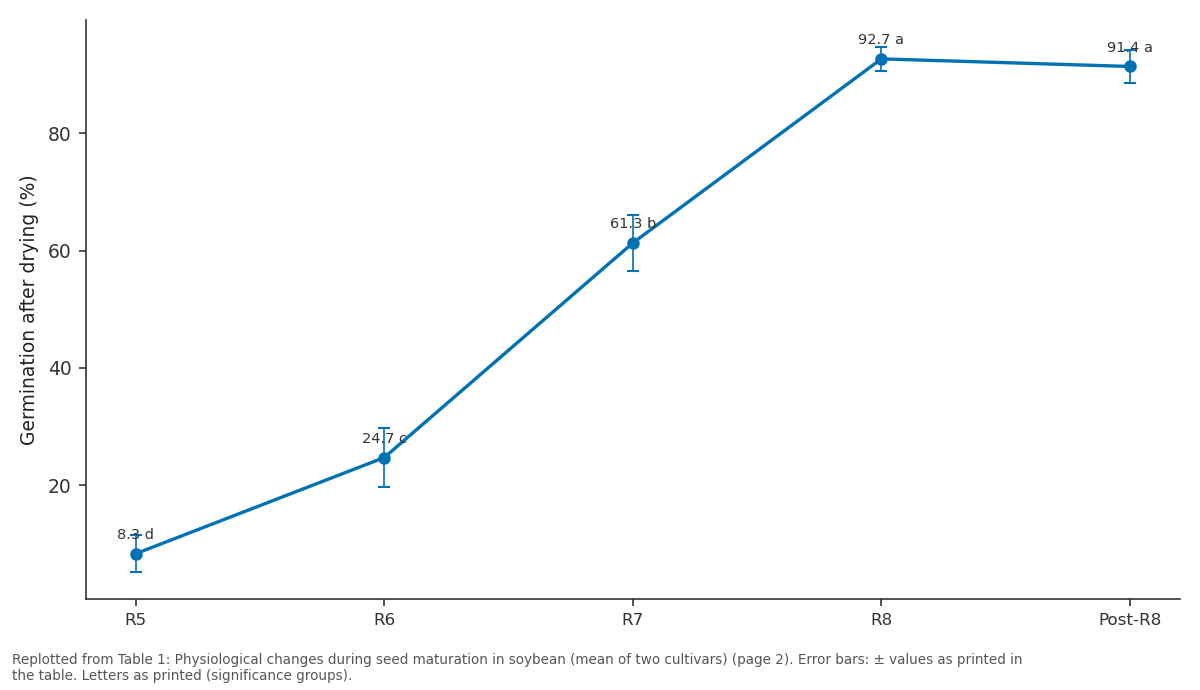
Germ. after drying (%): R5 vs R6 vs R7 vs R8 vs Post-R8
Replotted from Table 1 (page 2) of the original paper. Every bar is the paper's own table value.
View source evidence ↗Figures & tables
From the original paper Table 1
 Table 2
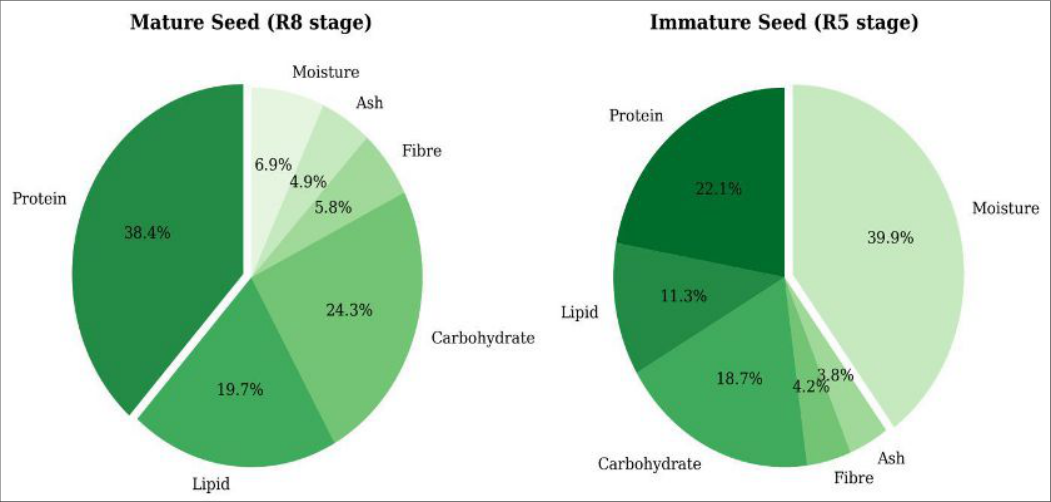 Figure 1
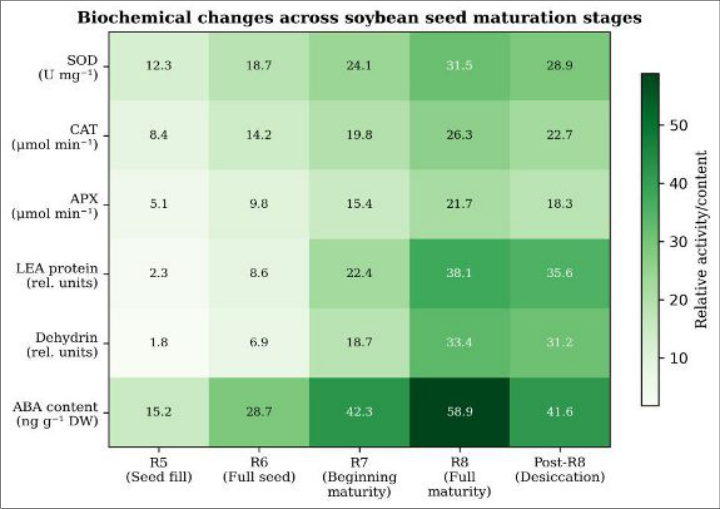 Figure 2
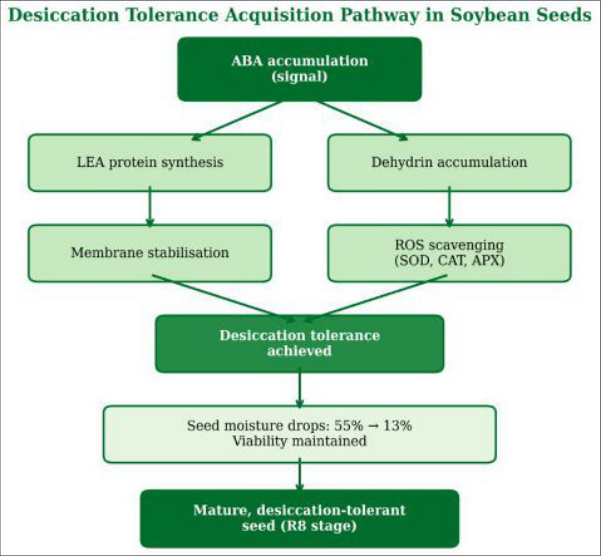 Figure 3
Introduction
An estimated 353 million tonnes of soybean were produced worldwide in 2022, making it the most important oilseed crop on earth [1] . Behind that statistic lies the transformation of a watery, metabolically active embryo into a dry, quiescent seed capable of surviving months of storage. Seed maturation in soybean spans several well-defined reproductive stages, from R5 to R8, during which moisture drops from above 55% to below 15% [2] . Protein and oil reserves accumulate rapidly, and a suite of protective molecules LEA proteins, dehydrins, and small heat shock proteins are synthesised under the control of abscisic acid [3] . Desiccation tolerance is acquired progressively during later maturation stages and reaches its maximum around R8 [4] . Seeds harvested prematurely show reduced germination and shorter storage life [5] . The biochemical basis involves LEA proteins preventing protein aggregation [6] , non-reducing sugars replacing water molecules through vitrification [7] , and antioxidant enzymes scavenging reactive oxygen species [8] . ABA orchestrates this protective response by activating transcription factors that switch on relevant gene sets [3] . Despite decades of research on model species, detailed time-course data on seed maturation in tropical soybean cultivars remain scarce, particularly for East African highland varieties [9,10] . This research aimed to document the physiological and biochemical transitions from early seed fill through post-maturity desiccation and relate these changes to desiccation tolerance acquisition.
Research area description
The research was conducted at the experimental farm of the Oromia Institute of Agricultural Sciences near Jimma, Ethiopia (7°40′N, 36°50′E, elevation 1,753 m). The site has deep Nitisols with loamy clay texture, pH 5.3, and organic carbon 2.87%. The 2022 main season (June-November) received 1,482 mm of rainfall, with gradually declining rainfall during the R5-R8 period favouring seed drying on the plant.
Material and Methods
Material and Methods
Material
Two soybean cultivars, Awassa-95 and Belessa-95, were used. Certified seed was obtained from the Jimma Agricultural Research Centre. Chemical reagents for protein and lipid determination were from Fisher Scientific. ABA was quantified by ELISA (Phytodetek, Agdia Inc.). LEA and dehydrin antibodies were from Agrisera AB. Antioxidant enzyme assay kits were from Cayman Chemical [11] .
Methods
The experiment followed a randomised complete block design with five replications. Plots measured 4 m × 3 m; sowing was on 18 June 2022. Seeds were sampled at R5 (14 September), R6 (28 September), R7 (12 October), R8 (26 October), and post-R8 (9 November). Fifty seeds per plot were frozen in liquid nitrogen and stored at -80°C [12] .
Moisture was determined gravimetrically at 103°C for 72 hours [13] . Protein was estimated by micro-Kjeldahl (N × 6.25), lipid by Soxhlet extraction. ABA was extracted with 80% methanol and quantified by ELISA. LEA proteins and dehydrins were analysed by immunoblotting; band intensities were quantified using ImageJ [14] . SOD, CAT, and APX were assayed spectrophotometrically [8] . Desiccation tolerance was assessed by drying seeds to 8% moisture over silica gel and evaluating germination at 25°C [15] . Data were analysed by ANOVA in R 4.2.1 with Fisher's LSD at p≤0.05. Protein and lipid increased continuously from R5 to R8 then plateaued (Table 1). ABA peaked at R8 before declining at post-R8. Germination after controlled desiccation climbed from 8.3% at R5 to 92.7% at R8. SOD activity rose 2.6-fold from R5 to R8, while CAT and APX increased 3.1-fold and 4.3-fold, respectively (Table 2). LEA proteins reached 16.6 times their R5 level by R8. Both protective protein classes peaked at R8 then declined slightly.
| Stage | SOD (U mg⁻¹) | CAT (μmol min⁻¹) | APX (μmol min⁻¹) | LEA prot. (rel. units) | Dehydrins (rel. units) |
|---|---|---|---|---|---|
| R5 | 12.3 ± 1.1d | 8.4 ± 0.9d | 5.1 ± 0.6d | 2.3 ± 0.4e | 1.8 ± 0.3e |
| R6 | 18.7 ± 1.4c | 14.2 ± 1.2c | 9.8 ± 0.8c | 8.6 ± 1.1d | 6.9 ± 0.8d |
| R7 | 24.1 ± 1.6b | 19.8 ± 1.5b | 15.4 ± 1.1b | 22.4 ± 2.3c | 18.7 ± 1.9c |
| R8 | 31.5 ± 1.9a | 26.3 ± 1.8a | 21.7 ± 1.4a | 38.1 ± 2.8a | 33.4 ± 2.6a |
| Post-R8 | 28.9 ± 1.7ab | 22.7 ± 1.6ab | 18.3 ± 1.3ab | 35.6 ± 2.5b | 31.2 ± 2.4ab |
Table text extracted from the original PDF; superscript letters are shown inline. The original table image is below.
View original table image
| Stage | Moisture (%) | Protein (% DW) | Lipid (% DW) | Sugars (mg g⁻¹) | ABA (ng g⁻¹) | Germ. after drying (%) |
|---|---|---|---|---|---|---|
| R5 | 57.3 ± 2.1a | 22.1 ± 1.4d | 11.3 ± 0.9d | 38.7 ± 2.8a | 15.2 ± 1.8d | 8.3 ± 3.2d |
| R6 | 43.8 ± 1.7b | 29.4 ± 1.2c | 14.8 ± 0.7c | 31.2 ± 2.3b | 28.7 ± 2.4c | 24.7 ± 5.1c |
| R7 | 28.4 ± 1.3c | 34.6 ± 1.1b | 17.5 ± 0.8b | 26.8 ± 1.9c | 42.3 ± 3.1b | 61.3 ± 4.8b |
| R8 | 12.8 ± 0.9d | 38.4 ± 0.9a | 19.7 ± 0.6a | 22.1 ± 1.7d | 58.9 ± 3.7a | 92.7 ± 2.1a |
| Post-R8 | 9.1 ± 0.7e | 38.8 ± 1.0a | 19.9 ± 0.7a | 21.4 ± 1.5d | 41.6 ± 2.9b | 91.4 ± 2.8a |
Table text extracted from the original PDF; superscript letters are shown inline. The original table image is below.
View original table image
Results
Results
Discussion
The 2.6-fold increase in SOD from R5 to R8 was lower than the 3.5-fold reported for temperate soybean cultivars [8] , possibly reflecting milder oxidative stress at Jimma's altitude. LEA protein accumulation was more pronounced (16.6-fold vs ~10-fold in temperate genotypes), which may be an adaptive response to rapid post-maturity drying during the Ethiopian dry season onset [9] . The decline in ABA at post-R8, while LEA proteins remained near peak levels, confirms that ABA is a transient signal rather than a structural protectant [3] . Once the protective machinery is assembled, tolerance depends on accumulated proteins and sugars rather than continued hormonal signalling [7] . From a seed technology perspective, the results reinforce the recommendation to delay harvest until seeds reach R8 (below 13% moisture). Harvesting at R7 would result in ~30 percentage points germination loss after drying [5] .
Conclusion
This research established a detailed timeline of seed maturation biochemistry in two Ethiopian soybean cultivars. The transition from desiccation-sensitive tissue at R5 to tolerant seeds at R8 was driven by ABA-mediated induction of LEA proteins, dehydrins, and antioxidant enzymes.
Figures and tables from the paper
References
19 in the original paper- FAOSTAT. Food and Agriculture Organization Corporate Statistical Database. Soybean production statistics. FAO, Rome. 2023.
- Egli DB. Seed Biology and the Yield of Grain Crops. Second edition. CAB International, Wallingford. 2017.
- Finkelstein RR, Gampala SSL, Rock CD. Abscisic acid signaling in seeds and seedlings. The Plant Cell. 2002;14(Suppl):S15-S45.
- Leprince O, Pellizzaro A, Berriri S, Buitink J. Late seed maturation: drying without dying. Journal of Experimental Botany. 2017;68(4):827-841.
- TeKrony DM, Egli DB, Balles J, Tomes L, Stuckey RE. Effect of date of harvest maturity on soybean seed quality. Crop Science. 1984;24(1):189-193.
- Hundertmark M, Hincha DK. LEA proteins and their encoding genes in Arabidopsis thaliana. BMC Genomics. 2008;9:118.
- Buitink J, Leprince O. Glass formation in plant anhydrobiotes. Cryobiology. 2004;48(3):215-228.
- Bailly C. Active oxygen species and antioxidants in seed biology. Seed Science Research. 2004;14(2):93107.
- Tesfaye K, Walker S, Tsubo M. Radiation interception and radiation use efficiency of three grain legumes. European Journal of Agronomy. 2006;25(1):60-70.
- Abate T, Alene AD, Bergvinson D, Shiferaw B, Silim S, Orr A, Asfaw S. Tropical grain legumes in Africa and south Asia. ICRISAT, Nairobi. 2012.
- Bradford MM. A rapid and sensitive method for the quantitation of microgram quantities of protein. Analytical Biochemistry. 1976;72(1-2):248-254.
- Fehr WR, Caviness CE. Stages of soybean development. Iowa State University Extension Special Report 80. 1977.
- ISTA. International Rules for Seed Testing. ISTA, Bassersdorf, Switzerland. 2021.
- Towbin H, Staehelin T, Gordon J. Electrophoretic transfer of proteins from polyacrylamide gels to nitrocellulose sheets. Proceedings of the National Academy of Sciences. 1979;76(9):4350-4354.
- Hong TD, Ellis RH. A protocol to determine seed storage behaviour. IPGRI Technical Bulletin No. 1, Rome. 1996.
- Kermode AR. Role of abscisic acid in seed dormancy. Journal of Plant Growth Regulation. 2005;24(4):319344.
- Angelovici R, Galili G, Fernie AR, Fait A. Seed desiccation: A bridge between maturation and germination. Trends in Plant Science. 2010;15(4):211218.
- Rocha FS, Belmaia MJ, Pereira WE. Physiological quality of soybean seeds during maturation. Revista Brasileira de Sementes. 2006;28(2):192-198.
- Siddique AB, Wright D. Effects of time of harvest at different moisture contents on seed quality of pea. Bangladesh Journal of Agricultural Research. 2004;29(1):1-8.