
Research article · 2025 · Full text
International Journal of Agriculture and NutritionWeed seed bank dynamics under different tillage and crop rotation sequences
Volume 7(1) · Pages 105–108 · DOI: 10.33545/26646064.2025.v7.i1b.381 ↗
Research areasWeed Control and Herbicide ApplicationsAllelopathy and phytotoxic interactionsSoil Management and Crop Yield
Abstract
Author-writtenPredicting weed pressure from season to season remains one of the hardest challenges in sustainable crop management. This research quantified weed seed bank dynamics under three tillage systems zero tillage (ZT), minimum tillage (MT), and conventional tillage (CT) combined with a four-year wheat–canola–maize–wheat rotation at Wielkopolska Agricultural University, Poznań, Poland, from 2019 to 2023. Soil cores (0–30 cm) were collected each autumn and seeds extracted by wet sieving and flotation. Total seed bank density was highest under ZT (2,847 seeds m⁻²) and lowest under CT (1,523 seeds m⁻²), but seed viability was 23% lower under ZT owing to greater surface predation. Species richness peaked under MT (Shannon H' = 2.14). The wheat–canola break reduced Apera spica-venti density by 38% relative to continuous wheat. These results indicate that combining minimum tillage with diversified rotations offers the best trade-off between seed bank suppression and biodiversity conservation in Central European arable systems.
Summary
Source-checkedPlain-language reading of the full paper, prepared with AI and checked against the text. Each point links to the authors' own words.
Why it matters
- Reducing reliance on herbicides is a major agronomic challenge due to the spread of herbicide-resistant weed biotypes in Europe and increasing societal pressure to lower chemical use. View evidence ↗
- The soil weed seed bank acts as a reservoir of viable seeds that determines future weed emergence, making its dynamics critical for long-term management. View evidence ↗
- Introducing broadleaf crops into cereal monocultures can disrupt the life cycles of cereal-adapted weeds by changing the competitive and allelopathic environment. View evidence ↗
The question
- The study aimed to compare weed seed bank density and distribution across three tillage systems over four years, track species diversity, and measure how a canola break affects grass weed populations. View evidence ↗
What they did
- The research was conducted from 2019 to 2023 on a 2.4 ha Luvisol block in Poznań, Poland, using a four-year rotation of winter wheat, winter canola, grain maize, and winter wheat. View evidence ↗
- Soil cores were collected at three depths (0-5, 5-15, and 15-30 cm), and seeds were extracted via wet sieving and flotation, then tested for viability using tetrazolium chloride staining. View evidence ↗
- The study used the Shannon diversity index (H') and Pielou's evenness (J'), analyzing the data with repeated-measures ANOVA and Tukey's HSD test. View evidence ↗
What they found
- Zero tillage (ZT) resulted in the highest total seed bank density at 2,847 seeds m⁻², while conventional tillage (CT) had the lowest at 1,523 seeds m⁻². View evidence ↗
- The introduction of a canola break reduced the density of the grass weed Apera spica-venti by 38% compared to continuous wheat. View evidence ↗
What it means
- The authors conclude that combining minimum tillage with diversified crop rotations is the most sustainable strategy for balancing weed seed bank suppression and biodiversity conservation in Central European arable systems. View evidence ↗
- The study is limited by its four-year duration, as weed communities may take a decade to stabilize, and the results from the Luvisol soil may not apply to sandier soils. View evidence ↗
Visual summary
2 visualsIllustrations explain the paper; charts are replotted from the paper's own table values.
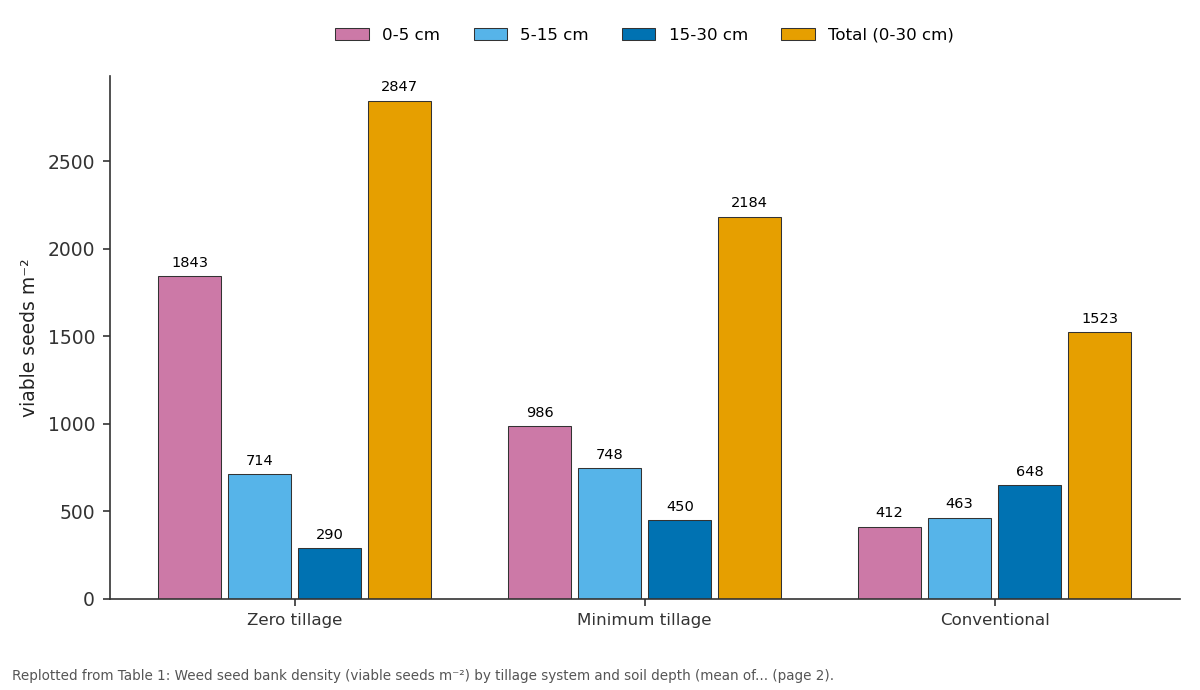
0-5 cm and 5-15 cm and more: Zero tillage vs Minimum tillage vs Conventional
Replotted from Table 1 (page 2) of the original paper. Every bar is the paper's own table value.
View source evidence ↗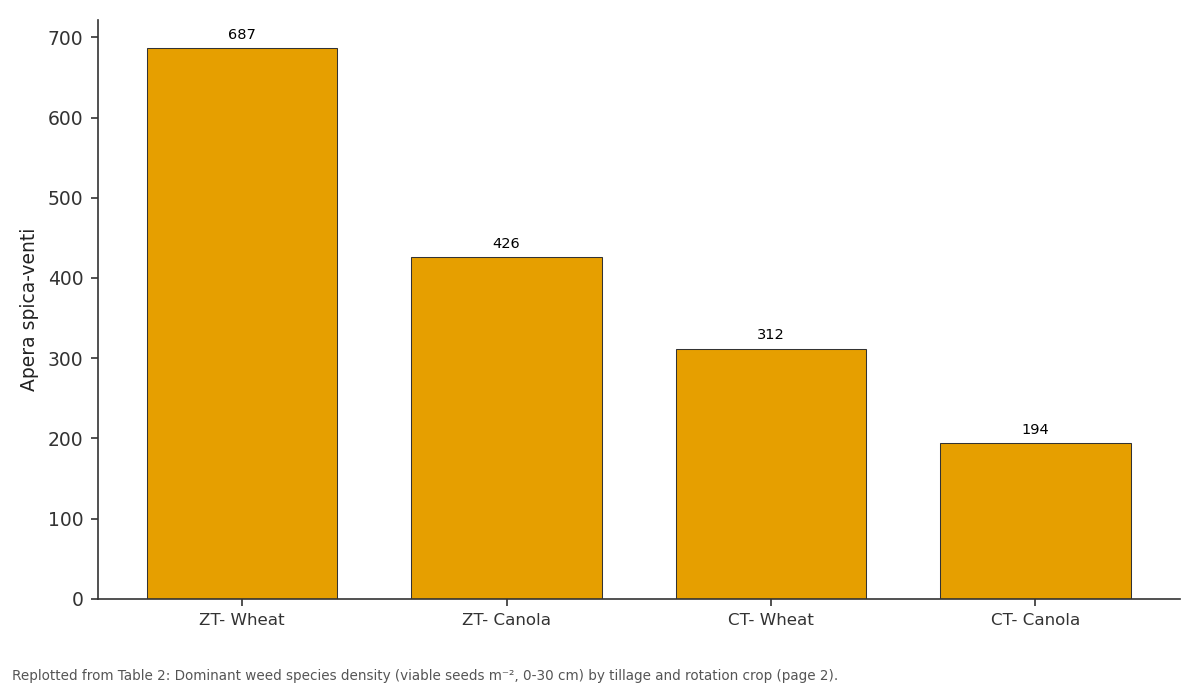
Apera spica-venti: ZT- Wheat vs ZT- Canola vs CT- Wheat vs CT- Canola
Replotted from Table 2 (page 2) of the original paper. Every bar is the paper's own table value.
View source evidence ↗Figures & tables
From the original paper Table 1
 Table 2
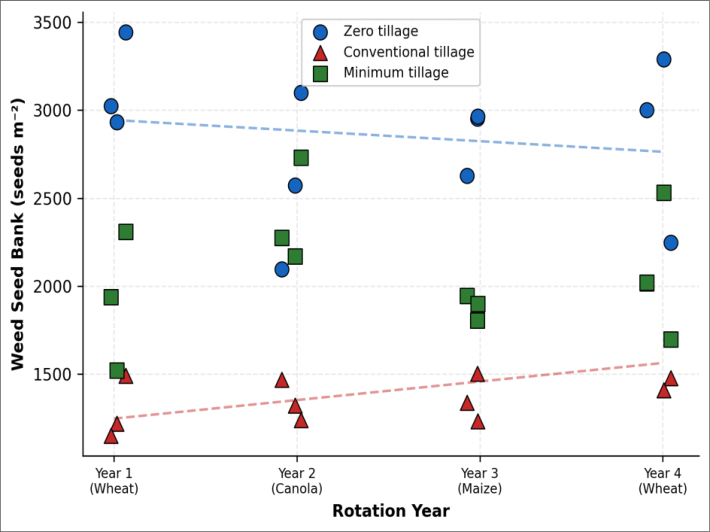 Figure 1
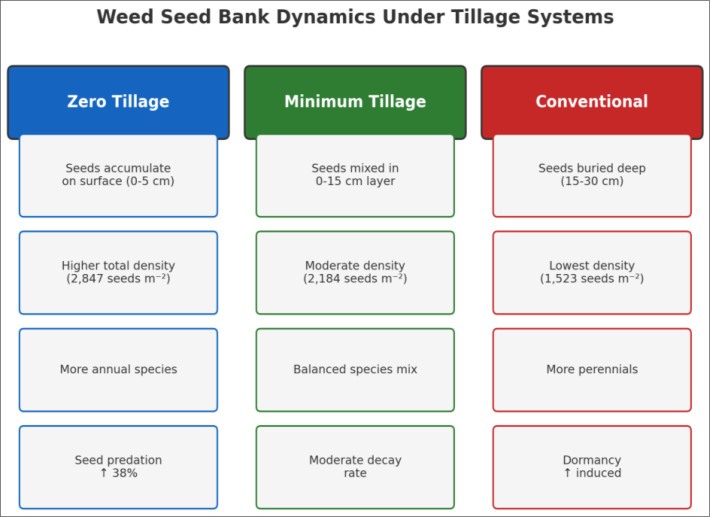 Figure 2
Introduction
Managing weed populations without over-relying on herbicides is arguably the biggest agronomic challenge of the 21st century [1] . Herbicide-resistant biotypes are spreading across Europe at an accelerating rate, and societal pressure to cut chemical inputs continues to grow [2, 3] . The soil weed seed bank the reservoir of viable seeds in the soil profile governs future weed emergence, so understanding what drives its size and composition is central to any long-term management strategy [4] . Tillage is the most direct tool for manipulating seed bank vertical distribution. Conventional ploughing buries freshly shed seeds below emergence depth but also brings older, dormant seeds to the surface. Zero tillage leaves seeds on or near the surface, exposing them to predation and desiccation but also allowing rapid germination of shallow-germinators [5,6] . Minimum tillage sits between these extremes and is increasingly popular in Poland, where conservation agriculture adoption has grown five-fold since 2010 [7] . Crop rotation adds a second dimension of control. Breaking a cereal monoculture with a broadleaf crop alters the competitive and allelopathic environment, disrupting the life cycle of cereal-adapted weeds like Apera spica-venti and Alopecurus myosuroides [8,9] . Yet few long-term trials have measured the joint effect of tillage and rotation on both seed bank density and species diversity in the same experiment [10] .
This research aimed to a) Compare total seed bank density and vertical distribution under ZT, MT, and CT over four rotation years. b) Track changes in species composition and diversity. c) Quantify the suppressive effect of the canola break on grass weed populations.
Seed Extraction and Counting Protocol
Soil cores (5 cm diameter) were taken with a motorised auger at three depth increments: 0-5, 5-15, and 15-30 cm. Five cores per plot were composited by depth. Seeds were extracted by wet sieving (0.2 mm mesh) and sodium chloride flotation (specific gravity 1.19) following the method of Gross [11] . Extracted seeds were identified to species under a Leica S9i stereomicroscope and tested for viability with 1% tetrazolium chloride (TZ) staining for 24 h at 30 °C [10] . Only TZ-positive seeds were included in density estimates. A voucher set of identified seeds was deposited at the Wielkopolska Agricultural University herbarium.
Material and Methods
Material and Methods
Material
The trial occupied a 2.4 ha block on a Luvisol at the Wielkopolska Agricultural University experimental farm, Poznań (52.41° N, 16.93° E; 86 m a.s.l.). The rotation was winter wheat (year 1) → winter canola (year 2) → grain maize (year 3) → winter wheat (year 4), running from 2019 to 2023. Three tillage treatments were applied: ZT (direct drilling, no soil disturbance), MT (one pass with a disc harrow to 8 cm), and CT (mouldboard plough to 25 cm followed by two harrowings). Each treatment had four replications in a randomised complete block design on 12 × 50 m strips. Herbicide programmes were standardised within each crop to remove confounding.
Methods
Seed bank sampling was done each October after harvest and before autumn tillage, giving four annual snapshots. Five soil cores per plot per depth were collected (total = 3 treatments × 4 reps × 3 depths × 5 cores = 180 cores per year). After extraction and identification, species density (seeds m⁻²) was calculated by scaling core area to 1 m². Shannon diversity index (H') and Pielou's evenness (J') were computed per plot. Data were analysed by repeatedmeasures ANOVA (tillage × rotation year × depth) in SAS 9.4 with Tukey's HSD at p ≤ 0.05. Seed predation was estimated indirectly as the proportional decline in surfacelayer (0-5 cm) viable seed density between autumn and spring under ZT [6] .
Results
Results
Comprehensive Interpretation
ZT concentrated 65% of all viable seeds in the top 5 cm, while CT distributed them more evenly, with 42% in the deepest layer. Despite its higher total density, ZT showed the lowest seed viability (61.4%), likely because surfaceexposed seeds suffered greater predation by carabid beetles and desiccation [6] . The canola break reduced A. spica-venti the most problematic grass weed by 38% under ZT and 37.8% under CT, confirming the value of broadleaf crop rotation. MT had the highest species diversity (H' = 2.14), suggesting that partial disturbance creates the most heterogeneous germination niches.
Discussion
The inverse relationship between total seed density and seed viability under ZT matches findings from long-term trials in the UK and Germany [5,12] . Seeds on the surface are accessible to granivorous invertebrates; Westerman et al. [6] estimated that carabids can remove 30-50% of freshly shed seeds within two months of harvest. This "biological tillage" partly compensates for the lack of mechanical seed burial in ZT systems. The 38% reduction in A. spica-venti after the canola phase supports the well-documented rotation effect: canola's autumn sowing date and its distinct herbicide options target the grass weed's germination flush that normally coincides with wheat sowing [8,9] . Farmers who rotate canola at least once in four years can expect a meaningful decline in grass weed seed bank, even without increasing herbicide rates [13] . A limitation is the four-year duration; weed community shifts can take a decade to stabilise under a new tillage regime [14] . And the trial site's Luvisol with moderate clay content may not represent sandier soils where seed burial-depth effects differ. Multisite extension of this research would strengthen generalisability [15] .
Conclusion
Zero tillage accumulated the highest total seed bank but also the lowest viability, reflecting surface predation. Conventional tillage had the smallest bank but buried seeds deeper, potentially prolonging dormancy. Minimum tillage combined moderate density with the highest species diversity. The canola break reduced the dominant grass weed A. spica-venti by 38%. For Central European arable systems seeking to balance weed control with biodiversity, minimum tillage paired with a diversified rotation appears the most sustainable strategy.
Figures and tables from the paper
| Tillage | 0-5 cm | 5-15 cm | 15-30 cm | Total (0-30 cm) | Shannon H' | Viability (%) |
|---|---|---|---|---|---|---|
| Zero tillage | 1,843 | 714 | 290 | 2,847 | 1.87 | 61.4 |
| Minimum tillage | 986 | 748 | 450 | 2,184 | 2.14 | 72.8 |
| Conventional | 412 | 463 | 648 | 1,523 | 1.93 | 84.3 |
| CD (p=0.05) | 187 | 94 | 72 | 246 | 0.14 | 4.7 |
Table text extracted from the original PDF; superscript letters are shown inline. The original table image is below.
View original table image
| Species | ZT- Wheat | ZT- Canola | CT- Wheat | CT- Canola | MT- Wheat | MT- Canola |
|---|---|---|---|---|---|---|
| Apera spica-venti | 687 | 426 | 312 | 194 | 478 | 297 |
| Viola arvensis | 341 | 298 | 218 | 187 | 267 | 231 |
| Stellaria media | 284 | 317 | 143 | 162 | 213 | 248 |
| Chenopodium album | 198 | 184 | 241 | 213 | 224 | 201 |
| Galium aparine | 163 | 74 | 97 | 41 | 128 | 63 |
Table text extracted from the original PDF; superscript letters are shown inline. The original table image is below.
View original table image
References
21 in the original paper- Accessed June 2023.
- Powles SB, Yu Q. Evolution in action: plants resistant to herbicides. Annual Review of Plant Biology. 2010;61:317-347.
- Beckie HJ. Herbicide-resistant weed management: focus on glyphosate. Pest Management Science. 2011;67(9):1037-1048.
- Cousens R, Mortimer M. Dynamics of weed populations. Cambridge: Cambridge University Press; 1995.
- Chauhan BS, Singh RG, Mahajan G. Ecology and management of weeds under conservation agriculture: a review. Crop Protection. 2012;38:57-65.
- Westerman PR, Wes JS, Kropff MJ, Van der Werf W. Annual losses of weed seeds due to predation in organic cereal fields. Journal of Applied Ecology. 2003;40(5):824-836.
- Kus J, Madej A. Conservation agriculture in Poland: trends and challenges. Problemy Inzynierii Rolniczej. 2019;27(1):33-44.
- Lutman PJW, Moss SR, Cook S, Welham SJ. A review of the effects of crop agronomy on the management of Alopecurus myosuroides. Weed Research. 2013;53(5):299-313.
- Melander B, Munier-Jolain N, Charles R, Wirth J, Schwarz J, van der Weide R, Bonin L, Jensen PK, Kudsk P. European perspectives on the adoption of nonchemical weed management in reduced-tillage systems for arable crops. Weed Technology. 2013;27(1):231-240.
- Thompson K, Bakker JP, Bekker RM. The soil seed banks of north-west Europe: methodology, density and longevity. Cambridge: Cambridge University Press; 1997.
- Gross KL. A comparison of methods for estimating seed numbers in the soil. Journal of Ecology. 1990;78(4):1079-1093.
- Albrecht H. Changes in the arable weed flora of Germany during the last five decades. In: Proceedings of the 9th EWRS Symposium. Budapest; 1995. p. 4148.
- Colbach N, Dürr C, Roger-Estrade J, Chauvel B, Caneill J. AlomySys: modelling black-grass (Alopecurus myosuroides Huds.) germination and emergence, in interaction with seed characteristics, tillage and soil climate. European Journal of Agronomy. 2006;24(2):95-112.
- Légère A, Stevenson FC, Benoit DL. Diversity and assembly of weed communities: contrasting responses across cropping systems. Weed Research. 2005;45(4):303-315.
- Cardina J, Herms CP, Doohan DJ. Crop rotation and tillage system effects on weed seedbanks. Weed Science. 2002;50(4):448-460.
- Ball DA. Weed seedbank response to tillage, herbicides, and crop rotation sequence. Weed Science. 1992;40(4):654-659.
- Nichols V, Verhulst N, Cox R, Govaerts B. Weed dynamics and conservation agriculture principles: a review. Field Crops Research. 2015;183:56-68.
- Swanton CJ, Shrestha A, Roy RC, Ball-Coelho BR, Knezevic SZ. Effect of tillage systems, N, and cover crop on the composition of weed flora. Weed Science. 1999;47(4):454-461.
- Anderson RL. A multi-tactic approach to manage weed population dynamics in crop rotations. Agronomy Journal. 2005;97(6):1579-1583.
- Teasdale JR, Mangum RW, Radhakrishnan J, Cavigelli MA. Weed seedbank dynamics in three organic farming crop rotations. Agronomy Journal. 2004;96(5):14291435.
- Buhler DD. Weed population responses to weed control practices. I. Seed bank, weed populations, and crop yields. Weed Science. 1999;47(4):416-422.