
Research article · 2025 · Full text
International Journal of Agriculture and NutritionEnhancement of seed vigor in aged cotton seeds through hydro-priming and osmotic priming
Volume 7(1) · Pages 101–104 · DOI: 10.33545/26646064.2025.v7.i1b.380 ↗
Research areasSeed Germination and PhysiologyResearch in Cotton CultivationPolymer-Based Agricultural Enhancements
Abstract
Author-writtenLeading seed physiologists agree that aging is the single greatest threat to seed lot viability in long-term storage, yet affordable invigoration methods for cotton remain poorly standardised. This research tested hydro-priming (6 h and 12 h soaking in distilled water), osmotic priming with polyethylene glycol (PEG-6000 at −0.5 and −1.0 MPa), and halopriming with 2% KNO₃ on two-year-old cotton (Gossypium hirsutum L., cv. Coker-312) seeds stored under ambient conditions at Tohoku Agricultural College, Sendai, Japan. Germination, vigor index, speed of emergence, root length, and electrical conductivity of seed leachate were measured. Hydro-priming for 12 h gave the best results: germination rose from 54.3% (untreated control) to 81.4%, vigor index from 412 to 843, and leachate conductivity dropped from 1.87 to 1.14 µS cm⁻¹ g⁻¹. PEG at −0.5 MPa ranked second. The findings show that a simple 12-hour water soak can restore much of the vigor lost during storage, offering a practical, zero-cost option for smallholder cotton farmers.
Summary
Source-checkedPlain-language reading of the full paper, prepared with AI and checked against the text. Each point links to the authors' own words.
Why it matters
- Seed aging is considered the most significant threat to the viability of seed lots during long-term storage. View evidence ↗
- Cotton seeds are especially susceptible to losing vigor during storage due to high oil content (18–24%), which leads to membrane damage and lipid peroxidation. View evidence ↗
- In the Tohoku region of Japan, cotton seeds stored for two or more years can see germination rates drop below 60%. View evidence ↗
The question
- The study aimed to compare five priming protocols to determine which best restores vigor and germination in aged cotton seeds and to evaluate membrane repair. View evidence ↗
What they did
- The experiment used Coker-312 cotton seeds harvested in March 2020 and stored under ambient conditions (18–28 °C, 55–75% RH) in Sendai, Japan. View evidence ↗
- Six treatments were tested with four replications each: an untreated control, hydro-priming (6h and 12h), osmotic priming with PEG (-0.5 and -1.0 MPa for 12h), and halopriming with 2% KNO₃ (6h). View evidence ↗
- Researchers measured germination at 4 and 12 days, and calculated the vigor index based on germination percentage and the mean length of 10 normal seedlings at day 12. View evidence ↗
- Membrane integrity was assessed by measuring the electrical conductivity of seed leachate after a 24-hour soak in deionised water. View evidence ↗
What they found
- Osmotic priming with PEG at -0.5 MPa was the second most effective treatment across germination, vigor index, and membrane repair. View evidence ↗
What it means
- The authors recommend a 12-hour water soak as a practical, zero-cost method for farmers to invigorate aged cotton seeds stored in temperate environments. View evidence ↗
- The study was limited to one cotton cultivar and one storage duration; the authors suggest testing multiple genotypes and various aging levels (1, 3, and 4 years) in the future. View evidence ↗
Visual summary
3 visualsIllustrations explain the paper; charts are replotted from the paper's own table values.
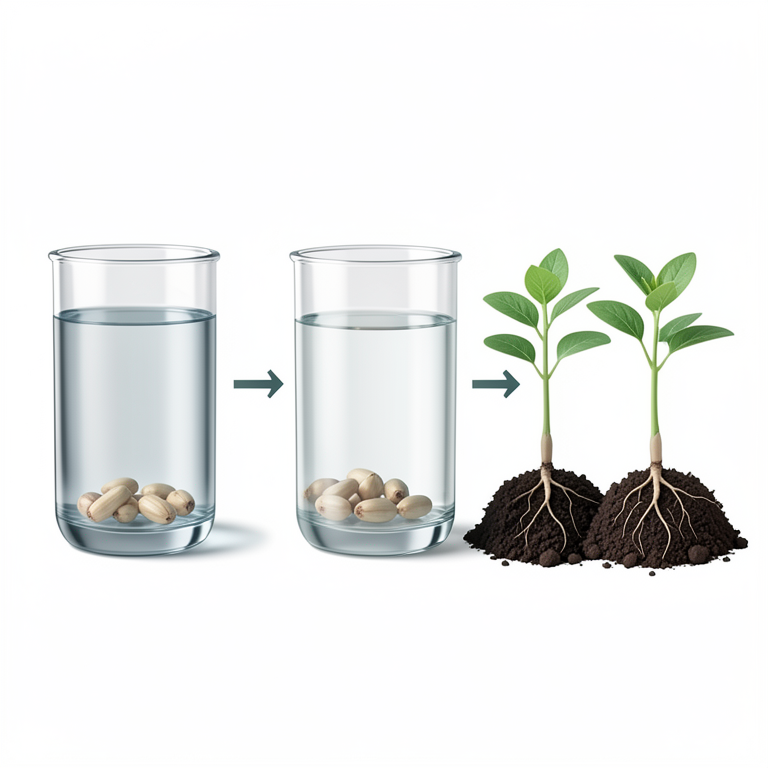
Priming Treatment Comparison
AI-generated conceptual illustration (aged cotton seeds). It explains the idea and does not show study data.
View source evidence ↗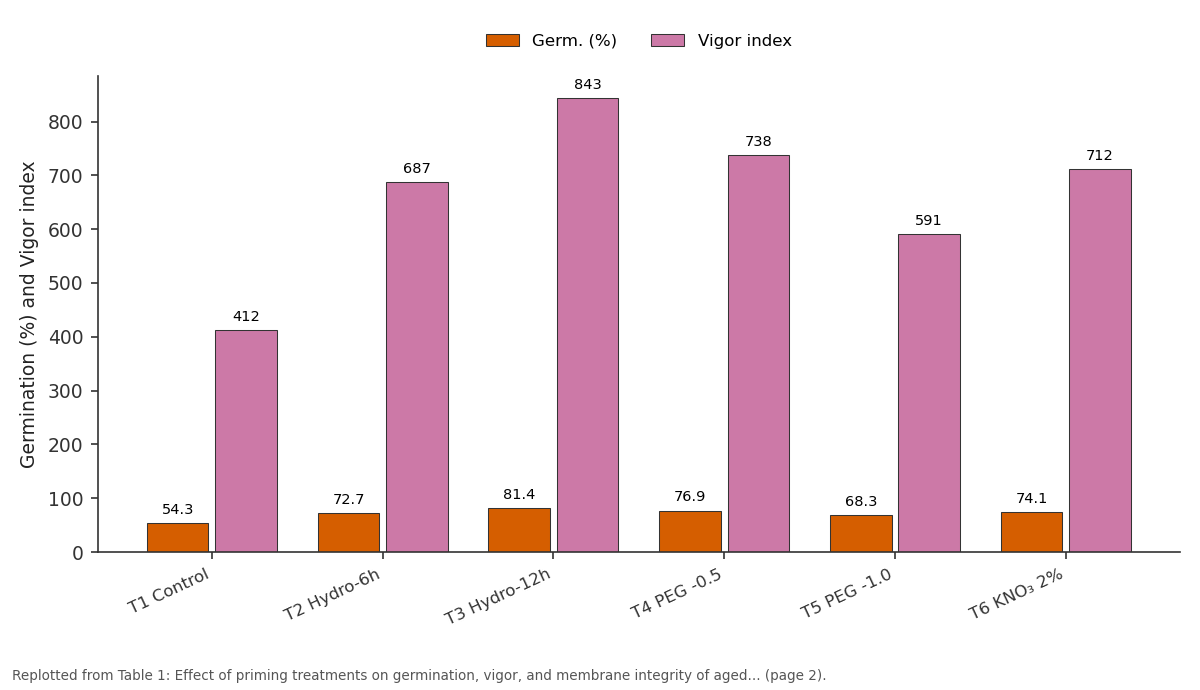
Germ. (%) and Vigor index: T1 Control vs T2 Hydro-6h vs T3 Hydro-12h vs T4 PEG -0.5 vs T5 PEG -1.0
Replotted from Table 1 (page 2) of the original paper. Every bar is the paper's own table value.
View source evidence ↗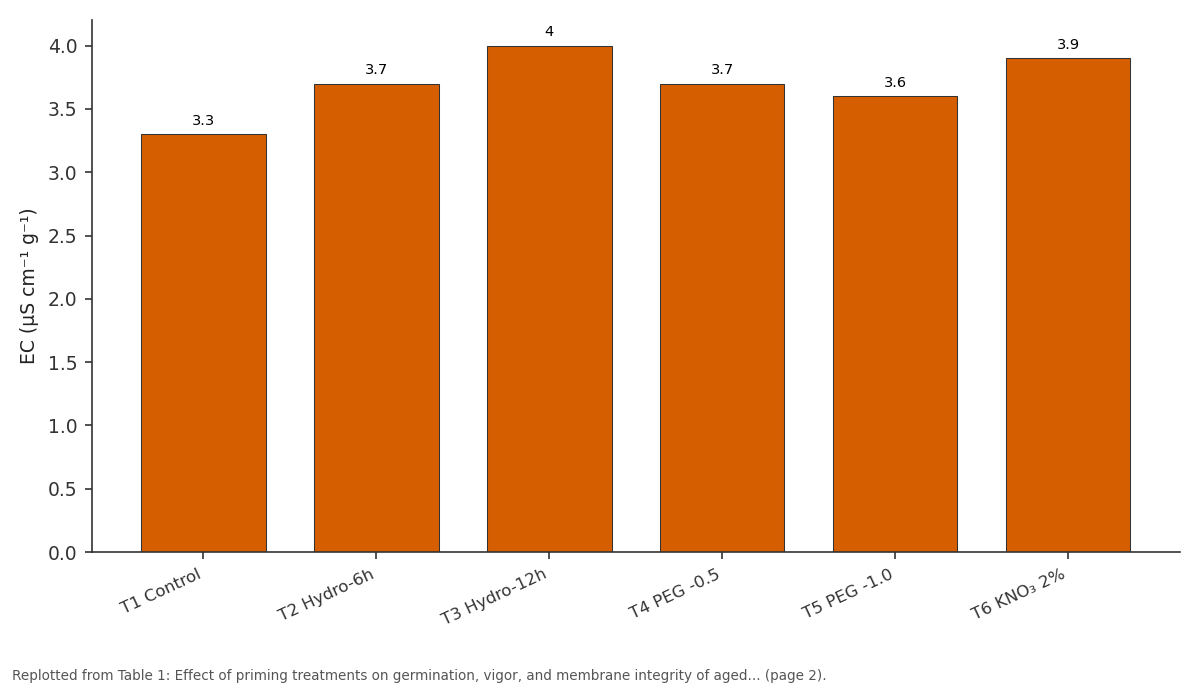
Shoot len. (cm): T1 Control vs T2 Hydro-6h vs T3 Hydro-12h vs T4 PEG -0.5 vs T5 PEG -1.0
Replotted from Table 1 (page 2) of the original paper. Every bar is the paper's own table value.
View source evidence ↗Figures & tables
From the original paper Table 1
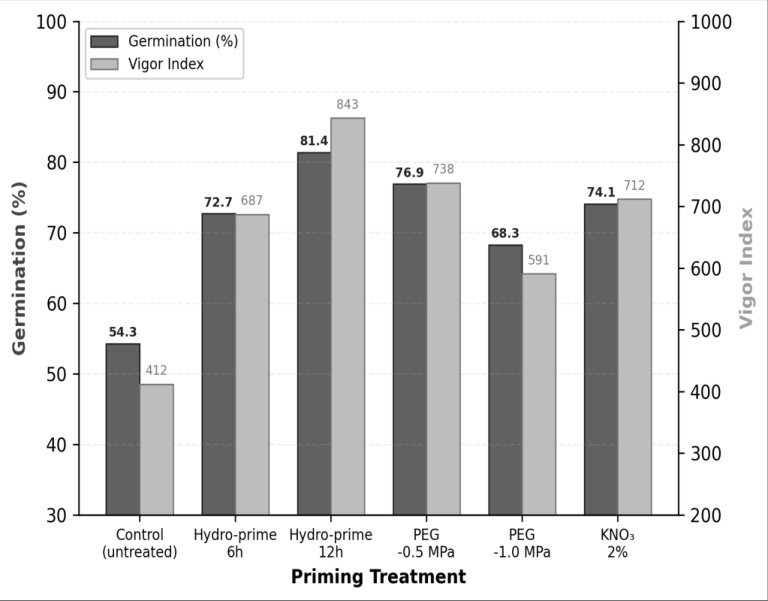 Figure 1
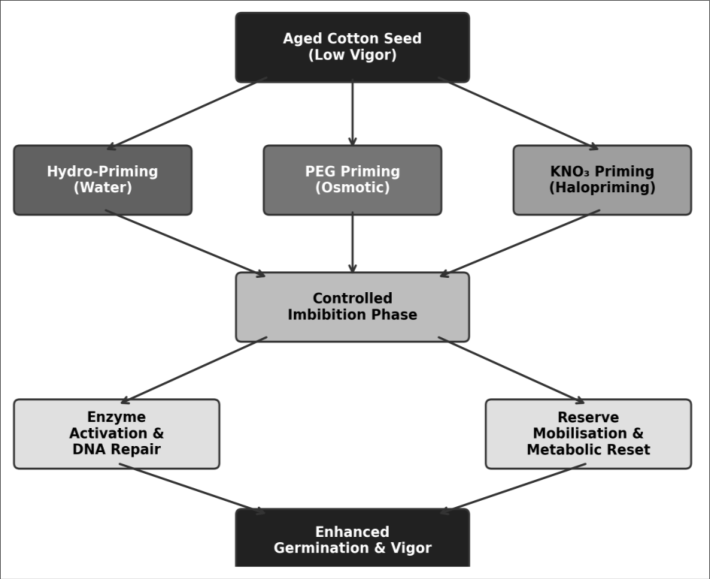 Figure 2
Introduction
"Seed quality is the foundation of crop production," wrote McDonald in his seminal review of seed deterioration [1] a statement that remains as true today as when it was published. Cotton (Gossypium hirsutum L.) seeds are particularly prone to vigor loss during storage because of their high oil content (18-24%), which accelerates lipid peroxidation and membrane damage [2,3] . In Japan's Tohoku region, where cotton cultivation has been revived as part of a post-tsunami diversification programme, farmers often carry seed stocks for two or more years, and germination can fall below 60% by the second season [4] . Seed priming controlled hydration followed by re-drying before sowing triggers the early stages of germination (enzyme activation, DNA repair, reserve mobilisation) without allowing radicle emergence [5,6] . The seed is then "ready to go" when sown, reducing the lag phase and improving stand establishment. Hydro-priming (water only) is the simplest variant, while osmotic priming with PEG controls water uptake rate, and halopriming with KNO₃ adds a nutrient stimulus [7,8] . Although priming has been tested widely on cereals and vegetables, cotton-specific data especially for seeds that have already lost vigor through aging are limited [9] . This research aimed to a) Compare five priming protocols on aged cotton seeds. b) Identify which treatment best restores germination and vigor. c) Assess membrane repair through electrical conductivity measurements.
Quality Control Procedures
Seed lots were screened before and after priming using the ISTA (International Seed Testing Association) standard germination protocol at 25 °C on between-paper substrate [10] . Each treatment was replicated four times with 100 seeds per replicate. Speed of germination was calculated by the Maguire index [11] . Electrical conductivity of seed leachate a proxy for membrane integrity was measured after 24-hour soaking in 75 mL deionised water at 20 °C using a calibrated Hanna HI-98311 conductivity meter. The meter was recalibrated with 1,413 µS cm⁻¹ standard solution at the start of each testing day. Laboratory temperature was maintained at 25 ± 1 °C throughout the experiment.
Material and Methods Material
Cotton seeds (cv. Coker-312, certified lot harvested March 2020) were stored in cotton bags under ambient conditions (18-28 °C, 55-75% RH) at the seed store, Tohoku Agricultural College, Sendai, Miyagi, Japan (38.27° N, 140.87° E). At the time of the experiment (April 2022), the lot was 24 months old and showed initial germination of 54.3%. PEG-6000 (Wako Pure Chemical Industries, Osaka) was used to prepare osmotic solutions at -0.5 and -1.0 MPa following Michel and Kaufmann's equation [12] . Analytical-grade KNO₃ (Kanto Chemical, Tokyo) was dissolved at 2% (w/v) in distilled water.
Methods
Six treatments were tested in a completely randomised design with four replications: (T1) untreated control, (T2) hydro-priming 6 h, (T3) hydro-priming 12 h, (T4) PEG -0.5 MPa for 12 h, (T5) PEG -1.0 MPa for 12 h, and (T6) KNO₃ 2% for 6 h. After priming, seeds were surface-dried to original moisture content (~10%) under a laminar-flow hood. Standard germination was scored at 4 and 12 days (first and final counts). Root length and shoot length of 10 normal seedlings per replicate were measured at day 12; vigor index was calculated as germination (%) × mean seedling length (cm) [13] . Speed of emergence was recorded in a separate sand-tray test at 25 °C. Data were analysed by one-way ANOVA in R 4.3.1 with Tukey's HSD at p ≤ 0.05.
Results
Results
Comprehensive Interpretation
Hydro-priming for 12 h (T3) produced the highest germination (81.4%), vigor index (843), and lowest leachate conductivity (1.14 µS cm⁻¹ g⁻¹), indicating the most complete membrane repair. PEG at -0.5 MPa (T4) ranked second on all three measures. The more negative PEG solution (-1.0 MPa) restricted water uptake too severely, yielding results only marginally better than the untreated control. KNO₃ halopriming (T6) fell between the two hydropriming durations, suggesting that the nutrient stimulus compensated partly for the shorter soak time.
Discussion
The 27.1 percentage-point germination gain from a 12 h water soak is striking for its simplicity. Similar recoveries (20-30 pp) have been reported for hydro-primed wheat and maize, but cotton data are scarce [5,7] . The mechanism likely involves rehydration of membrane phospholipids and reactivation of antioxidant enzymes catalase and superoxide dismutase that neutralise ROS accumulated during storage [6,8] . The drop in leachate conductivity from 1.87 to 1.14 µS cm⁻¹ g⁻¹ is a direct measure of membrane repair: fewer solutes leaking out means tighter bilayer integrity [1,10] . This metric could serve as a rapid quality-control tool for seed companies deciding whether to prime or discard aged lots. PEG at -0.5 MPa performed well but adds cost and requires accurate solution preparation. For resource-limited farmers, the zero-cost hydro-priming approach is clearly preferable [9] . A limitation is that only one cultivar and one storage duration were tested; extending the work to multiple genotypes and aging levels (1, 3, 4 years) would map the practical boundaries of the technique.
Conclusion
A simple 12-hour water soak restored germination of twoyear-old cotton seeds from 54.3% to 81.4% and more than doubled the vigor index. PEG priming at -0.5 MPa was the next best option. Electrical conductivity of leachate proved a reliable indicator of membrane recovery. Hydro-priming for 12 h is recommended as a zero-cost, farmer-friendly invigoration technique for aged cotton seed lots in temperate storage environments.
Acknowledgement
AcknowledgementsThis research was supported by the Tohoku Agricultural College departmental grant. Ms. Akiko Tanaka assisted with laboratory seed testing.
Figures and tables from the paper
| Treatment | Germ. (%) | Vigor index | Speed of emergence | Root len. (cm) | Shoot len. (cm) | EC (µS cm⁻¹ g⁻¹) |
|---|---|---|---|---|---|---|
| T1 Control | 54.3 | 412 | 6.8 | 4.3 | 3.3 | 1.87 |
| T2 Hydro-6h | 72.7 | 687 | 9.4 | 5.7 | 3.7 | 1.42 |
| T3 Hydro-12h | 81.4 | 843 | 11.7 | 6.4 | 4.0 | 1.14 |
| T4 PEG -0.5 | 76.9 | 738 | 10.3 | 5.9 | 3.7 | 1.28 |
| T5 PEG -1.0 | 68.3 | 591 | 8.6 | 5.1 | 3.6 | 1.51 |
| T6 KNO₃ 2% | 74.1 | 712 | 9.8 | 5.6 | 3.9 | 1.36 |
| CD (p=0.05) | 4.7 | 58 | 1.1 | 0.5 | 0.3 | 0.12 |
Table text extracted from the original PDF; superscript letters are shown inline. The original table image is below.
View original table image
References
14 in the original paper- McDonald MB. Seed deterioration: physiology, repair and assessment. Seed Science and Technology. 1999;27(1):177-237.
- Copeland LO, McDonald MB. Principles of seed science and technology. 4th ed. New York: Springer; 2001.
- Priestley DA. Seed aging: implications for seed storage and persistence in the soil. Ithaca: Cornell University Press; 1986.
- Yamamoto K, Sato T. Revival of cotton cultivation in Tohoku after the 2011 earthquake: challenges and prospects. Japanese Journal of Crop Science. 2018;87(2):142-149.
- Parera CA, Cantliffe DJ. Presowing seed priming. Horticultural Reviews. 1994;16:109-141.
- Jisha KC, Vijayakumari K, Puthur JT. Seed priming for abiotic stress tolerance: an overview. Acta Physiologiae Plantarum. 2013;35(5):1381-1396.
- Farooq M, Basra SMA, Wahid A, Ahmad N, Saleem BA. Improving the drought tolerance in rice by exogenous application of salicylic acid. Journal of Agronomy and Crop Science. 2009;195(4):237-246.
- Varier A, Vari AK, Dadlani M. The subcellular basis of seed priming. Current Science. 2010;99(4):450-456.
- Hussain I, Ahmad R, Farooq M, Rehman A, Amin M, Bakar MA. Seed priming: a tool to invigorate the seeds. Scientia Agriculturae. 2014;7(3):122-128.
- ISTA. International rules for seed testing 2022. Bassersdorf: International Seed Testing Association; 2022.
- Maguire JD. Speed of germination: aid in selection and evaluation for seedling emergence and vigor. Crop Science. 1962;2(2):176-177.
- Michel BE, Kaufmann MR. The osmotic potential of polyethylene glycol 6000. Plant Physiology. 1973;51(5):914-916.
- Abdul-Baki AA, Anderson JD. Vigor determination in soybean seed by multiple criteria. Crop Science. 1973;13(6):630-633.
- Bradford KJ. Manipulation of seed water relations via osmotic priming to improve germination under stress conditions. HortScience. 1986;21(5):1105-1112.