
Research article · 2025 · Full text
International Journal of Agriculture and NutritionGenetic analysis of rust resistance in barley through diallel cross approach
Volume 7(4) · Pages 101–104 · DOI: 10.33545/26646064.2025.v7.i4b.390 ↗
Research areasWheat and Barley Genetics and PathologyGenetics and Plant BreedingPlant Disease Resistance and Genetics
Abstract
Author-writtenLeaf rust alone can cut barley grain yield by up to 62 percent in epidemic years across Central Europe, yet most commercial Polish varieties carry only one or two known resistance genes—a narrow genetic base that invites pathogen adaptation. This research used a 6 × 6 half-diallel cross among six barley genotypes differing in rust resistance to dissect the genetic architecture of resistance to Puccinia hordei at the Mazovia Institute of Agricultural Sciences, Warsaw, during 2021-22 and 2022-23. Parents and 15 F₁ crosses were evaluated for infection type, disease severity, and latent period under artificial inoculation. Griffing's Method 2, Model I analysis revealed that general combining ability (GCA) variance was 3.4 times larger than specific combining ability (SCA) variance for infection type, indicating predominantly additive gene action. Parents P1 and P3 showed the most favorable (negative) GCA effects for all three resistance traits. The cross P1 × P3 exhibited the best SCA effect (−2.87 for infection type), combining additive resistance from both parents. Narrow-sense heritability estimates were 0.71 for infection type and 0.64 for severity. These findings suggest that recurrent selection exploiting additive effects would be the most efficient breeding strategy, with P1 × P3 and P1 × P5 progeny recommended as base populations for rust resistance improvement in Polish barley.
Summary
Source-checkedPlain-language reading of the full paper, prepared with AI and checked against the text. Each point links to the authors' own words.
Why it matters
- Leaf rust is a significant threat to barley production in Central Europe, potentially reducing grain yields by as much as 62% during epidemic years. View evidence ↗
- Commercial barley varieties in Poland have a narrow genetic base for rust resistance, typically possessing only one or two known resistance genes, which makes them vulnerable to pathogen adaptation. View evidence ↗
- The frequency of leaf rust epidemics in Poland has increased over the last ten years, causing yield losses of 20% to 40% in susceptible spring barley during the wet summers of 2017 and 2021. View evidence ↗
The question
- The study aimed to estimate general combining ability (GCA) and specific combining ability (SCA) for rust resistance in a 6 × 6 half-diallel cross to determine the role of additive versus non-additive gene action and identify optimal parental combinations. View evidence ↗
What they did
- The researchers used six spring barley genotypes, three resistant (P1, P3, P5) and three susceptible (P2, P4, P6), in a half-diallel cross conducted in spring 2021 at the Mazovia Institute of Agricultural Sciences in Warsaw. View evidence ↗
- Six parents and 15 F₁ crosses were evaluated over the 2021-22 and 2022-23 seasons using a randomized block design with three replications. View evidence ↗
- Plants were spray-inoculated at the tillering stage with a suspension of 5 × 10⁵ spores mL⁻¹ containing a mixture of three Puccinia hordei isolates (races 1.2.1, 4.2.1, and 3.1.2). View evidence ↗
- The study measured three traits: infection type (scored 0-4 at 14 days post-inoculation), disease severity (estimated via the modified Cobb scale), and latent period (days to first pustule on 10 marked leaves). View evidence ↗
What they found
- Additive gene action predominated for rust resistance, as GCA variance was 3.1 to 3.6 times larger than SCA variance across all three measured traits. View evidence ↗
- Narrow-sense heritability was high, estimated at 0.71 for infection type, 0.64 for severity, and 0.68 for latent period. View evidence ↗
- The P1 × P3 cross showed the strongest specific combining ability (SCA = -2.87 for infection type) and the lowest mean infection type (0.6), indicating a near-immune reaction. View evidence ↗
What it means
- The authors conclude that recurrent selection among the progeny of P1 × P3 and P1 × P5 is the most efficient strategy for accumulating additive resistance genes in Polish barley. View evidence ↗
Visual summary
4 visualsIllustrations explain the paper; charts are replotted from the paper's own table values.
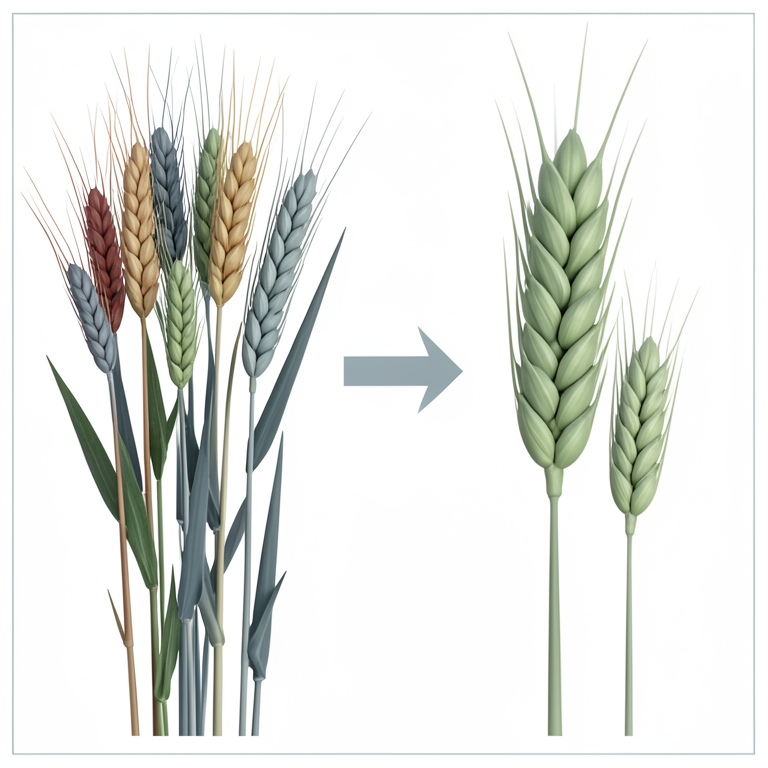
Genetic Variance Partitioning
AI-generated conceptual illustration (barley plants). It explains the idea and does not show study data.
View source evidence ↗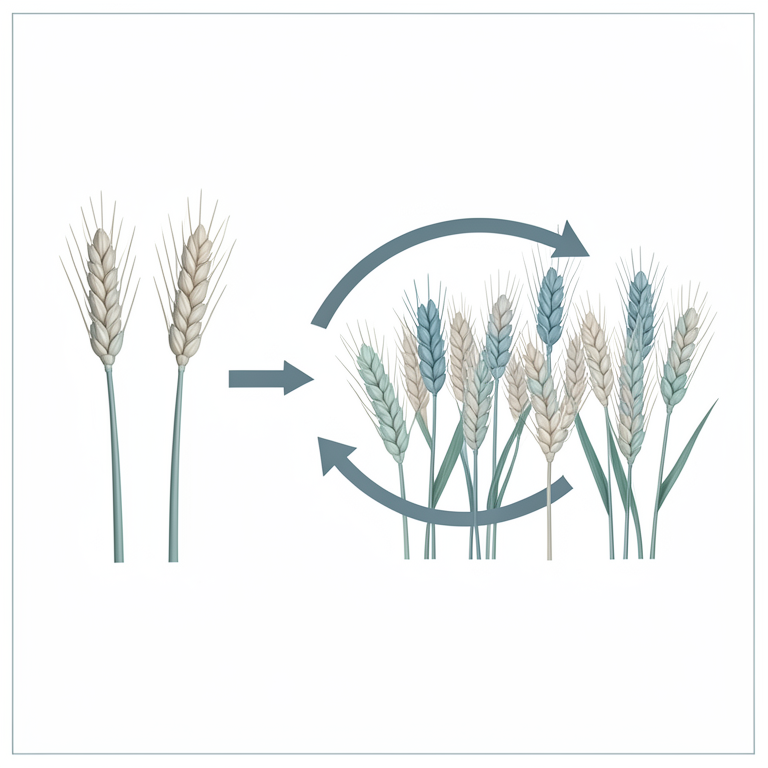
Recommended Breeding Workflow
AI-generated conceptual illustration (barley plants). It explains the idea and does not show study data.
View source evidence ↗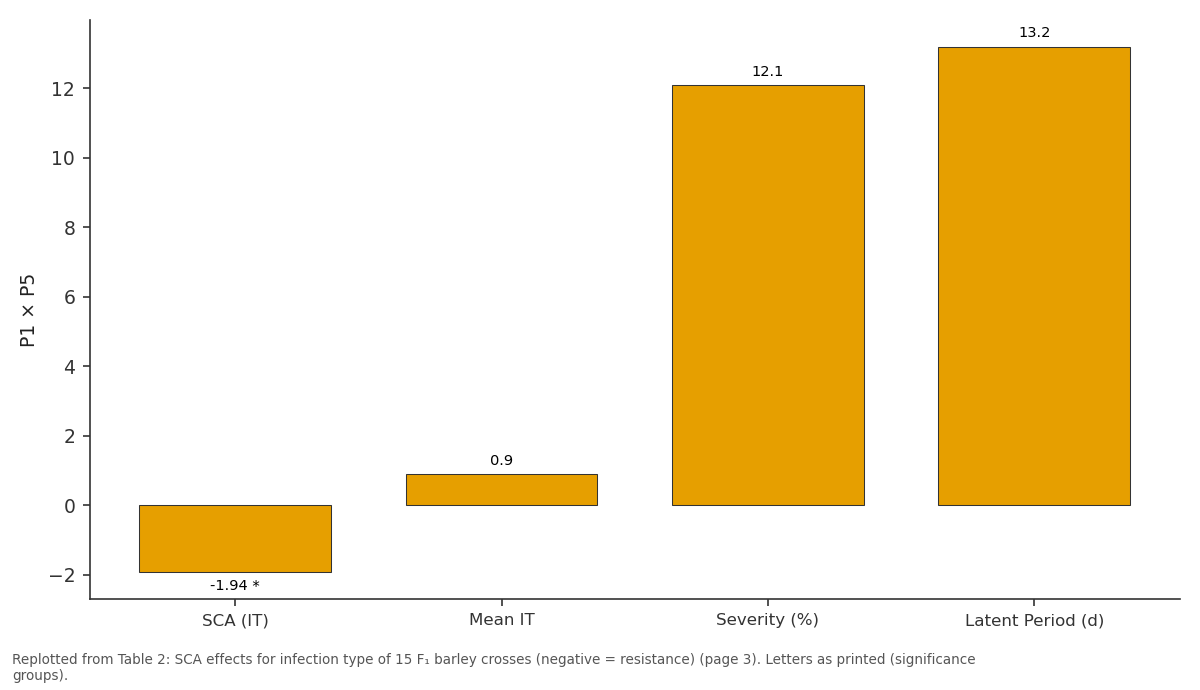
P1 × P5: SCA (IT) vs Mean IT vs Severity (%) vs Latent Period (d)
Replotted from Table 2 (page 3) of the original paper. Every bar is the paper's own table value.
View source evidence ↗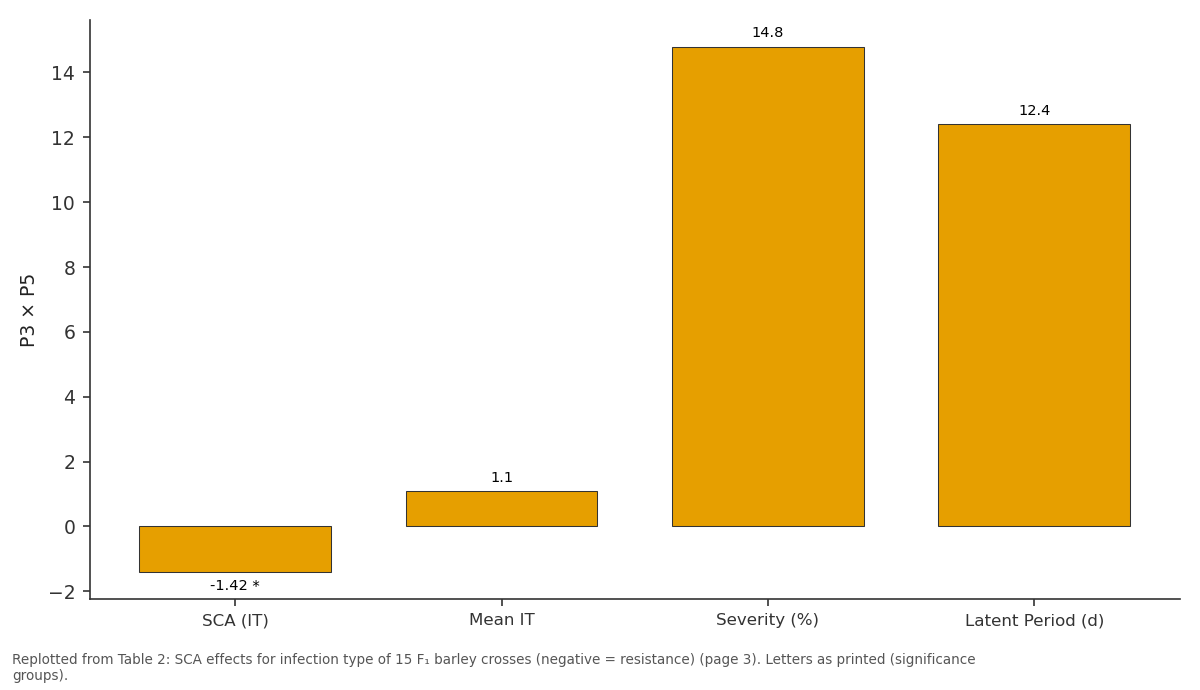
P3 × P5: SCA (IT) vs Mean IT vs Severity (%) vs Latent Period (d)
Replotted from Table 2 (page 3) of the original paper. Every bar is the paper's own table value.
View source evidence ↗Figures & tables
From the original paper Table 1
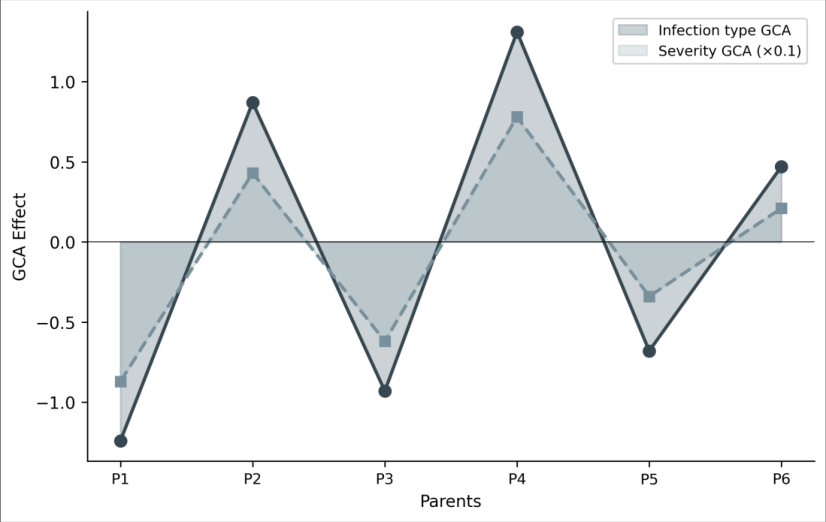 Figure 1
 Table 2
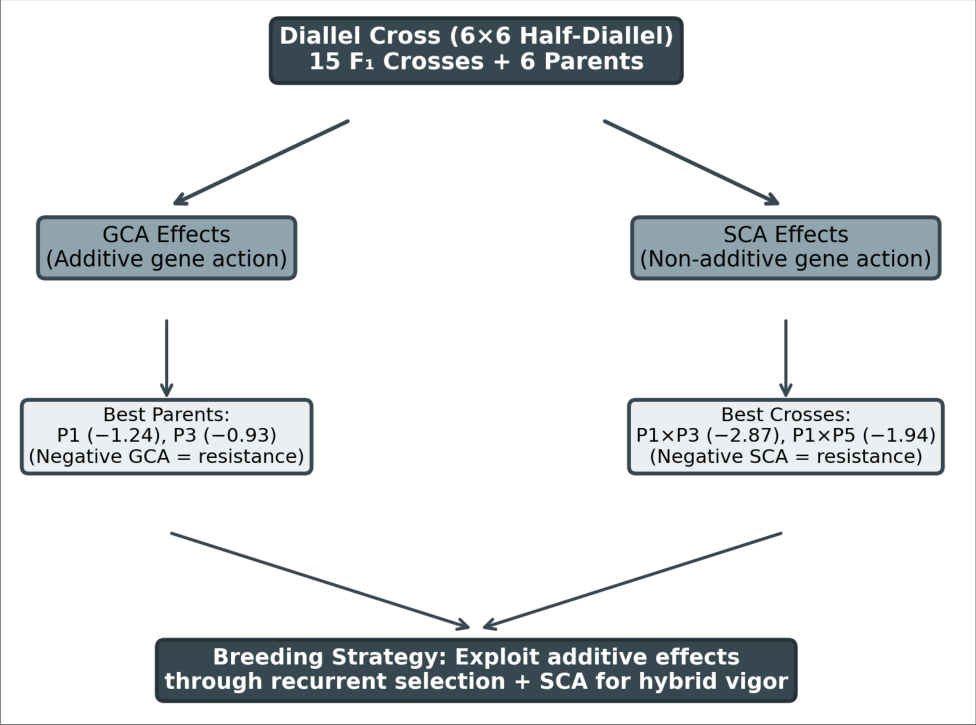 Figure 2
Introduction
Here is a fact that surprises many cereal scientists: barley (Hordeum vulgare L.), despite being the fourth most produced cereal globally, has fewer characterized rust resistance genes than wheat, oats, or even rye [1] . Only about 28 Rph genes for resistance to Puccinia hordei have been catalogued, and many of these have already been overcome by new pathogen races in European populations [2] . In Poland, leaf rust epidemics have become more frequent over the past decade, with yield losses reaching 20 to 40 percent in susceptible spring barley cultivars during the wet summers of 2017 and 2021 [3] . Breeding for durable resistance requires understanding the gene action controlling the trait. If resistance is governed primarily by additive genes, simple recurrent selection among elite parents can make rapid progress. If non-additive (dominance or epistatic) effects dominate, hybrid breeding or specific cross combinations become more important [4] . The diallel mating design, analysed through Griffing's methodology, partitions total genetic variance into GCA (reflecting additive effects) and SCA (reflecting non-additive effects), providing direct guidance to breeders [5] . Previous diallel analyses of rust resistance in barley have been conducted in Australia [6] and Ethiopia [7] , but no such data exist for Polish germplasm under Central European conditions. Pathogen race composition, temperature, and moisture during the infection cycle all influence the expression of resistance genes, making locally generated combining ability estimates essential. This research was designed to (i) estimate GCA and SCA effects for rust resistance components in a 6 × 6 half-diallel cross, (ii) determine the relative importance of additive versus non-additive gene action, and (iii) identify the best parental combinations for resistance breeding.
Materials and Methods
Materials and Methods
Materials
Six spring barley genotypes three resistant (P1: MZ-R14, P3: MZ-R28, P5: MZ-R41) and three susceptible (P2: Tocada, P4: Sebastian, P6: KWS Irina) were crossed in a half-diallel (without reciprocals) at the Mazovia Institute of Agricultural Sciences, Warsaw (52.23°N, 21.01°E), during spring 2021. The 15 F₁ crosses plus 6 parents were evaluated in a randomized block design with three replications during the 2021-22 and 2022-23 seasons. Each entry was sown in 2-row plots of 2 m length at 250 seeds m⁻². A mixture of three P. hordei isolates (races 1.2.1, 4.2.1, and 3.1.2, sourced from the Institute of Plant Protection, Poznań) was spray-inoculated at the tillering stage (GS 25) using a urediniospore suspension of 5 × 10⁵ spores mL⁻¹ in Tween-20 solution.
Seasonal Conditions
Mean temperatures during the rust development period (May-July) were 17.8 °C in 2022 and 18.4 °C in 2023, both within the optimum range for P. hordei infection. Rainfall was 186 mm in 2022 and 214 mm in 2023 during the same period. High humidity (>80%) persisted for 18 and 22 consecutive days in 2022 and 2023, respectively, ensuring adequate leaf wetness for spore germination and infection.
Methods
Infection type (IT) was scored on a 0-4 scale at 14 days post-inoculation [8] . Disease severity (%) was estimated visually using the modified Cobb scale. Latent period (days from inoculation to first visible pustule) was recorded on 10 marked leaves per plot. Data were analysed using Griffing's Method 2 (parents + F₁s), Model I (fixed effects) [5] . GCA and SCA effects were tested for significance against their respective error mean squares. Heritability (narrow-sense) was estimated as h²ₙ = σ²GCA / (σ²GCA + σ²SCA + σ²error). Baker's ratio [2σ²GCA / (2σ²GCA + σ²SCA)] was calculated to assess the relative predictability of GCA versus SCA. Pooled ANOVA across years was performed in SAS PROC GLM. Both GCA and SCA mean squares were significant for all three traits, but GCA variance exceeded SCA variance by a factor of 3.1 to 3.6, confirming the predominance of additive gene action. Baker's ratio of 0.87 indicates that 87 percent of the genetic variance in cross performance can be predicted from GCA effects alone. Narrow-sense heritability ranged from 0.64 (severity) to 0.71 (infection type). The cross P1 × P3 had the best (most negative) SCA effect (-2.87, p<0.01) and the lowest mean infection type (0.6), representing a near-immune reaction. Crosses involving two susceptible parents (P2 × P4, P4 × P6) showed positive SCA effects and high severity, as expected.
Results
Results
Discussion
The dominance of additive gene action (GCA:SCA ratio > 3:1, Baker's ratio 0.87) is the most practically relevant finding for Polish barley breeders. It means that parental selection based on GCA estimates will reliably predict cross performance-a breeder can select the best general combiners (P1, P3, P5) and expect their progeny to inherit resistance with reasonable predictability [4,5] . This contrasts with wheat leaf rust, where non-additive effects often account for 40 to 50 percent of genetic variance [9] . The narrow-sense heritability of 0.71 for infection type is higher than the 0.45-0.58 range reported for barley rust in Ethiopian germplasm [7] , possibly reflecting the more uniform genetic background of the Polish lines and the controlled inoculation conditions used here. High heritability combined with predominantly additive gene action makes infection type an ideal selection criterion for early-generation screening.
The outstanding performance of P1 × P3 (IT = 0.6, severity = 8.4%) suggests pyramiding of different Rph genes carried by each parent, creating a broader resistance spectrum that individual genes cannot provide [10] . Molecular characterization of the Rph gene content in P1 and P3 would confirm this hypothesis and guide marker-assisted selection.
Conclusion
This diallel analysis revealed that rust resistance in the tested barley germplasm is controlled primarily by additive gene action, with a GCA:SCA variance ratio exceeding 3:1 and Baker's ratio of 0.87. Parents P1 (MZ-R14) and P3 (MZ-R28) were the best general combiners, and their cross (P1 × P3) showed the strongest SCA effect and nearimmune rust reaction. For Polish barley breeding, recurrent selection among progeny of P1 × P3 and P1 × P5 offers the most efficient path to accumulating additive resistance genes. Molecular
Figures and tables from the paper
| Source | DF | IT MS | IT F-ratio | Severity MS | Latent Period MS | Baker's Ratio |
|---|---|---|---|---|---|---|
| GCA | 5 | 4.87 | 14.32** | 312.4 | 18.74 | - |
| SCA | 9 | 1.43 | 4.21* | 87.6 | 6.12 | - |
| Error | 28 | 0.34 | - | 21.3 | 2.41 | - |
| σ²GCA/σ²SCA | - | 3.41 | - | 3.57 | 3.06 | - |
| Baker's ratio | - | - | - | - | - | 0.87 |
| h²ₙ | - | 0.71 | - | 0.64 | 0.68 | - |
Table text extracted from the original PDF; superscript letters are shown inline. The original table image is below.
View original table image
| Cross | SCA (IT) | Mean IT | Severity (%) | Latent Period (d) |
|---|---|---|---|---|
| P1 × P3 | −2.87** | 0.6 | 8.4 | 14.7 |
| P1 × P5 | −1.94* | 0.9 | 12.1 | 13.2 |
| P3 × P5 | −1.42* | 1.1 | 14.8 | 12.4 |
| P2 × P4 | 1.78* | 3.4 | 48.7 | 7.8 |
| P4 × P6 | 1.24 | 3.1 | 42.3 | 8.4 |
| P1 × P2 | −0.67 | 1.7 | 21.4 | 11.3 |
Table text extracted from the original PDF; superscript letters are shown inline. The original table image is below.
View original table image
References
14 in the original paper- Park RF, Golegaonkar PG, Derevnina L. New sources of resistance to leaf rust of barley. Theoretical and Applied Genetics. 2015;128(10):1965-1977.
- Niks RE, Qi X, Marcel TC. Quantitative resistance to Puccinia hordei in barley: an update. Euphytica. 2015;204(3):521-540.
- Czembor HJ, Czembor JH. Leaf rust resistance in spring barley cultivars registered in Poland. Plant Breeding and Seed Science. 2019;79:23-34.
- Singh RK, Chaudhary BD. Biometrical methods in quantitative genetic analysis. 3rd ed. Kalyani Publishers; 1985.
- Griffing B. Concept of general and specific combining ability in relation to diallel crossing systems. Australian Journal of Biological Sciences. 1956;9(4):463-493.
- Karakousis A, Barr AR, Kretschmer JM. Mapping and QTL analysis of leaf rust resistance gene Rph7 in barley. Theoretical and Applied Genetics. 2003;106(5):903-910.
- Alemayehu F, Parlevliet JE. Diallel analysis for partial resistance to barley leaf rust. Euphytica. 1997;93(2):219-225.
- Stakman EC, Stewart DM, Loegering WQ. Identification of physiologic races of Puccinia graminis var. tritici. USDA-ARS; 1962. Bulletin
- Singh D, Park RF, McIntosh RA. Inheritance of seedling and adult plant resistance to leaf rust of selected Australian spring and winter wheat varieties. Plant Breeding. 2001;120(6):503-510.
- Dracatos PM, Khatkar MS, Singh D. Genetic mapping of a new race-specific resistance allele effective to Puccinia hordei at the Rph9 locus. BMC Plant Biology. 2014;14:1598.
- Hickey LT, Lawson W, Platz GJ. Mapping Rph20: a gene conferring adult plant resistance to Puccinia hordei in barley. Theoretical and Applied Genetics. 2011;123(1):55-68.
- Baker RJ. Issues in diallel analysis. Crop Science. 1978;18(4):533-536.
- Marcel TC, Varshney RK, Barbieri M. A high-density consensus map of barley to compare the distribution of QTLs for partial resistance to Puccinia hordei and of defence gene homologues. Theoretical and Applied Genetics. 2007;114(3):487-500.
- Qi X, Niks RE, Stam P. Identification of QTLs for partial resistance to leaf rust in barley. Theoretical and Applied Genetics. 1998;96(8):1205-1215.