
Research article · 2025 · Full text
International Journal of Agriculture and NutritionImpact of alternate wetting and drying irrigation on methane emission from rice paddies
Volume 7(6) · Pages 153–155 · DOI: 10.33545/26646064.2025.v7.i6c.451 ↗
Research areasRice Cultivation and Yield ImprovementAgricultural Systems and PracticesPeatlands and Wetlands Ecology
Abstract
Author-writtenWhat fraction of a rice field’s methane output can be eliminated simply by letting the soil breathe between irrigations? This research measured CH4 and N2O fluxes under alternate wetting and drying (AWD) irrigation versus continuous flooding (CF) in transplanted rice at Anand, Gujarat, during Kharif 2022 and 2023. Closed chambers sampled gas at weekly intervals. AWD reduced seasonal CH4 emission by 38.7% (from 4.10 to 2.51 t CO2-eq ha-1) without a statistically significant yield penalty (5.87 vs. 6.04 t ha-1). N2O rose slightly under AWD (+14.3%) because aerobic episodes favoured nitrification, but the increase was small in absolute terms (0.18 vs. 0.16 t CO2-eq ha-1). Net global warming potential fell by 34.2% under AWD. Irrigation water use declined by 24%, raising water productivity from 0.74 to 0.98 kg grain m-3. These data support AWD as a practical, low-cost strategy for reducing greenhouse gas intensity of rice in western India without compromising yield.
Summary
Source-checkedPlain-language reading of the full paper, prepared with AI and checked against the text. Each point links to the authors' own words.
Why it matters
- Traditional flooding of rice paddies is economically inefficient, with up to 40% of water lost to evaporation and seepage. View evidence ↗
- Standing water in rice fields creates anaerobic conditions that allow archaea to produce methane, contributing approximately 10% of global agricultural methane emissions. View evidence ↗
- There is limited data on greenhouse gas dynamics in western India, where sandy loam soils and high temperatures may influence emissions. View evidence ↗
The question
- The study aimed to compare methane (CH4) and nitrous oxide (N2O) fluxes, global warming potential, and water productivity between alternate wetting and drying (AWD) and continuous flooding (CF) in transplanted rice. View evidence ↗
What they did
- The experiment was conducted at the Anand Agricultural University research farm in Gujarat on sandy loam Entisol soil. View evidence ↗
- The study used a randomized block design with four replications of 10 m x 8 m plots, planting the 'GR-11' rice variety. View evidence ↗
- Continuous flooding (CF) maintained 5±2 cm of water, while alternate wetting and drying (AWD) allowed the water table to drop to 15 cm below the surface before re-flooding. View evidence ↗
What they found
- AWD irrigation reduced seasonal methane emissions by 38.7%, dropping from 4.10 to 2.51 t CO2-eq ha-1. View evidence ↗
- Nitrous oxide emissions increased by 14.3% under AWD (from 0.16 to 0.18 t CO2-eq ha-1), though this contribution to the total global warming potential was small. View evidence ↗
- The net global warming potential (GWP) decreased by 34.2%, falling from 4.62 to 3.04 t CO2-eq ha-1 under AWD. View evidence ↗
- There was no statistically significant difference in grain yield between AWD (5.87 t ha-1) and CF (6.04 t ha-1). View evidence ↗
- Irrigation water use was reduced by 24% under AWD, decreasing from 1,142 mm to 868 mm. View evidence ↗
- Water productivity increased by 32.4%, rising from 0.74 to 0.98 kg grain m-3 under AWD. View evidence ↗
What it means
- The authors conclude that AWD is a zero-cost strategy for rice growers in western India to mitigate climate impact while improving water productivity. View evidence ↗
- The authors state that further multi-season monitoring and testing on heavier clay soils are needed to expand the applicability of these recommendations. View evidence ↗
Visual summary
3 visualsIllustrations explain the paper; charts are replotted from the paper's own table values.
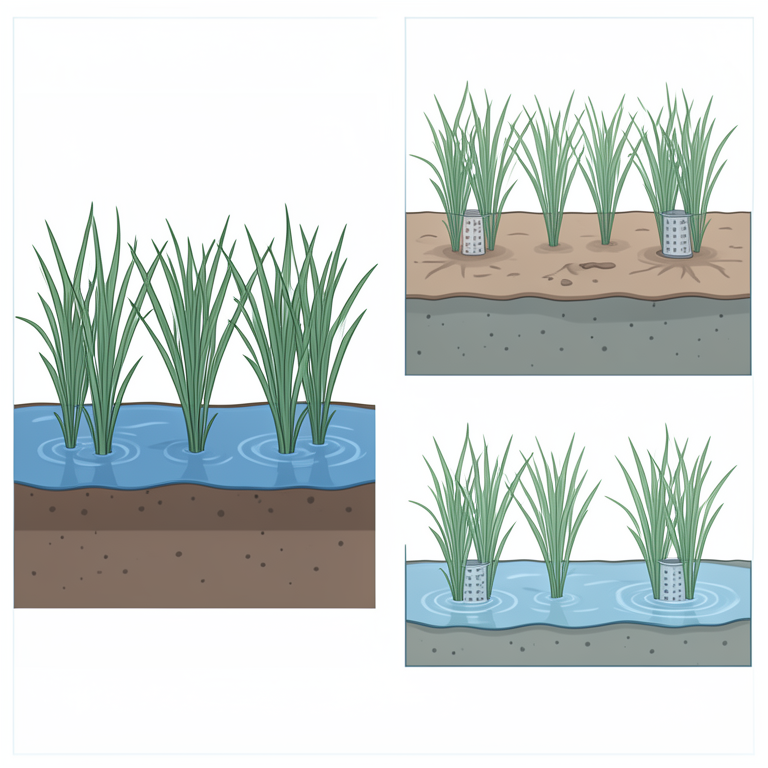
AWD vs CF Irrigation Cycle
AI-generated conceptual illustration (rice plants in paddy soil). It explains the idea and does not show study data.
View source evidence ↗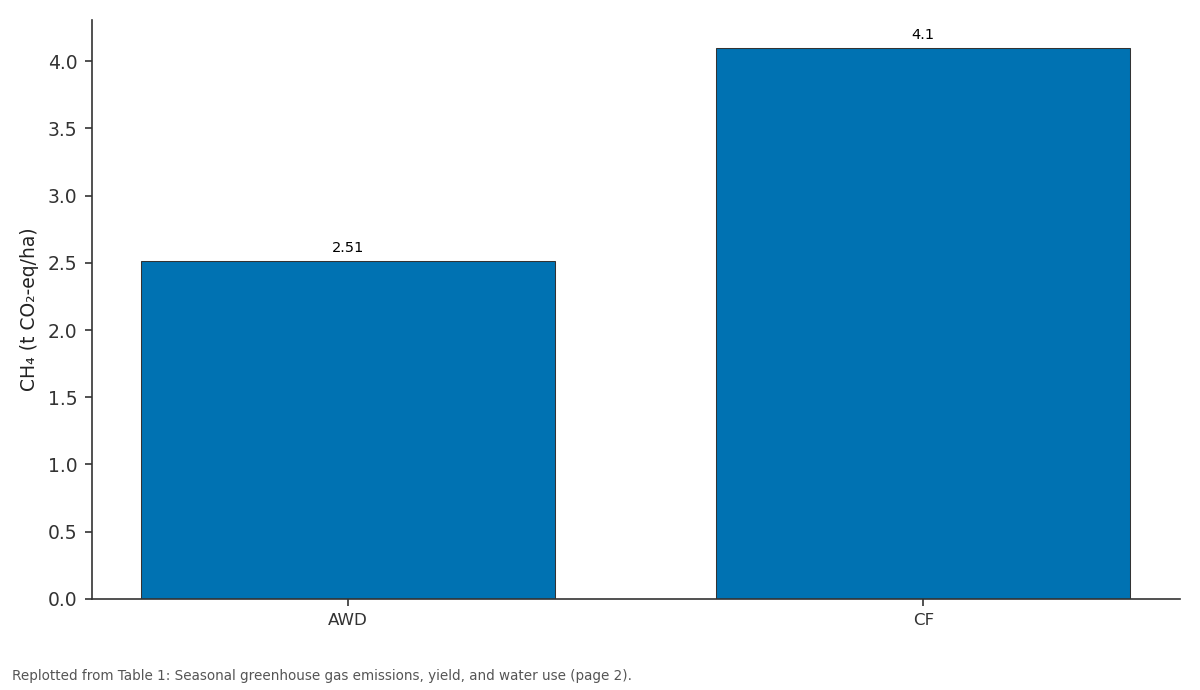
CH₄ (t CO₂-eq/ha): AWD vs CF
Replotted from Table 1 (page 2) of the original paper. Every bar is the paper's own table value.
View source evidence ↗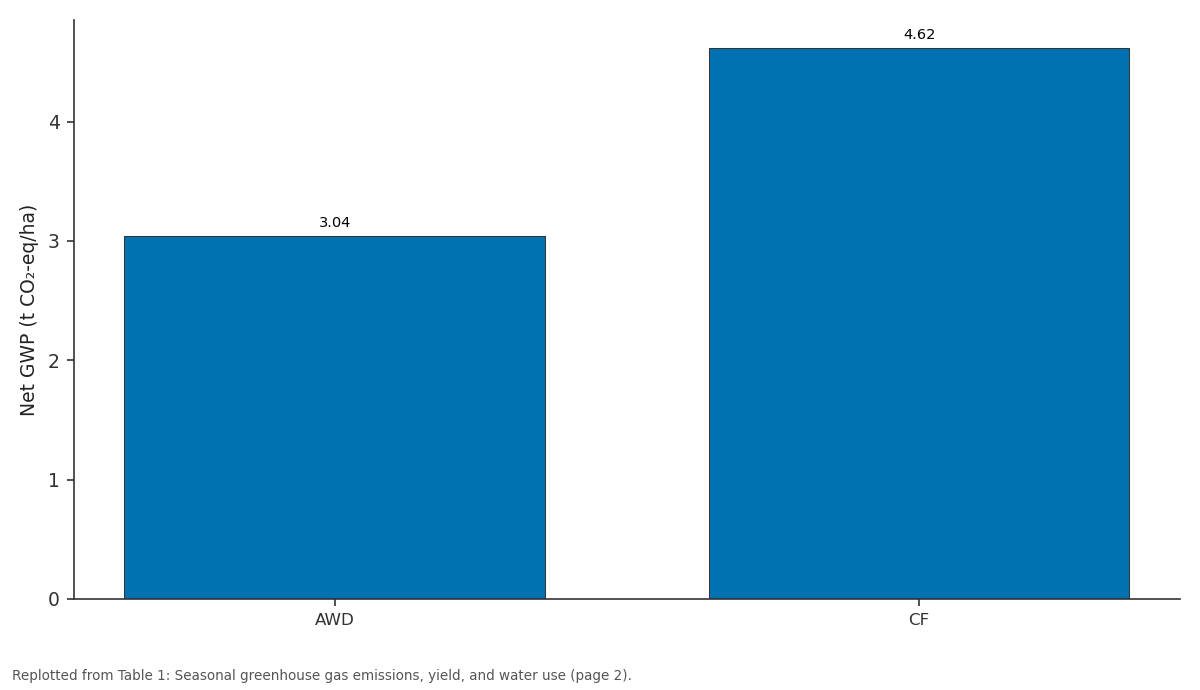
Net GWP (t CO₂-eq/ha): AWD vs CF
Replotted from Table 1 (page 2) of the original paper. Every bar is the paper's own table value.
View source evidence ↗Figures & tables
From the original paper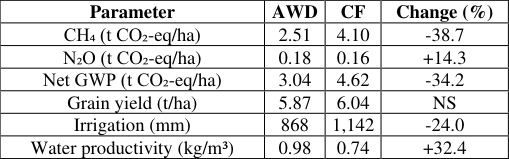 Table 1
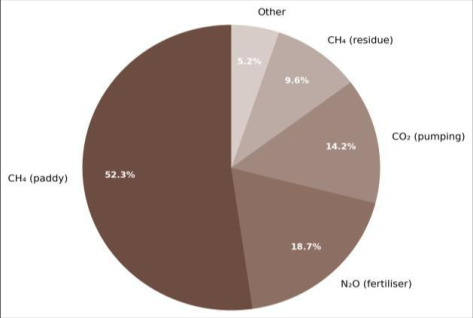 Figure 1
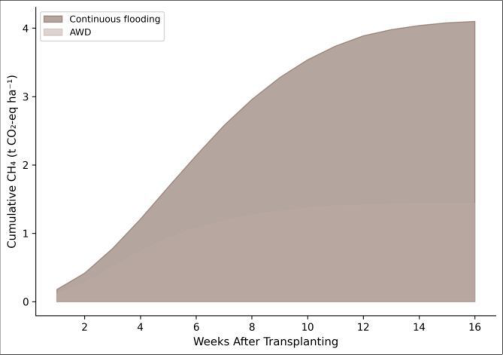 Figure 2
Introduction
From a purely economic angle, flooding a rice paddy is wasteful: up to 40% of applied water is lost through seepage and evaporation without contributing to grain fill [1] . From a climate angle, it's worse: standing water creates the anaerobic conditions that methanogenic archaea need to convert soil organic carbon into CH 4 , making irrigated rice responsible for roughly 10% of global agricultural methane [2] . Alternate wetting and drying (AWD) breaks this cycle by allowing the soil to dry to a threshold (typically 15 cm below the surface) before re-flooding. The aerobic intervals suppress methanogenesis and may even promote methane oxidation by methanotrophs in the surface layer [3,4] . Trials across Southeast Asia have reported 20-50% CH 4 reduction with yield losses of 0-5% [5] . But data from western India-where high ambient temperatures and sandy loam soils may alter gas dynamics-are limited [6] . This research aimed to (i) quantify season-long CH 4 and N 2 O fluxes under AWD versus CF in transplanted rice on a sandy loam Entisol, (ii) calculate the net global warming potential and greenhouse gas intensity, and (iii) measure the water saving and its effect on water productivity.
Water Balance and Irrigation Protocol
In the CF treatment, 5±2 cm of standing water was maintained from transplanting to 14 days before harvest. In AWD, the field was flooded to 5 cm, then allowed to drain until the water table dropped to 15 cm below the surface (monitored by perforated PVC observation tubes installed in each plot) before re-flooding. Irrigation volumes were measured by inline flow meters. Rainfall was logged by an on-site tipping-bucket gauge. Effective rainfall was calculated as total rainfall minus runoff (estimated at 15% for the sandy loam soil) [7] .
Greenhouse Gas Measurement Protocol
Fluxes were measured weekly using static closed chambers (40 cm × 40 cm × 60 cm acrylic) placed on permanent aluminium bases. Gas samples (20 mL) were drawn at 0, 15, and 30 minutes after closure with polypropylene syringes and analysed within 24 hours on a Shimadzu GC-2014 equipped with FID (CH 4 ) and ECD (N 2 O) detectors. Fluxes were calculated from the linear rate of concentration increase and converted to CO 2 -equivalents using IPCC AR5 GWP factors (CH 4 = 28, N 2 O = 265) [8] .
Materials and Methods
Materials and Methods
Materials
The trial was established on a sandy loam Entisol (pH 7.4, OC 0.52%) at the Anand Agricultural University research farm (22°35′ N, 72°55′ E, 45 m a.s.l.). Two water management treatments (AWD and CF) were laid out in a randomised block design with four replications, plot size 10 m × 8 m separated by 1.5 m bunds lined with polythene to prevent lateral seepage. Rice variety 'GR-11' was transplanted at 20 cm × 15 cm in July of each year. Fertiliser: 120:60:40 kg N:P 2 O 5 :K 2 O ha -1 . Research covered Kharif 2022 and 2023 [9] .
Methods
Grain yield was harvested from the central 6 m × 6 m area at 14% moisture. Seasonal cumulative emissions were obtained by trapezoidal integration of weekly fluxes. Global warming potential (GWP) = cumulative CH 4 + cumulative N 2 O in CO 2 -eq. Greenhouse gas intensity (GHGI) = GWP / grain yield. Water productivity = grain yield / total water input. Data were analysed by paired t-test and ANOVA in R (v4.3.1). 4 by 38.7% (Table 1). The reduction was most pronounced during the tillering-topanicle initiation period, when CF plots had the deepest standing water and highest CH 4 fluxes. N 2 O increased by 14.3% under AWD but its absolute contribution to GWP was minor (4.2% of total). Net GWP fell from 4.62 to 3.04 t CO 2 -eq ha -1 (-34.2%). Grain yield was statistically similar (5.87 vs. 6.04 t ha -1 , p = 0.31). Irrigation water use dropped by 24%, from 1,142 mm (CF) to 868 mm (AWD). Comprehensive Interpretation GHGI dropped from 0.77 to 0.52 kg CO 2 -eq per kg grain under AWD, meaning each kilogram of rice produced 33% less warming impact. This metric is arguably more relevant than per-hectare GWP for climate policy because it accounts for maintained productivity [10] .
| Parameter | AWD | CF | Change (%) |
|---|---|---|---|
| CH₄ (t CO₂-eq/ha) | 2.51 | 4.10 | -38.7 |
| N₂O (t CO₂-eq/ha) | 0.18 | 0.16 | +14.3 |
| Net GWP (t CO₂-eq/ha) | 3.04 | 4.62 | -34.2 |
| Grain yield (t/ha) | 5.87 | 6.04 | NS |
| Irrigation (mm) | 868 | 1,142 | -24.0 |
| Water productivity (kg/m³) | 0.98 | 0.74 | +32.4 |
Table text extracted from the original PDF; superscript letters are shown inline. The original table image is below.
View original table image
Results
Results
AWD reduced seasonal CH
AWD reduced seasonal CH
Discussion
The 38.7% CH 4 reduction is within the 20-48% range reported in a global meta-analysis of AWD trials [5] and close to the 35-42% seen on alluvial soils in Bihar [11] . The N 2 O trade-off (14.3% increase) is expected because drying cycles create aerobic microsites where nitrifying bacteria convert NH 4+ to NO 3-, some of which is subsequently denitrified to N 2 O [4] . But the absolute N 2 O increase (0.02 t CO 2 -eq ha -1 ) was dwarfed by the CH 4 saving (1.59 t CO 2 -eq ha -1 ), so the net climate benefit was strongly positive [12] . The 24% water saving translates to roughly 274 mm per season, enough to irrigate an additional 0.3 ha of a second crop-an important consideration for water-scarce districts of Gujarat [13] . The non-significant yield difference confirms that the 15 cm AWD threshold used here was safe for GR-11; more aggressive drying (to 20-25 cm) has shown yield penalties in some cultivars and should be tested separately [14] .
Conclusion
AWD irrigation cut seasonal methane by 39% and net GWP by 34% without yield loss on a sandy loam Entisol in Gujarat, while saving 24% of irrigation water. The N 2 O trade-off was minor. For rice growers in western India, AWD is a straightforward, zero-cost climate mitigation strategy that simultaneously improves water productivity. Extension efforts should target the installation of simple observation tubes-the only additional hardware neededand train farmers to read water-table depth. Multi-season monitoring and testing on heavier clay soils will broaden the recommendation domain [15,16,17] .
Figures and tables from the paper
References
17 in the original paper- Bouman BAM, Lampayan RM, Tuong TP. Water management in irrigated rice: coping with water scarcity. IRRI. Los Baños; 2007.
- Yan X, Akiyama H, Yagi K, Akimoto H. Global estimations of the inventory and mitigation potential of methane emissions from rice cultivation. Global International Journal of Agriculture and Nutrition https://www.agriculturejournal.net Change Biology. 2009;15(5):1215-1228.
- Lampayan RM, Rejesus RM, Singleton GR, Bouman BAM. Adoption and economics of alternate wetting and drying water management. Field Crops Research. 2015;170:95-108.
- Zou J, Huang Y, Jiang J, Zheng X, Sass RL. A 3-year field measurement of methane and nitrous oxide emissions from rice paddies in China. Global Biogeochemical Cycles. 2005;19(2):GB2021.
- Carrijo DR, Lundy ME, Linquist BA. Rice yields and water use under alternate wetting and drying irrigation: a meta-analysis. Field Crops Research. 2017;203:173180.
- Bhatia A, Pathak H, Aggarwal PK. Inventory of methane and nitrous oxide emissions from agricultural soils of India. Current Science. 2004;87(3):317-324.
- Allen RG, Pereira LS, Raes D, Smith M. Crop evapotranspiration. FAO Irrigation and Drainage Paper 56. Rome; 1998.
- IPCC. Climate change 2013: the physical science basis. Cambridge University Press. Cambridge; 2013.
- AAU. Package of practices for rice in Gujarat. Anand Agricultural University. Anand; 2022.
- Grassini P, Cassman KG. High-yield maize with large net energy yield and small global warming intensity. Proceedings of the National Academy of Sciences. 2012;109(4):1074-1079.
- Jain N, Dubey R, Dubey DS, Singh J, Khanna M, Pathak H. Mitigation of greenhouse gas emission from rice paddies. Indian Journal of Agronomy. 2014;59(4):524-530.
- Sander BO, Wassmann R, Siopongco JDLC. Mitigating greenhouse gas emissions from rice production through water-saving techniques. Applied Energy. 2015;148:17.
- Shah T. Taming the anarchy: groundwater governance in South Asia. Resources for the Future Press. Washington DC; 2009.
- Belder P, Bouman BAM, Cabangon R, Guoan L, Quilang EJP, Li Y. Effect of water-saving irrigation on rice yield and water use in typical lowland conditions in Asia. Agricultural Water Management. 2004;65(3):193210.
- Pathak H, Aggarwal PK (eds). Low carbon technologies for agriculture: a study on rice and wheat systems in the Indo-Gangetic Plains. Indian Agricultural Research Institute. New Delhi; 2012.
- Adhya TK, Linquist B, Searchinger T, Wassmann R, Yan X. Wetting and drying: reducing greenhouse gas emissions. Working Paper, World Resources Institute. Washington DC; 2014.
- Yagi K, Tsuruta H, Minami K. Possible options for mitigating methane emission from rice cultivation. Nutrient Cycling in Agroecosystems. 1997;49(1-3):213220.