
Research article · 2025 · Full text
International Journal of Agriculture and NutritionBionomics and chemical control of leaf miner in groundnut under semi-arid conditions
Volume 7(4) · Pages 169–172 · DOI: 10.33545/26646064.2025.v7.i4c.431 ↗
Research areasInsect-Plant Interactions and ControlInsect Pest Control StrategiesAgricultural pest management studies
Abstract
Author-writtenThe groundnut leaf miner, Aproaerema modicella (Deventer), is a micro-lepidopteran pest whose larvae feed inside folded leaflets, creating characteristic blotch mines that can reduce photosynthetic area by 30 to 60 percent in severe outbreaks. Despite its economic importance in semi-arid groundnut production zones, detailed biological data on this pest under the specific climate of southern Gujarat remain scarce. This research documented the bionomics of A. modicella and evaluated six insecticidal treatments for its management during kharif 2022 and 2023 at Navsari Agricultural University, Gujarat. Life history observations on caged plants revealed a total developmental period of 21.5 ± 2.1 days (egg: 2.1 days, larval instars L1-L3: 8.4 days, pupa: 6.7 days, adult longevity: 4.3 days). Peak larval activity occurred during September across both seasons, coinciding with temperatures of 28-32 °C and relative humidity above 75 percent. Among insecticidal treatments tested in a randomized block design, chlorantraniliprole 18.5 SC at 30 g a.i. ha⁻¹ gave the highest larval reduction (84.7%) at 7 days after spraying (DAS), followed by emamectin benzoate 5 SG at 11 g a.i. ha⁻¹ (79.3%). Neem-based formulation (azadirachtin 1500 ppm) achieved 53.8 percent control. Pod yield was highest in the chlorantraniliprole treatment (2.18 t ha⁻¹) compared to the untreated check (1.24 t ha⁻¹). Two sprays—the first at economic threshold level and the second at 15-day intervals—provided season-long protection and are recommended for integrated management of A. modicella in semi-arid groundnut systems.
Summary
Source-checkedPlain-language reading of the full paper, prepared with AI and checked against the text. Each point links to the authors' own words.
Why it matters
- The groundnut leaf miner (Aproaerema modicella) is a pest that creates blotch mines in leaflets, which can reduce the plant's photosynthetic area by 30% to 60% during severe outbreaks. View evidence ↗
- Severe infestations of this pest can lower groundnut pod yields by 25% to 50% in crops that are not protected. View evidence ↗
- There is a lack of detailed biological data regarding this pest specifically within the climate of southern Gujarat, despite its economic impact in semi-arid zones. View evidence ↗
The question
- The study aimed to document the bionomics of A. modicella in Navsari, track seasonal population changes relative to weather, and evaluate the efficacy of six insecticides on pest control and pod yield. View evidence ↗
What they did
- The study used groundnut cultivar GG-20 and was conducted during the kharif seasons of 2022 and 2023 at Navsari Agricultural University in Gujarat. View evidence ↗
- Six insecticides (chlorantraniliprole, emamectin benzoate, flubendiamide, spinosad, azadirachtin, and lambda-cyhalothrin) were tested against an untreated control group. View evidence ↗
- To study bionomics, 50 newly emerged adults (25 pairs) were kept on potted groundnut plants in muslin-sleeved cages under ambient conditions. View evidence ↗
- Insecticide applications consisted of two sprays: the first triggered by an economic threshold of 5 larvae per 10 leaflets, and the second applied 15 days later. View evidence ↗
What they found
- Under ambient temperatures of 28-30 °C, the total life cycle of A. modicella averaged 21.5 days. View evidence ↗
- The pupal stage was the longest phase at 6.7 days, while the combined duration of the three larval instars was 8.4 days. View evidence ↗
- Larval populations peaked in September, with densities of 14.8 larvae per 10 leaflets in 2022 and 13.2 in 2023. View evidence ↗
- Larval counts showed a significant positive correlation with both mean temperature (r = 0.71) and relative humidity (r = 0.64). View evidence ↗
- Chlorantraniliprole achieved the highest overall larval reduction, peaking at 84.7% at 7 days after spraying (DAS). View evidence ↗
- Emamectin benzoate was the second most effective treatment, providing a 79.3% larval reduction. View evidence ↗
- The botanical treatment, azadirachtin (1500 ppm), achieved a moderate control level of 53.8%. View evidence ↗
- Chlorantraniliprole resulted in the highest pod yield at 2.18 t ha⁻¹, compared to 1.24 t ha⁻¹ for the untreated check. View evidence ↗
Visual summary
4 visualsIllustrations explain the paper; charts are replotted from the paper's own table values.
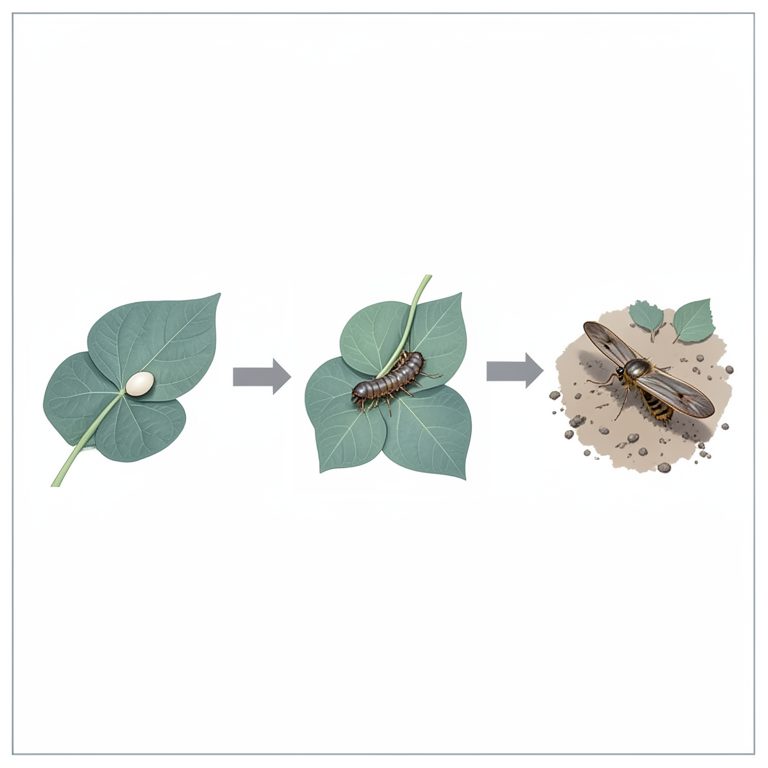
Life Cycle of A. modicella
AI-generated conceptual illustration (groundnut plants and the moth species A. modicella). It explains the idea and does not show study data.
View source evidence ↗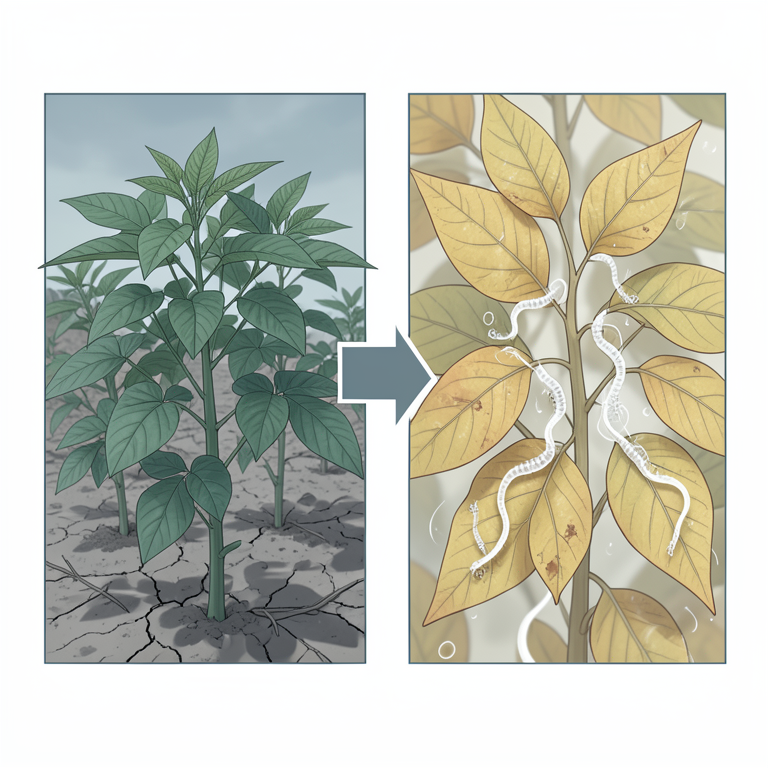
Environmental Influence on Pest Population
AI-generated conceptual illustration (groundnut plants and leaf miner larvae). It explains the idea and does not show study data.
View source evidence ↗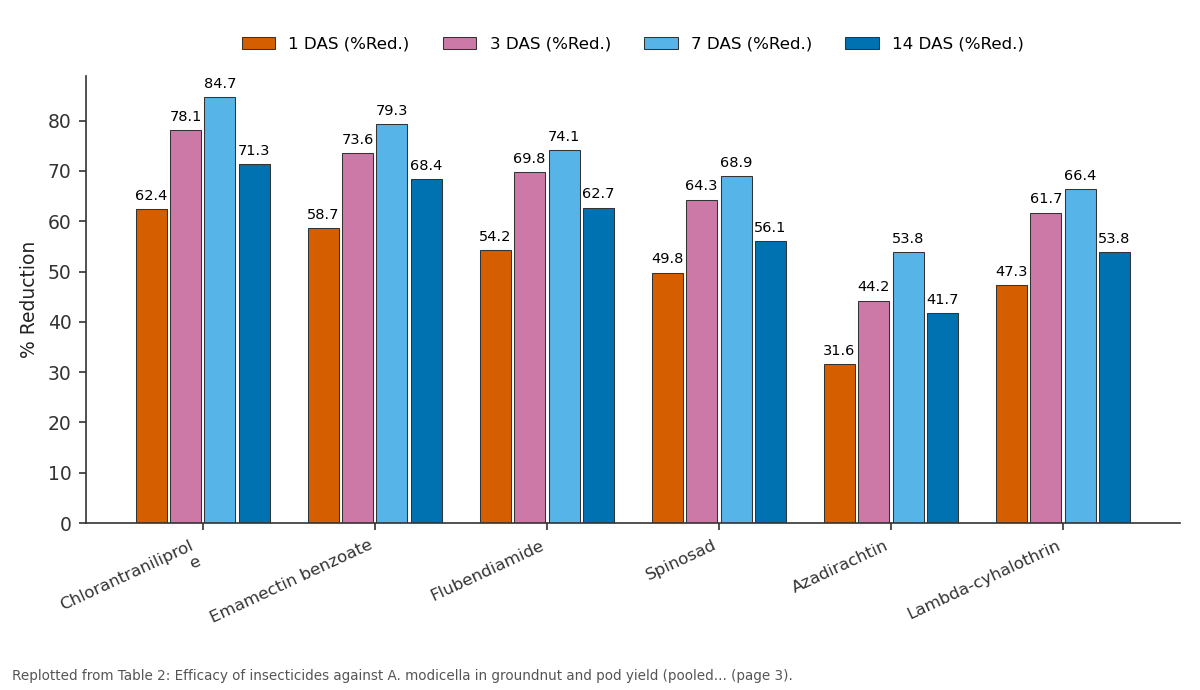
1 DAS (%Red.) and 3 DAS (%Red.) and more: Chlorantraniliprole vs Emamectin benzoate vs Flubendiamide vs Spinosad vs Azadirachtin
Replotted from Table 2 (page 3) of the original paper. Every bar is the paper's own table value.
View source evidence ↗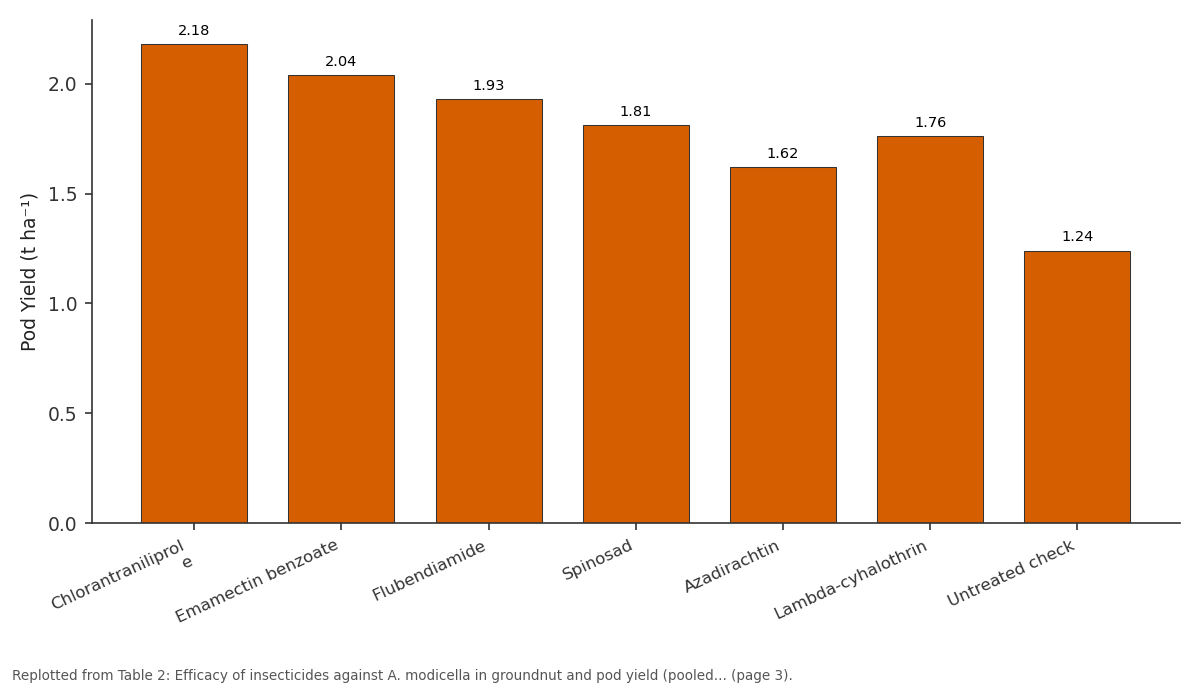
Pod Yield (t ha⁻¹): Chlorantraniliprole vs Emamectin benzoate vs Flubendiamide vs Spinosad vs Azadirachtin
Replotted from Table 2 (page 3) of the original paper. Every bar is the paper's own table value.
View source evidence ↗Figures & tables
From the original paper Table 1
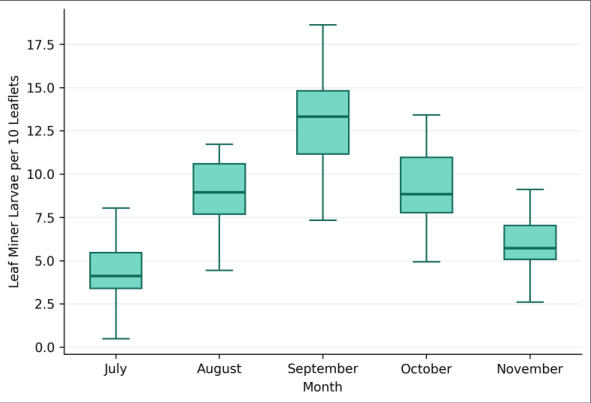 Figure 1
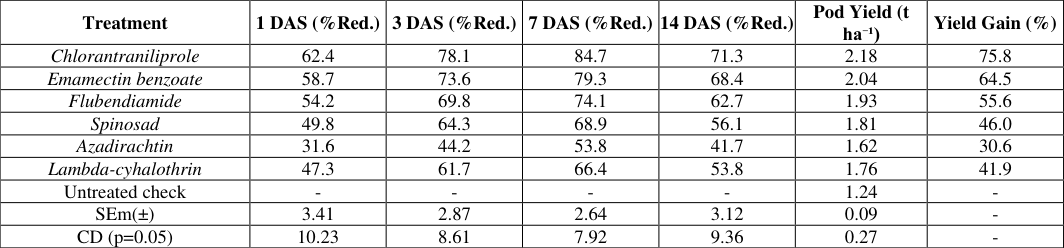 Table 2
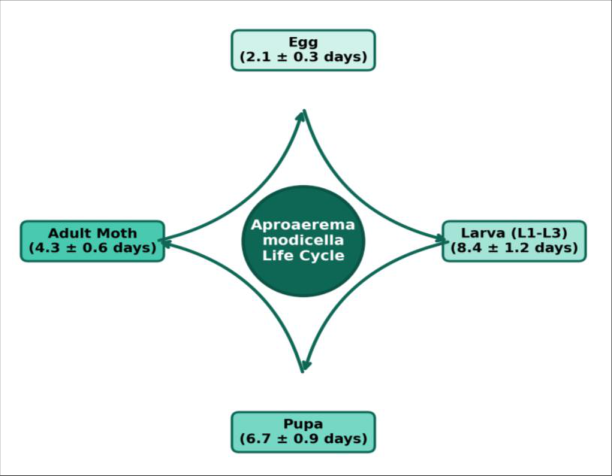 Figure 2
Introduction
Aproaerema modicella (Deventer) (Lepidoptera: Gelechiidae) is a specialist pest of legumes, but it reaches its highest economic significance on groundnut (Arachis hypogaea L.) across the semi-arid tropics of South Asia and East Africa [1] . The larvae mine and web together the upper and lower surfaces of leaflets, feeding on mesophyll tissue within the folded shelter. Heavy infestations reduce leaf area index by 35 to 60 percent, shorten the effective photosynthetic period, and lower pod yield by 25 to 50 percent in unprotected crops [2] . In Gujarat-India's largest groundnut-producing state-the pest appears in two overlapping generations per kharif season, with peak damage occurring between late August and mid-October [3] . The semi-arid climate (annual rainfall 800-1,100 mm, concentrated in July-September) creates conditions that favour rapid larval development: warm temperatures (27-33 °C) accelerate metabolic rates, while moderate humidity supports leaf surface moisture needed for first-instar establishment [4] . Yet, published life-table data for A. modicella from the Navsari region are limited to older reports that pre-date the introduction of newer insecticide chemistries. Chemical control remains the primary tool for managing leaf miner outbreaks when larval populations exceed the economic threshold of 5 larvae per 10 leaflets [5] . Traditional organophosphate and synthetic pyrethroid sprays have been gradually replaced by newer molecules-chlorantraniliprole (Anthranilic diamide), Emamectin benzoate (avermectin), and Flubendiamide (phthalic acid diamide)-that offer improved selectivity, lower mammalian toxicity, and better residual activity [6] . However, comparative efficacy data for these products under field conditions at Navsari are lacking. This research aimed to (i) document the developmental biology (bionomics) of A. modicella under ambient conditions at Navsari, (ii) record seasonal population fluctuations in relation to weather variables, and (iii) compare the field efficacy of six insecticidal treatments against the pest and their effect on groundnut pod yield over two kharif seasons.
Material and Methods
Material and Methods
Material
The research was conducted during kharif 2022 and 2023 at the Main Oilseeds Research Station, Navsari Agricultural University, Navsari, Gujarat (20.95°N, 72.93°E; altitude 12 m). The groundnut cultivar GG-20, widely grown in the semi-arid zones of south Gujarat, was used as the host plant. Six insecticidal treatments-chlorantraniliprole 18.5 SC (30 g a.i. ha⁻¹), emamectin benzoate 5 SG (11 g a.i. ha⁻¹), flubendiamide 39.35 SC (48 g a.i. ha⁻¹), spinosad 45 SC (73 g a.i. ha⁻¹), azadirachtin 1500 ppm (3 mL L⁻¹), and lambdacyhalothrin 5 EC (15 g a.i. ha⁻¹)-were tested alongside an untreated check. Sprays were applied with a knapsack sprayer at 500 L ha⁻¹.
Seasonal Population Monitoring
Population dynamics were tracked on unsprayed border rows from 30 DAS until harvest. Ten plants per replication were sampled weekly; all leaflets were opened and live larvae counted. Data were correlated with weekly mean temperature, relative humidity, and rainfall recorded at the university's agro-meteorological observatory situated 200 m from the trial site. Pearson correlation coefficients were calculated between larval counts and each weather variable.
Methods
Bionomics were studied by confining 50 newly emerged adults (25 pairs) on potted groundnut plants inside muslinsleeved cages under ambient conditions. Egg-laying, egg hatch, larval instar duration, pupation, and adult emergence were recorded daily. Developmental period was computed as the sum of egg, larval, pupal, and adult stages. For field efficacy, the experiment was laid out in a randomized block design with seven treatments and three replications. Subplot size was 5 m × 4 m. Two sprays were given: the first when larval count reached the economic threshold (5 larvae per 10 leaflets) and the second 15 days later. Larval counts were recorded at 1, 3, 7, and 14 DAS. Percent reduction over control was computed using Henderson-Tilton's formula [7] . Pod yield was recorded from net plots. Data were pooled across years and analysed using ANOVA with DMRT at 5 percent significance in SAS 9.4. The complete life cycle averaged 21.5 days under ambient temperatures of 28-30 °C. Pupal stage was the longest single phase (6.7 days), while the three larval instars collectively lasted 8.4 days. Adults survived 4.3 days on average, with females laying 38.6 ± 7.2 eggs during their lifespan. Larval population peaked sharply in September in both years, reaching 14.8 larvae per 10 leaflets in 2022 and 13.2 in 2023. Correlation analysis showed a significant positive relationship between larval counts and mean temperature (r = 0.71, p<0.01) and relative humidity (r = 0.64, p<0.05). September recorded the highest median larval density and the widest interquartile range (Figure 1), reflecting rapid population buildup during the warm, humid post-monsoon transition. By November, larval numbers had declined below the economic threshold as temperatures dropped and crop maturity advanced.
Results
Results
Discussion
The total developmental period of 21.5 days recorded at Navsari is shorter than the 25-28 days reported from Andhra Pradesh at lower ambient temperatures [8] and longer than the 18-19 days observed in controlled laboratory conditions at 30 °C [9] . This intermediate value reflects the fluctuating field temperatures (27-33 °C) at the Navsari site during kharif, which alternate between conditions that accelerate and slightly retard development. The September population peak aligns with the phenological stage when groundnut is at maximum vegetative growth and the canopy provides a humid, shaded microclimate favourable for larval establishment. Similar mid-season peaks have been recorded in Karnataka [3] and Tamil Nadu [10] , though the exact timing shifts by 2 to 3 weeks depending on sowing date and monsoon onset. The positive correlation with temperature and humidity indicates that early warning systems based on weather forecasts could help time insecticide applications more precisely. Chlorantraniliprole's superior performance (84.7% reduction at 7 DAS) over older molecules like lambda-cyhalothrin (66.4%) is attributed to its ryanodine receptor mode of action, which causes rapid cessation of larval feeding even before mortality occurs [11] . This characteristic reduces the window during which larvae can damage leaflet tissue. Emamectin benzoate, acting on glutamate-gated chloride channels, showed comparable but slightly lower efficacy, consistent with reports from Rajasthan and Maharashtra [12,13] . The two-spray strategy adopted here-first at economic threshold and second at 15 days-proved practical and cost-effective. A single spray of chlorantraniliprole costs roughly ₹1,800 ha⁻¹ at current prices, and the yield gain of 0.94 t ha⁻¹ over the untreated check translates to a benefit-cost ratio exceeding 3:1 even under conservative price assumptions.
Conclusion
This research provided updated biological data on Aproaerema modicella under the semi-arid conditions of southern Gujarat and established chlorantraniliprole 18.
Acknowledgement
Acknowledgements Funding SourcesThis research was carried out under the ongoing pest management research program of Navsari Agricultural University. No external project funding was received. Institutional SupportThe authors thank the Main Oilseeds Research Station, Navsari Agricultural University, for providing field and laboratory facilities, and Rani Lakshmi Bai Central Agricultural University, Jhansi, for collaborative support. Contributions Not Qualifying for AuthorshipTechnical staff at the entomology laboratory assisted with insect rearing, cage maintenance, and larval counting.
Figures and tables from the paper
| Life Stage | Duration (Mean ± SE) | Range (days) | Temp. (°C) | RH (%) |
|---|---|---|---|---|
| Egg | 2.1 ± 0.3 | 1.5-3.0 | 29.4 | 78.6 |
| Larva L1 | 2.6 ± 0.4 | 1.8-3.4 | 30.1 | 76.3 |
| Larva L2 | 2.9 ± 0.5 | 2.1-3.8 | 29.8 | 77.1 |
| Larva L3 | 2.9 ± 0.6 | 2.0-4.1 | 28.7 | 79.4 |
| Pupa | 6.7 ± 0.9 | 5.2-8.6 | 28.3 | 74.8 |
| Adult longevity | 4.3 ± 0.6 | 3.1-5.8 | 29.1 | 76.2 |
| Total cycle | 21.5 ± 2.1 | 17.4-26.1 | - | - |
Table text extracted from the original PDF; superscript letters are shown inline. The original table image is below.
View original table image
| Treatment | 1 DAS (%Red.) | 3 DAS (%Red.) | 7 DAS (%Red.) | 14 DAS (%Red.) | Pod Yield (t ha⁻¹) | Yield Gain (%) |
|---|---|---|---|---|---|---|
| Chlorantraniliprole | 62.4 | 78.1 | 84.7 | 71.3 | 2.18 | 75.8 |
| Emamectin benzoate | 58.7 | 73.6 | 79.3 | 68.4 | 2.04 | 64.5 |
| Flubendiamide | 54.2 | 69.8 | 74.1 | 62.7 | 1.93 | 55.6 |
| Spinosad | 49.8 | 64.3 | 68.9 | 56.1 | 1.81 | 46.0 |
| Azadirachtin | 31.6 | 44.2 | 53.8 | 41.7 | 1.62 | 30.6 |
| Lambda-cyhalothrin | 47.3 | 61.7 | 66.4 | 53.8 | 1.76 | 41.9 |
| Untreated check | - | - | - | - | 1.24 | - |
| SEm(±) | 3.41 | 2.87 | 2.64 | 3.12 | 0.09 | - |
| CD (p=0.05) | 10.23 | 8.61 | 7.92 | 9.36 | 0.27 | - |
Table text extracted from the original PDF; superscript letters are shown inline. The original table image is below.
View original table image
References
15 in the original paper- Shanower TG, Wightman JA, Gutierrez AP. Biology and control of the groundnut leaf miner, Aproaerema modicella (Deventer). Crop Protection. 1993;12(1):310.
- Amin PW, Mohammad AB. Groundnut pest research at ICRISAT. Proceedings of the International Workshop on Groundnuts, ICRISAT. 1980;158-166.
- Logiswaran G, Mohanasundaram M. Seasonal incidence of Aproaerema modicella on groundnut in Tamil Nadu. Madras Agricultural Journal. 1985;72(8):446-450.
- Reddy PS, Basu MS, Ghewande MP. Bioclimatic association of leaf miner incidence in groundnut. Tropical Pest Management. 1990;36(2):157-161.
- Yadav CP, Sachan JN, Ahmad R. Economic threshold for Aproaerema modicella on groundnut in India. International Arachis Newsletter. 1991;10:15-16.
- Srinivasan G, Babu PCS. Newer insecticide molecules for management of leaf miner in groundnut. Annals of Plant Protection Sciences. 2013;21(2):322-326.
- Henderson CF, Tilton EW. Tests with acaricides against the brown wheat mite. Journal of Economic Entomology. 1955;48(2):157-161.
- Rao GVR, Wightman JA, Ranga Rao DV. World review of the natural enemies and diseases of Spodoptera litura. Insect Science and Its Application. 1993;14(3):273-284.
- Kapadia MN, Butani PG. Biology of groundnut leaf miner under laboratory conditions. Gujarat Agricultural University Research Journal. 1997;23(1):66-70.
- Senguttuvan T, Srinivasan G. Population dynamics of Aproaerema modicella in groundnut agroecosystems of South India. Journal of Entomological Research. 2001;25(3):185-190.
- Lahm GP, Cordova D, Barry JD. New and selective ryanodine receptor activators for insect control. Bioorganic and Medicinal Chemistry. 2009;17(12):4127-4133.
- Patel HM, Khanpara AV. Bio-efficacy of newer insecticides against leaf miner in groundnut. International Journal of Plant Protection. 2015;8(2):283-287.
- Deore BV, Patil CS, Deokar CD. Management of leaf miner in groundnut with newer molecules. Journal of Entomology and Zoology Studies. 2018;6(4):17381741.
- Wightman JA, Amin PW. Groundnut pests and their control in the semi-arid tropics. Tropical Pest Management. 1988;34(2):218-226.
- Dhaliwal GS, Jindal V, Dhawan AK. Insect pest problems and crop losses: Changing trends. Indian Journal of Ecology. 2010;37(1):1-7.