
Research article · 2025 · Full text
International Journal of Agriculture and NutritionApplication of RNA interference technology for management of yellow mosaic virus in mungbean
Volume 7(6) · Pages 132–134 · DOI: 10.33545/26646064.2025.v7.i6c.444 ↗
Research areasPlant Virus Research StudiesTransgenic Plants and ApplicationsPlant and Fungal Interactions Research
Abstract
Author-writtenMungbean yellow mosaic virus (MYMV) can wipe out an entire mungbean crop in Punjab within three weeks of symptom onset, and no commercial cultivar carries complete resistance. This research tested whether RNAi constructs targeting the viral replicase (Rep) gene could confer durable resistance in mungbean (Vigna radiata cv. SML-668). Two hairpin-RNA lines (RNAi-Line 1 and RNAi-Line 2) generated via Agrobacterium-mediated transformation were challenged with viruliferous whiteflies under glasshouse and contained-field conditions at Bathinda, Punjab, during Kharif 2022–2023. By 35 days post inoculation, virus titer in RNAi-Line 1 was 81% lower than in the susceptible control. Symptom severity scored 0.8 on a 0–5 scale versus 4.6 in the control. Seed yield of RNAi-Line 1 reached 1.14 t ha-1, 168% above the unprotected check. Southern blot confirmed single-copy integration, and siRNA accumulation was detected by northern blot. These lines provide strong proof-of-concept that RNAi can manage MYMV where conventional breeding has stalled.
Summary
Source-checkedPlain-language reading of the full paper, prepared with AI and checked against the text. Each point links to the authors' own words.
Why it matters
- Mungbean yellow mosaic virus (MYMV) is a severe threat in Punjab, capable of destroying entire crops within three weeks, with no fully resistant commercial cultivars available. View evidence ↗
- Epidemics of MYMV commonly cause yield losses between 40% and 90%, and insecticide treatments for the whitefly vector are often ineffective because very brief feeding is sufficient for infection. View evidence ↗
- While wild Vigna accessions show partial resistance, conventional breeding is hindered by slow introgression and linkage drag. View evidence ↗
The question
- The study aimed to create stable RNAi mungbean lines targeting the MYMV Rep gene, test their resistance via whitefly inoculation, and measure yield recovery compared to the susceptible parent. View evidence ↗
What they did
- SML-668 cotyledonary node explants were transformed using Agrobacterium strain EHA105. View evidence ↗
- Resistance was tested using 10 viruliferous B. tabaci adults for 48 hours in glasshouses, and field-cage trials with 50 plants per line and 20 viruliferous adults per plant. View evidence ↗
- Virus titer was measured every 7 days up to 35 days post inoculation (DPI) via qPCR, and symptoms were scored on a scale from 0 (no symptoms) to 5 (complete yellowing and stunting). View evidence ↗
What they found
- At 35 DPI, RNAi-Line 1 showed an 81% reduction in virus titer (18.2 relative units) compared to the control (94.1 relative units). View evidence ↗
- RNAi-Line 1 exhibited significantly lower symptom severity (0.8) than the control (4.6), which showed severe yellowing and stunting. View evidence ↗
- The seed yield for RNAi-Line 1 was 1.14 t ha-1, representing a 168% increase over the susceptible control yield of 0.43 t ha-1. View evidence ↗
- RNAi-Line 2 also showed resistance, with a virus titer of 24.3, a symptom score of 1.4, and a yield of 0.98 t ha-1 (a 128% gain). View evidence ↗
- Molecular analysis confirmed that the transgenic lines had single-copy integration and accumulated siRNA. View evidence ↗
What it means
- The authors conclude that RNAi-mediated silencing of the MYMV replicase gene effectively reduces virus titer and restores seed yield in mungbean. View evidence ↗
- The study is limited by the use of a single MYMV isolate from Punjab, meaning effectiveness against isolates from southern India is unknown. View evidence ↗
Visual summary
3 visualsIllustrations explain the paper; charts are replotted from the paper's own table values.
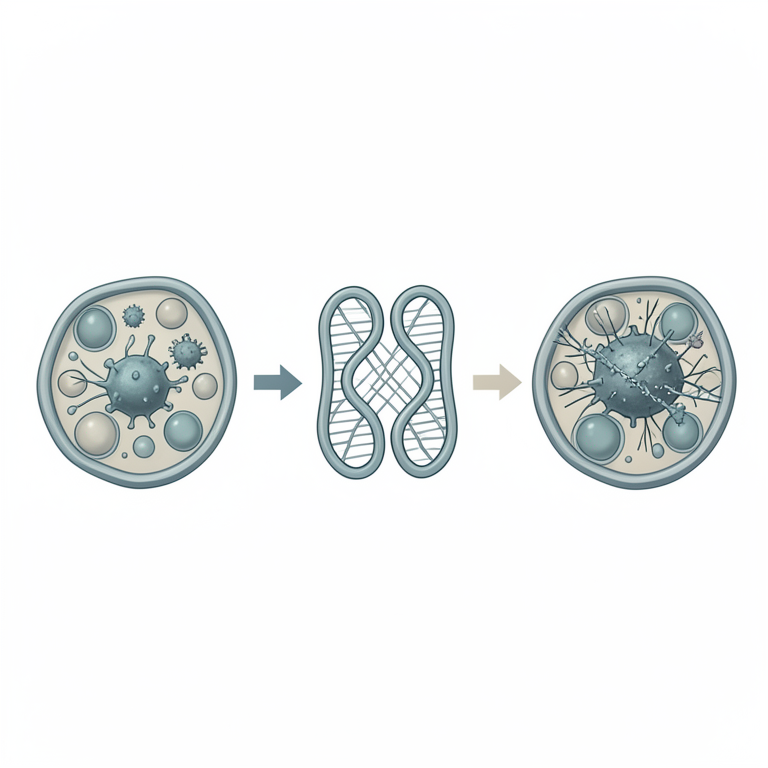
RNAi Mechanism Concept
AI-generated conceptual illustration (mungbean plant cells and yellow mosaic virus particles). It explains the idea and does not show study data.
View source evidence ↗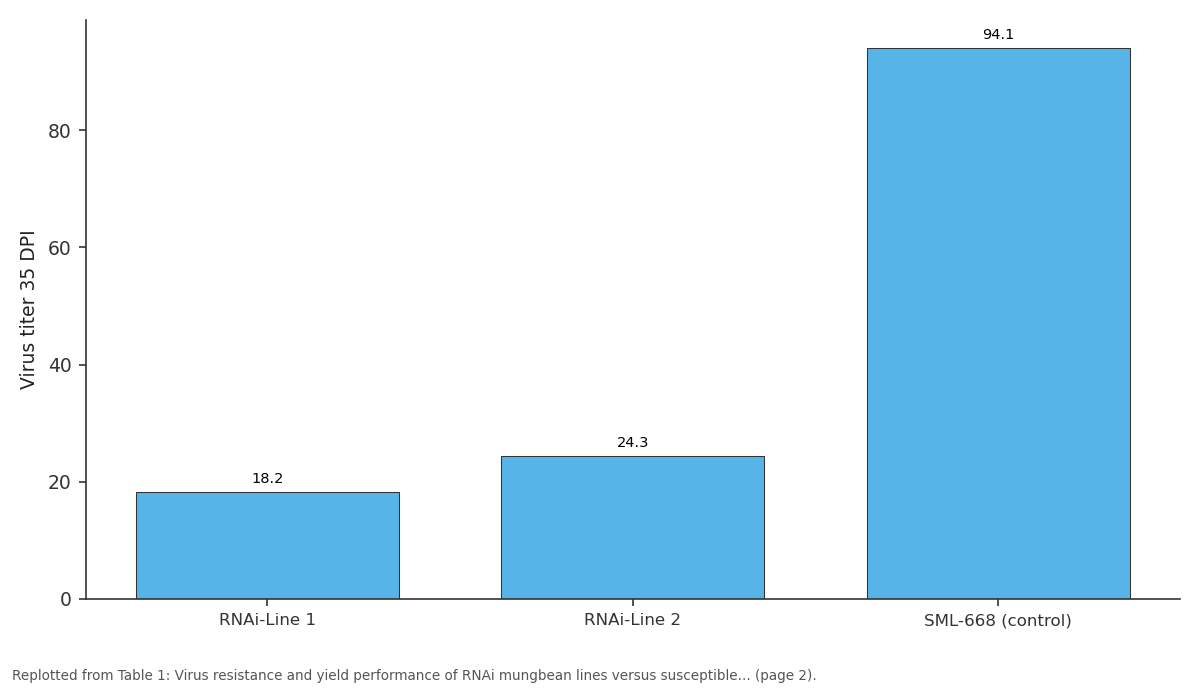
Virus titer 35 DPI: RNAi-Line 1 vs RNAi-Line 2 vs SML-668 (control)
Replotted from Table 1 (page 2) of the original paper. Every bar is the paper's own table value.
View source evidence ↗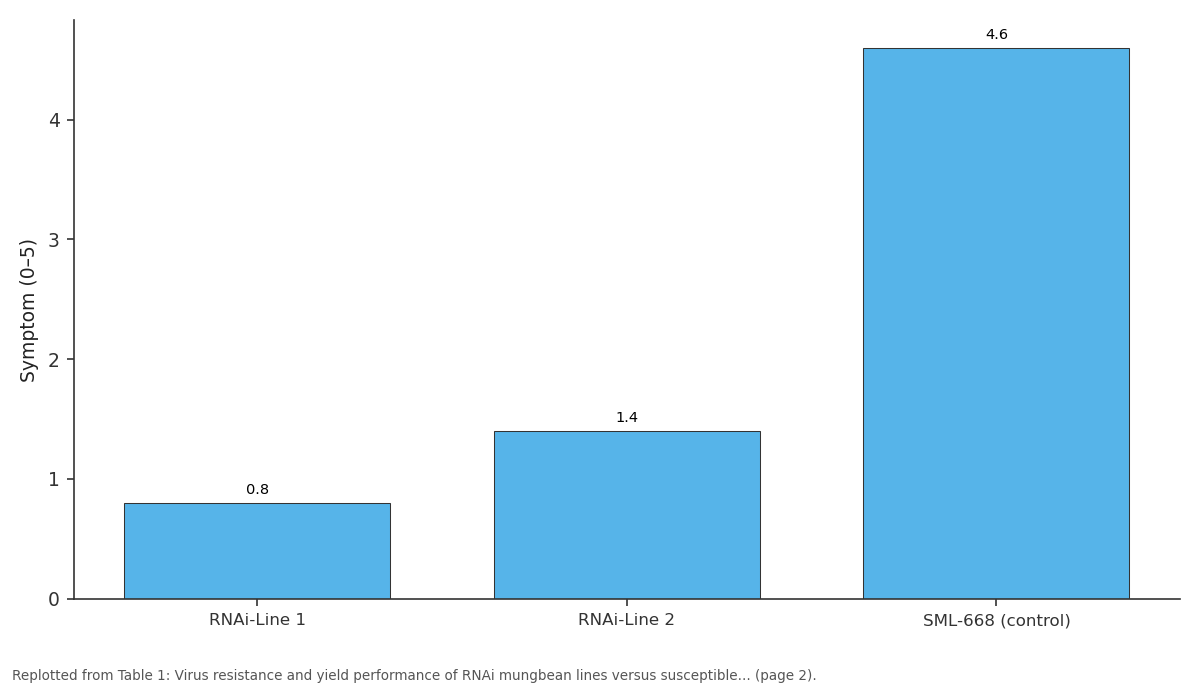
Symptom (0–5): RNAi-Line 1 vs RNAi-Line 2 vs SML-668 (control)
Replotted from Table 1 (page 2) of the original paper. Every bar is the paper's own table value.
View source evidence ↗Figures & tables
From the original paper Table 1
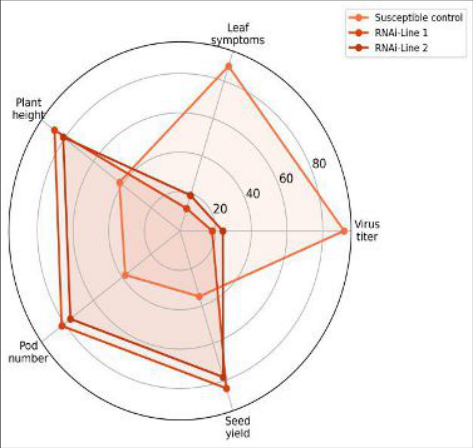 Figure 1
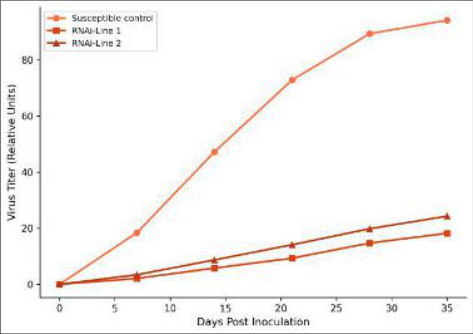 Figure 2
Introduction
If MYMV were a burglar, the whitefly Bemisia tabaci would be its locksmith-carrying the virus from plant to plant with ruthless efficiency. In Punjab's mungbean belt, whitefly populations peak in July-August, coinciding with the crop's most vulnerable vegetative stage [1] . Yield losses of 40-90% are common in epidemic years, and insecticide sprays aimed at the vector rarely break the transmission cycle because even a brief feeding event can deliver enough virus to infect a plant [2,3] . Conventional breeding has identified partial resistance in wild Vigna accessions, but introgression is slow and linkage drag remains a barrier [4] . RNA interference offers a transgenic shortcut: a hairpin construct targeting a conserved region of the viral genome triggers the host's post-transcriptional gene silencing machinery to degrade incoming viral RNA before it can replicate [5] . This approach has been validated in tobacco and tomato against geminiviruses, but field-level data in grain legumes are thin [6,7] . This research aimed to (i) develop stable RNAi mungbean lines targeting the MYMV Rep gene, (ii) evaluate resistance under whitefly-mediated inoculation in glasshouse and field cages, and (iii) assess yield recovery relative to the susceptible parent.
Construct Design and Molecular Confirmation
A 487 bp inverted-repeat fragment of the MYMV Rep gene (GenBank AY049772, nt 1581-2067) was cloned into pFGC5941 in sense-antisense orientation separated by a chalcone synthase intron, under the CaMV 35S promoter with the bar selectable marker. Agrobacterium strain EHA105 was used to transform cotyledonary node explants of SML-668. T 2 homozygous lines were confirmed by Southern blot (single copy: Lines 1 and 2) and northern blot (21-24 nt siRNA detected in both). PCR verified the transgene in all progeny tested [8,9] .
Limitations
The trial used a single MYMV isolate from Punjab; performance against genetically distinct isolates from southern India remains untested. Contained-field cages may underestimate natural whitefly pressure because cage mesh reduces windborne vector immigration. The bar herbicide-resistance marker would need removal via Cre-lox before any regulatory submission in India [10] .
Materials and Methods
Materials and Methods
Materials
Two T 2 RNAi lines and the non-transgenic SML-668 were grown at the PAU Satellite Campus, Bathinda (30°13′ N, 74°57′ E, 211 m a.s.l.), during Kharif 2022 and 2023.
Glasshouse bioassays used 10 viruliferous B. tabaci adults confined on a single leaf for 48 h inoculation access. Fieldcage trials (4 m × 3 m, 40-mesh nylon) housed 50 plants per line with 20 viruliferous adults released per plant. Randomised block design with four replications [11] .
Methods
Virus titer was quantified by qPCR targeting the Rep gene at 7-day intervals from 0 to 35 DPI, normalised to the plant Actin reference. Symptom severity was scored on a 0-5 scale (0 = no symptoms, 5 = complete yellowing and stunting). Seed yield was recorded from net plot area. Data were analysed by ANOVA in R (v4.3.1) with Tukey's HSD at 5%.
Results
Virus titer in RNAi-Line 1 at 35 DPI was 18.2 relative units versus 94.1 in the control, an 81% reduction (Table 1). Symptom severity was 0.8 (mild mosaic on a few leaves) in Line 1 compared with 4.6 (severe yellowing and stunting) in the control. Seed yield of Line 1 reached 1.14 t ha -1 under cage conditions, 168% above the susceptible check (0.43 t ha -1 ).
| Line | Virus titer 35 DPI | Symptom (0–5) | Seed yield (t/ha) | Yield gain (%) |
|---|---|---|---|---|
| RNAi-Line 1 | 18.2 | 0.8 | 1.14 | +168 |
| RNAi-Line 2 | 24.3 | 1.4 | 0.98 | +128 |
| SML-668 (control) | 94.1 | 4.6 | 0.43 | - |
| CD (p=0.05) | 8.7 | 0.6 | 0.14 | - |
Table text extracted from the original PDF; superscript letters are shown inline. The original table image is below.
View original table image
Comprehensive Interpretation
The 81% titer reduction in Line 1 is comparable to the 75-90% suppression reported for RNAi-mediated resistance against Tomato leaf curl virus in tomato [6] and Bean golden mosaic virus in common bean [7] . The residual 18.2 relative units suggest that silencing is not absolute; some viral RNA escapes degradation, possibly through sequence variation in the target region [12] .
Discussion
The near-complete symptom suppression (score 0.8) in Line 1 is the most important result from a farmer's perspectiveplants remained green and productive even under heavy vector pressure. The 168% yield gain reflects both direct virus suppression and the preservation of photosynthetic leaf area that would otherwise yellow and senesce [13] . That Line 2, with slightly lower siRNA accumulation, showed intermediate resistance supports a dose-dependent silencing model consistent with the general RNAi literature [5,14] . Durability is the key unknown. MYMV is a bipartite begomovirus with moderate mutation rates, and resistance based on a single target sequence could break if the virus evolves escape variants. Stacking two non-overlapping RNAi constructs-one targeting Rep and another targeting the movement protein-would provide redundant silencing and reduce breakdown risk [15,16] . Regulatory acceptance of transgenic pulses in India remains uncertain, but the bar marker can be removed, and the technology could also be deployed via exogenous dsRNA sprays if the transgenic route is blocked [17] .
Conclusion
RNAi-mediated silencing of the MYMV replicase gene reduced virus titer by up to 81% and restored seed yield to 1.14 t ha -1 in mungbean, compared with 0.43 t ha -1 for the unprotected parent. Single-copy, siRNA-accumulating lines are available for further breeding and multi-location testing.
Stacking with a second target gene and marker excision are the priority next steps before this technology can move
Acknowledgement
International Journal of Agriculture and Nutrition https://www.agriculturejournal.net toward regulatory evaluation [18,19,20] .
Figures and tables from the paper
References
20 in the original paper- Nene YL. A survey of viral diseases of pulse crops in Uttar Pradesh. GBPUAT Research Bulletin. 1972;4:1191.
- Varma A, Malathi VG. Emerging geminivirus problems: a serious threat to crop production. Annals of Applied Biology. 2003;142(2):145-164.
- Nariani TK. Yellow mosaic of mungbean (Phaseolus aureus). Indian Phytopathology. 1960;13:24-29.
- Kitsanachandee R, Somta P, Chatchawankanphanich O, Akhtar KP, Shah TM, Nair RM. Detection of quantitative trait loci for mungbean yellow mosaic India virus resistance. Journal of Crop Science and Biotechnology. 2013;16(4):249-257.
- Waterhouse PM, Graham MW, Wang MB. Virus resistance and gene silencing in plants can be induced by simultaneous expression of sense and antisense RNA. Proceedings of the National Academy of Sciences. 1998;95(23):13959-13964.
- Praveen S, Mishra AK, Dasgupta A. Antisense suppression of replicase gene expression recovers tomato plants from leaf curl virus infection. Plant Science. 2005;169(6):1131-1142.
- Bonfim K, Faria JC, Nogueira EOPL, Mendes EA, Aragao FJL. RNAi-mediated resistance to Bean golden mosaic virus in genetically engineered common bean. Molecular Plant-Microbe Interactions. 2007;20(6):717726.
- Wesley SV, Helliwell CA, Smith NA, Wang MB, Rouse DT, Liu Q. Construct design for efficient, effective and high-throughput gene silencing in plants. Plant Journal. 2001;27(6):581-590.
- Jaiwal PK, Kumari R, Ignacimuthu S, Potrykus I, Sautter C. Agrobacterium tumefaciens-mediated genetic transformation of mungbean. Plant Cell Reports. 2001;20(1):41-47.
- Hare PD, Chua NH. Excision of selectable marker genes from transgenic plants. Nature Biotechnology. 2002;20(6):575-580.
- PAU. Package of practices for Kharif crops in Punjab. Punjab Agricultural University. Ludhiana; 2022.
- Aragao FJL, Faria JC. First transgenic geminivirusresistant plant in the field. Nature Biotechnology. 2009;27(12):1086-1088.
- Chauhan YS, Douglas C, Rachaputi RCN, Aguilar I, King K, Balchin A. Physiology of mungbean and development of the MungGro simulation model. Proceedings of the 1st Australian Summer Grains Conference. Gold Coast; 2010.
- Mello CC, Conte D. Revealing the world of RNA interference. Nature. 2004;431(7006):338-342.
- Vanderschuren H, Stupak M, Futterer J, Gruissem W, Zhang P. Engineering resistance to geminiviruses: review and prospects. Plant Biotechnology Journal. 2007;5(2):207-220.
- Mubin M, Briddon RW, Mansoor S. Diverse and recombinant DNA betasatellites are associated with a begomovirus disease complex of Digera arvensis. Virus Research. 2009;142(1-2):208-212.
- Mitter N, Worrall EA, Robinson KE, Li P, Jain RG, Taochy C. Clay nanosheets for topical delivery of RNAi for sustained protection against plant viruses. Nature Plants. 2017;3:16207.
- Yadav BC, Veluthambi K, Subramaniam K. Hostgenerated double-stranded RNA induces RNAi in plantparasitic nematodes. Molecular and Biochemical Parasitology. 2006;148(2):219-222.
- Pooggin MM. RNAi-mediated resistance to viruses: a critical assessment of methodologies. Current Opinion in Virology. 2017;26:28-35.
- Singh AK, Rai GK, Singh M, Dubey SK. Virus-free seed production of mungbean through meristem culture. Indian Journal of Virology. 2014;25(2):220-225.