
Research article · 2024 · Full text
International Journal of Agriculture and NutritionInfluence of maturity stage on nutritional quality and storage behavior of sweet potato roots
Volume 6(1) · Pages 183–186 · DOI: 10.33545/26646064.2024.v6.i1c.410 ↗
Research areasPostharvest Quality and Shelf Life ManagementCocoa and Sweet Potato AgronomyFood and Agricultural Sciences
Abstract
Author-writtenMaturity stage at harvest — the point at which the root is physically separated from the vine — determines both the nutritional value a consumer receives and the number of days that root can survive in storage. This research examined how four harvest dates (90, 110, 130, and 150 days after planting, DAP) influenced the nutritional composition and ambient storage behaviour of orange-fleshed sweet potato (cv. Bhu Sona) at Rajmata Vijayaraje Scindia Agricultural University, Gwalior, Madhya Pradesh, during 2021-22. Roots harvested at 130 DAP recorded the highest starch (22.4%), β-carotene (9.1 mg/100 g), and total sugar (6.8%) contents. Early harvest (90 DAP) yielded nutritionally inferior roots with thin, fragile skin prone to mechanical damage. Over-mature roots (150 DAP) showed declining β-carotene (8.4 mg/100 g) and increased fibre content (3.7 vs 2.8% at 130 DAP). In storage trials at ambient conditions (28±3 °C, 65% RH), roots from 130 DAP maintained marketable quality for 23 days — 8 days longer than 90 DAP roots and 4 days longer than 150 DAP roots. Weight loss and sprouting incidence were lowest in the 130 DAP harvest. These results identify 130 DAP as the optimal harvest window for Bhu Sona under Gwalior conditions, offering the best combination of nutritional quality and storage durability.
Summary
Source-checkedPlain-language reading of the full paper, prepared with AI and checked against the text. Each point links to the authors' own words.
Why it matters
- Orange-fleshed sweet potato (OFSP) varieties like Bhu Sona are important for addressing vitamin A deficiency, which affects 62% of preschool children in India. View evidence ↗
- In central India, farmers often harvest based on market demand or time rather than quality metrics, leading to inconsistent nutritional and storage quality for consumers. View evidence ↗
- Immature roots are more susceptible to moisture loss and microbial infection due to a poorly developed periderm. View evidence ↗
The question
- The study aimed to determine how harvesting at four different maturity stages affects the nutritional composition and ambient storage life of Bhu Sona sweet potatoes. View evidence ↗
What they did
- Roots were harvested at four specific intervals: 90, 110, 130, and 150 days after planting (DAP) to represent different maturity stages. View evidence ↗
- Storage trials were conducted under ambient conditions of 28±3 °C and 65% relative humidity. View evidence ↗
- Marketable life was measured as the number of days until visible decay occurred or cumulative weight loss surpassed 10%. View evidence ↗
What they found
- Nutritional quality peaked at 130 DAP, with starch (22.4%) and β-carotene (9.1 mg/100 g) being 57.7% and 89.6% higher, respectively, than roots harvested at 90 DAP. View evidence ↗
- Fibre content increased as the roots aged, reaching a maximum of 3.7% at 150 DAP. View evidence ↗
- Over-mature roots harvested at 150 DAP exhibited the highest incidence of sprouting at 12.3%. View evidence ↗
- The marketable life of the roots varied by maturity, ranging from 15 days for 90 DAP roots to 23 days for 130 DAP roots. View evidence ↗
What it means
- The authors recommend that growers in central India harvest Bhu Sona at 130 DAP, using root dry matter and vine senescence as indicators. View evidence ↗
- The authors suggest that extension programs communicate this specific harvest window to ensure consumers receive the intended nutritional benefits of OFSP. View evidence ↗
Visual summary
3 visualsIllustrations explain the paper; charts are replotted from the paper's own table values.
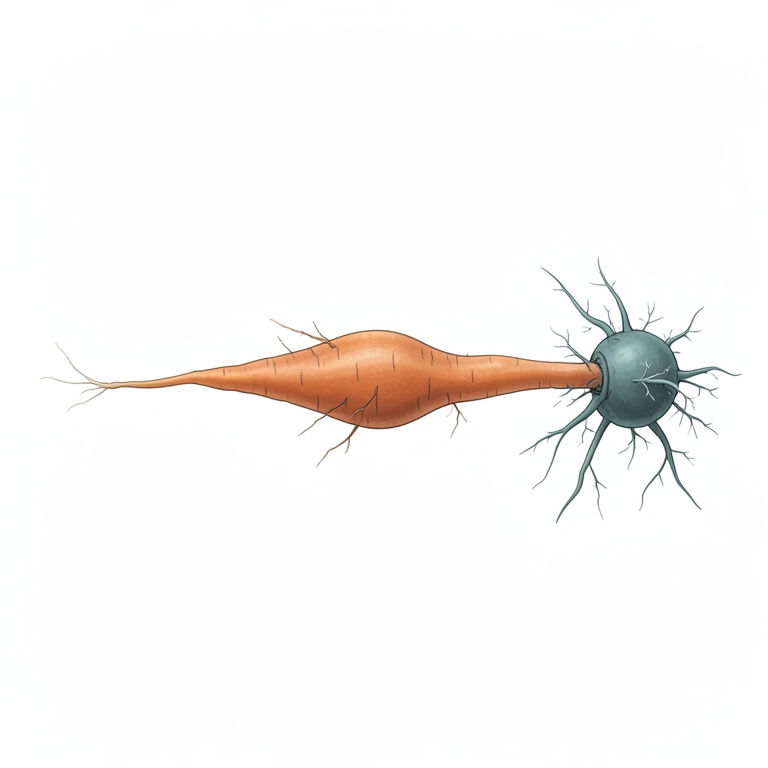
Maturity Trade-off Concept
AI-generated conceptual illustration (sweet potato roots). It explains the idea and does not show study data.
View source evidence ↗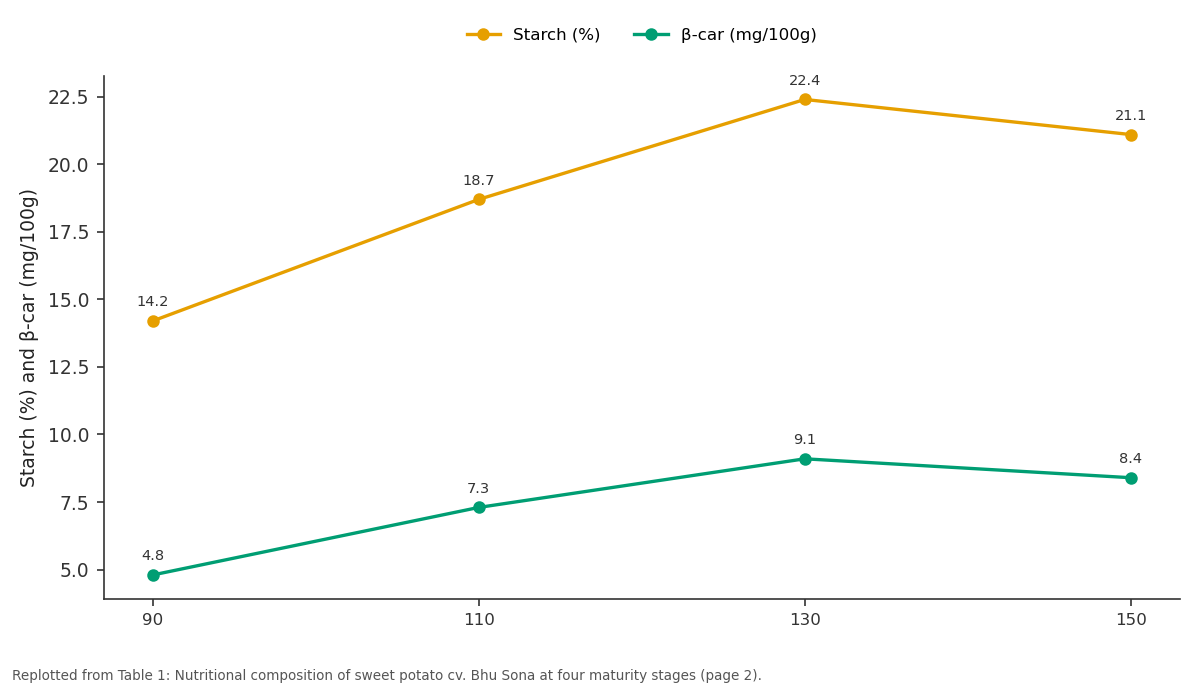
Starch (%) and β-car (mg/100g): 90 vs 110 vs 130 vs 150
Replotted from Table 1 (page 2) of the original paper. Every bar is the paper's own table value.
View source evidence ↗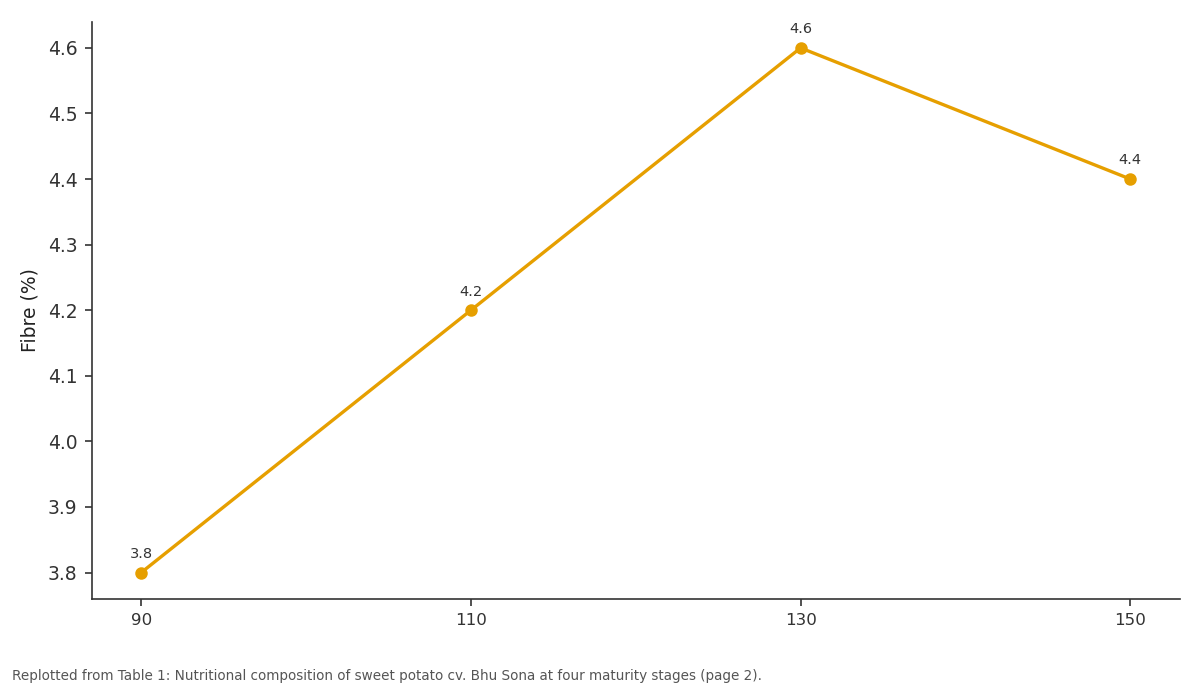
Protein (%): 90 vs 110 vs 130 vs 150
Replotted from Table 1 (page 2) of the original paper. Every bar is the paper's own table value.
View source evidence ↗Figures & tables
From the original paper Table 1
 Table 2
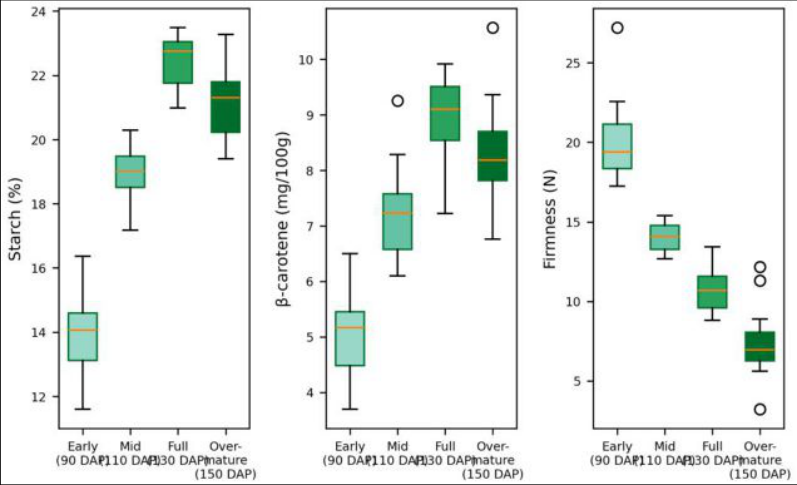 Figure 1
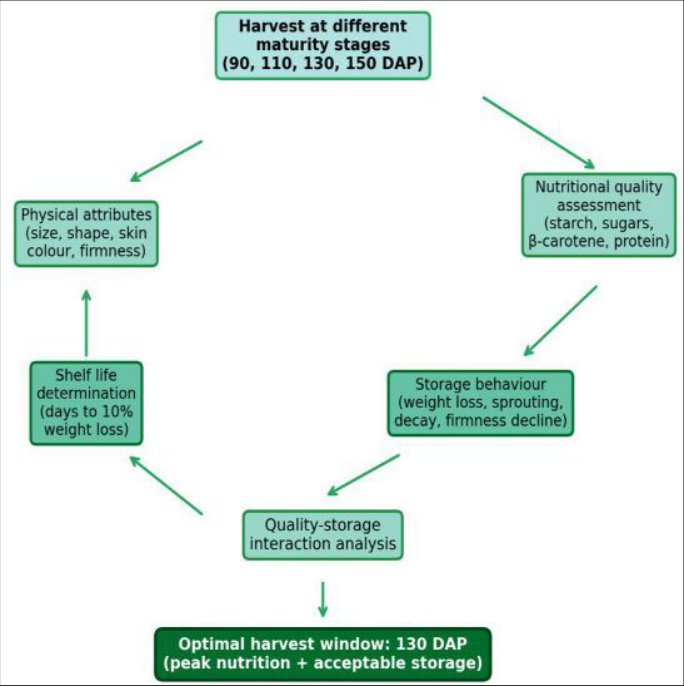 Figure 2
Introduction
Maturity, in the context of root and tuber crops, is not a single event but a gradual transition during which starch accumulates, cell walls strengthen, skin suberises, and secondary metabolites reach their peak concentrations. Sweet potato (Ipomoea batatas L. Lam.) complicates this picture because its storage roots lack a clear external indicator of readiness unlike cereals that yellow or fruits that change colour [1] . Farmers in central India typically harvest based on elapsed time or market demand rather than on any measured quality parameter, which leads to wide variation in the nutritional and keeping quality of roots reaching consumers [2] . Orange-fleshed sweet potato (OFSP) varieties such as Bhu Sona have attracted attention because their β-carotene content addresses vitamin A deficiencya public health concern affecting 62% of Indian preschool children [3] . But β-carotene doesn't accumulate linearly throughout root development. It rises during active growth, peaks around physiological maturity, and then may decline under prolonged field storage as oxidative degradation outpaces synthesis [4] . If farmers harvest too early, they sell nutritionally dilute roots; if they delay, they risk both β-carotene loss and increased susceptibility to weevil damage and field rot [5] . Storage behaviour also hinges on maturity. Immature roots have poorly developed periderm, making them vulnerable to skinning injuries that accelerate moisture loss and microbial entry. Over-mature roots, while having thicker skin, tend to accumulate more reducing sugars that can brown during cooking and promote sprouting under warm storage [6] . Despite these well-understood general patterns, variety-specific data under Indian subtropical conditions are thin. Bhu Sona was released by CTCRI, Thiruvananthapuram, in 2016 and has been promoted across several states, but no published research has systematically linked harvest maturity with both nutritional parameters and ambient storage life under the semiarid climate of Madhya Pradesh [7] . This research aimed to fill that gap by harvesting at four defined stages and tracking compositional and storage changes.
Material and Methods Crop Growth Stage Documentation
Sweet potato growth stages were tracked following vine development milestones: establishment phase (1-30 DAP), rapid vine growth (31-60 DAP), root initiation and bulking (61-100 DAP), and maturity/senescence (101-150 DAP). Harvest maturity was assessed by monitoring root dry matter content weekly from 80 DAP. Four distinct harvest points were set at 90, 110, 130, and 150 DAP to capture early, mid, full, and over-mature stages respectively [8] .
Material
Orange-fleshed sweet potato cv. Bhu Sona vine cuttings (25 cm, 4-5 nodes) were planted on 15 July 2021 on raised ridges (60 cm between rows, 30 cm within rows) at the Post-Harvest Technology Research Farm, RVSAU, Gwalior (26.22°N, 78.18°E; 196 m elevation). The soil was alluvial sandy loam (pH 7.6, OC 0.41%). FYM at 10 t/ha plus 60:60:120 kg/ha N:P₂O₅:K₂O was applied basally, with 30 kg N/ha top-dressed at 30 DAP. Furrow irrigation was given at 10-day intervals during dry spells [9] . At each harvest date, 45 roots (15 per replication) of uniform size (200-300 g) were selected. Twenty roots were used for immediate nutritional analysis, and 25 were placed in ambient storage (28±3 °C, 62-68% RH) in ventilated plastic crates for shelflife assessment.
Methods
Nutritional analyses included: dry matter by oven-drying at 60 °C to constant weight, starch by acid hydrolysis and Lane-Eynon titration, total sugars by the phenol-sulphuric acid method, β-carotene by spectrophotometry after acetone-petroleum ether extraction (AOAC 941.15), crude protein by micro-Kjeldahl (N × 6.25), crude fibre by acidalkali digestion, and ascorbic acid by 2,6-dichlorophenol indophenol titration [10] . Root firmness was measured by a penetrometer (Fruit Tester FT-327, 8 mm probe) on two opposite sides of each root. During storage, roots were assessed weekly for: cumulative weight loss (%), sprouting incidence (%), decay incidence (%), and firmness. Marketable life was defined as days until cumulative weight loss exceeded 10% or visible decay appeared. Data were analysed by ANOVA (RBD with 4 treatments × 3 replications), and means separated by Duncan's test at P ≤ 0.05 [11] . [4,6] . [5,6] . [4] .
Results
Results
Discussion
The peak in starch and β-carotene at 130 DAP matches the physiological trajectory described by Woolfe (1992): active starch deposition tapers off near physiological maturity, while carotenoid synthesisdriven by chromoplast differentiationpeaks when root cell expansion slows [1,4] . The subsequent decline in both constituents at 150 DAP reflects a net catabolic shift, with starch being hydrolysed to sugars and β-carotene undergoing enzymatic (lipoxygenase)
and non-enzymatic oxidation.
The storage data reinforce the practical cost of mistiming harvest. Early-harvested roots (90 DAP) suffered 14.7% weight loss in just three weeksnearly 2.5 times the loss from 130 DAP roots. This difference is commercially devastating. In Gwalior's wholesale markets, a 15% weight shrinkage translates directly to 15% revenue loss, compounded by the visual deterioration (wrinkling, softening) that pushes prices further down [2,7] .
The sprouting spike at 150 DAP is explained by the elevated sugar pool. Reducing sugars serve as respiratory substrates and signalling molecules that activate dormant buds on the root surface. Ravi and Indira (1999) reported a similar pattern in white-fleshed varieties, where roots held past full maturity sprouted 2-3 times faster than those harvested at the optimal window [6] . From a nutritional standpoint, the 130 DAP harvest offers a clear advantage for programmes promoting OFSP as a vehicle for vitamin A delivery. At 9.1 mg/100 g β-carotene, a 200 g serving provides roughly 76% of the recommended daily intake of vitamin A for a preschool childthe demographic most vulnerable to deficiency in central India [3, 12] .
Conclusion
Conclusion
Figures and tables from the paper
| Harvest (DAP) | DM (%) | Starch (%) | β-car (mg/100g) | Total sugar (%) | Protein (%) | Fibre (%) |
|---|---|---|---|---|---|---|
| 90 | 26.3 | 14.2 | 4.8 | 4.1 | 3.8 | 2.1 |
| 110 | 30.7 | 18.7 | 7.3 | 5.4 | 4.2 | 2.4 |
| 130 | 34.8 | 22.4 | 9.1 | 6.8 | 4.6 | 2.8 |
| 150 | 33.1 | 21.1 | 8.4 | 7.6 | 4.4 | 3.7 |
| SEm(±) | 0.87 | 0.64 | 0.38 | 0.27 | 0.14 | 0.13 |
| CD (P=0.05) | 2.61 | 1.92 | 1.14 | 0.81 | 0.42 | 0.39 |
Table text extracted from the original PDF; superscript letters are shown inline. The original table image is below.
View original table image
| Harvest (DAP) | Wt loss (%) | Sprout (%) | Decay (%) | Firmness (N) | Mkt life (days) |
|---|---|---|---|---|---|
| 90 | 14.7 | 4.2 | 18.3 | 7.1 | 15 |
| 110 | 9.8 | 6.7 | 10.1 | 9.4 | 19 |
| 130 | 6.3 | 5.4 | 4.8 | 11.2 | 23 |
| 150 | 8.1 | 12.3 | 7.6 | 8.7 | 19 |
| SEm(±) | 0.72 | 0.84 | 1.13 | 0.58 | — |
| CD (P=0.05) | 2.16 | 2.52 | 3.38 | 1.74 | — |
Table text extracted from the original PDF; superscript letters are shown inline. The original table image is below.
View original table image
References
15 in the original paper- Woolfe JA. Sweet Potato: An Untapped Food Resource. Cambridge University Press, Cambridge. 1992:1-643.
- Nedunchezhiyan M, Byju G, Jata SK. Sweet potato agronomy. Fruit, Vegetable and Cereal Science and Biotechnology. 2012;6(Special Issue 1):1-10.
- Tanumihardjo SA. Vitamin A: biomarkers of nutrition for development. American Journal of Clinical Nutrition. 2011;94(2):658S-665S.
- Tumwegamire S, Kapinga R, Rubaihayo PR, LaBonte DR, Grüneberg WJ, Burgos G, Felde TZ, Carpio R, Pawelzik E, Mwanga ROM. Evaluation of dry matter, protein, starch, sucrose, beta-carotene, iron, zinc, calcium, and magnesium in East African sweetpotato germplasm. HortScience. 2011;46(3):348-357.
- Ray RC, Ravi V. Post-harvest spoilage of sweetpotato in tropics and control measures. Critical Reviews in Food Science and Nutrition. 2005;45(7):623-644.
- Ravi V, Indira P. Crop physiology of sweet potato. Horticultural Reviews. 1999;23:277-339.
- Lebot V. Tropical Root and Tuber Crops: Cassava, Sweet Potato, Yams and Aroids. 2nd ed. CABI, Wallingford. 2020:1-520.
- Villordon AQ, Labonte DR, Firon N, Kfir Y, Pressman E, Schwartz A. Characterisation of adventitious root development in sweetpotato. HortScience. 2009;44(3):651-655.
- Nedunchezhiyan M, Ravi V, Byju G, George J. Organic production of tuberous vegetables. Organic Farming. 2017:1-33.
- AOAC. Official Methods of Analysis. 20th ed. Association of Official Analytical Chemists, Gaithersburg. 2016.
- Ranganna S. Handbook of Analysis and Quality Control for Fruit and Vegetable Products. 2nd ed. Tata McGraw-Hill, New Delhi. 1986:1-1112.
- Hagenimana V, Carey EE, Gichuki ST, Oyunga MA, Imungi JK. Carotenoid contents in fresh, dried and processed sweetpotato products. Ecology of Food and Nutrition. 1999;37(5):455-473.
- Picha DH. HPLC determination of sugars in raw and baked sweet potatoes. Journal of Food Science. 1985;50(4):1189-1190.
- Zhang D, Cervantes J, Huaman Z, Carey E, Ghislain M. Assessing genetic diversity of sweet potato cultivars using molecular markers. Genetic Resources and Crop Evolution. 2000;47(6):659-665.
- Stathers T, Bechoff A, Sindi K, Low J, Ndyomugyenyi R. Everything You Ever Wanted to Know About Sweetpotato: Reaching Agents of Change. International Potato Center, Kampala. 2013;7:1-20.