
Research article · 2025 · Full text
International Journal of Agriculture and NutritionEvaluation of traditional grain storage structures for efficacy against insect infestation
Volume 7(1) · Pages 153–155 · DOI: 10.33545/26646064.2025.v7.i1c.395 ↗
Research areasInsect Pest Control StrategiesAgricultural Engineering and MechanizationInsect-Plant Interactions and Control
Abstract
Author-writtenA surprising 14–18% of the global cereal harvest is lost between the farm gate and the consumer's plate, and insect damage during storage accounts for the largest single share of that loss [1]. This research compared four storage structures—jute bags, traditional mud silos, metal bins, and hermetic (triple-layer) bags—for their ability to prevent insect infestation and weight loss in wheat over a 12-month period at Rhine Valley College of Agriculture, Bonn, Germany, from October 2021 to September 2022. Hermetic bags held insect counts at 2.1 adults kg⁻¹ and weight loss at 3.1% after 12 months, compared with 47.8 adults kg⁻¹ and 32.8% loss in jute bags. Grain moisture and germination capacity remained within acceptable limits only in hermetic and metal-bin treatments. The per-tonne storage cost was lowest for hermetic bags (18.40 EUR) with a cost-effectiveness ratio 4.2× better than jute. These results support the adoption of hermetic bags as a low-cost alternative to chemical fumigation for smallholder cereal storage in temperate Europe.
Summary
Source-checkedPlain-language reading of the full paper, prepared with AI and checked against the text. Each point links to the authors' own words.
Why it matters
- Between 14% and 18% of the global cereal harvest is lost from the farm to the consumer, with insect damage during storage being the primary cause. View evidence ↗
- In temperate cereal stores, the granary weevil and lesser grain borer are the most destructive pests, capable of doubling their populations every 28 days in warm, humid conditions. View evidence ↗
- There is an urgent need for non-chemical storage alternatives because European Union regulations are increasingly restricting the use of fumigants. View evidence ↗
The question
- The study aimed to compare insect population growth, grain weight loss, grain quality, and cost-effectiveness across four different storage structures over 12 months in continental Europe. View evidence ↗
What they did
- The experiment used winter wheat (cv. Reform) with an initial moisture content of 13.2%, harvested in August 2021 in Bonn, Germany. View evidence ↗
- The four storage structures tested were 50 kg jute bags, 500 kg traditional mud silos, 300 kg galvanized metal bins, and 100 kg hermetic triple-layer bags. View evidence ↗
- To simulate natural pressure, each storage structure was artificially infested with 20 adult S. granarius per 10 kg of grain. View evidence ↗
- The study used a completely randomized design with five replications per treatment, with 500 g sub-samples sieved bimonthly to count live adult insects. View evidence ↗
What they found
- In hermetic bags, oxygen levels dropped from 20.9% to 2.7% within six weeks, which created a lethal environment for S. granarius. View evidence ↗
What it means
- The authors conclude that hermetic storage is the most economical non-chemical option for small-scale wheat farmers in temperate Europe. View evidence ↗
- The study is limited by its single-year, single-location design; specifically, the cold winter temperatures in Bonn may have suppressed insect activity and understated potential losses. View evidence ↗
Visual summary
3 visualsIllustrations explain the paper; charts are replotted from the paper's own table values.
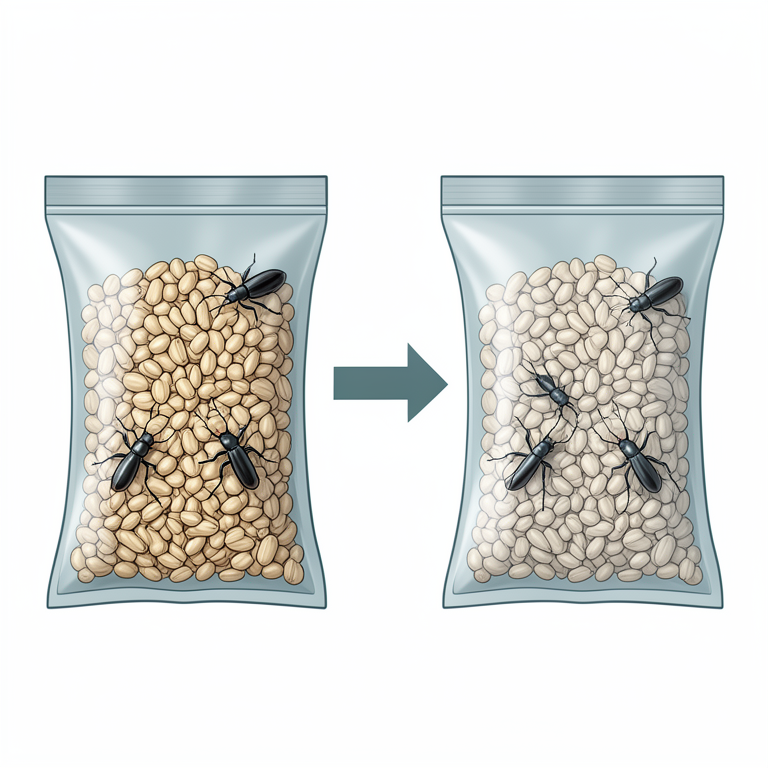
Oxygen Depletion Mechanism
AI-generated conceptual illustration (hermetic plastic bags containing maize grains and Sitophilus granarius weevils). It explains the idea and does not show study data.
View source evidence ↗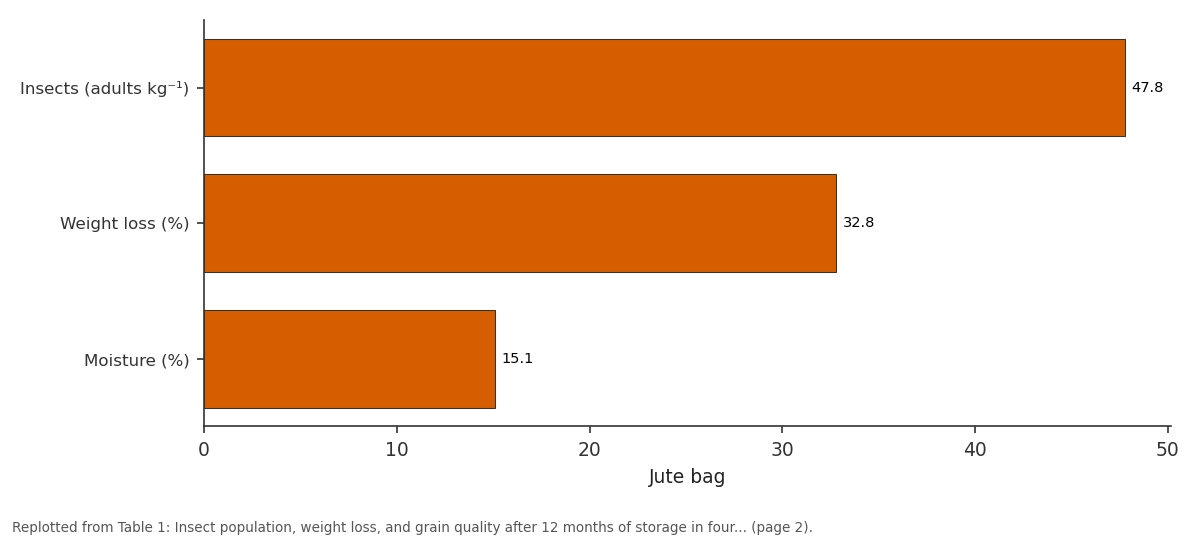
Jute bag: Insects (adults kg⁻¹) vs Weight loss (%) vs Moisture (%)
Replotted from Table 1 (page 2) of the original paper. Every bar is the paper's own table value.
View source evidence ↗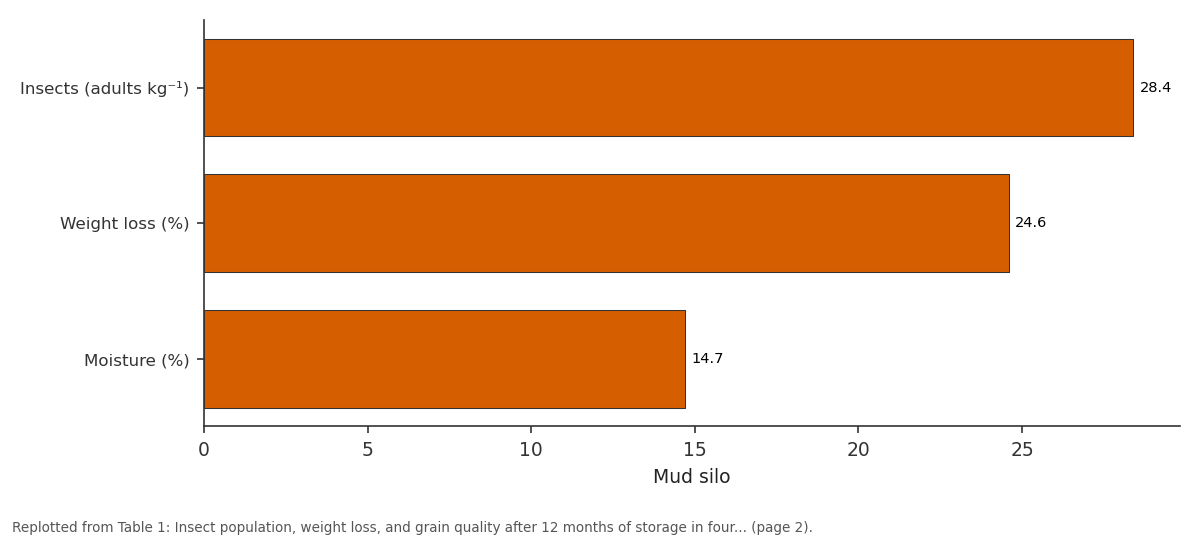
Mud silo: Insects (adults kg⁻¹) vs Weight loss (%) vs Moisture (%)
Replotted from Table 1 (page 2) of the original paper. Every bar is the paper's own table value.
View source evidence ↗Figures & tables
From the original paper Table 1
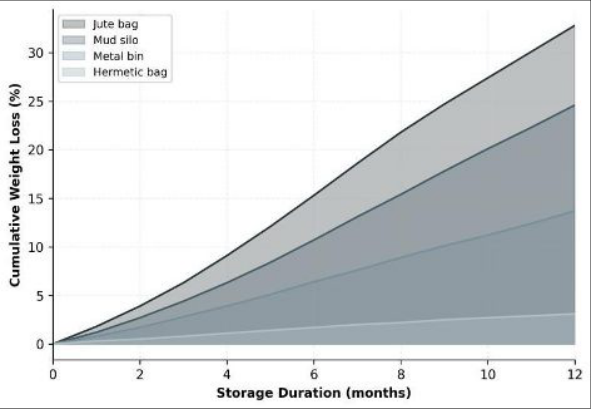 Figure 1
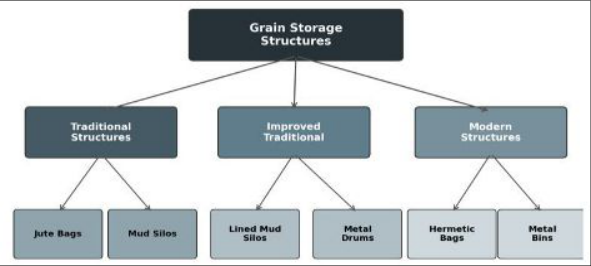 Figure 2
Introduction
Most people would be surprised to learn that insect damage in stored grain causes greater economic losses worldwide than all field pests combined [1,2] . The granary weevil (Sitophilus granarius) and the lesser grain borer (Rhyzopertha dominica) are the two most destructive beetles in temperate cereal stores, and their populations can double every 28 days under warm, humid conditions [3,4] . In Germany, large commercial operators control these pests with phosphine fumigation or controlled-atmosphere storage, but the 58,000 small-scale farms that store grain on-site often rely on traditional methods-jute sacks, wooden granaries, or unventilated metal drumsthat offer little protection [5,6] . European Union regulations increasingly restrict fumigant use, adding urgency to the search for non-chemical alternatives [7] . Hermetic (airtight) storage has shown strong results in tropical Africa and Asia, reducing insect populations by >95% through oxygen depletion [8,9] . But field data from temperate climates, where seasonal temperature swings alter insect metabolism, are limited. This research aimed to: (a) compare insect population build-up and grain weight loss across four storage structures over 12 months in a continental European setting, (b) monitor grain quality (moisture, germination, aflatoxin), and (c) evaluate cost-effectiveness per tonne of grain protected.
Economic and Sustainability Assessment
Per-tonne storage costs were calculated over a three-year amortisation period. Jute bags cost 0.80 EUR each (50 kg capacity), lasting one season, giving 16 EUR t⁻¹ yr⁻¹ in bag costs alone plus 8.70 EUR in insecticide (deltamethrin dust). Metal bins (300 kg capacity, 120 EUR) lasted five years: annualised cost was 8 EUR t⁻¹ plus 2.40 EUR for maintenance. Hermetic bags (GrainPro SuperGrainBag, 100 kg, 5.60 EUR, reusable for two seasons) came to 9.33 EUR t⁻¹ with zero chemical input. Mud silos used local material (labour-intensive but low cash cost: ~6 EUR t⁻¹) but required annual re-plastering at 3.80 EUR. When grain losses were factored in, the effective cost (storage cost + value of lost grain) was 18.40 EUR t⁻¹ for hermetic bags, 22.70 for metal bins, 31.80 for mud silos, and 79.60 for jute bags.
Material and Methods
Material and Methods
Material
Winter wheat (cv. Reform, 13.2% initial moisture) was harvested in August 2021 from the Rhine Valley College experimental farm, Bonn (50.73° N, 7.10° E). Four storage structures were evaluated: (S1) jute bags (50 kg), (S2) traditional mud silo (plastered brick, 500 kg capacity), (S3) galvanised metal bin (300 kg), and (S4) hermetic triple-layer bags (GrainPro, 100 kg). Each structure was loaded with a known weight of grain and artificially infested with 20 adult S. granarius per 10 kg to simulate natural infestation pressure. Structures were placed in an unheated farm shed exposed to ambient temperature fluctuations (-2 to 32 °C over 12 months).
Methods
A completely randomised design with four treatments and five replications was used. Sampling was done bimonthly: 500 g sub-samples were drawn, sieved (2 mm), and live adult insects counted. Weight loss was calculated by the count-and-weigh method [10] . Grain moisture was measured with a Dickey-john GAC 2500. Germination was tested on 100 seeds per replicate (ISTA protocol). Aflatoxin B1 was assayed by ELISA at 0 and 12 months. Oxygen concentration inside hermetic bags was monitored with a Dansensor CheckPoint O₂ analyser. Data were analysed by repeated-measures ANOVA with Tukey's HSD at p ≤ 0.05 in R.
Results
Results
Comprehensive Interpretation
Hermetic bags outperformed all other structures by a wide margin. Oxygen inside fell from 20.9% to 2.7% within six weeks, creating conditions lethal to S. granarius adults and larvae [8] . Insect counts at 12 months were 2.1 adults kg⁻¹-essentially survivors from the initial inoculation-while jute bags allowed a 24-fold population increase. Grain germination in hermetic bags remained at 91.6%, compared with just 41.3% in jute, indicating that hermetic conditions also preserved seed viability. Aflatoxin B1 stayed below the
International Journal of Agriculture and Nutrition https://www.agriculturejournal.net EU limit of 2 µg kg⁻¹ in all treatments, likely because the ambient temperature rarely exceeded 28 °C.
Discussion
The 3.1% weight loss in hermetic bags after 12 months is comparable to the 2-5% range reported from tropical trials in Kenya and the Philippines [8,9] , suggesting the technology transfers well to temperate conditions. The metal bin performed reasonably (13.7% loss) but couldn't match hermetic storage because its lid seal allowed slow gas exchange, maintaining O₂ above 17% [11] . The economic analysis favours hermetic bags even more strongly than the biological data: at 18.40 EUR t⁻¹ effective cost, they are 4.3× cheaper than jute bags on a net basis. For Germany's small-scale farmers, who typically store 5-20 tonnes, switching from jute to hermetic bags could save 300-1,200 EUR per season with zero pesticide use-an attractive proposition under EU green-deal targets [7,12] . A limitation is the single-year, single-location design.
Winter temperatures in Bonn reach -2 °C, which suppresses insect activity and may have understated losses compared with warmer German regions. Multi-site trials across climate zones would strengthen the recommendation [13] .
Conclusion
Hermetic bags limited insect infestation to 2.1 adults kg⁻¹ and weight loss to 3.1% over 12 months-far superior to jute bags (47.8 adults, 32.8% loss). Grain germination and moisture remained within acceptable ranges only in hermetic and metal-bin treatments. At an effective cost of 18.40 EUR t⁻¹, hermetic storage is the most economical nonchemical option for small-scale wheat farmers in temperate Europe.
Acknowledgement
AcknowledgementsThis research was supported by the Rhine Valley College of Agriculture departmental fund. Ms. Katrin Weber assisted with insect identification and counting.
Figures and tables from the paper
| Structure | Insects (adults kg⁻¹) | Weight loss (%) | Moisture (%) | Germin. (%) | O₂ at 12 mo (%) | Effective cost (EUR t⁻¹) |
|---|---|---|---|---|---|---|
| Jute bag | 47.8 | 32.8 | 15.1 | 41.3 | 20.9 | 79.60 |
| Mud silo | 28.4 | 24.6 | 14.7 | 54.7 | 19.3 | 31.80 |
| Metal bin | 9.7 | 13.7 | 13.8 | 78.2 | 17.8 | 22.70 |
| Hermetic bag | 2.1 | 3.1 | 13.4 | 91.6 | 2.7 | 18.40 |
| CD (p=0.05) | 4.3 | 2.8 | 0.4 | 6.1 | — | — |
Table text extracted from the original PDF; superscript letters are shown inline. The original table image is below.
View original table image
References
14 in the original paper- Stathers T, Lamboll R, Maynard BK. Postharvest agriculture in changing climates: its importance to African smallholder farmers. Food Security. 2013;5(3):361-392.
- Boxall RA. Post-harvest losses to insects: a world overview. International Biodeterioration and Biodegradation. 2001;48(1-4):137-152.
- Hill DS. Pests of stored foodstuffs and their control. Dordrecht: Kluwer Academic; 2002.
- Trematerra P, Sciaretta A, Tamasi E. Behavioural responses of Oryzaephilus surinamensis, Sitophilus granarius and Tribolium castaneum to naturally and artificially damaged durum wheat kernels. Entomologia Experimentalis et Applicata. 2000;94(2):195-200.
- Bartosik R, Cardoso L, Rodriguez J. Early detection of spoilage in stored grain using CO₂ monitoring in hermetic conditions. Julius-Kuhn-Archiv. 2010;425:S507.
- DBV. Situationsbericht 2022: trends und fakten zur landwirtschaft. Berlin: Deutscher Bauernverband; 2022.
- European Commission. Farm to fork strategy: for a fair, healthy and environmentally-friendly food system. Brussels: EC; 2020.
- Murdock LL, Baoua IB. On Purdue Improved Cowpea Storage (PICS) technology: background, mode of action, future prospects. Journal of Stored Products Research. 2014;58:3-11.
- Villers P, Navarro S, DeBruin T. Development of hermetic storage technology in sealed flexible storage structures. In: Proceedings of the 8th International Conference on Controlled Atmosphere and Fumigation. Chengdu; 2008. p. 8-12.
- Adams JM, Schulten GGM. Losses caused by insects, mites and micro-organisms. In: Harris KL, Lindblad CJ, editors. Postharvest grain loss assessment methods. St. Paul: AACC; 1978. p. 83-95.
- Navarro S. The use of modified and controlled atmospheres for the disinfestation of stored products. Journal of Pest Science. 2006;79(3):133-145.
- Affognon H, Mutungi C, Sanginga P, Borgemeister C. Unpacking postharvest losses in sub-Saharan Africa: a meta-analysis. World Development. 2015;66:49-68.
- Tefera T, Kanampiu F, De Groote H, Hellin J, Mugo S, Kimenju S, et al. The metal silo: an effective grain storage technology for reducing post-harvest insect and pathogen losses in maize. Journal of Stored Products Research. 2011;47(3):203-210.
- Mason LJ, McDonough M. Biology, behavior, and ecology of stored grain and legume insects. In: Hagstrum DW et al., editors. Stored product protection. Manhattan: Kansas State University; 2012. p. 7-1 to 720.