
Research article · 2025 · Full text
International Journal of Agriculture and NutritionAllelopathic potential of sorghum residues for suppression of weeds in subsequent wheat crop
Volume 7(2) · Pages 34–37 · DOI: 10.33545/26646064.2025.v7.i2a.454 ↗
Research areasAllelopathy and phytotoxic interactionsWeed Control and Herbicide ApplicationsAgronomic Practices and Intercropping Systems
Abstract
Author-writtenSorghum is among the strongest allelopathic crops known, yet its residue-based weed suppression potential in subsequent wheat remains poorly quantified under tropical conditions. This research evaluated sorghum residue incorporation at six rates (0-10 t ha⁻¹) and a herbicide check on weed density and wheat yield at Kerala Agricultural University, Thrissur, during 2022-2023. Increasing residue rates reduced total weed density from 124.3 to 33.1 plants m⁻². Wheat yield rose from 3.21 to 4.63 t ha⁻¹ at the highest rate, comparable to the herbicide check (4.78 t ha⁻¹). Sorgoleone and dhurrin were confirmed as main allelochemicals by HPLC. These results support sorghum residue incorporation as a viable non-chemical weed management tool.
Summary
Source-checkedPlain-language reading of the full paper, prepared with AI and checked against the text. Each point links to the authors' own words.
Why it matters
- Conventional weed control is becoming less effective because over 500 weed biotypes worldwide have developed resistance to synthetic herbicides. View evidence ↗
- Sorghum is known for strong allelopathic activity, which is primarily caused by chemicals such as sorgoleone, dhurrin, and phenolic acids. View evidence ↗
- While field data on sorghum's allelopathic effects exist for semi-arid regions like Egypt and Pakistan, there is limited information regarding its performance in humid tropical environments. View evidence ↗
The question
- The study aimed to determine how different rates of sorghum residue incorporation affect weed suppression in wheat crops within southern Indian conditions. View evidence ↗
What they did
- The research took place at Kerala Agricultural University in Thrissur, using lateritic sandy clay loam soil with a pH of 5.7 and 1.34% organic carbon. View evidence ↗
- The study used a randomized complete block design (RCBD) with four replications and seven treatments, including six residue rates (0 to 10 t ha⁻¹) and a herbicide check. View evidence ↗
- Isoproturon 75% WP applied at 1.0 kg a.i. ha⁻¹ was used as the chemical herbicide control. View evidence ↗
- Researchers measured weed density at 30 and 60 days after sowing (DAS) and used HPLC to analyze soil allelochemicals extracted at 15 DAS. View evidence ↗
What they found
- Increasing the rate of sorghum residue incorporation reduced total weed density from 124.3 plants m⁻² in the control to 33.1 plants m⁻² at the highest rate. View evidence ↗
- Wheat yield increased from 3.21 t ha⁻¹ in the control to 4.63 t ha⁻¹ at the highest residue rate, which was comparable to the 4.78 t ha⁻¹ yield of the herbicide check. View evidence ↗
- The benefit of increasing residue rates declined marginally; increasing from 4 to 6 t ha⁻¹ reduced weeds by approximately 28%, while increasing from 8 to 10 t ha⁻¹ only reduced them by about 13%. View evidence ↗
- Sorghum residues were relatively ineffective at suppressing Cyperus rotundus, likely because the weed's tuber-based reproduction occurs below the surface zone where allelochemicals are concentrated. View evidence ↗
What it means
- The authors conclude that 10 t ha⁻¹ of sorghum residue provides weed control comparable to isoproturon and increases yield by 44.2% over the control, though 6-8 t ha⁻¹ is the most practical range. View evidence ↗
- The authors state that further validation across multiple seasons and the development of complementary measures to control sedges are necessary. View evidence ↗
Visual summary
3 visualsIllustrations explain the paper; charts are replotted from the paper's own table values.
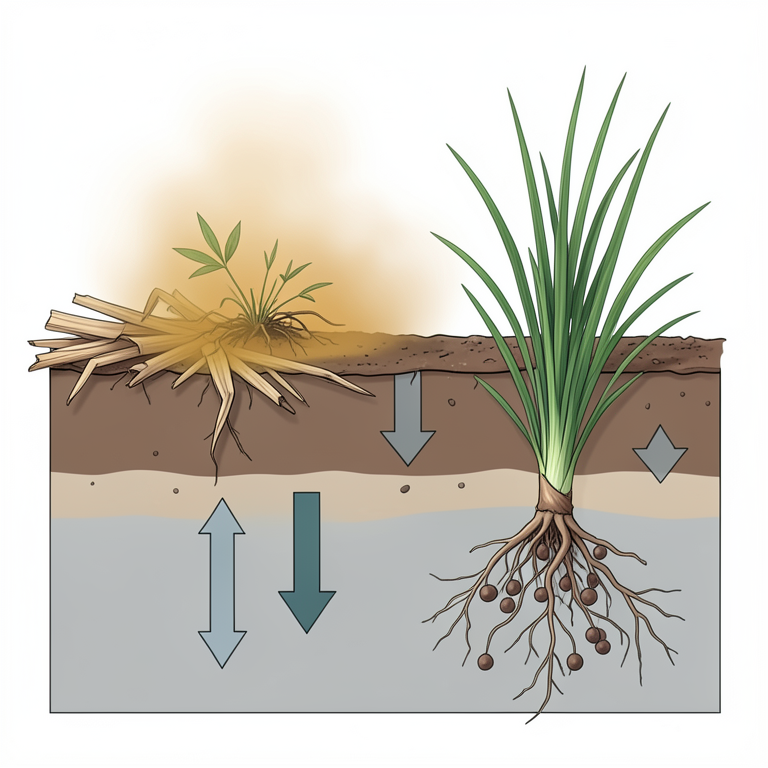
Mechanism of Sedge Resistance
AI-generated conceptual illustration (Sorghum residues, wheat plants, and Cyperus rotundus sedge in a soil cross-section). It explains the idea and does not show study data.
View source evidence ↗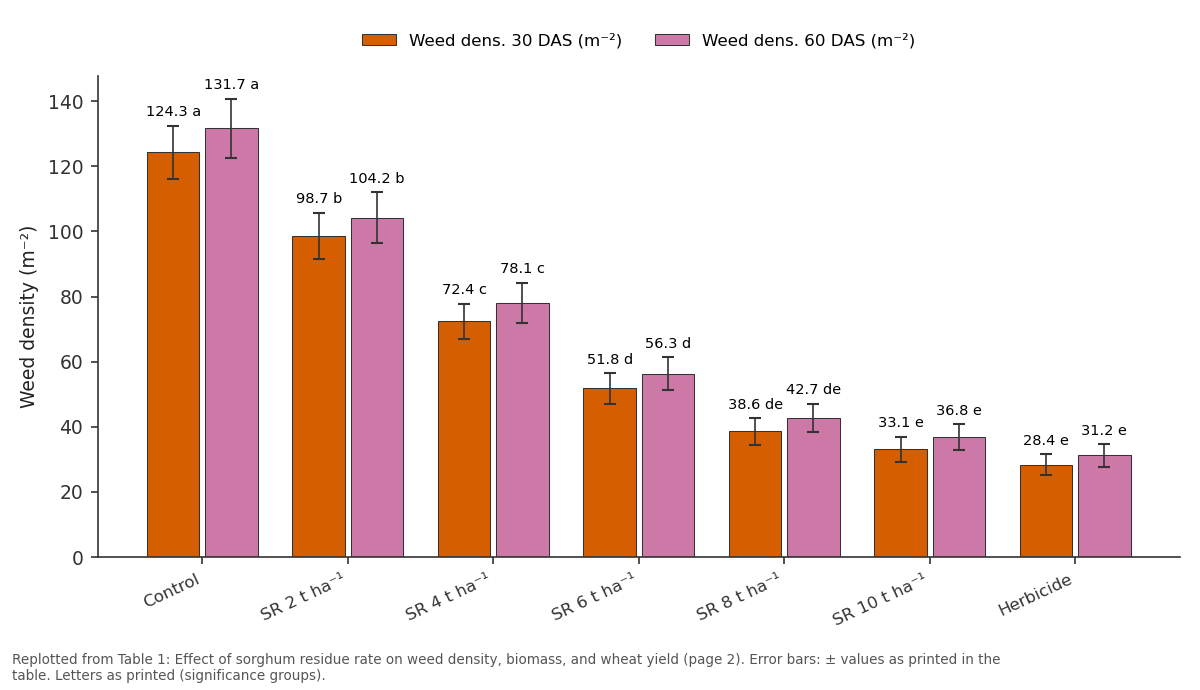
Weed dens. 30 DAS (m⁻²) and Weed dens. 60 DAS (m⁻²): Control vs SR 2 t ha⁻¹ vs SR 4 t ha⁻¹ vs SR 6 t ha⁻¹ vs SR 8 t ha⁻¹
Replotted from Table 1 (page 2) of the original paper. Every bar is the paper's own table value.
View source evidence ↗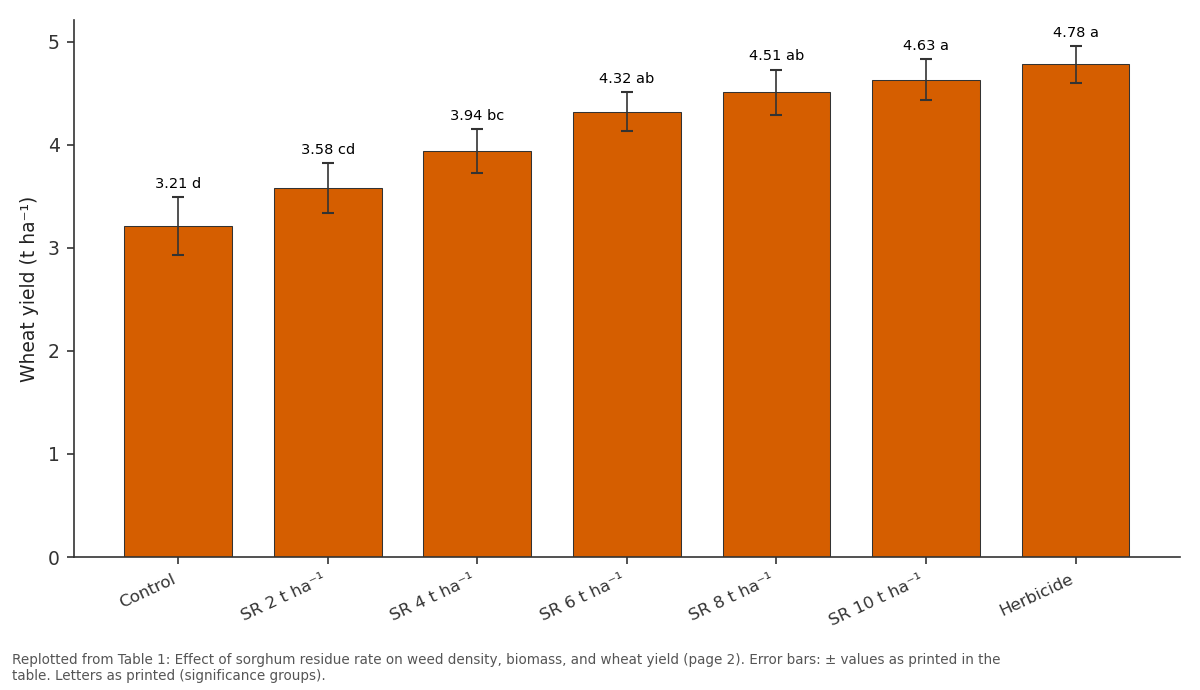
Wheat yield (t ha⁻¹): Control vs SR 2 t ha⁻¹ vs SR 4 t ha⁻¹ vs SR 6 t ha⁻¹ vs SR 8 t ha⁻¹
Replotted from Table 1 (page 2) of the original paper. Every bar is the paper's own table value.
View source evidence ↗Figures & tables
From the original paper Table 1
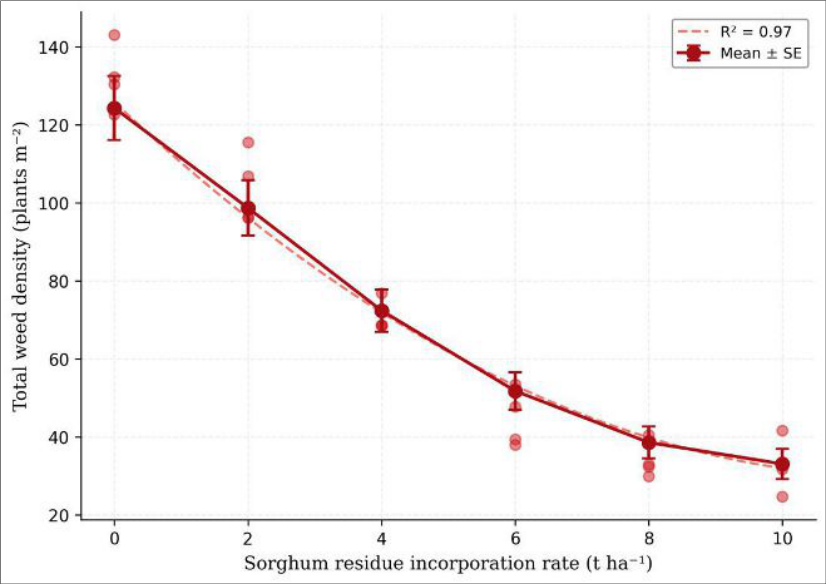 Figure 1
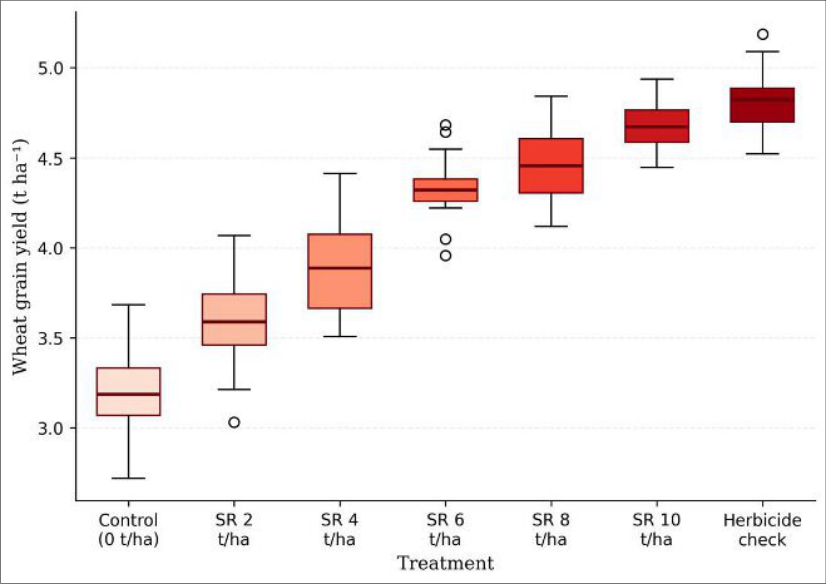 Figure 2
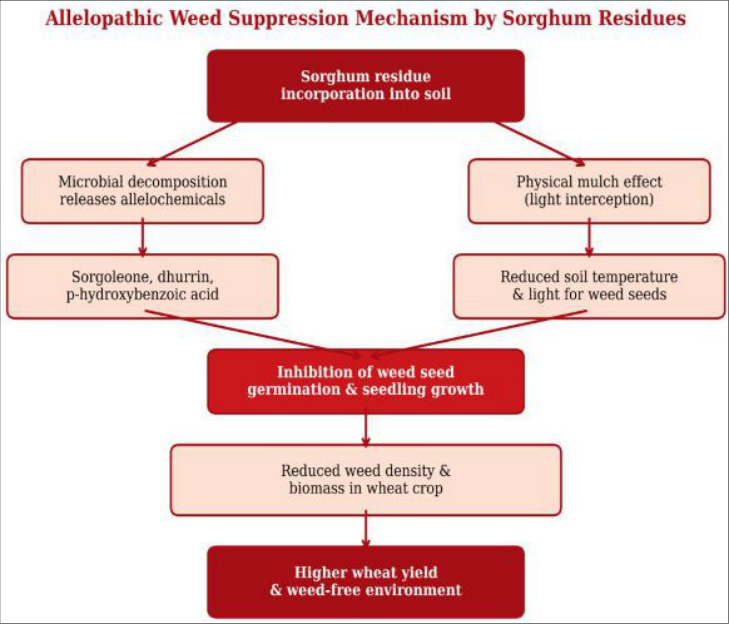 Figure 3
Introduction
Synthetic herbicides are losing the war against weeds. Resistance has been confirmed in over 500 weed biotypes worldwide, and new modes of action are scarce [1]. Allelopathy the release of growth-inhibiting chemicals by one plant species has re-emerged as a serious complement to conventional weed control [2]. Sorghum (Sorghum bicolor L.) stands out for its strong allelopathic activity, attributable mainly to sorgoleone, dhurrin, and several phenolic acids [3].
When sorghum residues are incorporated into soil after harvest, microbial decomposition releases allelochemicals into the root zone over several weeks [4]. Laboratory bioassays show strong inhibition of Phalaris minor and Chenopodium album [5]. But field translation is complicated by soil type, moisture, temperature, and microbial activity [6]. Most published field data come from semi-arid Pakistan and Egypt [4, 5]; data from the humid tropics are limited.
This research aimed to quantify the relationship between sorghum residue rate and weed suppression in wheat under southern Indian conditions. The experiment was conducted at the Agronomic Research Station of Kerala Agricultural University, Thrissur (10°32′N, 76°13′E, 22 m elevation). The soil is lateritic sandy clay loam, pH 5.7, organic carbon 1.34%. During the rabi season (December 2022-March 2023), mean temperature was 23.4-33.7°C, total rainfall 87 mm, and solar radiation 18.3-21.6 MJ m⁻² day⁻¹.
Material And Methods
Material Sorghum residues from variety CSH-16 were air-dried and chopped to 2-5 cm. Wheat HD- 2967 seed was from IARI, New Delhi. Sorgoleone and dhurrin HPLC standards were from Sigma-Aldrich. Isoproturon 75% WP served as the herbicide check at 1.0 kg a.i. ha⁻¹ [7].
Methods
The RCBD experiment had four replications and seven treatments: residue at 0, 2, 4, 6, 8, 10 t ha⁻¹ plus herbicide. Residues were incorporated 10 days before sowing (5 December 2022). Plot size: 5 m × 3 m. Wheat was sown at 100 kg ha⁻¹ in 22.5 cm rows with 120:60:40 kg IJAN 2025; 7(2): 34-37 Namrata Phukan Department of Agronomy and Weed Science, Kerala Agricultural University, Thrissur, Kerala, India Ankita Gill Department of Agronomy and Weed Science, Kerala Agricultural University, Thrissur, Kerala, India Namrata Phukan Department of Agronomy and Weed Science, Kerala Agricultural University, Thrissur, Kerala, India https://www.agriculturejournal.net Wheat yield was recorded at maturity (15 March 2023).
ANOVA in SAS 9.4 with Tukey's HSD at p<0.05. N:P₂O₅:K₂O ha⁻¹ [7]. Weed density was recorded at 30 and 60 DAS using quadrats. Soil allelochemicals were extracted at 15 DAS with methanol: water and analysed by HPLC [3].
Results
Table 1: Effect of sorghum residue rate on weed density, biomass, and wheat yield allelochemical at all rates, reaching 1.87 μg g⁻¹ soil at 10 t ha⁻¹. Treatment Weed dens. 30 DAS (m⁻²) Weed dens. 60 DAS (m⁻²) Weed biom. 60 DAS (g m⁻²) Wheat yield (t ha⁻¹) WCE (%) Control 124.3 ± 8.2a 131.7 ± 9.1a 48.6 ± 4.3a 3.21 ± 0.28d — SR 2 t ha⁻¹ 98.7 ± 7.1b 104.2 ± 7.8b 37.4 ± 3.8b 3.58 ± 0.24cd 20.6 ± 3.4d SR 4 t ha⁻¹ 72.4 ± 5.4c 78.1 ± 6.2c 27.8 ± 3.1c 3.94 ± 0.21bc 41.8 ± 2.8c SR 6 t ha⁻¹ 51.8 ± 4.8d 56.3 ± 5.1d 19.4 ± 2.6d 4.32 ± 0.19ab 58.3 ± 2.4b SR 8 t ha⁻¹ 38.6 ± 4.1de 42.7 ± 4.4de 14.1 ± 2.2de 4.51 ± 0.22ab 68.9 ± 2.1ab SR 10 t ha⁻¹ 33.1 ± 3.9e 36.8 ± 4.0e 11.3 ± 1.9e 4.63 ± 0.20a 73.4 ± 1.8a Herbicide 28.4 ± 3.2e 31.2 ± 3.6e 9.7 ± 1.7e 4.78 ± 0.18a 77.1 ± 1.6a Different letters within columns indicate differences at p < 0.05. WCE = weed control efficiency At 10 t ha⁻¹, weed density at 60 DAS was reduced by 72.1% relative to control, statistically similar to isoproturon (Table 1). HPLC confirmed sorgoleone was the dominant Fig 1: Relationship between sorghum residue rate and total weed density at 60 DAS (R² = 0.97) https://www.agriculturejournal.net Fig 2: Box plots of wheat grain yield across sorghum residue rates and herbicide check Fig 3: Schematic of allelopathic weed suppression mechanism by sorghum residues
| Treatment | Weed dens. 30 DAS (m⁻²) | Weed dens. 60 DAS (m⁻²) | Weed biom. 60 DAS (g m⁻²) | Wheat yield (t ha⁻¹) | WCE (%) |
|---|---|---|---|---|---|
| Control | 124.3 ± 8.2a | 131.7 ± 9.1a | 48.6 ± 4.3a | 3.21 ± 0.28d | — |
| SR 2 t ha⁻¹ | 98.7 ± 7.1b | 104.2 ± 7.8b | 37.4 ± 3.8b | 3.58 ± 0.24cd | 20.6 ± 3.4d |
| SR 4 t ha⁻¹ | 72.4 ± 5.4c | 78.1 ± 6.2c | 27.8 ± 3.1c | 3.94 ± 0.21bc | 41.8 ± 2.8c |
| SR 6 t ha⁻¹ | 51.8 ± 4.8d | 56.3 ± 5.1d | 19.4 ± 2.6d | 4.32 ± 0.19ab | 58.3 ± 2.4b |
| SR 8 t ha⁻¹ | 38.6 ± 4.1de | 42.7 ± 4.4de | 14.1 ± 2.2de | 4.51 ± 0.22ab | 68.9 ± 2.1ab |
| SR 10 t ha⁻¹ | 33.1 ± 3.9e | 36.8 ± 4.0e | 11.3 ± 1.9e | 4.63 ± 0.20a | 73.4 ± 1.8a |
| Herbicide | 28.4 ± 3.2e | 31.2 ± 3.6e | 9.7 ± 1.7e | 4.78 ± 0.18a | 77.1 ± 1.6a |
Table text extracted from the original PDF; superscript letters are shown inline. The original table image is below.
View original table image
Discussion
The quadratic relationship between residue rate and weed density (R² = 0.97) indicates declining marginal benefit at higher rates moving from 4 to 6 t ha⁻¹ reduced weeds by ~28%, but 8 to 10 t ha⁻¹ only by ~13%. Practically, 6-8 t ha⁻¹ may be the optimal range [6]. That the herbicide check performed only marginally better than 10 t ha⁻¹ residues is encouraging for low-input farming [4]. An unexpected finding was relatively poor suppression of Cyperus rotundus, likely because its tuber-based reproduction avoids the surface zone where allelochemicals concentrate.
Conclusion
Sorghum residues at 10 t ha⁻¹ achieved weed control comparable to isoproturon (73.4% vs 77.1%) and increased wheat yield by 44.2% over control. Rates of 6-8 t ha⁻¹ offer the best practical balance. This positions sorghum residue incorporation as a viable non-chemical strategy within https://www.agriculturejournal.net tropical sorghum-wheat rotations. Validation across multiple seasons and complementary sedge control measures are needed.
References
14 in the original paper- Heap I. The international herbicide-resistant weed database. Accessed March 2023.
- Weston LA, Duke SO. Weed and crop allelopathy. Critical Reviews in Plant Sciences. 2003;22(3-4):367- 389.
- Czarnota MA, Paul RN, Dayan FE, Nimbal CI, Weston LA. Mode of action, localisation of production, and activity of sorgoleone. Weed Technology. 2001;15(4):813-825.
- Cheema ZA, Khaliq A. Use of sorghum allelopathic properties to control weeds in irrigated wheat. Agriculture Ecosystems and Environment. 2000;79(2- 3):105-112.
- Alsaadawi IS, Sarbout AK, Al-Shamma LM. Differential allelopathic potential of grain sorghum genotypes. Allelopathy Journal. 2012;30(1):11-24.
- Inderjit, Weston LA, Duke SO. Challenges, achievements, and opportunities in allelopathy research. Journal of Plant Interactions. 2005;1(2):69-81.
- Directorate of Wheat Research. Wheat cultivation in India: pocket guide. ICAR-IIWBR, Karnal. 2014.
- Nimbal CI, Yerkes CN, Weston LA, Weller SC. Herbicidal activity and site of action of sorgoleone. Pesticide Biochemistry and Physiology. 1996;54(2):73- 83.
- Ben-Hammouda M, Kremer RJ, Minor HC, Sarwar M. A chemical basis for differential allelopathic potential of sorghum hybrids on wheat. Journal of Chemical Ecology. 1995;21(6):775-786.
- Roth CM, Shroyer JP, Paulsen GM. Allelopathy of sorghum on wheat under several tillage systems. Agronomy Journal. 2000;92(5):855-860.
- Belz RG. Allelopathy in crop/weed interactions an update. Pest Management Science. 2007;63(4):308-326.
- Kamran M, Cheema ZA, Farooq M. Allelopathic crop water extracts for weed management: a review. International Journal of Agriculture and Biology. 2019;21(6):1102-1110.
- Tesio F, Ferrero A. Allelopathy, a chance for sustainable weed management. International Journal of Sustainable Development and World Ecology. 2010;17(5):377-389.
- Weidenhamer JD, Morton TC, Romeo JT. Solution volume and seed number in allelopathic bioassays. Journal of Chemical Ecology. 1987;13(6):1481-1491.