
Research article · 2026 · Full text
International Journal of Agriculture and NutritionDetermination of Heavy Metal accumulation in vegetables and their potential health risk analysis in Bargarh, Odisha
Volume 8(4) · Pages 41–45 · DOI: 10.33545/26646064.2026.v8.i4a.437 ↗
Research areasHeavy metals in environmentHeavy Metals in PlantsHeavy Metal Exposure and Toxicity
Abstract
Author-writtenAgriculture is integral to global food security and economic stability, while vegetables constitute a significant component of the human diet and provide essential elements necessary for health and well-being. Nevertheless, the growing global emphasis on nutrition-sensitive agriculture necessitates a heightened evaluation of crop nutrient density and the quality of soils utilized for food cultivation. Advancement is unattainable without understanding the significance of vegetables in nutrition and healthcare services. Human exposure to heavy metal contamination primarily occurs through the consumption of green vegetable crops irrigated with wastewater. Objective of the current study was focused on to determine the concentration of heavy metals (cadmium, manganese, chromium, copper, iron, nickel, lead, zinc) in plant and soil from collected from five different samples from Sambalpur, Odisha. The study also determines bioconcentration factor, daily intake of metals from vegetables and health risk index from vegetable intakes. In tomato higher concentration of cadmium, manganese, chromium, copper and Zinc were found whereas, iron concentration was found in maximum concentration parwal (25.07±0.547 mg/kg) in soil. In case of vegetables maximum concentration of heavy metals such as Cd, Mn, Cr, Cu were found in chilli and parwal. Additionally, metals such as Fe, Ni and Zn was found in parwal and brinjal. The concentration of Cd, Mn, Cr and Ni have surpassing the permissible limit given by WHO/FAO. The human DIM has been calculated and found to be below the recommended values set by the FAO/WHO. However, to prevent any chronic health risk and extent of heavy metal contamination, steps must be taken to reduce human activities at the sites. Consistent surveillance of heavy metals in vegetables cultivated in wastewater-irrigated regions is essential.
Summary
Source-checkedPlain-language reading of the full paper, prepared with AI and checked against the text. Each point links to the authors' own words.
Why it matters
- People are primarily exposed to heavy metal contamination by eating green vegetables that have been irrigated with wastewater. View evidence ↗
- Industrialization, unregulated development, and the long-term use of pesticides and fertilizers lead to the accumulation of toxic substances in the air, water, and soil. View evidence ↗
- The global shift toward nutrition-sensitive agriculture makes it necessary to more closely evaluate soil quality and the nutrient density of crops. View evidence ↗
The question
- The study aimed to determine the concentrations of eight heavy metals (Cd, Mn, Cr, Cu, Fe, Ni, Pb, and Zn) in soil and plants from five different samples in Sambalpur, Odisha. View evidence ↗
- The researchers also sought to calculate the bioconcentration factor and the daily dietary intake of these metals in adults to assess potential health impacts. View evidence ↗
What they did
- Soil samples were collected from agricultural fields in Bargarh, Odisha, where five different crops were grown: brinjal, tomato, parwal, cabbage, and chilli. View evidence ↗
- Soil was randomly sampled from trenches measuring 15 x 15 x 15 cm at a depth of 0-15 cm. View evidence ↗
- Heavy metal concentrations were measured using an Atomic Absorption Spectrometer (AAS), specifically the Buck Model 210 VGP. View evidence ↗
- To calculate daily intake, the study used average body weights of 57.1 kg for adults and 30.3 kg for children, with daily vegetable intakes of 0.330 kg and 0.208 kg, respectively. View evidence ↗
What they found
- In the soil, iron (Fe) concentrations were highest in parwal (25.07±0.547 mg/kg) and lowest in tomato (9.58±0.216 mg/kg). View evidence ↗
- Manganese (Mn) concentrations in all tested vegetables exceeded the FAO/WHO safe limit of 0.2 mg/kg, with the highest concentration found in parwal (30.252 mg/kg) and the lowest in cabbage (19.621 mg/kg). View evidence ↗
- Chromium (Cr) levels in cabbage (2.8 mg/kg) and brinjal (2.5 mg/kg) exceeded the FAO/WHO limit of 2.3 mg/kg. View evidence ↗
- Nickel (Ni) concentrations in all vegetables, ranging from 1.7 mg/kg in brinjal to 5.05 mg/kg in parwal, exceeded the FAO/WHO standard limit of 0.1 mg/kg. View evidence ↗
- The bioconcentration factor (BCF) for cadmium was highest in chilli (4.32) and lowest in tomato (0.544). View evidence ↗
- The Health Risk Index (HRI) indicated that these vegetables are generally fit for consumption without risk, although overconsumption could potentially lead to health risks. View evidence ↗
What it means
- The authors conclude that Solanaceous vegetables should not be grown in soils contaminated with heavy metals. View evidence ↗
- The authors state that implementing suitable management practices can make these foods safe for human consumption. View evidence ↗
Visual summary
3 visualsIllustrations explain the paper; charts are replotted from the paper's own table values.
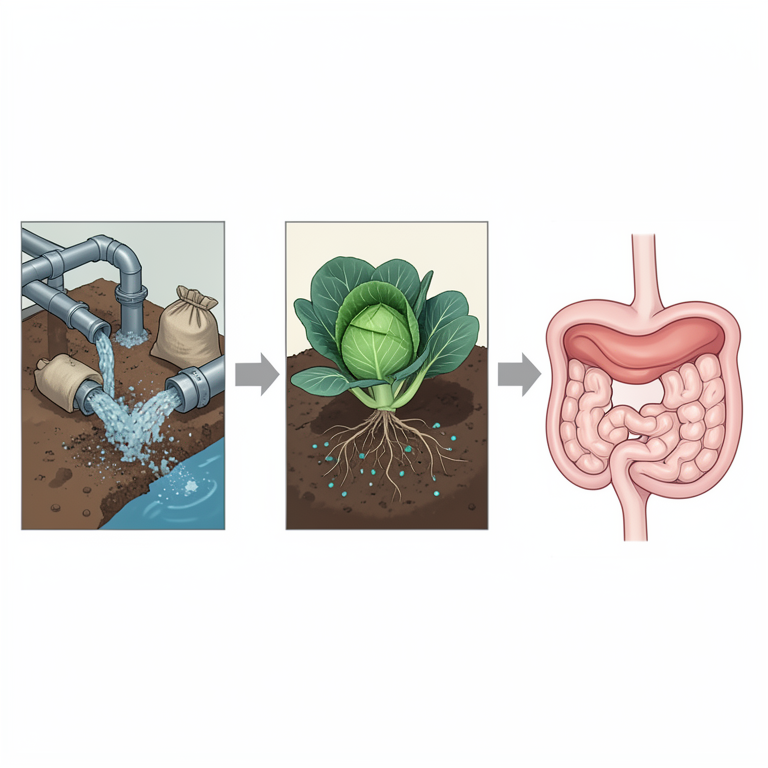
Heavy Metal Pathway
AI-generated conceptual illustration (Leafy green vegetables and root vegetables in soil). It explains the idea and does not show study data.
View source evidence ↗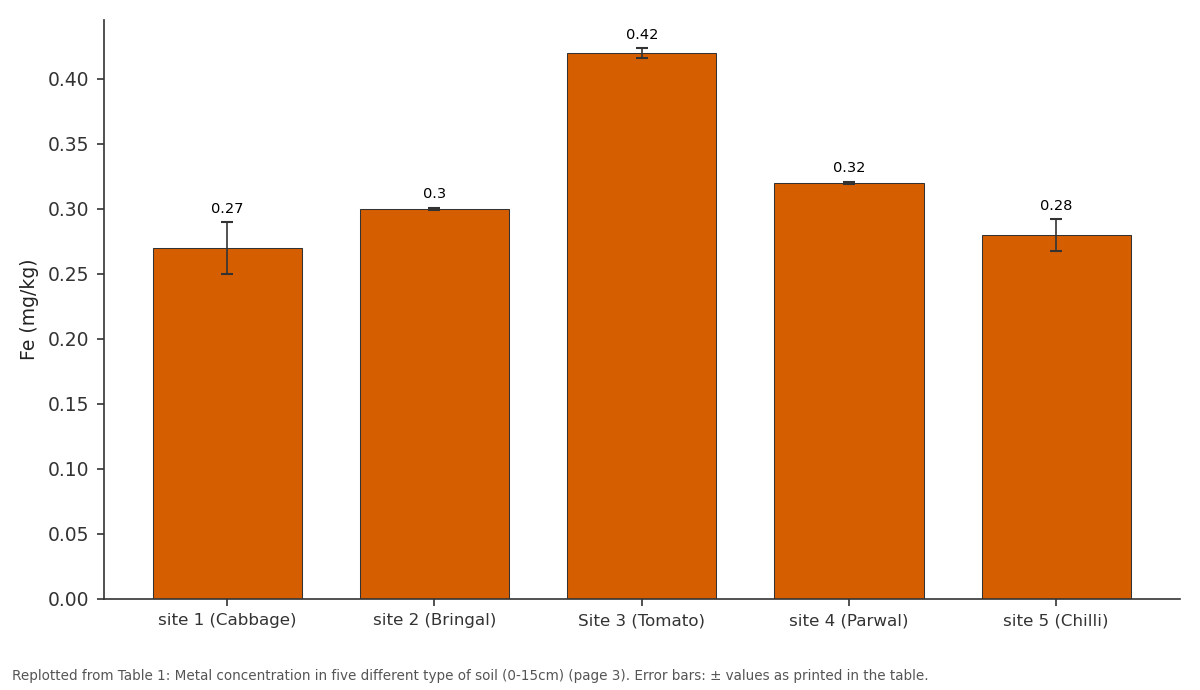
Cu: site 1 (Cabbage) vs site 2 (Bringal) vs Site 3 (Tomato) vs site 4 (Parwal) vs site 5 (Chilli)
Replotted from Table 1 (page 3) of the original paper. Every bar is the paper's own table value.
View source evidence ↗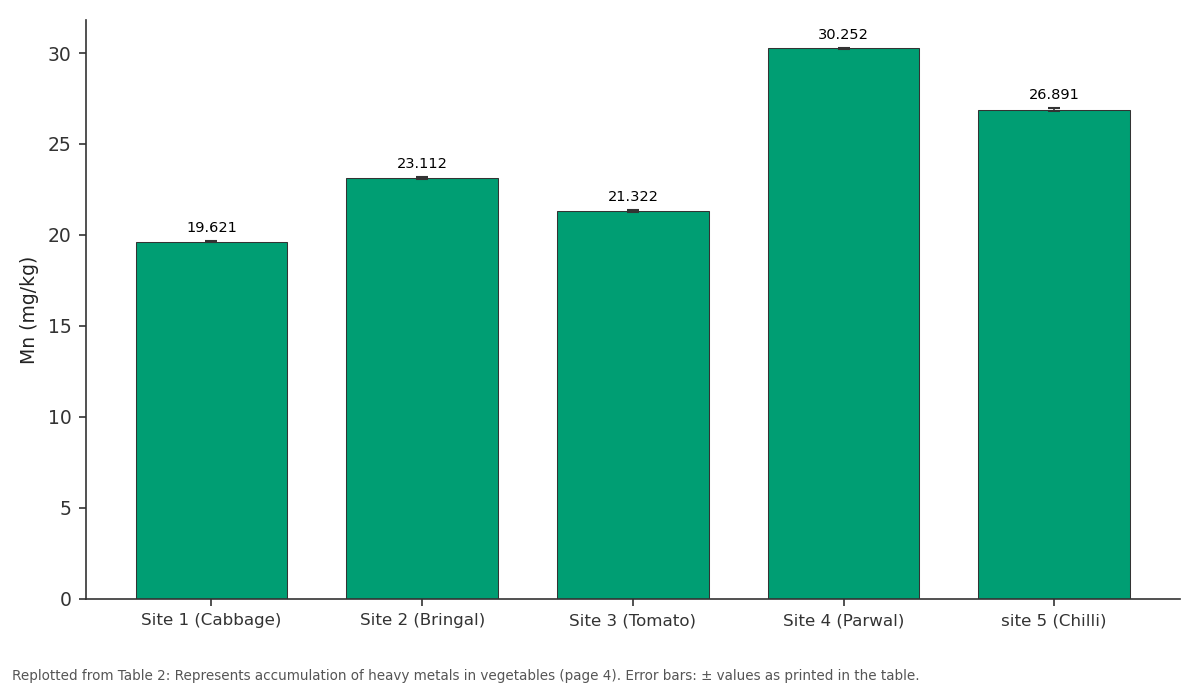
Mn: Site 1 (Cabbage) vs Site 2 (Bringal) vs Site 3 (Tomato) vs Site 4 (Parwal) vs site 5 (Chilli)
Replotted from Table 2 (page 4) of the original paper. Every bar is the paper's own table value.
View source evidence ↗Figures & tables
From the original paper Table 1
 Table 2
 Table 3
 Table 4
Introduction
Vegetables are esteemed for their abundant vitamins, minerals, dietary fibers, and phytochemicals, as well as their role in mitigating chronic ailments such as cardiovascular diseases, diabetes, and specific cancers (Woodside et al., 2013) [1] . The growing population and urbanization have significantly elevated vegetable consumption, thereby generating considerable interest in various agricultural strategies aimed at enhancing both crop output and nutritional quality. The quality of vegetables has emerged as a significant concern for researchers, policymakers, and consumers alike. The composition of soil is a primary factor influencing the quality of vegetables. Consequently, the nutritional composition for assessing quality is of paramount importance. Plants intrinsically necessitate nutrients such as macronutrients for growth and development. Microelements, although needed in minute quantities, are as essential for a plant's physiological functions (Nieder et al., 2018) [2] . Further, understanding the interaction between soil and plants is essential for advancing agricultural practices. The quantification of soil nutrients is essential for assessing the nutrient content of the crops cultivated in that soil. Human exposure to heavy metal contamination primarily occurs through the consumption of green vegetables irrigated with chemically polluted wastewater (Ismail et al., 2014; Qureshi et al., 2016) [4,3] . The accumulation of Cu, Ni, Zn, Cr, Fe, Mn, Co, and Pb in red onion (Allium cepa), garlic (Allium sativum), tomato (Solanum lycopersicum), and eggplant (Solanum melongena) irrigated with wastewater was examined by Hussain et al. (2013) [3] . Zhou [6] . The world's industrial production is growing at an accelerated rate, increasing the likelihood of heavy metal pollution in the environment. Toxic substances accumulate in soil, water, and air due to accelerated industrialization, unregulated development, and prolonged application of fertilizers and pesticides (Kumar et al., 2015) [8] . Vegetables cultivated near abandoned industrial areas provide a significant danger of heavy metal pollution (Murray et al., 2011; Chen et al., 2018) [10,17] . The purpose of this study is to evaluate the accumulation of heavy metals in various regularly cultivated vegetables. The investigation aimed to compute the bioconcentration factor of metals and the daily dietary intake of metals from vegetable eating in adults to assess the impact on their health.
Materials and Methods
Materials and Methods
Geographical location and Soil sampling
Geographical location and Soil sampling
Estimation of heavy metals from vegetables
Methods of Latif et al. (2018) was followed for estimation of heavy metals from soil and vegetables. To evaluate the content of heavy metals in plant samples, around 0.3 g of the ground dried materials was placed in a vessel (Model number XP-1500) of the microwave digester, to which 4 ml of concentrated HNO 3 was added. The heating system utilized was that specified in the client's directives. The three-stage temperature protocol comprised an initial connection at -180°C, a ramp length of 10 minutes, a holding period of 15 minutes, and a cooling duration of 10 minutes. Subsequent to digestion, it is important to reduce the rotor's temperature to 60°C. Upon cooling, carefully remove the upper screw of the vessel with a torque wrench to relieve pressure beneath a fume hood. The gathered samples were subsequently separated and diluted to the calibration line with deionized water in a 10 ml volumetric flask. The samples were subsequently analysed using AAS to quantify heavy metals.
Estimation of heavy metals from soil
One gram of soil was placed in a 250 cm³ digestion tube containing 10 cm³ of pure HNO 3 .The tubes were subsequently cooked for 30 to 45 minutes. Following oxidation, the samples were cooled, and 5 cm³ of 70% HClO 4 was added, after which the mixture was heated until white vapours were observed. The tubes were allowed to cool for an extended period, after which 20 cm³ of distilled water was added and heated until the vapour had dissipated.
The solution was thereafter allowed to cool and was filtered using Whatman filter paper No. 42. The filtrate was transferred to a 25 cm³ volumetric flask. The final volume was designated with deionized water. A blank was similarly prepared following the appropriate protocol without incorporating a soil sample. Water samples were prepared by measuring 50 cm³ into a beaker and treating it with 10 cm³ of concentrated HNO 3 . The solution in the container was heated until a volume of 40 cm³ remained. The solution was re-filtered using Whatman filter paper No. 42 and diluted to 50 cm³ with deionized water. A blank solution was prepared along the same pathway without the inclusion of a water sample. A serial dilution method was utilized to create the working standards and determine the metal concentrations in each sample. The concentration was ascertained utilizing AAS (Buck Model 210 VGP) with an integrated digital readout device.
Daily intake of heavy metals from vegetables
Bio-concentration Factor (BCF)-BCF is the ratio of elemental concentration in plant tissues, including leaves, stems, and roots, to the "exchangeable" or potentially accessible fraction of metals in rhizospheric soils. The BCF for the edible portion of the vegetable was computed using the following formula:
Where, Cp= Concentration of metal in edible part of vegetable (mg/kg), Cs= Metal content in soil (mg/kg).
Daily intake estimate
Daily intake estimate
DIM= M × K× I/W
Where, DIM=Daily intake of metals, M=concentration of heavy metals in plants (mg/kg), K= Conversion factor, I= Daily intake of vegetables, w=Average body weight. The fresh weight of vegetables was converted to dry weight using a conversion factor of 0.085, as previously outlined.
The average body weights for adults and children were 57. Copper is a crucial micronutrient vital for sustaining plant life and functioning as a cofactor in significant physiological processes. The present study revealed that the concentration of Cu was highest in tomato (0.42±0.004) mg/kg, whereas the lowest concentration was seen in cabbage (0.27±0.02) mg/kg. Nickel is a vital micronutrient necessary for plant growth and development due to its function as a cofactor in key enzymatic biological processes. The concentration of Ni was greater in tomato (0.92±0.032) mg/kg and lesser in chilli (0.88±0.047) mg/kg. Zinc is an element essential for the synthesis of enzymes, proteins, and the regulation of plant hormones, as well as for other physiological and biochemical processes within the plant. The content was determined to be greater in tomatoes (1.58±0.012) mg/kg and lesser in Brassicaceae vegetables (0.05±0.001) mg/kg (Table 1).
| Sites | Cd | Mn | Cr | Cu | Fe | Ni | Pb | Zn |
|---|---|---|---|---|---|---|---|---|
| site 1 (Cabbage) | 0.09±0.02 | 7.45±0.087 | 0.96±0.015 | 0.27±0.02 | 23.07±0.954 | 0.9±0.054 | nd | 0.05±0.001 |
| site 2 (Bringal) | 0.07±0.01 | 14.26±0.052 | 0.95±0.023 | 0.3±0.001 | 19.97±0.745 | 0.88±0.041 | nd | 0.16±0.014 |
| Site 3 (Tomato) | 0.09±0.05 | 20.76±0.046 | 0.98±0.019 | 0.42±0.004 | 9.58±0.216 | 0.92±0.032 | nd | 1.58±0.012 |
| site 4 (Parwal) | 0.08±0.04 | 8.45±0.054 | 0.97±0.034 | 0.32±0.001 | 25.07±0.547 | 0.89±0.018 | nd | 0.1±0.014 |
| site 5 (Chilli) | 0.09±0.03 | 15.21±0.074 | 0.92±0.029 | 0.28±0.012 | 17.25±0.554 | 0.88±0.047 | nd | 0.2±0.023 |
Table text extracted from the original PDF; superscript letters are shown inline. The original table image is below.
View original table image
Estimation of heavy metal concentration in vegetables
In the current study, the accumulation of heavy in different parts of vegetables was analysed and represented in table 2 with respect to mg/kg. Cadmium is a non-essential element and its concentration is also limit with no role in plant's nutrient uptake. Excessive accumulation will inhibit important processes like photosynthesis and respiration which result in stunted growth, chlorosis and yield reduction. As compare to men, women accumulates high concentration of Cd, because of their high Fe necessities. The level of Cd was shown significant variation in all selected vegetables. The level of Cd was higher in Chilli as compare to other. The accumulation Cd in five vegetable samples was Cabbage (0.125), Brinjal (0.188), Tomato (0.149), Parwal (0.293), Chilli (0.388) mg/kg respectively. The result was also supported by Rapheal and Adebayo (2011). The resulted concentration was slightly higher than the safe limit 0.2 mg/kg given by FAO/ WHO. The Cd concentration in Chilli was 0.388 mg/kg which crossed the safe limit, thus proved to be dangerous for consumption may be due to excessive use of chemical fertilizers. (2011). Cu concentration of all vegetables was not crossed safe limit of FAO/WHO of 73mg/kg. Iron (Fe) is an important fundamental element of living life form and essential to maintain cell homeostasis. It is also important for chlorophyll synthesis and its deficiency cause chlorosis in plants. Fe concentration was higher in parwal (190.22) mg/kg and less concentration was seen in cabbage (120.12) mg/kg. The concentration of Fe was found in all vegetables are 120.12 to 190.22 mg/kg. In the current study, the concentration of Fe found in all vegetable has not crossed safe limit of 425 mg/kg. The Fe values in vegetables were in following sequence i.e cabbage ˂ brinjal ˂ tomato ˂ chilli ˂ parwal. The result was also studied by Ismail et al. (2014).
| — | Cd | Mn | Cr | Cu | Fe | Ni | Pb | Zn |
|---|---|---|---|---|---|---|---|---|
| Site 1 (Cabbage) | 0.125±0.001 | 19.621±0.025 | 2.8±0.089 | 21.68±0.096 | 120.12±0.156 | 2.9±0.056 | Nd | 24.8±0.265 |
| Site 2 (Bringal) | 0.188±0.012 | 23.112±0.056 | 2.5±0.024 | 31.9±0.123 | 164.22±0.256 | 1.7±0.096 | Nd | 42.16±0.236 |
| Site 3 (Tomato) | 0.149±0.003 | 21.322±0.034 | 1.8±0.056 | 32.15±0.213 | 171.21±0.325 | 2.88±0.024 | Nd | 31.86±0.562 |
| Site 4 (Parwal) | 0.293±0.023 | 30.252±0.035 | 2.6±0.028 | 50.3±0.325 | 190.22±0.165 | 5.05±0.264 | Nd | 22.18±0.564 |
| site 5 (Chilli) | 0.388±0.005 | 26.891±0.065 | 2.2±0.006 | 30.9±0.016 | 181.9±0.125 | 2.14±0.09 | Nd | 40.22±0.562 |
| FAO/WHO | 0.2 | 0.2 | 2.3 | 73 | 425 | 0.1 | 0.3 | 99 |
Table text extracted from the original PDF; superscript letters are shown inline. The original table image is below.
View original table image
Ni is a poisonous heavy metal and its concentration was maximum in parwal (5.05) and minimum in brinjal (1.7).These concentration slightly exceeds the standard limit given by FAO/WHO i.e 0.1 mg/kg. Ni concentration in all vegetables was found in sequence as followed brinjal ˂chilli˂ tomato˂ cabbage ˂ parwal. Zn is minimally toxic and an essential element in the human diet, necessary for maintaining immune system function. A deficiency of zinc in the dietary regimen may be significantly more detrimental to human health than an excess of zinc in the diet. In the current study, concentration of Zn was found between range from 22.18 to 42.16mg/kg. Maximum concentration was found in brinjal (42.16) mg/kg while minimum concentration was seen in parwal 22.18 mg/kg. Zn values present in vegetables are brinjal˂chilli ˂tomato˂cabbage ˂parwal (Table 2). (1985). The variation in transfer factor of metals was related to the absorption capacity, management of nutrients and soil characteristics of different vegetables (Qazi et al. 2004). Therefore, by selecting a suitable crop, the risk of human exposer to metal will reduced (Table 3)
| — | Cd | Mn | Cr | Cu | Fe | Ni | Pb | Zn |
|---|---|---|---|---|---|---|---|---|
| site 1 (Cabbage) | 1.388 | 2.633 | 2.916 | 80.3 | 5.206 | 3.22 | nd | 496 |
| site 2 (Bringal) | 1.257 | 1.62 | 2.631 | 106.3 | 8.223 | 1.93 | nd | 264 |
| Site 3 (Tomato) | 0.544 | 1.027 | 1.836 | 76.54 | 17.871 | 3.13 | nd | 20.2 |
| site 4 (Parwal) | 3.662 | 3.182 | 2.68 | 157.2 | 7.587 | 5.67 | nd | 222 |
| site 5 (Chilli) | 4.32 | 1.767 | 2.391 | 110.4 | 10.544 | 2.43 | Nd | 201 |
Table text extracted from the original PDF; superscript letters are shown inline. The original table image is below.
View original table image
Daily intake of heavy metals through vegetables and health risk index
Quantification of level of exposure and the way through which contaminants get into the target are of greater significance for watching the underlying health risks. An essential pathway of human to get into these heavy metals is food chain. In children and adults, the DIM was calculated from considering normal measure of vegetables they consumed on daily basis. The DIM values for different vegetables for both adult and children were calculated and shown in table 4. In the current study, DIM values for both child and adults are free of risks, as dietary intake provisional tolerable intake are given by FAO/WHO. Health risk index related to these heavy metals were calculated from ratio of daily intake metals to their reference doses given table. HRI measures how much risk for a human to suffered by consuming these metals in food. HRI ˂ 1 showing probability of not going into health risk. HRI> 1 exactly not represents the health risk rather over dose creates health risk for human. In the current study the value of HRI shows, the consumption of these vegetables are fit for consumption without any risk, but over consumption may cause health risk in human.
| Heavy metal | Mean CONC. (mg/kg) | Daily intake in adults (mg/kg) | Daily intake child (mg/kg) | FAO /WHO Limits (mg/µg)) | HRI | Rfd (mg/kg/bw/day) |
|---|---|---|---|---|---|---|
| Cd | 0.23 | 0.000296 | 0.0001002 | 60µg | 0.29696 | 0.001 |
| Mn | 24.23 | 0.031296 | 0.01056 | 20µg | 0.94839 | 0.033 |
| Cr | 2.38 | 0.003072 | 0.00103 | 0.00204 | 1.5 | |
| Cu | 33.38 | 0.043106 | 0.01455 | 3µg | 1.07765 | 0.04 |
| Fe | 165.53 | 0.213729 | 0.072181 | 48µg | ||
| Ni | 2.93 | 0.003788 | 0.001279 | 0.18941 | 0.02 | |
| Pb | nd | nd | 214µg | 0.004 | ||
| Zn | 32.24 | 0.041631 | 0.014059 | 60µg | 0.13877 | 0.3 |
Table text extracted from the original PDF; superscript letters are shown inline. The original table image is below.
View original table image
Conclusion
The current study selected vegetables (Cabbage, brinjal, tomato, parwal, chilli) variate to accumulate metals in their parts. Vegetables such as cabbage have the great tendency to absorb metal due to high leaf surface area. In our study, it was shown that Solanaceous vegetables should not grown in heavy metal contaminated soil. Foods are major dietary source and play a significant part in nutrition commitment to human. Except some vegetables, others are found within safe limit given by FAO/WHO and some others crossed the limits shows human health affected by consuming these vegetables in food. DIM value and HRI in the current study were under safe limit. Thus, suitable management practices make the food enable to consume without any risk by human.
Acknowledgement
AcknowledgementsThe authors are thankful to the Vice Chancellor, Gangadhar Meher University, Sambalpur, Odisha Gangadhar Meher University, Sambalpur, Odisha, India for the necessary guidance and support. The investigation was made possible through the support provided by Soil Testing lab, Sambalpur.
References
19 in the original paper- Woodside JV, Young IS, McKinley MC. Fruit and vegetable intake and risk of cardiovascular disease. Proceedings of the Nutrition Society. 2013;72(4):399406.
- Nieder R, Benbi DK, Reichl FX. Microelements and their role in human health. In: Soil components and human health. Dordrecht: Springer Netherlands; 2018. p. 317-374.
- Qureshi AS, Hussain MI, Ismail S, Khan QM. Evaluating heavy metal accumulation and potential health risks in vegetables irrigated with treated wastewater. Chemosphere. 2016;163:54-61.
- Ismail A, Riaz M, Akhtar S, Ismail T, Amir M, Zafarul-Hye M. Heavy metals in vegetables and respective soils irrigated by canal, municipal waste and tube well waters. Food Additives and Contaminants Part B. 2014;7(3):213-219.
- Zhou H, Yang WT, Zhou X, Liu L, Gu JF, Wang WL, Zou JL, Tian T, Peng PQ, Liao BH. Accumulation of heavy metals in vegetable species planted in contaminated soils and the health risk assessment. International Journal of Environmental Research and Public Health. 2016;13(3):289-300.
- Al Jassir MS, Shaker A, Khaliq MA. Deposition of heavy metals on green leafy vegetables sold on roadsides of Riyadh City, Saudi Arabia. Bulletin of Environmental Contamination and Toxicology. 2005;75(5):1020-1027.
- Kumar NK, Kumar SK, Bauddh KB, Dwivedi ND, Shukla PS, Singh DP, Barman SC. Toxicity assessment and accumulation of metals in radish irrigated with battery manufacturing industry effluent. 2015;373-385.
- Rodrigues MN, Sampaio RA, Junio GR, Oliveira AL. Nutrients and heavy metals in maize crop fertilized with rock phosphate and biosolid. 2017.
- Murray H, Pinchin TA, Macfie SM. Compost application affects metal uptake in plants grown in urban garden soils and potential human health risk. Journal of Soils and Sediments. 2011;11(5):815-829.
- Chen X, Ren Y, Li C, Shang Y, Ji R, Yao D, He Y. Study on factors influencing the migration of heavy metals from soil to vegetables in a heavy industry city. Sustainability. 2024;16(24):11084.
- Latif A, Bilal M, Asghar W, Azeem M, Ahmad MI, Abbas A, Ahmad MZ, Shahzad T. Heavy metal accumulation in vegetables and assessment of their potential health risk. Journal of Environmental Analytical Chemistry. 2018;5:2380-2391.
- Jan FA, Ishaq M, Khan S, Ihsanullah I, Ahmad I, Shakirullah M. A comparative study of human health risks via consumption of food crops grown on wastewater irrigated soil and clean water irrigated soil. Journal of Hazardous Materials. 2010;179(1-3):612621.
- Raphael O, Adebayo KS. Assessment of trace heavy metal contaminations of selected vegetables irrigated with water from River Benue, Nigeria. Advances in Applied Science Research. 2011;2(5):590-601.
- Chary NS, Kamala CT, Raj DS. Assessing risk of heavy metals from consuming food grown on sewage irrigated soils and food chain transfer. Ecotoxicology and Environmental Safety. 2008;69(3):513-524.
- Cui YJ, Zhu YG, Zhai RH, Chen DY, Huang YZ, Qiu Y, Liang JZ. Transfer of metals from soil to vegetables near a smelter in Nanning, China. Environment International. 2004;30(6):785-791.
- Bi C, Zhou Y, Chen Z, Jia J, Bao X. Heavy metals and lead isotopes in soils, road dust and leafy vegetables and health risks via consumption in Shanghai. Science of the Total Environment. 2018;619:1349-1357.
- Kabata-Pendias A, Pendias H. Trace elements in soils and plants. Boca Raton: CRC Press; 1985.
- Qazi G, Bedi K, Johri R, Sharma S, Tikoo M, Tikoo A, Abdullah S, Singh K, Pandita R, Suri O, Gupta B. Plant-based agents as bioavailability/bioefficacy enhancers for drugs and nutraceuticals. United States patent US 10/621, 038; 2004 Jun 24.
- Food and Agriculture Organization, World Health Organization. Codex Alimentarius: General standard for contaminants and toxins in food. Rome: FAO/WHO; 2001.