
Research article · 2025 · Full text
International Journal of Agriculture and NutritionInfluence of crop establishment methods on paddy yield and water productivity in lowland ecosystems
Volume 7(4) · Pages 117–120 · DOI: 10.33545/26646064.2025.v7.i4b.402 ↗
Research areasRice Cultivation and Yield ImprovementAgricultural Systems and PracticesIrrigation Practices and Water Management
Abstract
Author-writtenA farmer in lowland Telangana once remarked that growing rice feels like pouring water into a leaking bucket—no matter how much goes in, the field always asks for more. This observation captures the central inefficiency of conventional transplanted rice, which consumes 3,000 to 5,000 litres of water per kilogram of grain produced. This research compared five crop establishment methods—conventional transplanting (CT), system of rice intensification (SRI), wet direct seeding (WDS), dry direct seeding (DDS), and aerobic rice (AR)—for their effects on grain yield, water use, and water productivity in lowland ecosystems at Pantnagar (Uttarakhand) and Warangal (Telangana) during kharif 2022. The experiment used a randomized block design with four replications at each location. CT produced the highest grain yield (5.87 t ha⁻¹ pooled) but consumed the most irrigation water (1,486 mm). AR gave the highest water productivity (0.61 kg m⁻³), using only 837 mm of water for a yield of 4.12 t ha⁻¹. SRI achieved 5.43 t ha⁻¹ with 23.1 percent less water than CT, making it the best compromise between yield and water savings. DDS saved the most labour (46%) but yielded 18.7 percent less than CT. These results suggest that SRI and WDS offer practical alternatives for lowland rice systems facing water scarcity.
Summary
Source-checkedPlain-language reading of the full paper, prepared with AI and checked against the text. Each point links to the authors' own words.
Why it matters
- Conventional transplanted rice is highly inefficient, requiring between 3,000 and 5,000 litres of water to produce a single kilogram of grain. View evidence ↗
- In India, lowland paddy fields account for approximately 24% of total freshwater withdrawals, though much of this is lost to evaporation, percolation, and seepage. View evidence ↗
- Declining groundwater levels in the Deccan and Indo-Gangetic plateaus make it necessary to find water-efficient rice cultivation methods that do not reduce yields. View evidence ↗
The question
- The study aimed to compare five crop establishment methods to evaluate their grain yield, water use, and water productivity across two different lowland locations to find the most balanced option for water-scarce areas. View evidence ↗
What they did
- The experimental design was a randomized block with four replications per location, using plots measuring 6 x 5 meters. View evidence ↗
- The methods varied from CT (25-day seedlings, puddled) and SRI (14-day seedlings, AWD) to direct seeding options like WDS (broadcast, puddled), DDS (drilled, non-puddled), and AR (raised beds, sprinkler irrigation). View evidence ↗
- Water productivity (WP) was measured by dividing the grain yield in kilograms by the total water input in cubic meters. View evidence ↗
What they found
- Conventional transplanting (CT) achieved the highest pooled grain yield at 5.87 t ha⁻¹, but had the lowest water productivity at 0.42 kg m⁻³. View evidence ↗
- Aerobic rice (AR) had the highest water productivity (0.61 kg m⁻³) and used 43.7% less water than CT, but suffered a 29.8% reduction in yield. View evidence ↗
- The greatest reductions in labour were found in aerobic rice (53.0% saved) and dry direct seeding (45.9% saved). View evidence ↗
- SRI compensated for having fewer panicles per m² (287) compared to CT (314) by producing more grains per panicle (124 vs 108) and heavier grains (24.6 g vs 23.8 g). View evidence ↗
- Dry direct seeding (DDS) had the highest panicle count (368) but the lowest grains per panicle (84) due to high plant density and competition. View evidence ↗
What it means
- The authors recommend SRI as the primary alternative for lowland rice systems in the Deccan and Indo-Gangetic regions experiencing moderate water scarcity. View evidence ↗
- For regions with severe water limitations, aerobic rice is suggested due to its high water productivity, despite the significant loss in yield. View evidence ↗
- The authors note that in dry direct seeding (DDS), weed competition could further lower yields if effective herbicide management is not used. View evidence ↗
Visual summary
3 visualsIllustrations explain the paper; charts are replotted from the paper's own table values.
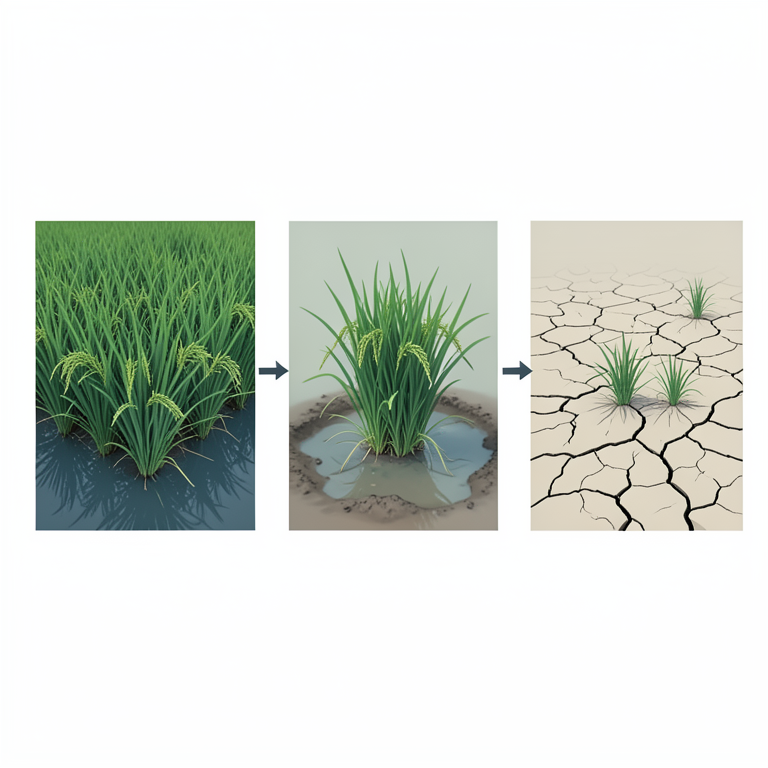
Yield vs. Water Productivity Trade-off
AI-generated conceptual illustration (paddy rice plants in lowland soil). It explains the idea and does not show study data.
View source evidence ↗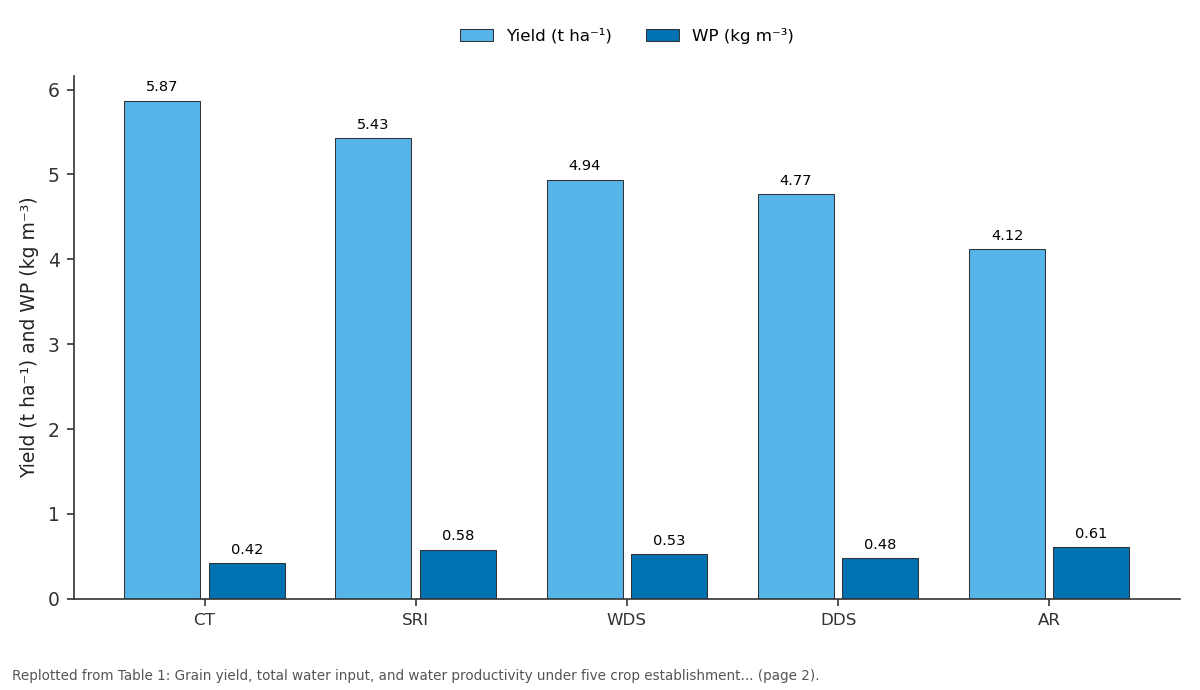
Yield (t ha⁻¹) and WP (kg m⁻³): CT vs SRI vs WDS vs DDS vs AR
Replotted from Table 1 (page 2) of the original paper. Every bar is the paper's own table value.
View source evidence ↗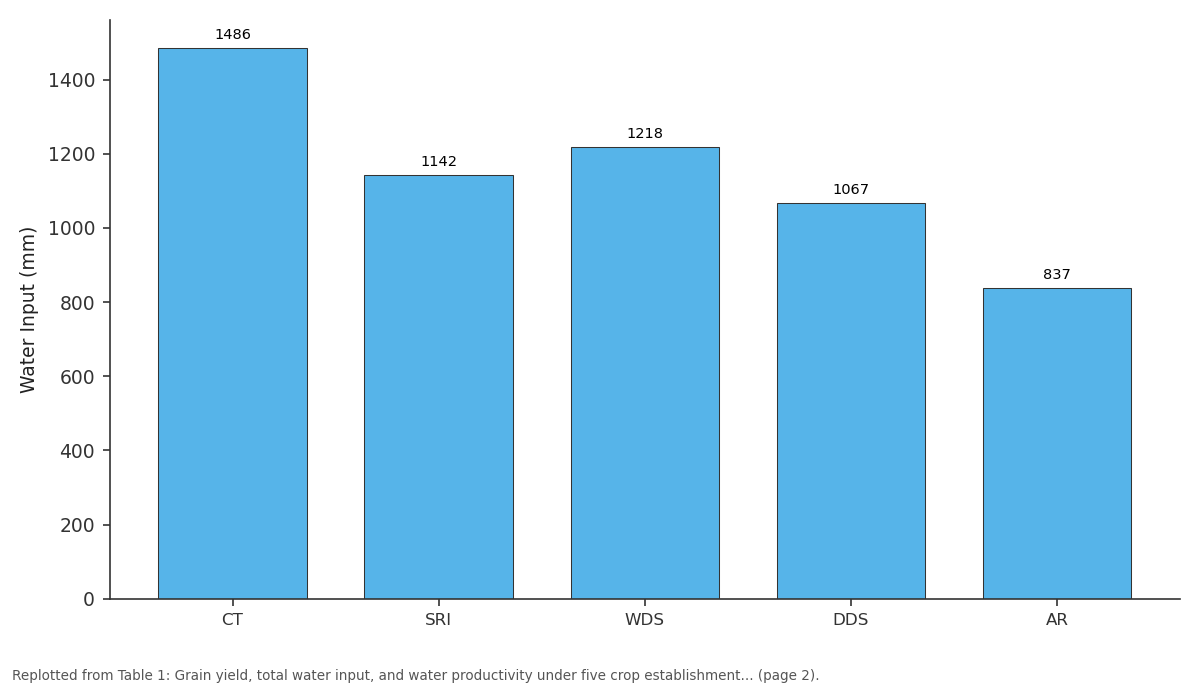
Water Input (mm): CT vs SRI vs WDS vs DDS vs AR
Replotted from Table 1 (page 2) of the original paper. Every bar is the paper's own table value.
View source evidence ↗Figures & tables
From the original paper Table 1
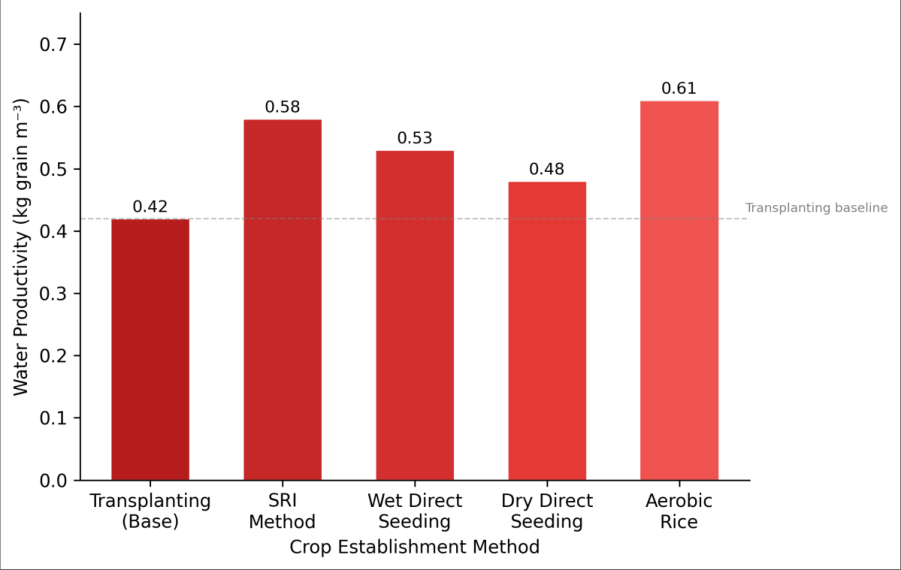 Figure 1
 Table 2
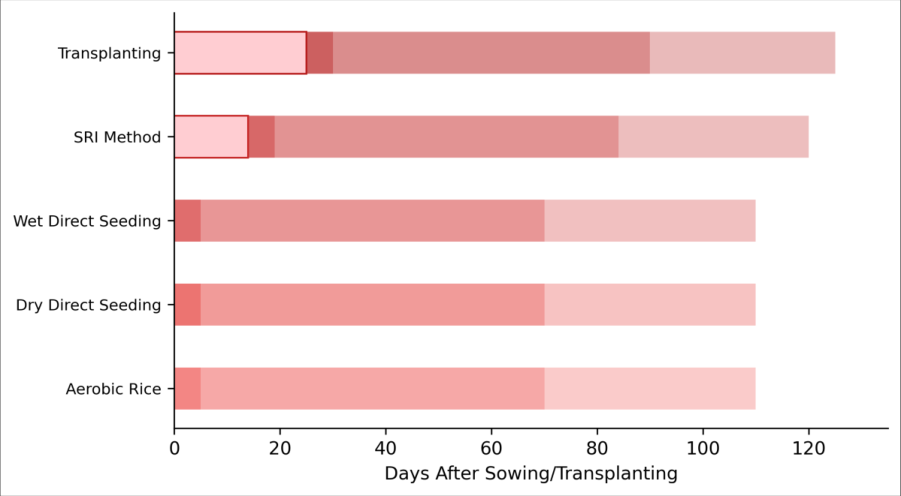 Figure 2
Introduction
Rice is the most water-intensive cereal crop on the planet. Lowland paddy fields in India alone consume an estimated 24 percent of the country's total freshwater withdrawals, yet much of this water is lost to seepage, percolation, and evaporation rather than being transpired productively through the plant [1] . With groundwater tables declining across the Indo-Gangetic and Deccan plateaus, the question is no longer whether rice cultivation must become more water-efficient-it's how to achieve that efficiency without sacrificing the yield levels that 1.4 billion people depend on [2] . Five crop establishment methods span the spectrum from high-water/high-yield to lowwater/lower-yield systems. CT nursery raising, puddling, and transplanting into standing water-is the default method across lowland India [3] . SRI modifies transplanting by using younger seedlings, wider spacing, and intermittent wetting-drying irrigation to reduce water input while stimulating root growth [4] . WDS and DDS eliminate transplanting altogether, placing seed directly into puddled or dry soil, respectively [5] . AR takes the concept further by growing rice under upland conditions with supplemental irrigation only during critical stages [6] . Comparative data across all five methods under identical management at multiple locations are scarce. Most trials compare only two or three methods, making it difficult for farmers and policymakers to rank the full range of options. This research was designed to (i) compare grain yield, water use, and water productivity of all five methods side by side, (ii) assess the yield-water trade-off at two contrasting lowland locations, and (iii) identify the most balanced option for water-scarce lowland systems.
Materials and Methods
Materials and Methods
Materials
The research was conducted during kharif 2022 at two locations: the Crop Research Centre, GBPUAT Pantnagar, Uttarakhand (29.02°N, 79.49°E; altitude 244 m; alluvial silty clay loam, pH 7.1) and the Agricultural Research Station, SKLTSAU Warangal, Telangana (17.97°N, 79.60°E; altitude 271 m; vertisol, pH 7.8). The rice variety Pusa Basmati 1121 was used at Pantnagar and BPT 5204 (Samba Mahsuri) at Warangal. Five establishment methods were tested: CT -25-day seedlings transplanted at 20 × 15 cm in puddled field; SRI -14-day seedlings at 25 × 25 cm with alternate wetting-drying (AWD); WDS -pre-germinated seed broadcast at 60 kg ha⁻¹ on puddled soil; DDS -dry seed drilled at 40 kg ha⁻¹ on non-puddled soil; AR -dry seed drilled on raised beds with sprinkler irrigation at critical stages only.
Water Balance Monitoring
Total water input (irrigation + effective rainfall) was recorded for each treatment using calibrated V-notch weirs at plot inlets (CT, SRI, WDS) or flow meters on sprinkler lines (DDS, AR). Effective rainfall was computed by the USDA-SCS method. Soil moisture was monitored at 15 cm depth using tensiometers (Irrometer, USA) in all treatments. AWD irrigation in SRI was triggered when soil water potential reached -15 kPa. Water productivity (WP) was calculated as grain yield (kg) divided by total water input (m³).
Methods
The experiment used a randomized block design with four replications at each location. Plot size was 6 × 5 m. Uniform fertilizer management (120-60-40 kg N-P₂O₅-K₂O ha⁻¹) and IPM-based pest control were applied across treatments. Labour input was recorded for each operation. Grain yield was adjusted to 14 percent moisture. Data from both locations were pooled after verifying error variance homogeneity. Two-way ANOVA (method × location) was performed using OPSTAT with LSD at p=0.05.
Results
Results
Discussion
The 23.1 percent water saving under SRI without significant yield loss aligns with meta-analyses showing 15-25 percent water reduction across Asian SRI trials [4,8] . The AWD irrigation regime works by allowing soil to dry to -15 kPa between irrigations, which reduces percolation losses while maintaining aerobic root growth that improves nutrient uptake efficiency [9] . The yield compensation mechanismfewer but more productive tillers with heavier grains-is a hallmark of SRI that has been documented across multiple rice types and climates [4] . AR's high water productivity (0.61 kg m⁻³) is attractive on paper but its 29.8 percent yield penalty makes it suitable only for severely water-limited areas where the alternative is no rice at all. The raised-bed sprinkler system also requires capital investment that smallholders may find prohibitive [6] . From a labour perspective, DDS and AR save 46-53 percent of person-days compared with CT-mostly by eliminating nursery raising and transplanting. But without effective herbicide management, weed competition in DDS can further reduce yields beyond what was observed in this trial [10] .
Conclusion
Among five crop establishment methods tested at two lowland locations, SRI offered the best balance between yield (5.43 t ha⁻¹, -7.5% vs CT), water savings (23.1%), and water productivity (0.58 kg m⁻³). It is recommended as the priority alternative for lowland rice systems facing moderate water scarcity in the Indo-Gangetic and Deccan regions.
For areas with severe water limitation, aerobic rice provides the highest water productivity (0.61 kg m⁻³) but at a substantial yield cost. Wet direct seeding occupies a middle position and suits situations where both water and labour are constrained. The choice of method should be guided by the local balance of water availability, labour cost, and target yield.
Figures and tables from the paper
| Method | Yield (t ha⁻¹) | Water Input (mm) | WP (kg m⁻³) | Water Saved (%) | Labour (pd/ha) | Labour Saved (%) |
|---|---|---|---|---|---|---|
| CT | 5.87 | 1,486 | 0.42 | - | 82.4 | - |
| SRI | 5.43 | 1,142 | 0.58 | +23.1 | 71.6 | 13.1 |
| WDS | 4.94 | 1,218 | 0.53 | +18.1 | 56.3 | 31.7 |
| DDS | 4.77 | 1,067 | 0.48 | +28.2 | 44.6 | 45.9 |
| AR | 4.12 | 837 | 0.61 | +43.7 | 38.7 | 53.0 |
| LSD (Method) | 0.34 | 87 | 0.04 | - | 4.8 | - |
| LSD (Location) | 0.22 | 61 | 0.03 | - | NS | - |
| LSD (M × L) | 0.48 | NS | NS | - | NS | - |
Table text extracted from the original PDF; superscript letters are shown inline. The original table image is below.
View original table image
| Method | Panicles m⁻² | Grains panicle⁻¹ | 1000-GW (g) | HI (%) |
|---|---|---|---|---|
| CT | 314 | 108 | 23.8 | 43.7 |
| SRI | 287 | 124 | 24.6 | 45.2 |
| WDS | 342 | 96 | 22.4 | 41.3 |
| DDS | 368 | 84 | 21.7 | 39.8 |
| AR | 276 | 91 | 22.1 | 40.6 |
| LSD | 24 | 8 | 0.9 | 1.8 |
Table text extracted from the original PDF; superscript letters are shown inline. The original table image is below.
View original table image
References
15 in the original paper- Bouman BAM, Humphreys E, Tuong TP. Rice and water. Advances in Agronomy. 2007;92:187-237.
- Rodell M, Velicogna I, Famiglietti JS. Satellite-based estimates of groundwater depletion in India. Nature. 2009;460(7258):999-1002.
- Balasubramanian V, Sie M, Hijmans RJ. Increasing rice production in sub-Saharan Africa: challenges and opportunities. Advances in Agronomy. 2007;94:55-133.
- Uphoff N, Kassam A, Harber R. Opportunities for raising cereal yields through SRI approaches. Agriculture and Food Security. 2011;6:33.
- Joshi E, Kumar D, Lal B. Management of direct-seeded rice for enhanced resource use efficiency. Plant Knowledge Journal. 2013;2(1):9-19.
- Kato Y, Okami M, Katsura K. Yield potential and water use efficiency of aerobic rice in Japan. Field Crops Research. 2009;113(3):328-334.
- Sudhir-Yadav, Gill G, Humphreys E. Effect of water management on dry-seeded and puddled transplanted rice. Field Crops Research. 2011;120(1):130-138.
- Thakur AK, Rath S, Roychowdhury S. Comparative performance of rice with system of rice intensification management. Paddy and Water Environment. 2010;8(3):279-290.
- Lampayan RM, Rejesus RM, Singleton GR. Adoption and economics of alternate wetting and drying water management for irrigated lowland rice. Field Crops Research. 2015;170:95-108.
- Chauhan BS, Mahajan G, Sardana V. Productivity and sustainability of the rice-wheat cropping system in the Indo-Gangetic Plains. Advances in Agronomy. 2012;117:315-369.
- Belder P, Bouman BAM, Cabangon R. Effect of watersaving irrigation on rice yield and water use. Agricultural Water Management. 2004;65(3):193-210.
- Prasad R. Aerobic rice systems. Advances in Agronomy. 2011;111:207-247.
- Tuong TP, Bouman BAM, Mortimer M. More rice, less water: integrated approaches for increasing water productivity in irrigated rice-based systems. Plant Production Science. 2005;8(3):231-241.
- Satyanarayana A, Thiyagarajan TM, Uphoff N. Opportunities for water saving with higher yield from the system of rice intensification. Irrigation Science. 2007;25(2):99-115.
- Tabbal DF, Bouman BAM, Bhuiyan SI. On-farm strategies for reducing water input in irrigated rice. Agricultural Water Management. 2002;56(2):93-112.