
Research article · 2025 · Full text
International Journal of Agriculture and NutritionEffect of pre- and post-emergence herbicides on weed flora and yield of irrigated soybean
Volume 7(4) · Pages 125–128 · DOI: 10.33545/26646064.2025.v7.i4b.426 ↗
Research areasWeed Control and Herbicide ApplicationsAllelopathy and phytotoxic interactionsPesticide and Herbicide Environmental Studies
Abstract
Author-written\Can herbicide combinations offer a more reliable path to managing complex weed flora in irrigated soybean than single-mode applications? This research was carried out during kharif 2022 at Acharya NG Ranga Agricultural University, Tirupati, Andhra Pradesh, to assess pre- and post-emergence herbicides against diverse weed species in irrigated soybean (Glycine max L. Merrill). Seven treatments were tested in a randomized block design with three replications. The weed flora comprised 14 species including 7 broadleaf weeds, 4 grasses, and 3 sedges. Sequential application of pendimethalin (1.0 kg ha⁻¹) followed by imazethapyr (75 g ha⁻¹) recorded the lowest weed density (20.3 plants m⁻²) and dry weight (17.8 g m⁻²) at 60 DAS compared to the weedy check (98.9 plants m⁻² and 84.6 g m⁻²). Grain yield was highest under the sequential treatment (2.37 t ha⁻¹), statistically at par with hand weeding (2.29 t ha⁻¹) but markedly superior to single herbicide applications and the unweeded control (0.94 t ha⁻¹). The results confirm that integrated pre- and post-emergence herbicide programs can effectively replace labour-intensive hand weeding.
Summary
Source-checkedPlain-language reading of the full paper, prepared with AI and checked against the text. Each point links to the authors' own words.
Why it matters
- Weed competition is a major factor in soybean productivity in South and Southeast Asia, causing potential grain yield losses of 25% to 77% in unmanaged fields. View evidence ↗
- Irrigation can worsen weed problems because the added water promotes weed germination alongside the crop. View evidence ↗
- While effective, hand weeding is becoming impractical in southern India due to increasing wages and a scarcity of labor. View evidence ↗
The question
- The study aimed to identify dominant weed species in Tirupati, compare the effectiveness of individual versus sequential herbicide applications, and evaluate their effects on soybean growth and yield. View evidence ↗
What they did
- The experiment took place from July to November 2022 at the Dryland Agriculture Research Station in Tirupati, Andhra Pradesh. View evidence ↗
- The researchers used a randomized block design consisting of seven different treatments, each with three replications. View evidence ↗
- Weed data were collected at 30 and 60 days after sowing (DAS) using 0.25 m² quadrats placed randomly in each plot. View evidence ↗
What they found
- The weed flora consisted of 14 species, with Commelina benghalensis and Digera arvensis being the most frequent broadleaf weeds, Echinochloa colona the dominant grass, and Cyperus rotundus the most persistent sedge. View evidence ↗
- Single pre-emergence herbicide applications were less effective than the sequential combination, reducing weed density to between 39.6 and 49.4 plants m⁻². View evidence ↗
- The sequential herbicide treatment led to the best growth parameters, including the tallest plants (56.9 cm), most pods per plant (42.3), and highest 100-seed weight (11.4 g). View evidence ↗
- Quizalofop-ethyl was effective at reducing grass density by 72.2% but failed to control broadleaf weeds. View evidence ↗
What it means
- The authors recommend the sequential application of pendimethalin followed by imazethapyr as a practical and labor-saving weed management strategy for irrigated soybean in the Rayalaseema region. View evidence ↗
- The authors state that further research across multiple seasons is needed to strengthen their recommendations. View evidence ↗
Visual summary
2 visualsIllustrations explain the paper; charts are replotted from the paper's own table values.
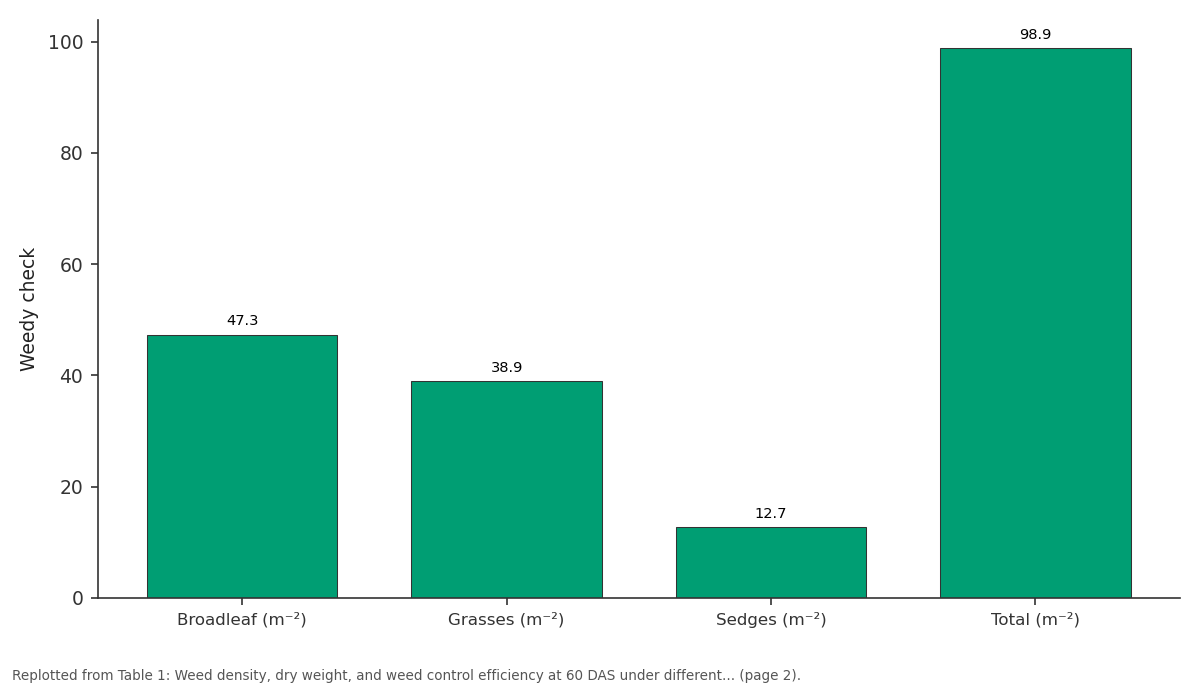
Weedy check: Broadleaf (m⁻²) vs Grasses (m⁻²) vs Sedges (m⁻²) vs Total (m⁻²)
Replotted from Table 1 (page 2) of the original paper. Every bar is the paper's own table value.
View source evidence ↗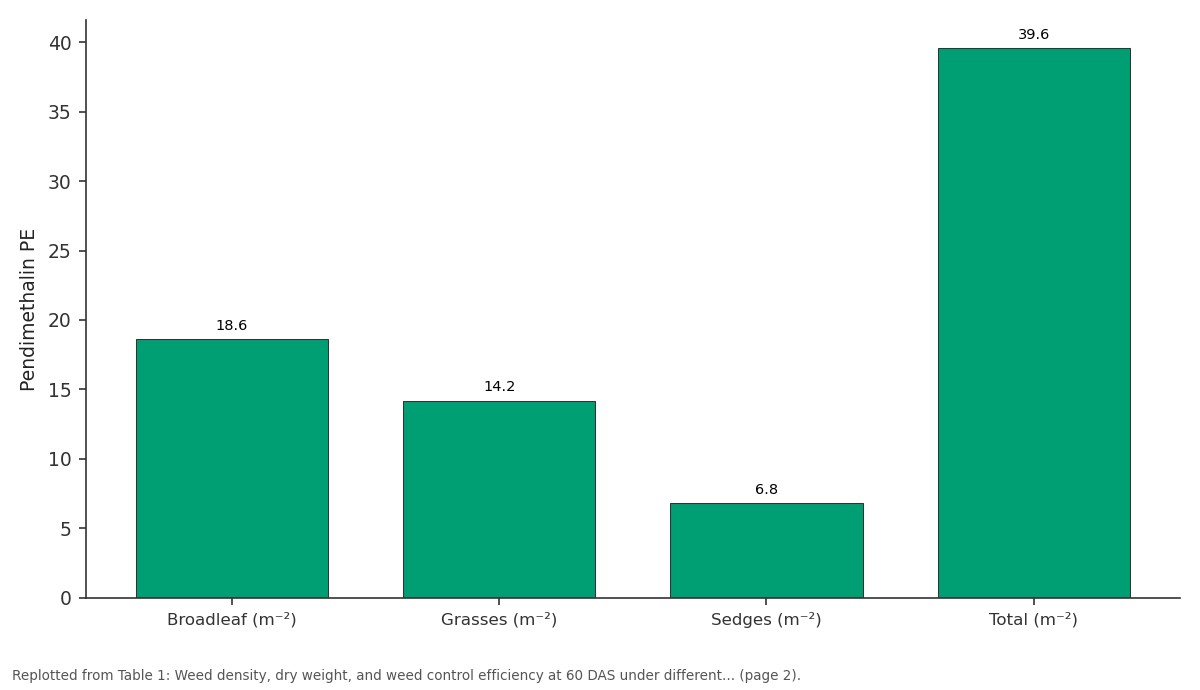
Pendimethalin PE: Broadleaf (m⁻²) vs Grasses (m⁻²) vs Sedges (m⁻²) vs Total (m⁻²)
Replotted from Table 1 (page 2) of the original paper. Every bar is the paper's own table value.
View source evidence ↗Figures & tables
From the original paper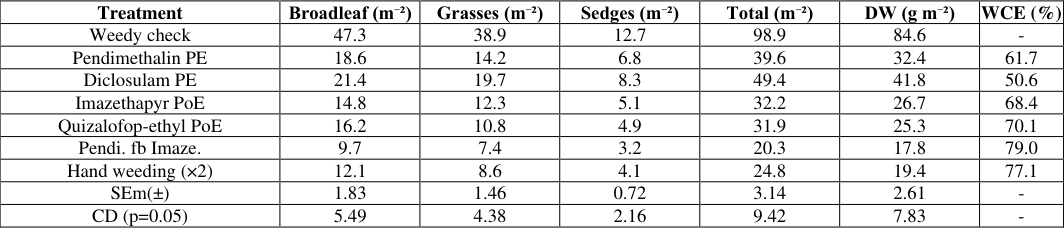 Table 1
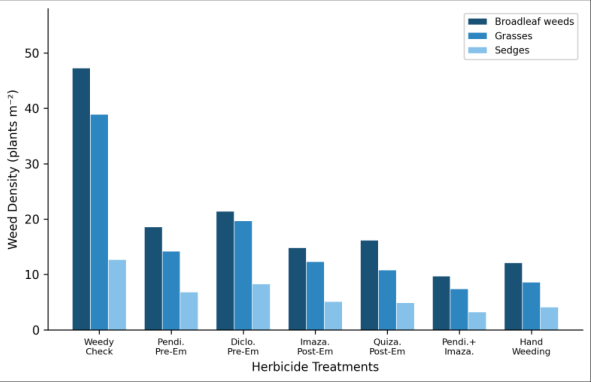 Figure 1
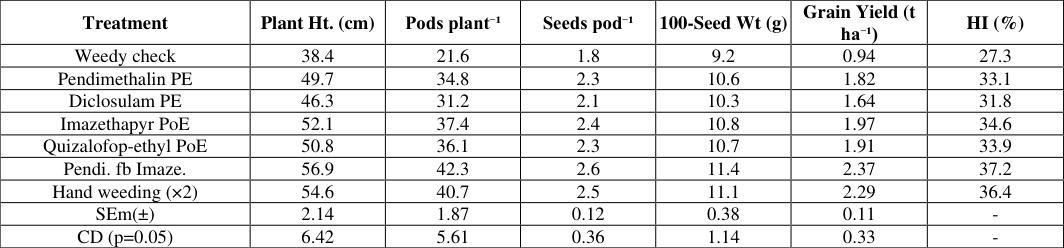 Table 2
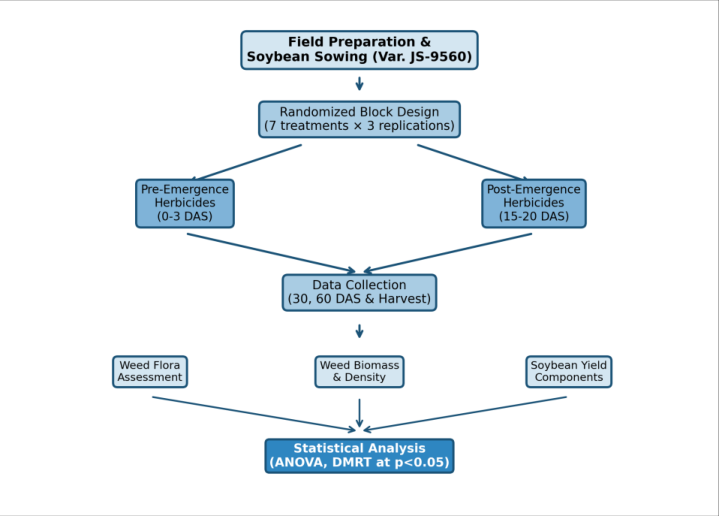 Figure 2
Introduction
What makes weed management the single largest variable affecting soybean productivity in tropical irrigated systems? Across South and Southeast Asia, soybean growers routinely lose between 25 and 77 percent of potential grain yield to weed competition when fields are left unmanaged [1] . The crop's slow initial canopy closure leaves wide inter-row spaces open to aggressive colonization by broadleaf weeds, grasses, and sedges [2] . Under irrigated conditions the problem intensifies because supplementary water favors weed germination just as much as it does the crop itself [3] . Hand weeding, though effective, has become increasingly impractical due to labour scarcity and rising wages across southern India [4] . Mechanical weeding cannot target in-row weeds and often damages surface roots at later growth stages [5] . These constraints have driven a shift toward chemical weed control during the first critical 40-day window [6] . Pre-emergence herbicides such as pendimethalin and diclosulam act on germinating weed seeds but their residual activity seldom extends beyond 25 to 30 days [7] . Post-emergence herbicides like imazethapyr and quizalofop-ethyl target weed escapes at 15 to 20 DAS but cannot prevent early-season competition [8] . A sequential application strategy-preemergence followed by post-emergence-addresses both windows. Trials in central India showed that pendimethalin at 1.0 kg ha⁻¹ followed by imazethapyr at 75 g ha⁻¹ reduced weed dry matter by up to 83 percent [9] . Similar patterns were reported from Maharashtra and Madhya Pradesh [10,11] . However, location-specific data from the Rayalaseema tract of Andhra Pradesh remain limited, as soil type, temperature, and local weed spectrum all influence herbicide efficacy [12] . This research was therefore designed to (i) identify the dominant weed flora in irrigated soybean at Tirupati, (ii) compare weed-suppression capacity of selected herbicides applied individually and in sequence, and (iii) measure their impact on soybean growth and grain yield.
Field Experimental Design
The experiment used a randomized block design with seven treatments and three replications. Plot size was 5.0 m × 4.0 m with 1.0 m alleys. Treatments: T1 -weedy check, T2 -pendimethalin 1.0 kg ha⁻¹ pre-emergence, T3 -diclosulam 25.2 g ha⁻¹ pre-emergence, T4 -imazethapyr 75 g ha⁻¹ postemergence (20 DAS), T5 -quizalofop-ethyl 50 g ha⁻¹ postemergence (20 DAS), T6 -pendimethalin pre-emergence followed by imazethapyr post-emergence, and T7 -hand weeding at 20 and 40 DAS. Sowing was done on 12 July 2022 at 30 cm row spacing with 75 kg ha⁻¹ seed rate.
Methods
Weed observations were recorded at 30 and 60 DAS using a 0.25 m² quadrat placed at two random spots per plot. Weeds were identified to species level, counted, and categorized as broadleaf, grass, or sedge. Weed dry weight was measured after oven-drying at 65 °C for 72 hours. Weed control efficiency was calculated as percentage reduction in weed dry weight relative to the weedy check [13] . Yield components-pods per plant, seeds per pod, 100-seed weight-were measured at harvest. Grain yield was estimated from net plot area. Data were analysed using ANOVA [14] and means separated by DMRT at 5 percent significance using OPSTAT software.
Results
Table The weed flora survey revealed 14 distinct species across all plots. Among broadleaf weeds, Commelina benghalensis and Digera arvensis were most frequent. Echinochloa colona dominated among grasses, while Cyperus rotundus was the most persistent sedge. Treatment T6 (pendimethalin followed by imazethapyr) achieved the lowest total weed density of 20.3 plants m⁻² and a WCE of 79.0 percent, statistically comparable to hand weeding (24.8 plants m⁻², WCE 77.1%). Single pre-emergence applications reduced density to 39.6-49.4 plants m⁻² but with markedly lower efficacy than the sequential combination. Broadleaf weeds constituted the dominant fraction across all treatments (Figure 1). Even under T6, broadleaf density (9.7 plants m⁻²) exceeded the combined grass and sedge count, suggesting that a broadleaf-specific post-emergence partner may further refine the sequential approach.
Discussion
The marked superiority of the sequential herbicide treatment over individual applications can be attributed to complementary modes of action targeting weeds at different emergence windows. Pendimethalin inhibits cell division in germinating seedlings with residual activity lasting 20 to 25 days under Tirupati's soil moisture conditions [7] . Once its activity wanes, post-emergence imazethapyr-an acetolactate synthase inhibitor-intercepts late-emerging broadleaf and grass weeds that escaped the initial barrier [8] . The observed WCE of 79.0 percent for the sequential treatment is consistent with values reported from Madhya Pradesh (81.3%) and Maharashtra (76.8%) under comparable conditions [10,11] . However, the absolute grain yield of 2.37 t ha⁻¹ is lower than the 2.8-3.1 t ha⁻¹ range achieved in vertisol-dominated areas of central India [9] , likely due to the lighter soil texture and erratic mid-season rainfall in the Rayalaseema region.
Quizalofop-ethyl reduced grass density by 72.2 percent but had no effect on broadleaf weeds, reaffirming that broadspectrum herbicides offer greater practical value where mixed weed flora dominate. Diclosulam produced the weakest results, possibly because its efficacy depends on adequate soil moisture at application [16] . The comparable performance of hand weeding and the sequential treatment has direct economic relevance-with agricultural wages rising 8 to 12 percent annually across Andhra Pradesh [4] , herbicide-based management offers a financially sustainable alternative for smallholders.
Conclusion
This research confirmed that weed flora in irrigated soybean at Tirupati is dominated by broadleaf species, with Commelina benghalensis and Digera arvensis accounting for over 40 percent of total weed density. Grasses led by Echinochloa colona and the sedge Cyperus rotundus formed the remaining community.
The sequential application of pendimethalin (1.0 kg ha⁻¹) as pre-emergence followed by imazethapyr (75 g ha⁻¹) as postemergence proved most effective, achieving 79.0 percent weed control efficiency and the highest grain yield of 2.37 t ha⁻¹. This performance was at par with two manual weedings but with considerably less labour input. Single-mode herbicide applications controlled weeds to varying degrees but couldn't match the sequential combination. Diclosulam showed limited suitability for the red sandy loam soils of the southern peninsular zone. For irrigated soybean in the Rayalaseema tract, the pendimethalin followed by imazethapyr program can be recommended as a practical, labour-saving weed management package. Future investigations across multiple seasons would strengthen these recommendations.
Figures and tables from the paper
| Treatment | Broadleaf (m⁻²) | Grasses (m⁻²) | Sedges (m⁻²) | Total (m⁻²) | DW (g m⁻²) | WCE (%) |
|---|---|---|---|---|---|---|
| Weedy check | 47.3 | 38.9 | 12.7 | 98.9 | 84.6 | - |
| Pendimethalin PE | 18.6 | 14.2 | 6.8 | 39.6 | 32.4 | 61.7 |
| Diclosulam PE | 21.4 | 19.7 | 8.3 | 49.4 | 41.8 | 50.6 |
| Imazethapyr PoE | 14.8 | 12.3 | 5.1 | 32.2 | 26.7 | 68.4 |
| Quizalofop-ethyl PoE | 16.2 | 10.8 | 4.9 | 31.9 | 25.3 | 70.1 |
| Pendi. fb Imaze. | 9.7 | 7.4 | 3.2 | 20.3 | 17.8 | 79.0 |
| Hand weeding (×2) | 12.1 | 8.6 | 4.1 | 24.8 | 19.4 | 77.1 |
| SEm(±) | 1.83 | 1.46 | 0.72 | 3.14 | 2.61 | - |
| CD (p=0.05) | 5.49 | 4.38 | 2.16 | 9.42 | 7.83 | - |
Table text extracted from the original PDF; superscript letters are shown inline. The original table image is below.
View original table image
| Treatment | Plant Ht. (cm) | Pods plant⁻¹ | Seeds pod⁻¹ | 100-Seed Wt (g) | Grain Yield (t ha⁻¹) | HI (%) |
|---|---|---|---|---|---|---|
| Weedy check | 38.4 | 21.6 | 1.8 | 9.2 | 0.94 | 27.3 |
| Pendimethalin PE | 49.7 | 34.8 | 2.3 | 10.6 | 1.82 | 33.1 |
| Diclosulam PE | 46.3 | 31.2 | 2.1 | 10.3 | 1.64 | 31.8 |
| Imazethapyr PoE | 52.1 | 37.4 | 2.4 | 10.8 | 1.97 | 34.6 |
| Quizalofop-ethyl PoE | 50.8 | 36.1 | 2.3 | 10.7 | 1.91 | 33.9 |
| Pendi. fb Imaze. | 56.9 | 42.3 | 2.6 | 11.4 | 2.37 | 37.2 |
| Hand weeding (×2) | 54.6 | 40.7 | 2.5 | 11.1 | 2.29 | 36.4 |
| SEm(±) | 2.14 | 1.87 | 0.12 | 0.38 | 0.11 | - |
| CD (p=0.05) | 6.42 | 5.61 | 0.36 | 1.14 | 0.33 | - |
Table text extracted from the original PDF; superscript letters are shown inline. The original table image is below.
View original table image
References
16 in the original paper- Kuchlan MK, Dadlani M, Samuel DVK. Weed competition and soybean productivity: A critical review. Indian Journal of Weed Science. 2018;50(3):211-218.
- Chandel S, Sharma OP. Canopy architecture and early weed suppression in soybean cultivars. Journal of Oilseeds Research. 2019;36(2):98-104.
- Tiwari AK, Shivhare AK. Weed dynamics in irrigated soybean under different moisture regimes. Legume Research. 2020;43(4):567-572.
- Ramesh P, Panwar NR. Labour economics in smallholder soybean production systems of peninsular India. Agricultural Economics Research Review. 2021;34(1):45-53.
- Gill GS, Vijaya Kumar R. Mechanical weed control in row crops: Scope and limitations under Indian conditions. Indian Journal of Agronomy. 2017;62(4):412-419.
- Das TK, Yaduraju NT. Herbicide efficacy windows and weed competition periods in soybean. Weed Technology. 2018;32(5):594-601.
- Gupta V, Singh T, Rathore SS. Residual activity of pendimethalin in different soil types under soybean. Pesticide Research Journal. 2019;31(1):78-84.
- Vyas MD, Kothikar RB. Post-emergence herbicide options for weed management in soybean. Soybean Research. 2020;18(1):33-41.
- Singh G, Shekhawat K. Sequential herbicide application for broad-spectrum weed control in soybean. Indian Journal of Agricultural Sciences. 2021;91(7):1034-1039.
- Jadhav AS, Patil BN. Herbicide combinations for weed management in kharif soybean on vertisols of Maharashtra. Journal of Maharashtra Agricultural Universities. 2020;45(2):178-183.
- Chouhan BS, Naidu VD. Pre-and post-emergence herbicide sequences in soybean-based cropping systems of central India. Crop Protection. 2022;157:106014.
- Rao AN, Chauhan BS. Weed ecology and management in tropical soybean: Regional perspectives. Field Crops Research. 2015;187:24-36.
- Mani VS, Malla ML, Gautam KC. Weed killing chemicals in agriculture. Indian Farming. 1973;23(1):17-19.
- Gomez KA, Gomez AA. Statistical procedures for agricultural research. 2nd ed. John Wiley and Sons; 1984:107-118.
- Punia SS, Yadav D, Malik RS. Labour requirement and cost analysis of weed management in soybean. Haryana Journal of Agronomy. 2019;35(1):65-70.
- Grey TL, Prostko EP. Diclosulam performance under varying soil moisture conditions in legume crops. Weed Science. 2017;65(3):389-397.