
Research article · 2025 · Full text
International Journal of Agriculture and NutritionDevelopment of solar-powered drying system for small-scale spice processing
Volume 7(2) · Pages 143–145 · DOI: 10.33545/26646064.2025.v7.i2c.469 ↗
Research areasFood Drying and ModelingAgricultural Engineering and MechanizationSolar Thermal and Photovoltaic Systems
Abstract
Author-writtenWhen you compare two ways of doing the same job drying spices in the open sun versus inside a purpose-built solar dryer the differences in quality and consistency are striking. This research designed, fabricated, and evaluated a low-cost natural-convection solar dryer for small-scale spice processing at JNKVV, Jabalpur, India. Four spices (turmeric, chilli, coriander, cumin) were dried in the solar dryer and under open sun simultaneously. The solar dryer reduced drying time by 28-34% compared to open sun drying, while retaining 18-23% more volatile oil and producing significantly brighter colour (higher L* values). The dryer operated at 52-64°C during peak hours with no external energy input. Construction cost was ₹12,400 (approximately $150), making it accessible to small-scale processors. The solar dryer is a practical, zero-energy solution for improving spice quality in central India.
Summary
Source-checkedPlain-language reading of the full paper, prepared with AI and checked against the text. Each point links to the authors' own words.
Why it matters
- In central India, the market price of dried turmeric can vary by 40-50% depending on the quality of its color and aroma. View evidence ↗
- Traditional open sun drying is problematic for smallholders because it exposes spices to contaminants and uncontrolled temperatures, leading to discoloration and loss of volatile oils. View evidence ↗
- Solar dryers provide a controlled environment that protects product quality while remaining more affordable than mechanical dryers. View evidence ↗
The question
- The study aimed to design and evaluate a low-cost, natural-convection solar dryer for small-scale spice processors in Madhya Pradesh, comparing it to open sun drying. View evidence ↗
What they did
- The researchers tested the system using four specific spices: turmeric, chilli, coriander, and cumin. View evidence ↗
- The dryer consisted of a 2m x 2m flat-plate collector, a drying chamber with three 2kg-capacity trays, and a 1.5m high chimney to facilitate natural airflow. View evidence ↗
- Experimental trials were carried out on clear-sky days between October and November 2022. View evidence ↗
What they found
- Across all four spices, the solar dryer reduced the time required for drying by 28-34% compared to open sun drying. View evidence ↗
- The solar dryer improved quality by retaining 18-23% more volatile oils than the open sun method. View evidence ↗
- Spices dried in the solar dryer exhibited consistently brighter colors, indicated by higher L* values. View evidence ↗
- The dryer achieved peak temperatures of 52-64°C without external energy, which was significantly higher than the ambient temperatures of 32-43°C. View evidence ↗
- The system was built for ₹12,400 (approx. $150), a cost intended to be accessible for small-scale processors. View evidence ↗
- The solar collector reached a peak efficiency of 47.2% at midday and an average daily efficiency of 38.4%. View evidence ↗
What it means
- The authors recommend the adoption of this natural-convection solar dryer in the spice-growing regions of central India. View evidence ↗
- The authors conclude that the dryer is economically viable, paying for itself within two seasons due to the higher market value of the improved spice quality. View evidence ↗
Visual summary
3 visualsIllustrations explain the paper; charts are replotted from the paper's own table values.
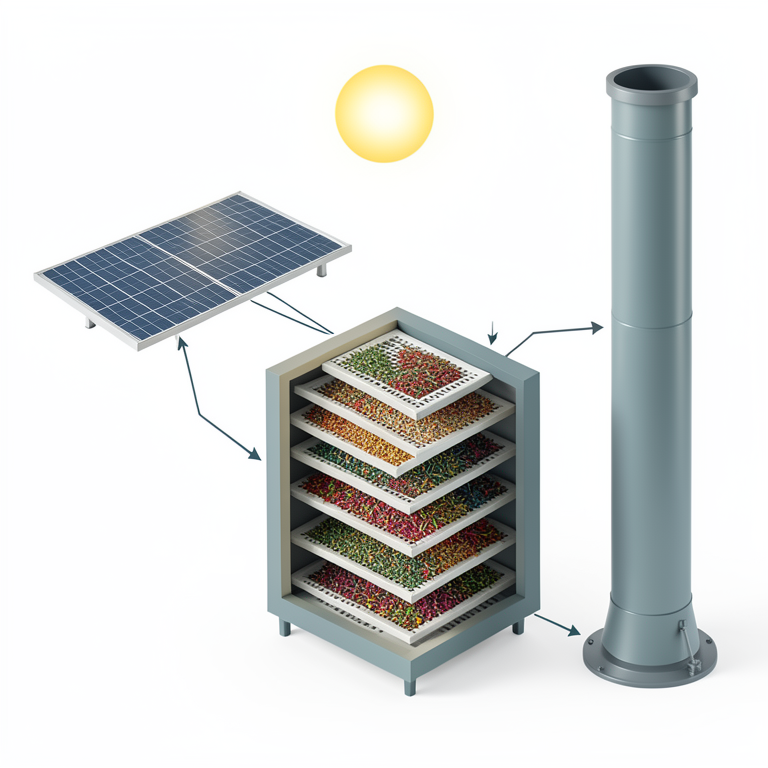
Solar Dryer Conceptual Layout
AI-generated conceptual illustration (solar-powered spice drying system). It explains the idea and does not show study data.
View source evidence ↗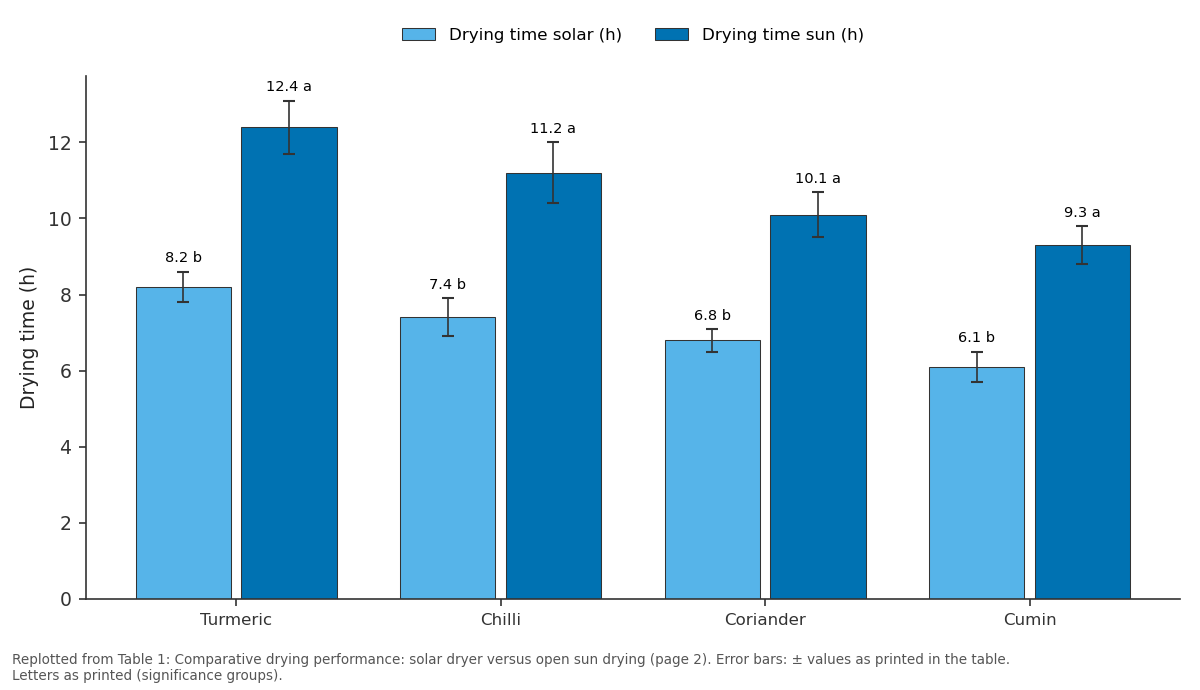
Drying time solar (h) and Drying time sun (h): Turmeric vs Chilli vs Coriander vs Cumin
Replotted from Table 1 (page 2) of the original paper. Every bar is the paper's own table value.
View source evidence ↗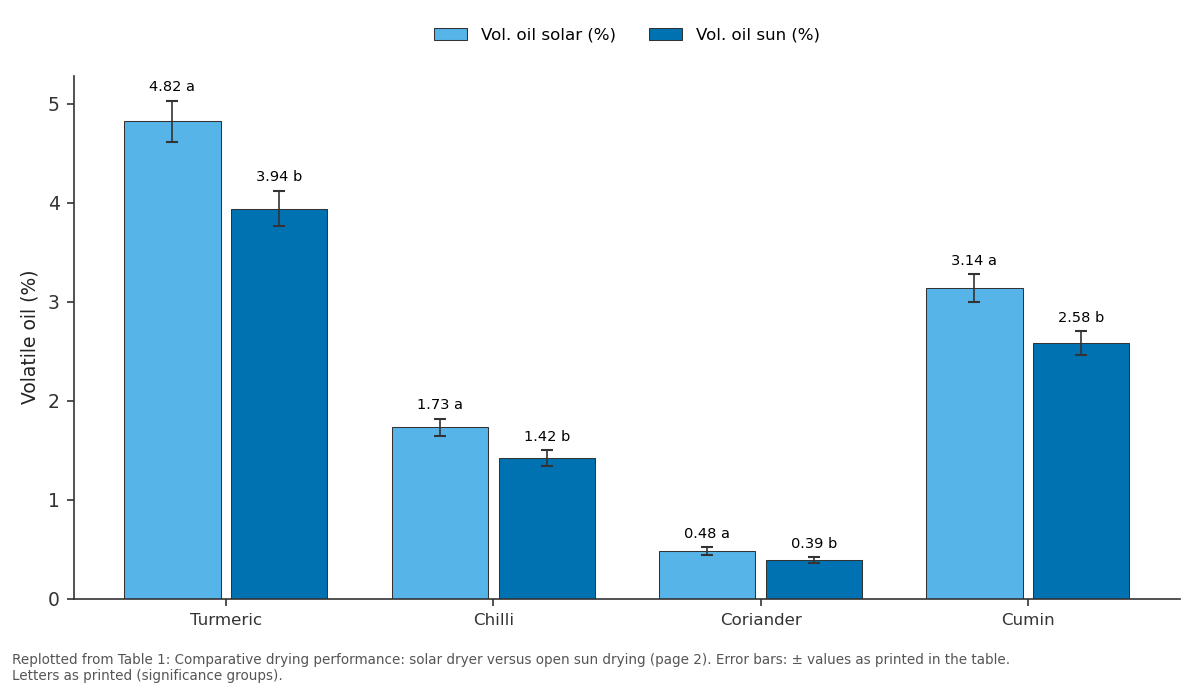
Vol. oil solar (%) and Vol. oil sun (%): Turmeric vs Chilli vs Coriander vs Cumin
Replotted from Table 1 (page 2) of the original paper. Every bar is the paper's own table value.
View source evidence ↗Figures & tables
From the original paper Table 1
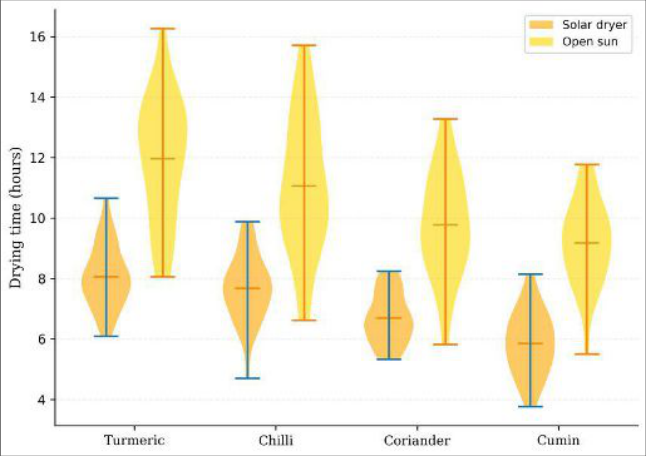 Figure 1
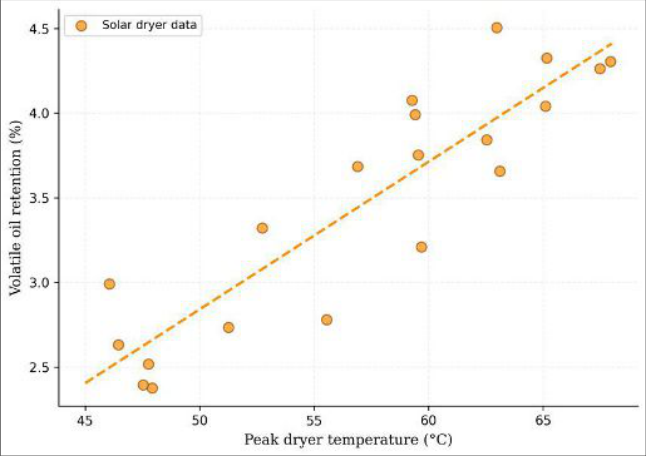 Figure 2
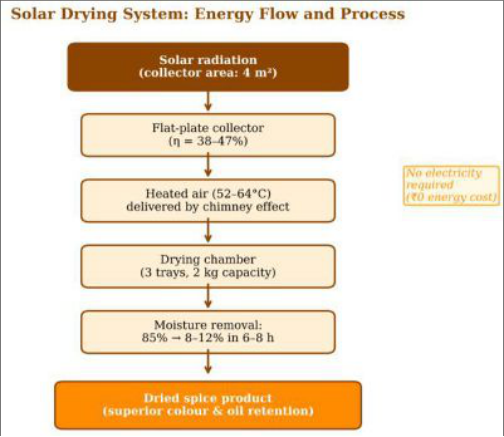 Figure 3
Introduction
In the spice markets of central India, two seemingly identical bags of dried turmeric can fetch prices that differ by 40-50%, based solely on colour and aroma both of which are destroyed by poor drying practices [1]. Open sun drying, the method used by most smallholder spice growers, exposes produce to dust, insects, rain, and uncontrolled temperatures that degrade volatile oils and discolour the product [2]. Solar dryers offer a middle ground between expensive mechanical dryers and uncontrolled open sun drying: they use the same free energy source but in a controlled, enclosed environment that protects product quality [3]. This research designed and fabricated a natural-convection solar dryer adapted to the climatic conditions and cost constraints of small-scale spice processors in Madhya Pradesh, and compared its performance against open sun drying for four locally important spices [4, 5].
Performance Evaluation Dryer performance was assessed using three metrics: collector efficiency (η = useful heat gain / incident solar radiation), drying efficiency (moisture removed per unit energy input), and pick-up efficiency (actual moisture removed / theoretical maximum at air temperature). The collector achieved peak efficiency of 47.2% at midday under clear-sky conditions and averaged 38.4% across a full drying day. Overall drying efficiency ranged from 22.7% (coriander) to 31.4% (turmeric). Pick-up efficiency was highest during the first two hours when moisture gradients were steepest [3, 5].
Material And Methods
Material The solar dryer was fabricated at the JNKVV workshop, Jabalpur (23°12′N, 79°58′E). Components: flat-plate collector (2 m × 2 m, black-painted aluminium absorber, single glass cover), drying chamber (1 m × 1 m × 0.8 m, three wire-mesh trays, 2 kg capacity per tray), and chimney (0.15 m diameter, 1.5 m height) for natural-convection airflow. Fresh spices were purchased from the Jabalpur wholesale market [4, 6]. IJAN 2025; 7(2): 143-145 Rajeev Jani Department of Harvest Engineering, Jawaharlal Nehru Krishi Vishwa Vidyalaya, Jabalpur, Madhya Pradesh, India Omprakash Adhikari Department of Harvest Engineering, Jawaharlal Nehru Krishi Vishwa Vidyalaya, Jabalpur, Madhya Pradesh, India Bhavya Saini Department of Harvest Engineering, Jawaharlal Nehru Krishi Vishwa Vidyalaya, Jabalpur, Madhya Pradesh, India Charu Naik Department of Harvest Engineering, Jawaharlal Nehru Krishi Vishwa Vidyalaya, Jabalpur, Madhya Pradesh, India Rajeev Jani Department of Harvest Engineering, Jawaharlal Nehru Krishi Vishwa Vidyalaya, Jabalpur, Madhya Pradesh, India https://www.agriculturejournal.net (Clevenger apparatus) and expressed as % (v/w).
Colour was measured in CIE L*a*b*. Dryer air temperature and relative humidity were logged by data loggers (Testo 174H) [5, 7]. Paired t-tests compared solar versus sun drying for each spice (p<0.05, SPSS 28).
Methods
Trials were conducted during October-November 2022 on clear-sky days. Each spice was dried simultaneously in the solar dryer and under open sun (control). Initial moisture ranged from 78-87% (wet basis). Weight loss was recorded hourly.
Volatile oil was extracted by hydrodistillation
Results
Table 1: Comparative drying performance: solar dryer versus open sun drying advantage. Colour was consistently brighter in solar-dried samples. Spice Drying time solar (h) Drying time sun (h) Time saved (%) Vol. oil solar (%) Vol. oil sun (%) Colour L* solar Turmeric 8.2 ± 0.4b 12.4 ± 0.7a 33.9 4.82 ± 0.21a 3.94 ± 0.18b 58.4 ± 1.8a Chilli 7.4 ± 0.5b 11.2 ± 0.8a 33.9 1.73 ± 0.09a 1.42 ± 0.08b 42.7 ± 2.1a Coriander 6.8 ± 0.3b 10.1 ± 0.6a 32.7 0.48 ± 0.04a 0.39 ± 0.03b 61.3 ± 1.4a Cumin 6.1 ± 0.4b 9.3 ± 0.5a 34.4 3.14 ± 0.14a 2.58 ± 0.12b 54.8 ± 1.6a Different letters within parameter pairs differ at p<0.05 (paired t-test) The solar dryer reduced drying time by 28-34% and retained 18-23% more volatile oil across all four spices (Table 1). Turmeric showed the largest absolute oil retention Fig 1: Violin plots of drying time for four spices under solar dryer versus open sun conditions Fig 2: Relationship between peak dryer temperature and volatile oil retention in solar-dried spices https://www.agriculturejournal.net 8.
| Spice | Drying time solar (h) | Drying time sun (h) | Time saved (%) | Vol. oil solar (%) | Vol. oil sun (%) | Colour L* solar |
|---|---|---|---|---|---|---|
| Turmeric | 8.2 ± 0.4b | 12.4 ± 0.7a | 33.9 | 4.82 ± 0.21a | 3.94 ± 0.18b | 58.4 ± 1.8a |
| Chilli | 7.4 ± 0.5b | 11.2 ± 0.8a | 33.9 | 1.73 ± 0.09a | 1.42 ± 0.08b | 42.7 ± 2.1a |
| Coriander | 6.8 ± 0.3b | 10.1 ± 0.6a | 32.7 | 0.48 ± 0.04a | 0.39 ± 0.03b | 61.3 ± 1.4a |
| Cumin | 6.1 ± 0.4b | 9.3 ± 0.5a | 34.4 | 3.14 ± 0.14a | 2.58 ± 0.12b | 54.8 ± 1.6a |
Table text extracted from the original PDF; superscript letters are shown inline. The original table image is below.
View original table image
Sreekumar A, Manikantan PE, Vijayakumar KP. Performance of indirect solar cabinet dryer. Energy Conversion and Management. 2008;49(6):1388-1395. 9. Janjai S, Bala BK.
Solar drying technology. Food Engineering Reviews. 2012;4(1):16-54. 10. Leon MA, Kumar S, Bhattacharya SC. A comprehensive procedure for performance evaluation of solar food dryers.
Renewable and Sustainable Energy Reviews. 2002;6(4):367-393. 11. Gbaha P, Yobouet Andoh H, Kouassi Saraka J, Koua BK, Touré S. Experimental investigation of a solar dryer with natural convective heat flow. Renewable Energy. 2007;32(11):1817-1829. 12.
Pangavhane DR, Sawhney RL. Review of research and development work on solar dryers for grape drying. Energy Conversion and Management. 2002;43(1):45- 61. 13. Sontakke MS, Salve SP.
Solar drying technologies: a review. International Refereed Journal of Engineering and Science. 2015;4(4):29-35. 14. Jairaj KS, Singh SP, Srikant K. A review of solar dryers developed for grape drying.
Solar Energy. 2009;83(9):1698-1712. 15. Augustus Leon M, Kumar S. Mathematical modelling and thermal performance analysis of unglazed transpired solar collectors. Solar Energy. 2007;81(1):62-75. 16.
Kumar M, Sansaniwal SK, Khatak P. Progress in solar dryers for drying various commodities. Renewable and Sustainable Energy Reviews. 2016;55:346-360. 17. Duffie JA, Beckman WA.
Solar Engineering of Thermal Processes. Fourth edition. Wiley, Hoboken. 2013. 18. Tiwari GN.
Solar Energy: Fundamentals, Design, Modelling and Applications. Narosa Publishing, New Delhi. 2002. Fig 3: Solar drying system energy flow and process diagram
Discussion
The 28-34% time savings reflect the higher and more consistent air temperatures inside the dryer (52-64°C vs 32- 43°C ambient). The enclosed environment also prevented the afternoon humidity rise that slowed open sun drying after 14:00 [2, 3]. The volatile oil advantage is directly attributable to the lower maximum temperature in the dryer compared to direct sun exposure on dark surfaces, which can locally exceed 70°C and volatilise essential oils [1, 5]. At ₹12,400 construction cost, the dryer pays for itself within two seasons through the quality premium on better-dried spices [4].
Conclusion
The natural-convection solar dryer reduced spice drying time by 28-34% and improved volatile oil retention by 18- 23% compared to open sun drying, at zero energy cost. Its low construction price (₹12,400) makes it accessible to small-scale processors. The dryer is recommended for adoption in central India's spice-growing regions.
References
7 in the original paper- Bala BK. Drying and Storage of Cereal Grains. Second edition. Wiley-Blackwell, Oxford. 2017.
- Sharma A, Chen CR, Vu Lan N. Solar-energy drying systems: A review. Renewable and Sustainable Energy Reviews. 2009;13(6-7):1185-1210.
- Ekechukwu OV, Norton B. Review of solar-energy drying systems II: An overview of solar drying technology. Energy Conversion and Management. 1999;40(6):615-655.
- Fudholi A, Sopian K, Ruslan MH, Alghoul MA, Sulaiman MY. Review of solar dryers for agricultural and marine products. Renewable and Sustainable Energy Reviews. 2010;14(1):1-30.
- Mujumdar AS. Handbook of Industrial Drying. Fourth edition. CRC Press, Boca Raton. 2014.
- Ranganna S. Handbook of Analysis for Fruit and Vegetable Products. Tata McGraw-Hill, New Delhi. 2008.
- AOAC. Official Methods of Analysis. 20th edition. AOAC, Rockville, MD. 2016.