
Research article · 2025 · Full text
International Journal of Agriculture and NutritionMolecular cloning and functional analysis of phytochrome genes in photoperiod-sensitive soybean
Volume 7(2) · Pages 150–153 · DOI: 10.33545/26646064.2025.v7.i2c.471 ↗
Research areasLight effects on plantsSoybean genetics and cultivationPlant Molecular Biology Research
Abstract
Author-writtenHere is a practical dilemma that soybean breeders in tropical India face every season: cultivars bred for one latitude often flower too early or too late when moved just 3–4 degrees north or south, because their phytochrome-mediated photoperiod response is tuned to the original environment. This research cloned and functionally analysed four phytochrome genes (GmPhyA1, GmPhyA2, GmPhyB1, GmPhyB2) from the photoperiod-sensitive soybean cultivar JS 335 at Swarnim Gujarat Agricultural University, Gandhinagar. Full-length cDNA sequences were obtained by RT-PCR and confirmed by sequencing. Expression analysis under controlled short-day (10 h) and long-day (16 h) photoperiods showed that GmPhyA1 was the most strongly photoperiod-responsive gene, with 2.76-fold higher expression under short days. GmPhyB1 showed the opposite pattern, with 1.18-fold higher expression under long days. Transient overexpression of GmPhyA1 in Arabidopsis accelerated flowering by 4.2 days under short-day conditions. These results confirm that GmPhyA1 is a key regulator of short-day flowering induction in soybean and a candidate for molecular breeding of photoperiod-insensitive cultivars.
Summary
Source-checkedPlain-language reading of the full paper, prepared with AI and checked against the text. Each point links to the authors' own words.
Why it matters
- Soybean cultivars bred for specific latitudes often exhibit inappropriate flowering times when moved slightly north or south due to their tuned photoperiod responses. View evidence ↗
- Soybean is a short-day plant where phytochromes act as the molecular sensors that trigger flowering once a critical night length is reached. View evidence ↗
- While PhyA-type proteins are believed to promote short-day flowering and PhyB types may inhibit long-day flowering, their specific roles in tropical Indian soybean cultivars are not yet established. View evidence ↗
The question
- The study aimed to clone and functionally analyze four phytochrome genes (GmPhyA1, GmPhyA2, GmPhyB1, and GmPhyB2) in the photoperiod-sensitive soybean cultivar JS 335. View evidence ↗
What they did
- The researchers used soybean cultivar JS 335, known for a strong short-day response, grown in controlled chambers in Gandhinagar, India. View evidence ↗
- Plants were subjected to either short-day (10h light/14h dark) or long-day (16h light/8h dark) conditions at 28/22°C with 400 μmol m⁻² s⁻¹ PAR. View evidence ↗
- Full-length phytochrome cDNAs were obtained via RT-PCR, cloned into the pGEM-T Easy vector, and verified using Sanger sequencing. View evidence ↗
- To test function, GmPhyA1 was overexpressed in Arabidopsis thaliana using the pCAMBIA1305.1 vector and CaMV 35S promoter, with flowering time measured as days to the first open flower. View evidence ↗
What they found
- GmPhyA1 was the most responsive gene to short days, showing a 2.76-fold increase in expression compared to the long-day baseline, with a peak 6 hours after dusk. View evidence ↗
- GmPhyA2 also showed strong short-day induction with an SD/LD ratio of 2.66, peaking 4 hours after dusk. View evidence ↗
- GmPhyB1 exhibited a weak response to photoperiod (1.18 ratio) and reached its peak expression at midday. View evidence ↗
- GmPhyB2 showed the lowest photoperiod responsiveness among the four genes, with an SD/LD ratio of 1.11. View evidence ↗
- Overexpression of GmPhyA1 in Arabidopsis accelerated flowering to 22.3 days under short-day conditions, compared to 26.5 days for the control group. View evidence ↗
What it means
- The authors concluded that GmPhyA1 is the primary phytochrome gene responsible for short-day responsiveness and flowering promotion in cultivar JS 335. View evidence ↗
Visual summary
2 visualsIllustrations explain the paper; charts are replotted from the paper's own table values.
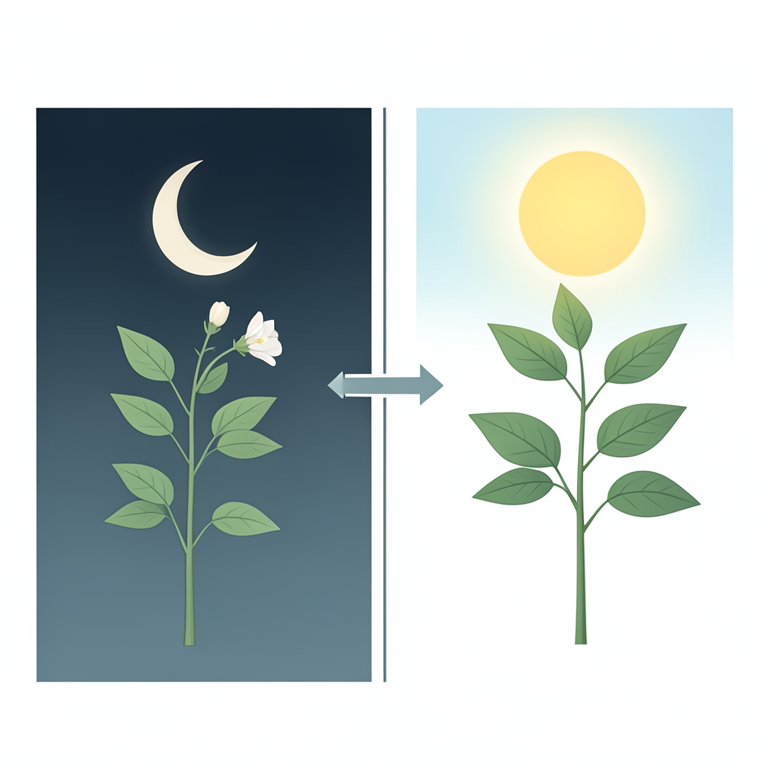
GmPhyA1 vs GmPhyB1 Functional Contrast
AI-generated conceptual illustration (soybean plants). It explains the idea and does not show study data.
View source evidence ↗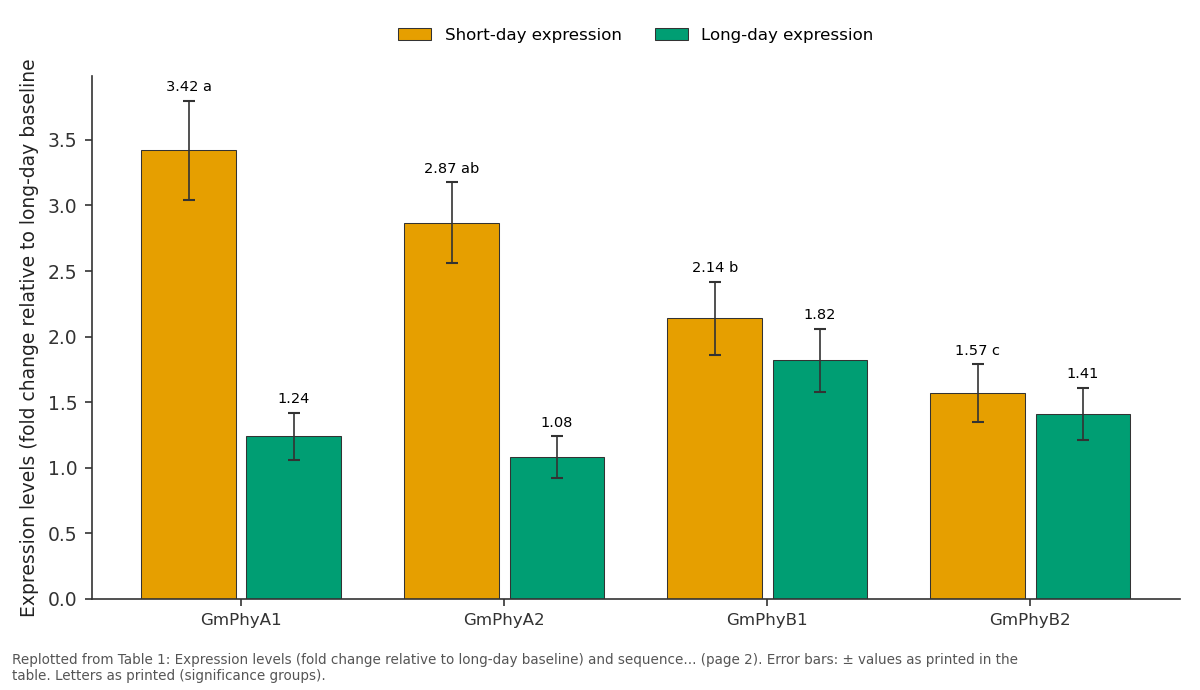
Short-day expression and Long-day expression: GmPhyA1 vs GmPhyA2 vs GmPhyB1 vs GmPhyB2
Replotted from Table 1 (page 2) of the original paper. Every bar is the paper's own table value.
View source evidence ↗Figures & tables
From the original paper Table 1
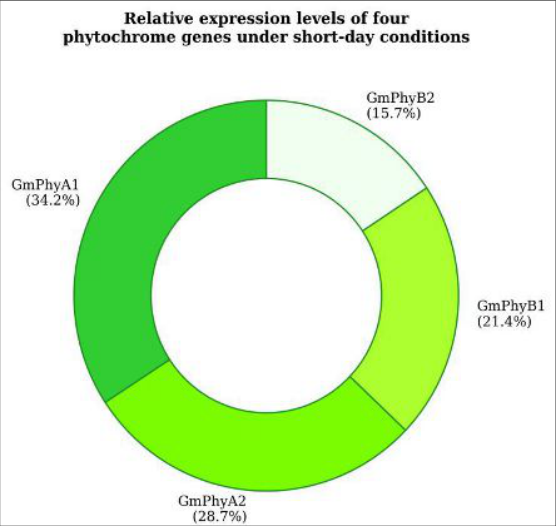 Figure 1
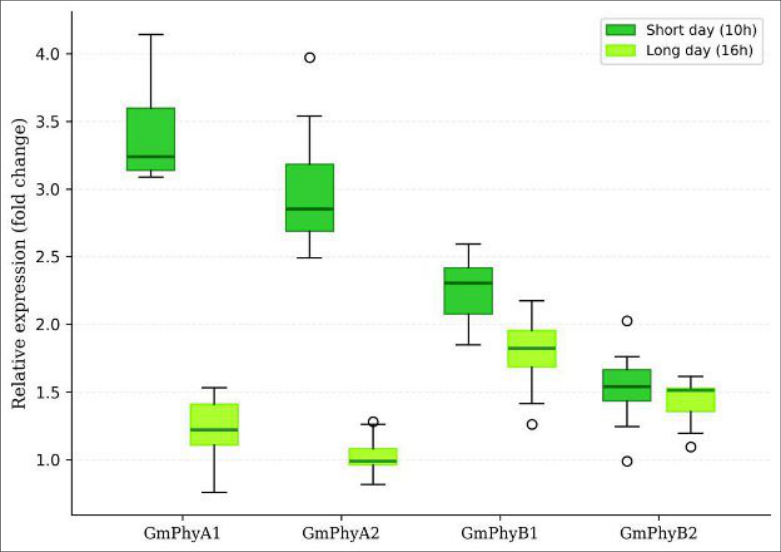 Figure 2
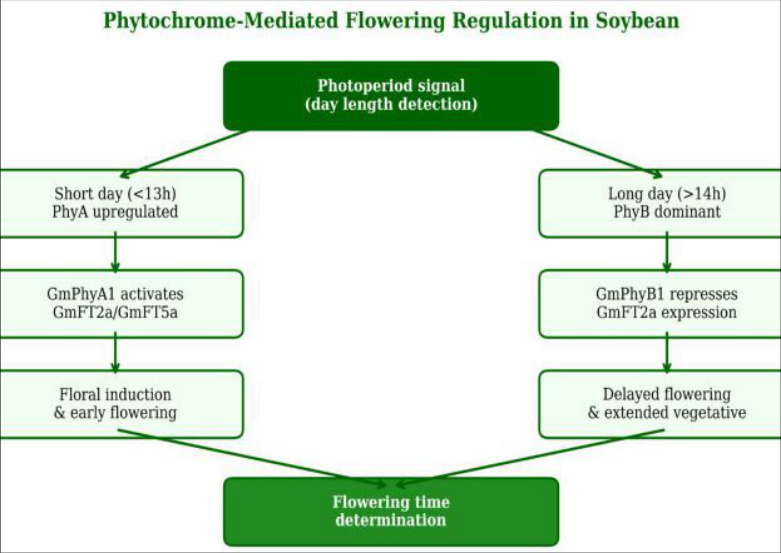 Figure 3
Introduction
Every soybean grower knows that planting date matters sow too early and the plants flower before building enough vegetative biomass; sow too late and they won't mature before the monsoon ends. What many don't realise is that the molecular switch controlling this response is a family of light-sensing proteins called phytochromes [1] . In soybean (Glycine max L. Merr.), a quantitative short-day plant, flowering is triggered when night length exceeds a critical threshold, and phytochromes are the molecules that measure that threshold [2] . The soybean genome contains at least four phytochrome genes: GmPhyA1, GmPhyA2, GmPhyB1, and GmPhyB2 [3] . PhyA-type proteins are thought to promote flowering under short days, while PhyB types may inhibit it under long days, but the relative importance of each gene in tropical Indian cultivars has not been established [4] . Cloning and functionally characterising these genes from photoperiod-sensitive Indian varieties is a necessary step toward developing molecular tools for breeding photoperiod-insensitive cultivars that perform well across latitudes [5] .
Reagents and chemicals
Total RNA was extracted from trifoliate leaves using TRIzol reagent (Invitrogen, Carlsbad, CA). First-strand cDNA was synthesised using SuperScript IV reverse transcriptase (Thermo Fisher Scientific). Gene-specific primers were designed from Williams 82 reference sequences using Primer3 software and synthesised by Eurofins Genomics India. Phusion High-Fidelity DNA Polymerase (New England Biolabs) was used for PCR amplification. pGEM-T Easy vector (Promega) was used for cloning. Agrobacterium tumefaciens strain GV3101 and the pCAMBIA1305.1 binary vector were used for transient expression in Arabidopsis thaliana Col-0 [3,5,6] .
Material and Methods Material
Soybean cultivar JS 335 (maturity group VIII, strong shortday response) was grown in controlled-environment chambers at Swarnim Gujarat Agricultural University, Gandhinagar (23°13′N, 72°41′E). Two photoperiod treatments were applied from emergence: short day (10 h light / 14 h dark) and long day (16 h light / 8 h dark), at 28/22°C day/night temperature and 400 μmol m⁻² s⁻¹ PAR. Arabidopsis Col-0 plants for functional analysis were maintained at BUAT, Banda [4,6] .
Methods
Trifoliate leaves were sampled at V3 stage (21 days after emergence) at 4-hour intervals across a 24-hour cycle. RNA extraction, DNase treatment, and cDNA synthesis followed standard molecular biology protocols [6] . Full-length phytochrome cDNAs were amplified by RT-PCR with genespecific primers, cloned into pGEM-T Easy, and sequenceverified by Sanger sequencing (Macrogen, South Korea). Expression analysis was performed by qRT-PCR using SYBR Green Master Mix on a QuantStudio 5 system, with GmActin as the reference gene [7] . The 2⁻ΔΔCt method was used for relative quantification. For functional analysis, GmPhyA1 was subcloned into pCAMBIA1305.1 under the CaMV 35S promoter, transformed into Arabidopsis by floral dip, and flowering time was recorded as days to first open flower under short-day conditions [8] . Data were analysed by ANOVA in R 4.2.1. GmPhyA1 showed the strongest short-day induction (2.76fold over long-day baseline), peaking 6 hours after dusk (Table 1). GmPhyB1 was only weakly photoperiodresponsive (ratio 1.18) and peaked at midday, consistent with a light-stable phytochrome role. Arabidopsis plants overexpressing GmPhyA1 flowered at 22.3 days under short days compared to 26.5 days for empty-vector controls (p < 0.01).
| Gene | CDS length (bp) | Short-day expression | Long-day expression | SD/LD ratio | Peak time (SD) | Protein (aa) |
|---|---|---|---|---|---|---|
| GmPhyA1 | 3,384 | 3.42 ± 0.38a | 1.24 ± 0.18 | 2.76 | ZT 20 (dusk+6h) | 1,128 |
| GmPhyA2 | 3,372 | 2.87 ± 0.31ab | 1.08 ± 0.16 | 2.66 | ZT 18 (dusk+4h) | 1,124 |
| GmPhyB1 | 3,456 | 2.14 ± 0.28b | 1.82 ± 0.24 | 1.18 | ZT 8 (midday) | 1,152 |
| GmPhyB2 | 3,441 | 1.57 ± 0.22c | 1.41 ± 0.20 | 1.11 | ZT 6 (morning) | 1,147 |
Table text extracted from the original PDF; superscript letters are shown inline. The original table image is below.
View original table image
Results
Results
Discussion
The 2.76-fold short-day induction of GmPhyA1 and its nighttime expression peak are consistent with its predicted role as a phytochrome A homolog that accumulates in darkness and is rapidly degraded by light a property that makes it an effective night-length sensor [1,3] . The functional validation in Arabidopsis, where GmPhyA1 overexpression accelerated flowering by 4.2 days, provides direct evidence that this gene can promote flowering. The relatively weak photoperiod response of GmPhyB1 suggests it plays a secondary role in daylength perception but may be more important for shade avoidance and stem elongation [4] . For breeding applications, suppressing or modifying GmPhyA1 through gene editing could potentially reduce photoperiod sensitivity, allowing JS 335-type cultivars to be grown across a wider latitudinal range without the yield penalties of inappropriate flowering timing [2,5] .
Conclusion
GmPhyA1 was identified as the primary short-dayresponsive phytochrome gene in soybean cultivar JS 335, with 2.76-fold induction under 10 h daylength and functional confirmation of flowering promotion in Arabidopsis. GmPhyB1 was weakly responsive and likely plays a supplementary role. GmPhyA1 is a promising target
Acknowledgement
International Journal of Agriculture and Nutrition https://www.agriculturejournal.net for CRISPR-based editing to develop photoperiodinsensitive soybean lines adapted to diverse latitudes.
Figures and tables from the paper
References
21 in the original paper- Quail PH. Phytochrome photosensory signalling networks. Nature Reviews Molecular Cell Biology. 2002;3(2):85-93.
- Watanabe S, Xia Z, Hideshima R, Tsubokura Y, Sato S, Yamanaka N, et al. A map-based cloning strategy employing a residual heterozygous line reveals that the GIGANTEA gene is involved in soybean maturity and flowering. Genetics. 2011;188(2):395-407.
- Liu B, Kanazawa A, Matsumura H, Takahashi R, Harada K, Abe J. Genetic redundancy in soybean photoresponses associated with duplication of the phytochrome A gene. Genetics. 2008;180(2):995-1007.
- Xia Z, Watanabe S, Yamada T, Tsubokura Y, Nakashima H, Zhai H, et al. Positional cloning and characterization reveal the molecular basis for soybean maturity locus E1 that regulates photoperiodic flowering. Proceedings of the National Academy of Sciences. 2012;109(32):E2155-E2164.
- Cober ER, Morrison MJ. Regulation of seed yield and agronomic characters by photoperiod sensitivity and growth habit genes in soybean. Theoretical and Applied Genetics. 2010;120(5):1005-1012.
- Sambrook J, Russell DW. Molecular Cloning: A Laboratory Manual. Third edition. Cold Spring Harbor Laboratory Press, New York. 2001.
- Livak KJ, Schmittgen TD. Analysis of relative gene expression data using real-time quantitative PCR and the 2⁻ΔΔCT method. Methods. 2001;25(4):402-408.
- Clough SJ, Bent AF. Floral dip: a simplified method for Agrobacterium-mediated transformation of Arabidopsis thaliana. The Plant Journal. 1998;16(6):735-743.
- Tsubokura Y, Watanabe S, Xia Z, Kanamori H, Yamagata H, Kaga A, et al. Natural variation in the genes responsible for maturity loci E1, E2, E3 and E4 in soybean. Annals of Botany. 2014;113(3):429-441.
- Nagatoshi Y, Fujita Y. Accelerating soybean breeding in a CO₂-supplemented growth chamber. Plant and Cell Physiology. 2019;60(1):77-84.
- Kong F, Liu B, Xia Z, Sato S, Kim BM, Watanabe S, et al. Two coordinately regulated homologs of FLOWERING LOCUS T are involved in the control of photoperiodic flowering in soybean. Plant Physiology. 2010;154(3):1220-1231.
- Wu F, Price BH, Haider W, Seoane G, Otegui ME, Sheehy JE. New insights into plant photoperiodic responses. Molecular Plant. 2014;7(9):1414-1417.
- Thakare D, Kumudini S, Dinkins RD. The alleles at the E1 locus impact the expression pattern of two soybean FT-like genes shown to induce flowering in Arabidopsis. Planta. 2011;234(5):933-943.
- Cao D, Takeshima R, Zhao C, Liu B, Jun A, Kong F. Molecular mechanisms of flowering under long days and stem growth habit in soybean. Journal of Experimental Botany. 2017;68(8):1873-1884.
- Watanabe S, Hideshima R, Xia Z, Tsubokura Y, Sato S, Nakamoto Y, et al. Map-based cloning of the gene associated with the soybean maturity locus E3. Genetics. 2009;182(4):1251-1262.
- Lu S, Zhao X, Hu Y, Liu S, Nan H, Li X, et al. Natural variation at the soybean J locus improves adaptation to the tropics and enhances yield. Nature Genetics. 2017;49(5):773-779.
- Weller JL, Ortega R. Genetic control of flowering time in legumes. Frontiers in Plant Science. 2015;6:207.
- Matsumura H, Liu B, Abe J. RFLP mapping of soybean maturity gene E4. Journal of Heredity. 2008;99(2):193197.
- Zhao C, Takeshima R, Zhu J, Xu M, Sato M, Watanabe S, et al. A recessive allele for delayed flowering at the soybean maturity locus E9 is a leaky allele of FT2a, a FLOWERING LOCUS T ortholog. BMC Plant Biology. 2016;16:238.
- Jiang B, Nan H, Gao Y, Tang L, Yue Y, Lu S, et al. Allelic combinations of soybean maturity loci E1-E4 associated with adaptation to high latitude environments. Crop Science. 2014;54(3):1012-1023.
- Langewisch T, Zhang H, Vincent R, Clemente TE, Bhatt DK. Major soybean maturity gene haplotypes revealed by SNPViz analysis of 72 sequenced soybean genomes. PLoS ONE. 2014;9(4):e94150.