
Research article · 2025 · Full text
International Journal of Agriculture and NutritionPhysiological responses of Mungbean genotypes to combined heat and drought stress
Volume 7(1) · Pages 53–56 · DOI: 10.33545/26646064.2025.v7.i1a.374 ↗
Research areasPlant Stress Responses and ToleranceGenetic and Environmental Crop StudiesGenetics and Plant Breeding
Abstract
Author-writtenMungbean production in South Asia faces an existential threat from the increasing overlap of heat waves and mid-season drought. This research evaluated physiological responses of five mungbean (Vigna radiata L.) genotypes under control, heat-only (>40 °C), drought-only (
Summary
Source-checkedPlain-language reading of the full paper, prepared with AI and checked against the text. Each point links to the authors' own words.
Why it matters
- Mungbean production in South Asia is seriously threatened by the simultaneous occurrence of heat waves and mid-season drought. View evidence ↗
The question
- The study aimed to quantify physiological damage in five mungbean genotypes under heat, drought, and combined stress, determine if the effects were additive or synergistic, and identify tolerant genotypes for breeding. View evidence ↗
What they did
- The experiment was a pot-culture study conducted at Assam Agricultural University in Jorhat, Assam. View evidence ↗
- Five genotypes (IPM-02-3, SML-668, Pusa Vishal, MH-421, and PDM-139) were tested using 12 pots per treatment in a randomized design over the 2022 and 2023 summer seasons. View evidence ↗
- Physiological measurements included relative water content (RWC), chlorophyll (SPAD), membrane stability index (MSI), proline, and malondialdehyde (MDA). View evidence ↗
What they found
- Under combined stress, SML-668 was the most resilient, maintaining the highest chlorophyll (31.2 SPAD) and RWC (0.61), whereas PDM-139 was the most sensitive. View evidence ↗
- SML-668 showed the lowest synergy index (1.25) and highest tolerance ranking, while PDM-139 had the highest synergy index (1.50) and lowest tolerance ranking. View evidence ↗
- Yield retention was strongly positively correlated with proline accumulation (r = 0.87) and strongly negatively correlated with MDA levels (r = -0.91). View evidence ↗
- Combined stress caused synergistic damage in all five genotypes, resulting in yield reductions 24–50% higher than what would be predicted by adding individual stress effects. View evidence ↗
What it means
- The authors recommend using the SML-668 genotype as a parental donor to breed mungbean varieties that are resilient to combined heat and drought stress. View evidence ↗
- The authors note that the use of pot-culture may underestimate the root-zone buffering that occurs in actual field soils. View evidence ↗
- The authors suggest that the next logical step is to validate the tolerance of SML-668 through multi-location field trials. View evidence ↗
Visual summary
2 visualsIllustrations explain the paper; charts are replotted from the paper's own table values.
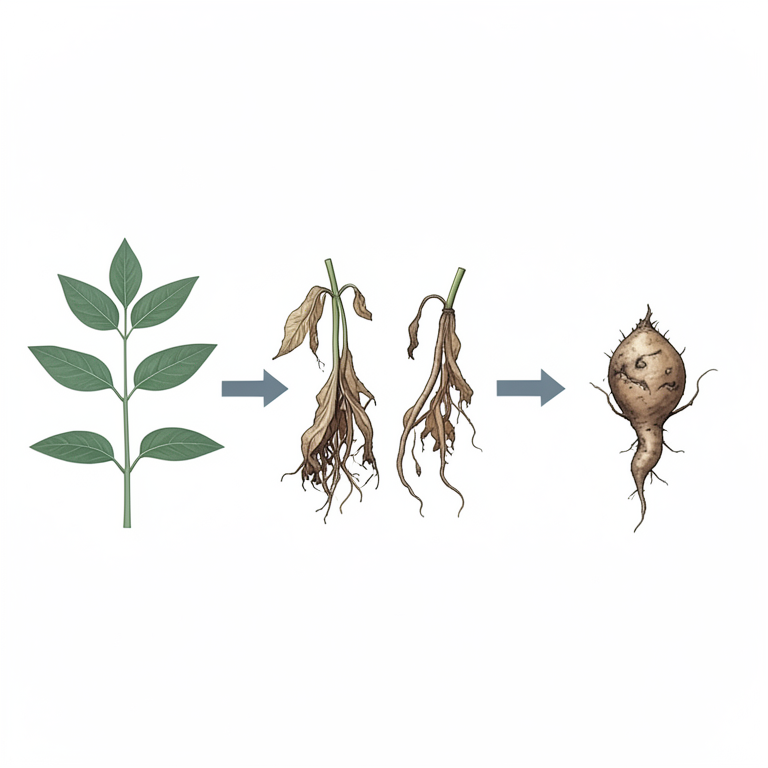
Synergistic Stress Pathway
AI-generated conceptual illustration (mungbean plants). It explains the idea and does not show study data.
View source evidence ↗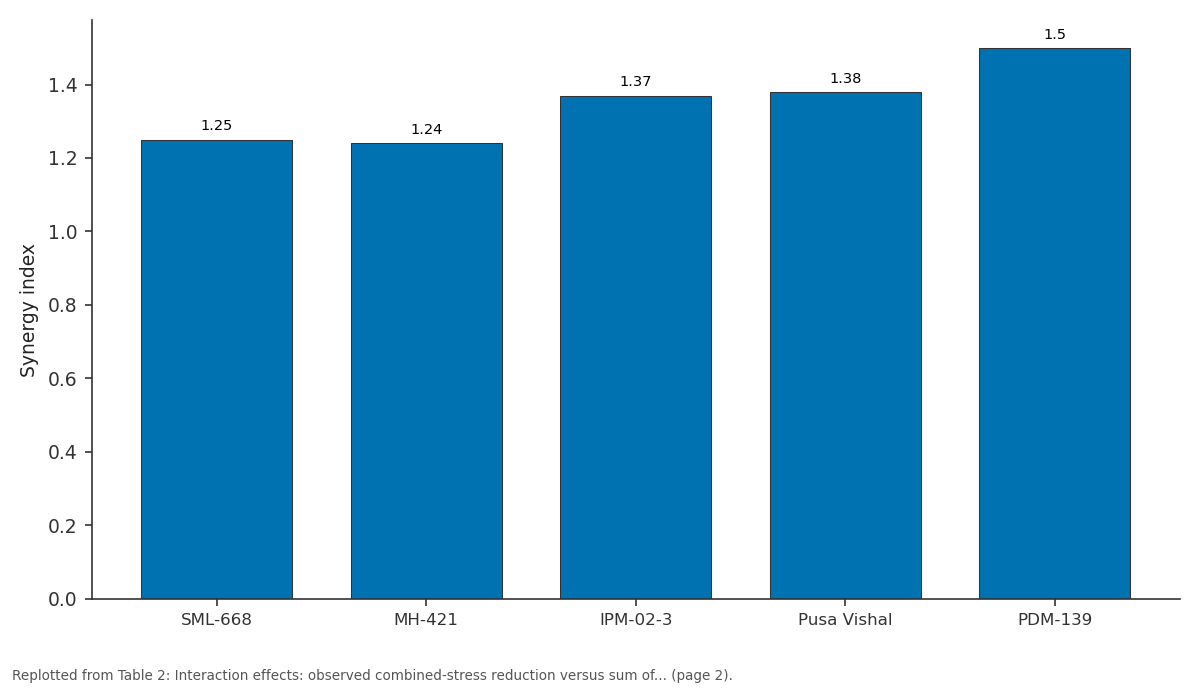
Synergy index: SML-668 vs MH-421 vs IPM-02-3 vs Pusa Vishal vs PDM-139
Replotted from Table 2 (page 2) of the original paper. Every bar is the paper's own table value.
View source evidence ↗Figures & tables
From the original paper Table 1
 Table 2
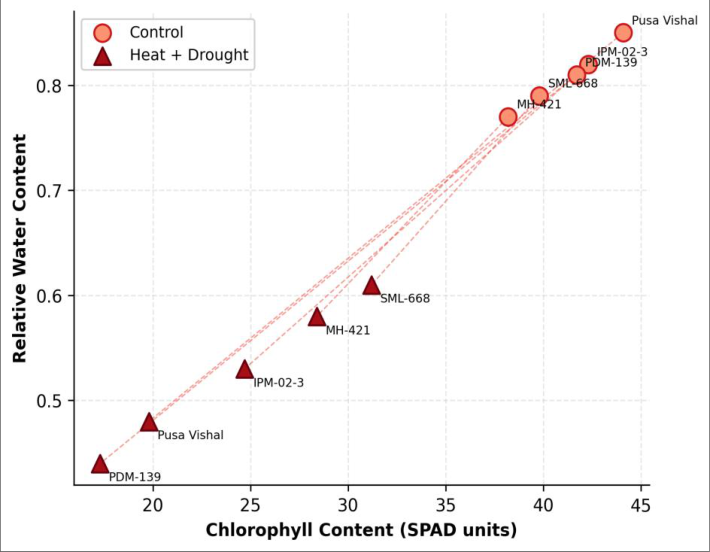 Figure 1
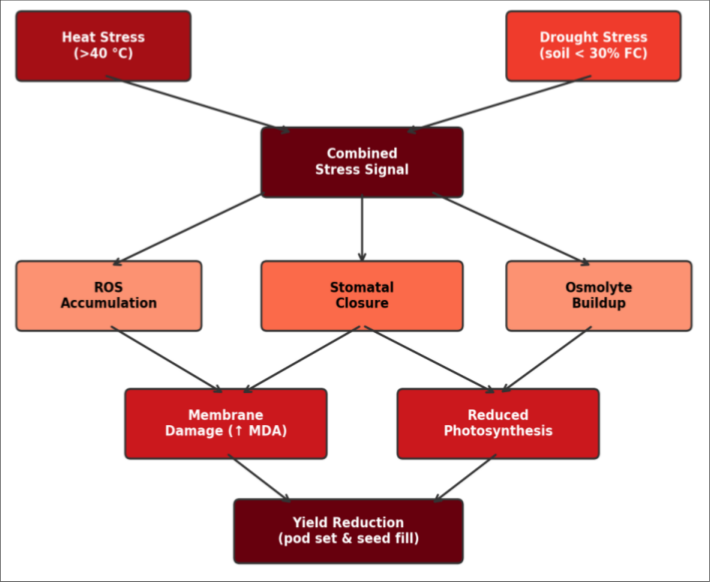 Figure 2
Introduction
Combined heat and drought stress is not simply the sum of two separate problems it triggers a unique set of physiological disruptions that single-stress experiments fail to capture [1] . Mungbean (Vigna radiata L.), a warm-season pulse grown across 7 million hectares in Asia, is particularly exposed because its reproductive window often coincides with late-spring heat waves and erratic pre-monsoon rainfall [2,3] . Under heat alone, pollen viability drops and pod set declines; under drought alone, stomatal closure limits carbon assimilation [4,5] . When both stresses overlap, reactive oxygen species (ROS) accumulate faster than antioxidant defences can neutralise them, accelerating membrane lipid peroxidation and chloroplast damage [6] . The net effect on yield is typically greater than predicted from either stress applied separately a phenomenon termed "stress interaction" [7] . Screening for combined-stress tolerance requires measuring traits that reflect both water status and thermal damage. Relative water content, chlorophyll retention, membrane stability, proline (an osmolyte marker), and MDA (a lipid peroxidation marker) are widely accepted indicators [8,9] . This research aimed to a) Quantify physiological damage under heat, drought, and their combination in five mungbean genotypes. b) Identify whether combined-stress effects are additive or synergistic c) Pinpoint genotypes with superior tolerance for use in breeding programmes.
Research Area and Experimental Conditions
The pot-culture experiment was conducted in the rain-out shelter and adjacent open field at Assam Agricultural University, Jorhat, Assam (26.75° N, 94.22° E; 86 m a.s.l.). Jorhat has a humid subtropical climate (Köppen Cwa) with mean summer temperatures of 28-33 °C and annual rainfall exceeding 2,000 mm. Pots (10 kg capacity) were filled with a sterilised mixture of local alluvial soil, sand, and vermicompost (2 : 1 : 1). Heat stress was imposed using a low-cost polyethylene chamber that raised canopy temperature to 42 ± 1.5 °C for six
Material and Methods
Material: Five mungbean genotypes were selected based on prior field reports: IPM-02-3, SML-668, Pusa Vishal, MH-421, and PDM-139. Seeds were obtained from the ICAR pulse seed repository. Each genotype was grown in 12 pots per treatment (control, heat, drought, combined), arranged in a completely randomised design with three replications across two summer seasons (2022 and 2023). Plants were thinned to three seedlings per pot at the first trifoliate stage.
Methods
Treatments were initiated at the onset of flowering (35 days after sowing) and maintained for 15 days. RWC was measured fully expanded leaves using the turgid-weight method [8] . Chlorophyll content was recorded with a SPAD-502 meter. MSI was determined by comparing electrolyte leakage at 40 °C and 100 °C [9] . Proline was quantified by the ninhydrin method, and MDA by the thiobarbituric acid reactive substances (TBARS) assay [6] . All assays were performed at the Department of Agricultural Botany laboratory, Assam Agricultural University. Data were subjected to two-way ANOVA (genotype × stress) and means compared using Tukey's HSD at p ≤ 0.05 in R 4.3.0.
Results
Results
Comprehensive Interpretation
Combined stress consistently produced greater damage than the arithmetic sum of individual stresses, confirmed by synergy indices exceeding 1.0 in all genotypes. SML-668 had the lowest synergy index (1.25), meaning its combinedstress penalty was only 25% above the additive expectation, compared with 50% for PDM-139. Proline accumulation under combined stress was positively correlated with yield retention (r = 0.87, p < 0.01), while MDA showed a strong negative association (r = -0.91), supporting the role of osmotic adjustment and membrane integrity in tolerance.
Discussion
The synergistic interaction between heat and drought observed here matches findings by Zandalinas et al. [7] in Arabidopsis and extends them to a grain legume context. The mechanism likely involves a feedback loop: heat accelerates transpiration, deepening the water deficit, which in turn reduces evaporative cooling and pushes leaf temperature higher [1,4] . SML-668 appears to cope through superior osmolyte accumulation its proline rose nearly five-fold under combined stress while PDM-139 showed weak osmotic adjustment and the sharpest membrane damage (MDA 36.7 nmol g⁻¹). These contrasts point to proline biosynthesis capacity as a selectable trait for breeders targeting combined-stress tolerance [6,9] . A practical limitation is that pot-culture conditions may underestimate root-zone buffering found in field soils. But the controlled setting allowed precise stress imposition, which field experiments cannot guarantee [8] . Multi-location field validation of SML-668's tolerance would be a logical next step.
Conclusion
Combined heat and drought stress caused synergistic not merely additive damage across all five mungbean genotypes, with yield reductions 24-50% greater than predicted from individual stresses. SML-668 was the most tolerant genotype, retaining the highest RWC, chlorophyll, and membrane stability while accumulating the most proline. PDM-139 was the most sensitive. Proline and MDA showed strong, opposing correlations with yield retention and can serve as rapid screening markers. SML-668 is recommended as a parental donor in breeding programmes targeting climate-resilient mungbean.
Acknowledgement
AcknowledgementsThis research was supported by the Assam Agricultural University departmental research grant. Technical assistance from Mr. Bipul Das in maintaining the rain-out shelter gratefully acknowledged.
Figures and tables from the paper
| Genotype | Treat- ment | RWC | SPAD | MSI (%) | Proline (µmol g⁻¹) | MDA (nmol g⁻¹) | Yield (g pot⁻¹) |
|---|---|---|---|---|---|---|---|
| SML-668 | Control | 0.79 | 39.8 | 74.2 | 3.1 | 8.7 | 18.4 |
| SML-668 | Heat+Dr | 0.61 | 31.2 | 51.3 | 14.8 | 21.6 | 9.7 |
| IPM-02-3 | Control | 0.82 | 42.3 | 76.8 | 2.8 | 7.9 | 19.1 |
| IPM-02-3 | Heat+Dr | 0.53 | 24.7 | 42.1 | 11.3 | 28.4 | 7.2 |
| PDM-139 | Control | 0.81 | 41.7 | 73.6 | 3.3 | 9.1 | 17.8 |
| PDM-139 | Heat+Dr | 0.44 | 17.3 | 33.8 | 9.6 | 36.7 | 4.3 |
Table text extracted from the original PDF; superscript letters are shown inline. The original table image is below.
View original table image
| Genotype | Heat only | Drought only | Sum (H+D) | Observed combined | Synergy index | Tolerance ranking |
|---|---|---|---|---|---|---|
| SML-668 | 12.7 | 15.3 | 28.0 | 34.9 | 1.25 | 1 (Tolerant) |
| MH-421 | 14.1 | 16.8 | 30.9 | 38.2 | 1.24 | 2 |
| IPM-02-3 | 11.9 | 18.6 | 30.5 | 41.8 | 1.37 | 3 |
| Pusa Vishal | 15.8 | 19.4 | 35.2 | 48.7 | 1.38 | 4 |
| PDM-139 | 13.6 | 21.2 | 34.8 | 52.3 | 1.50 | 5 (Sensitive) |
Table text extracted from the original PDF; superscript letters are shown inline. The original table image is below.
View original table image
References
14 in the original paper- Mittler R. Abiotic stress, the field environment and stress combination. Trends in Plant Science. 2006;11(1):15-19.
- Nair RM, Yang RY, Easdown WJ, Thavarajah D, Thavarajah P, Hughes JDA, Keatinge JDH. Biofortification of mungbean with zinc and iron. Journal of the Science of Food and Agriculture. 2013;93(8):1805-1813.
- Hanumantha Rao B, Nair RM, Nayyar H. Salinity and high-temperature tolerance in mungbean from a physiological perspective. Frontiers in Plant Science. 2016;7:957.
- Sita K, Sehgal A, Kumar J, Kumar S, Singh S, Siddique KHM, Nayyar H. Identification of high-temperature International Journal of Agriculture and Nutrition https://www.agriculturejournal.net tolerant lentil genotypes. Plant Physiology and Biochemistry. 2017;115:23-33.
- Lawlor DW, Cornic G. Photosynthetic carbon assimilation and associated metabolism in relation to water deficits in higher plants. Plant Cell and Environment. 2002;25(2):275-294.
- Hasanuzzaman M, Nahar K, Alam MM, Roychowdhury R, Fujita M. Physiological, biochemical and molecular mechanisms of thermotolerance in plants. International Journal of Molecular Sciences. 2013;14(5):9643-9684.
- Zandalinas SI, Mittler R, Balfagón D, Arbona V, Gómez-Cadenas A. Plant adaptations to the combination of drought and high temperatures. Physiologia Plantarum. 2018;162(1):2-12.
- Barrs HD, Weatherley PE. A re-examination of the relative turgidity technique for estimating water deficits in leaves. Australian Journal of Biological Sciences. 1962;15(3):413-428.
- Sairam RK, Rao KV, Srivastava GC. Differential response of wheat genotypes to long-term salinity stress in relation to oxidative stress, antioxidant activity and osmolyte concentration. Plant Science. 2002;163(5):1037-1046.
- Wahid A, Gelani S, Ashraf M, Foolad MR. Heat tolerance in plants: an overview. Environmental and Experimental Botany. 2007;61(3):199-223.
- Kumar S, Thakur P, Kaushal N, Malik JA, Gaur P, Nayyar H. Effect of varying high temperatures during reproductive growth on reproductive function, oxidative stress and seed yield in chickpea genotypes. Archives of Agronomy and Soil Science. 2013;59(6):823-843.
- Gill SS, Tuteja N. Reactive oxygen species and antioxidant machinery in abiotic stress tolerance in crop plants. Plant Physiology and Biochemistry. 2010;48(12):909-930.
- Farooq M, Wahid A, Kobayashi N, Fujita D, Basra SMA. Plant drought stress: effects, mechanisms and management. Agronomy for Sustainable Development. 2009;29(1):185-212.
- Priya M, Sharma L, Kaur R, Bindumadhava H, Nair RM, Siddique KHM, Nayyar H. Drought and heat stress-related proteins: an update about their functional relevance in imparting stress tolerance in peanut and mungbean. International Journal of Molecular Sciences. 2019;20(10):2421.