
Research article · 2025 · Full text
International Journal of Agriculture and NutritionEvaluation of phosphorus solubilizing bacteria for enhanced phosphorus uptake in acidic soils
Volume 7(6) · Pages 74–76 · DOI: 10.33545/26646064.2025.v7.i6b.420 ↗
Research areasAgricultural Science and FertilizationPlant-Microbe Interactions and ImmunityAgriculture, Plant Science, Crop Management
Abstract
Author-writtenPhosphorus fixation in acidic soils locks away up to 85% of applied fertiliser within days of application, leaving crops chronically P-deficient. This research evaluated five phosphorus solubilizing bacteria (PSB) isolates for their ability to mobilise fixed P and improve uptake in rice grown on acidic red soils (pH 4.7) at Lembucherra, Tripura, during Kharif 2022 and 2023. Isolates were characterised for solubilisation efficiency on Pikovskaya’s agar before field inoculation. The most effective strain, Pseudomonas fluorescens TPA-7, raised available P in the rhizosphere by 63.4% over the uninoculated control and increased grain P uptake to 17.4 kg ha-1 (vs. 8.3 kg ha-1 in the control). Grain yield under TPA-7 + 75% recommended P was statistically equal to full P without inoculation, implying a 25% saving on phosphatic fertiliser. Organic acid profiling showed that gluconic and oxalic acids were the dominant solubilising agents. These results support integrating PSB inoculants into fertiliser schedules for acid-soil rice production in north-eastern India.
Summary
Source-checkedPlain-language reading of the full paper, prepared with AI and checked against the text. Each point links to the authors' own words.
Why it matters
- In acidic soils, up to 85% of applied phosphorus fertilizer can become locked away and unavailable to crops within days. View evidence ↗
- In Tripura, India, over 70% of agricultural land has a pH below 5.5, leading farmers to apply double the recommended phosphorus to compensate for soil fixation. View evidence ↗
The question
- The study aimed to isolate PSB from acidic red soils, evaluate their effect on phosphorus mobilization and rice yield, and see if they could reduce the need for chemical phosphorus fertilizers. View evidence ↗
What they did
- The experiment used a factorial randomized block design testing five PSB strains plus a control across three phosphorus levels: 0%, 75%, and 100% of the recommended 60 kg P2O5 ha-1. View evidence ↗
- The 'Gomati' rice variety was used, with PSB applied via a seedling root dip (108 CFU mL-1) and a soil drench (2.5 kg ha-1) 15 days after transplanting. View evidence ↗
- Rhizosphere soil for PSB isolation was collected from 15 sites under native bamboo and grass on red lateritic soils near Tripura Agricultural University. View evidence ↗
- The researchers measured available phosphorus at three growth stages, determined grain and straw P uptake via nitric-perchloric digestion, and used HPLC to quantify organic acids. View evidence ↗
What they found
- The Pseudomonas fluorescens TPA-7 strain at 75% P level achieved the highest available phosphorus at harvest (23.1 kg ha-1), which was 63.4% higher than the 100% P control. View evidence ↗
- Rice grain yield using TPA-7 with 75% P (5.48 t ha-1) was statistically equivalent to the yield from 100% P without inoculation (5.32 t ha-1). View evidence ↗
- TPA-7 produced gluconic acid (4.7 mM) and oxalic acid (2.3 mM), which were 3-4 times higher than the concentrations produced by the TPA-15 strain. View evidence ↗
- A strong correlation (r = 0.91) between gluconic acid levels and available phosphorus identifies gluconic acid as the primary driver of phosphorus solubilization. View evidence ↗
- The TPA-7 strain remained effective throughout the season, persisting at a concentration of 106 CFU g-1 soil at harvest. View evidence ↗
What it means
- The authors conclude that Pseudomonas fluorescens TPA-7 is the most effective isolate for acidic red soils, allowing for a 25% reduction in chemical phosphorus fertilizer without reducing yield. View evidence ↗
- The authors state that scaling this solution will require the mass production of the TPA-7 strain and further demonstration trials for farmers. View evidence ↗
Visual summary
3 visualsIllustrations explain the paper; charts are replotted from the paper's own table values.
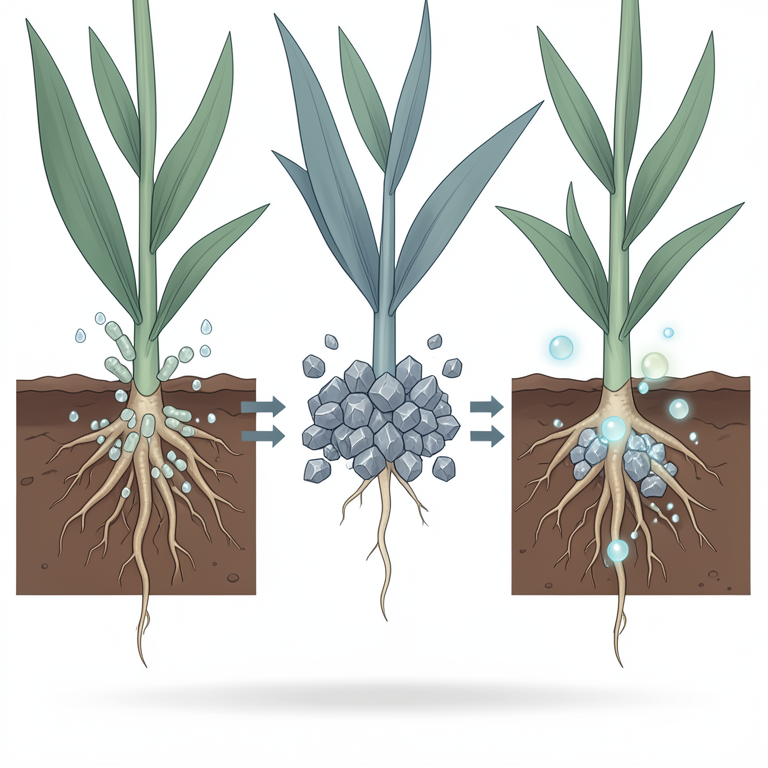
Mechanism of P-Solubilization
AI-generated conceptual illustration (maize plant roots in acidic soil). It explains the idea and does not show study data.
View source evidence ↗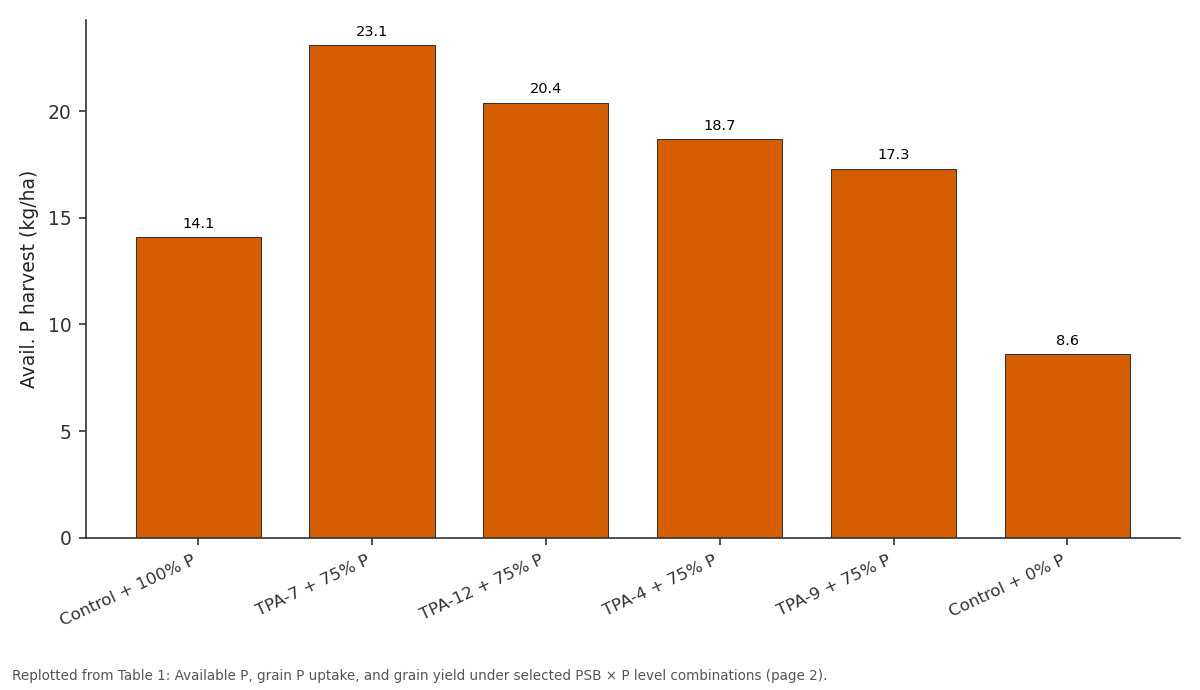
Avail. P harvest (kg/ha): Control + 100% P vs TPA-7 + 75% P vs TPA-12 + 75% P vs TPA-4 + 75% P vs TPA-9 + 75% P
Replotted from Table 1 (page 2) of the original paper. Every bar is the paper's own table value.
View source evidence ↗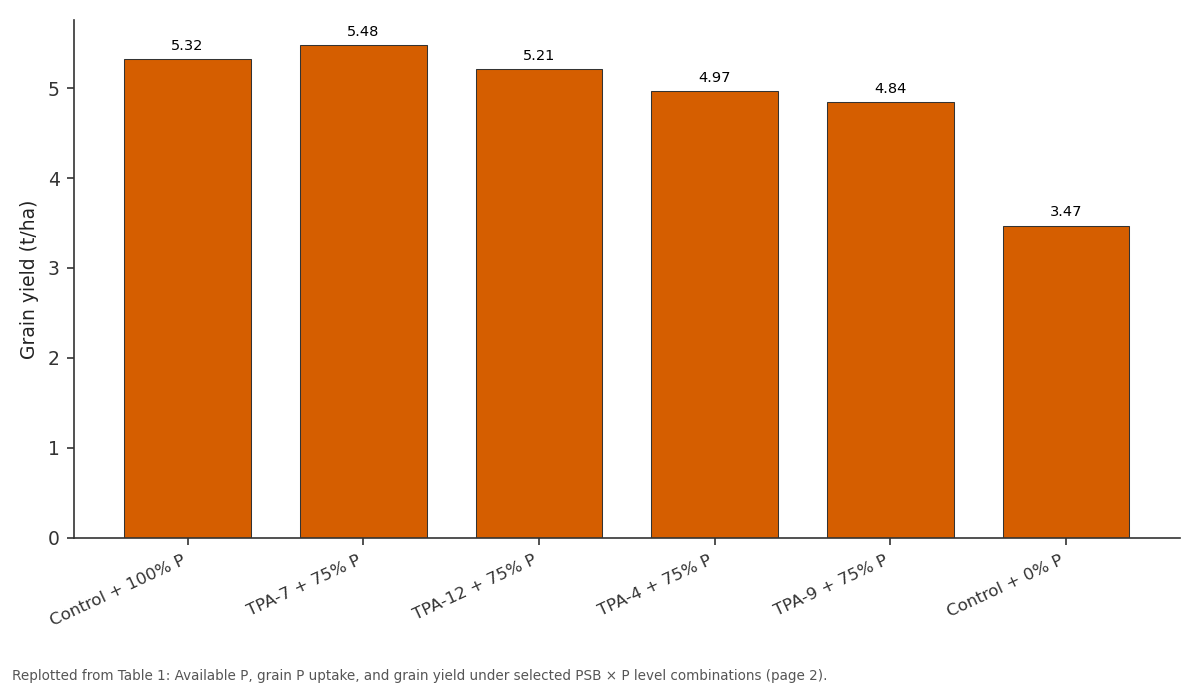
Grain yield (t/ha): Control + 100% P vs TPA-7 + 75% P vs TPA-12 + 75% P vs TPA-4 + 75% P vs TPA-9 + 75% P
Replotted from Table 1 (page 2) of the original paper. Every bar is the paper's own table value.
View source evidence ↗Figures & tables
From the original paper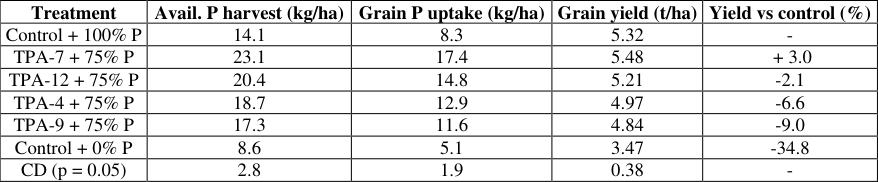 Table 1
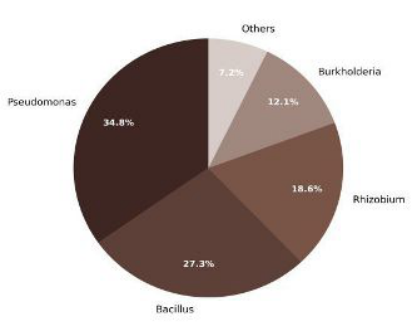 Figure 1
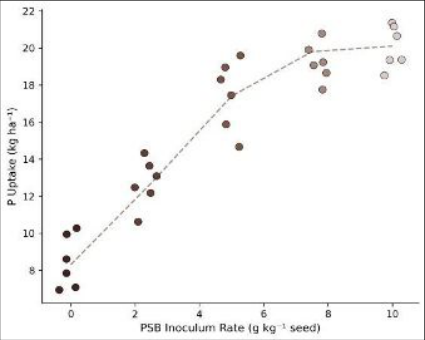 Figure 2
Introduction
Imagine applying a bag of phosphorus fertiliser and watching 80% of it become unavailable to the crop within a week. That is roughly what happens on strongly acidic soils, where aluminium and iron oxides rapidly fix soluble P into insoluble compounds [1] . In Tripura, where more than 70% of agricultural land has a pH below 5.5, rice farmers routinely apply superphosphate at twice the recommended rate simply to offset fixation losses [2] . Phosphorus solubilizing bacteria (PSB) offer a biological bypass. These rhizospheredwelling microbes secrete low-molecular-weight organic acids-gluconic, oxalic, citricthat chelate Al 3 + and Fe 3 + ions, releasing bound P back into soil solution [3] . Field trials on neutral to mildly acidic soils have demonstrated 10-25% yield increases from PSB inoculation [4,5] . However, performance on very acidic soils (pH < 5.0) is less predictable because the bacteria themselves may be inhibited by aluminium toxicity and low base saturation [6] . This research aimed to (i) isolate and screen PSB from the rhizosphere of native vegetation on acidic red soils, (ii) evaluate the five best isolates for P mobilisation and rice yield improvement under field conditions, and (iii) determine whether PSB inoculation can substitute part of the chemical P dose without yield loss.
Field Experimental Design
The trial was laid out in a factorial randomised block design with two factors: PSB isolate (five strains + uninoculated control) and P level (0%, 75%, and 100% of recommended P at 60 kg P 2 O 5 ha -1 ). This gave 18 treatment combinations replicated three times. Plot size was 4 m × 3 m. Rice variety 'Gomati' was transplanted at 20 × 15 cm. PSB were applied as a seedling root dip (10 8 CFU mL -1 ) and as a soil drench at 2.5 kg ha -1 15 days after transplanting [7] .
Climatic Conditions
Lembucherra (23°53′ N, 91°17′ E, 28 m a.s.l.) receives mean annual rainfall of 2,150 mm, most of it during June-September. Mean maximum temperature during Kharif 2022 was 32.4 °C and minimum 23.1 °C. Relative humidity exceeded 85% through July-August. These warm, moist conditions are generally favourable for microbial activity in the rhizosphere [8] .
Materials and Methods
Materials and Methods
Materials
Rhizosphere soil was collected from 15 sites under native grass and bamboo on red lateritic soils (Typic Kandiudults) around the Tripura Agricultural University campus. Serial dilutions were plated on Pikovskaya's medium amended with tricalcium phosphate. Colonies showing clear halo zones after 7 days were purified, identified by 16S rRNA sequencing, and tested for solubilisation index (SI = colony + halo diameter/colony diameter). The five isolates with SI > 2.5 were selected: Pseudomonas fluorescens TPA-7 (SI 3.8), Bacillus megaterium TPA-12 (SI 3.2), Burkholderia cepacia TPA-4 (SI 2.9), Pseudomonas putida TPA-9 (SI 2.7), and Bacillus subtilis TPA-15 (SI 2.6) [9] .
Methods
Rhizosphere available P (Bray-1) was measured at tillering, panicle initiation, and harvest. Grain and straw P uptake was determined after nitric-perchloric digestion using the vanadomolybdate method. Organic acids in root-zone soil were quantified by HPLC. Data were analysed by two-factor ANOVA in R (v4.3.1) with means separated by Tukey's HSD at p = 0.05.
Results
PSB inoculation significantly raised rhizosphere available P across all sampling stages (Table 1). TPA-7 at 75% P recorded the highest available P at harvest (23.1 kg ha -1 ), 63.4% above the uninoculated control at 100% P. Grain yield under TPA-7 + 75% P was 5.48 t ha -1 , statistically equal to the uninoculated 100% P treatment (5.32 t ha -1 ). TPA-12 was the second-best performer.
| Treatment | Avail. P harvest (kg/ha) | Grain P uptake (kg/ha) | Grain yield (t/ha) | Yield vs control (%) |
|---|---|---|---|---|
| Control + 100% P | 14.1 | 8.3 | 5.32 | - |
| TPA-7 + 75% P | 23.1 | 17.4 | 5.48 | + 3.0 |
| TPA-12 + 75% P | 20.4 | 14.8 | 5.21 | -2.1 |
| TPA-4 + 75% P | 18.7 | 12.9 | 4.97 | -6.6 |
| TPA-9 + 75% P | 17.3 | 11.6 | 4.84 | -9.0 |
| Control + 0% P | 8.6 | 5.1 | 3.47 | -34.8 |
| CD (p = 0.05) | 2.8 | 1.9 | 0.38 | - |
Table text extracted from the original PDF; superscript letters are shown inline. The original table image is below.
View original table image
Comprehensive Interpretation
HPLC profiling revealed that TPA-7 produced gluconic acid (4.7 mM) and oxalic acid (2.3 mM) in rhizosphere extracts, concentrations 3-4 times higher than those from TPA-15. Gluconic acid is the primary P-solubilising organic acid because it chelates both Al 3 + and Fe 3 + [3] . The strong correlation between gluconic acid concentration and available P (r = 0.91) confirms its role as the main driver of solubilisation in this soil.
Discussion
The 63% increase in available P with TPA-7 exceeds the 25-40% range typically seen on neutral soils [4,5] , probably because the strongly acidic conditions maximise the demand for organic acid-mediated chelation. On near-neutral soils, chemical equilibrium already keeps some P in solution, so the marginal benefit of PSB is smaller [10] . The ability of TPA-7 to maintain yield at 75% P indicates genuine substitution potential-a finding that could save Tripura's rice farmers roughly INR 1,200 ha -1 in fertiliser cost [11] . Survival of PSB through the season is a concern on very acidic soils. Colony counts at harvest showed that TPA-7 persisted at 10 6 CFU g -1 soil, above the threshold considered effective [12] . This resilience likely reflects the strain's origin from similarly acidic native soils. Introduced commercial strains isolated from neutral environments might not perform as well [13,14] .
Conclusion
Among five PSB isolates tested, Pseudomonas fluorescens TPA-7 was the most effective at mobilising fixed P on acidic red soils, raising available P by 63% and enabling a 25% reduction in chemical P input without yield loss. Gluconic acid secretion was the primary solubilisation mechanism. For acid-soil rice systems in Tripura and similar regions, TPA-7 offers a viable biofertiliser option. Scaling will require mass production of the strain and farmer-level demonstration trials [15,16] .
Acknowledgement
Acknowledgements Funding SourcesThis research was supported by the institutional research budget of Tripura Agricultural University. Institutional SupportThe author thanks the soil microbiology laboratory at Tripura Agricultural University, Lembucherra, for culture maintenance and analytical facilities.
Figures and tables from the paper
References
20 in the original paper- Hinsinger P. Bioavailability of soil inorganic P in the rhizosphere as affected by root-induced chemical changes. Plant and Soil. 2001;237(2):173-195.
- Sharma PD, Baruah TC. Soils of Tripura: properties and management. Journal of the Indian Society of Soil Science. 2013;61(2):98-108.
- Rodríguez H, Fraga R. Phosphate solubilizing bacteria and their role in plant growth promotion. Biotechnology Advances. 1999;17(4-5):319-339.
- Khan MS, Zaidi A, Wani PA. Role of phosphatesolubilizing microorganisms in sustainable agriculture. Agronomy for Sustainable Development. 2007;27(1):29-43.
- Sharma SB, Sayyed RZ, Trivedi MH, Gobi TA. Phosphate solubilizing microbes: sustainable approach for managing phosphorus deficiency. SpringerPlus. 2013;2(1):587.
- Bolan NS, Naidu R, Mahimairaja S, Baskaran S. Influence of low-molecular-weight organic acids on the solubilization of phosphates. Biology and Fertility of Soils. 1994;18(4):311-319.
- Vessey JK. Plant growth promoting rhizobacteria as biofertilizers. Plant and Soil. 2003;255(2):571-586.
- Alexander M. Introduction to soil microbiology. 2nd ed. John Wiley and Sons. New York; 1977.
- Nautiyal CS. An efficient microbiological growth medium for screening phosphate solubilizing microorganisms. FEMS Microbiology Letters. 1999;170(1):265-270.
- Richardson AE, Simpson RJ. Soil microorganisms mediating phosphorus availability. Plant Physiology. 2011;156(3):989-996.
- Tilak KVBR, Ranganayaki N, Pal KK, De R, Saxena AK, Shekhar Nautiyal C. Diversity of plant growth and soil health supporting bacteria. Current Science. 2005;89(1):136-150.
- Bashan Y, de-Bashan LE, Prabhu SR, Hernandez JP. Advances in plant growth-promoting bacterial inoculant technology. Plant and Soil. 2014;378(1):1-33.
- Whitelaw MA. Growth promotion of plants inoculated with phosphate-solubilizing fungi. Advances in Agronomy. 2000;69:99-151.
- Gyaneshwar P, Kumar GN, Parekh LJ, Poole PS. Role of soil microorganisms in improving P nutrition of plants. Plant and Soil. 2002;245(1):83-93.
- Zaidi A, Khan MS, Ahemad M, Oves M. Plant growth promotion by phosphate solubilizing bacteria. Acta Microbiologica et Immunologica Hungarica. 2009;56(3):263-284.
- Goldstein AH. Bioprocessing of rock phosphate ore: essential technical considerations. Proceedings of the 4th International Fertiliser Association Technical Conference. Paris; 2000. p.220-228.
- Sashidhar B, Podile AR. Mineral phosphate solubilization by rhizosphere bacteria and scope for manipulation. Journal of Scientific and Industrial Research. 2010;69(10):751-764.
- Oteino N, Lally RD, Kiwanuka S, Lloyd A, Ryan D, Germaine KJ. Plant growth promotion induced by phosphate solubilizing endophytic Pseudomonas isolates. Frontiers in Microbiology. 2015;6:745.
- Syers JK, Johnston AE, Curtin D. Efficiency of soil and fertilizer phosphorus use. FAO Fertilizer and Plant Nutrition Bulletin. 2008;18:1-108.
- Vassilev N, Vassileva M, Nikolaeva I. Simultaneous Psolubilizing and biocontrol activity of microorganisms. Applied Microbiology and Biotechnology. 2006;71(2):137-144.