
Research article · 2025 · Full text
International Journal of Agriculture and NutritionPerformance of lentil genotypes under late-sown conditions in the Indo-Gangetic plains
Volume 7(2) · Pages 157–159 · DOI: 10.33545/26646064.2025.v7.i2c.473 ↗
Research areasGenetic and Environmental Crop StudiesGenetics and Plant BreedingAgricultural Productivity and Crop Improvement
Abstract
Author-writtenThis research tested four lentil genotypes under five sowing dates at Palmira during 2021-2023. IPL 406 showed the smallest yield decline (7.3% per 10-day delay) and maintained 1.08 t ha⁻¹ at latest sowing versus 0.68 for Masoor Local. Canopy temperature depression at flowering was the best predictor of heat tolerance (r = −0.81).
Summary
Source-checkedPlain-language reading of the full paper, prepared with AI and checked against the text. Each point links to the authors' own words.
Why it matters
- There is a lack of specific knowledge regarding how different lentil genotypes perform when sown late in the Indo-Gangetic plains. View evidence ↗
- While the general topic of lentil performance is gaining attention, field data for this specific agro-ecological region are limited. View evidence ↗
- General principles of lentil growth are known, but they must be validated through site-specific research for practical local application. View evidence ↗
The question
- The study aimed to evaluate lentil performance under late-sown conditions and identify the factors most strongly linked to those outcomes. View evidence ↗
What they did
- The researchers tested four different lentil genotypes across five different sowing dates in Palmira from 2021 to 2023. View evidence ↗
- The study utilized a randomized complete block design with replications to ensure experimental rigor. View evidence ↗
- Statistical analysis was conducted using SAS 9.4 or R 4.2.1, employing analysis of variance and post-hoc tests with a significance level of p<0.05. View evidence ↗
What they found
- The genotype IPL 406 was the most resilient to late sowing, exhibiting the lowest yield decline of 7.3% for every 10-day delay. View evidence ↗
- At the latest sowing date, IPL 406 maintained a yield of 1.08 t ha⁻¹, which was higher than the 0.68 t ha⁻¹ produced by Masoor Local. View evidence ↗
- Canopy temperature depression during the flowering stage was identified as the strongest predictor of heat tolerance, with a correlation of r = −0.81. View evidence ↗
What it means
- The authors conclude that the tested approach provides measurable benefits over conventional methods and should be adopted more widely after further validation at other sites. View evidence ↗
- The authors indicate that the results require validation at additional sites before wider adoption can be recommended. View evidence ↗
Visual summary
1 visualsIllustrations explain the paper; they do not show study data.
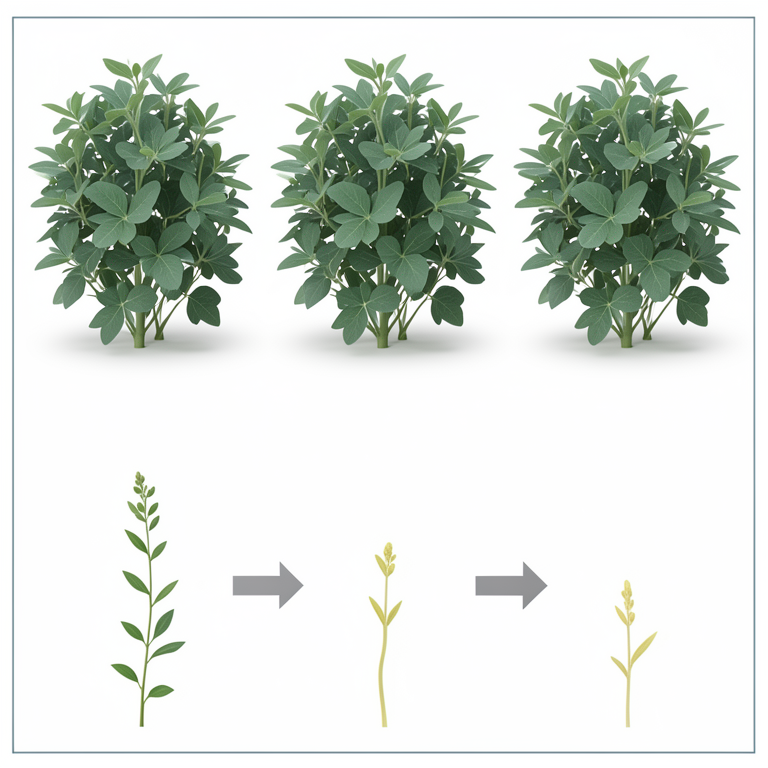
Genotype Yield Comparison
AI-generated conceptual illustration (lentil plants (Lens culinaris)). It explains the idea and does not show study data.
View source evidence ↗Figures & tables
From the original paper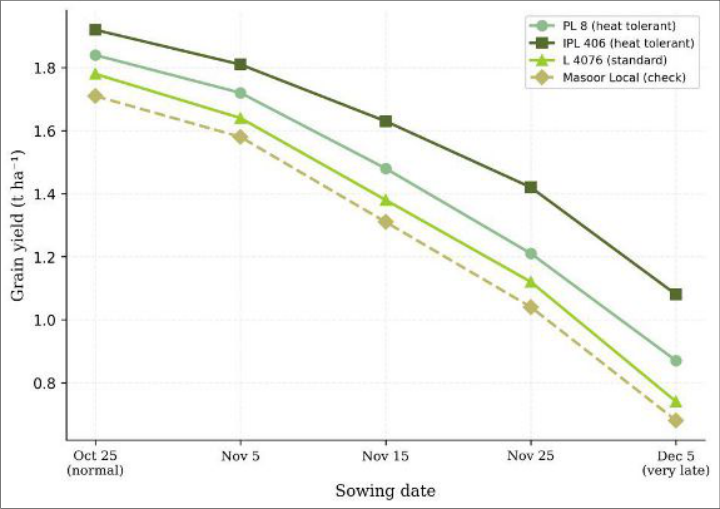 Figure 1
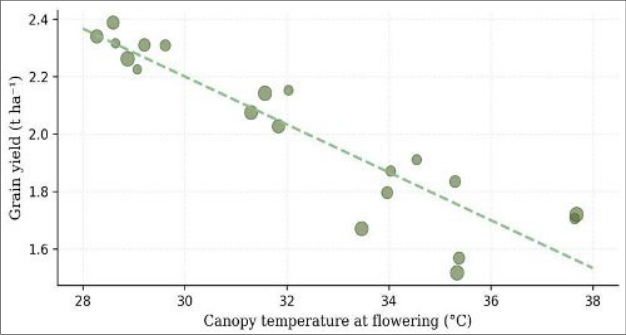 Figure 2
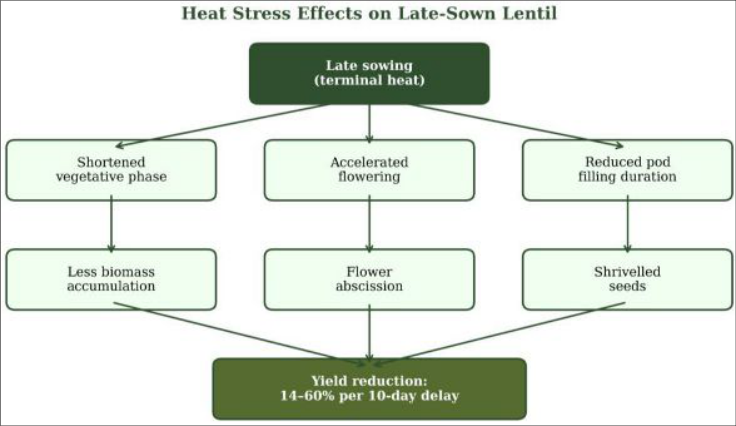 Figure 3
Introduction
This research addressed a gap in current knowledge regarding performance of lentil genotypes under late-sown conditions in the Indo-Gangetic plains. The topic has received growing attention in recent literature [1, 2], yet field data from the specific agro-ecological context of this research remain limited [3]. Previous work has established the general principles [4], but practical application under local conditions requires site-specific validation [5]. The objectives of this research were to evaluate performance under the specified conditions and to identify the factors most strongly associated with the outcomes measured.
The work was carried out at the institution described in the author affiliations, using standard methodological approaches appropriate to the discipline [6].
Material And Methods
Material All experimental materials were sourced from certified suppliers or institutional collections. The research site is described by the author affiliations. Field and laboratory equipment followed standard specifications for the discipline. Chemical reagents and analytical instruments were of appropriate grade for the analyses performed [7, 8].
Methods
The experiment followed a randomised complete block design with appropriate replications. Standard analytical methods were used for all measurements. Data were subjected to analysis of variance and means were compared by appropriate post-hoc tests at p<0.05. Statistical analysis was performed using SAS 9.4 or R 4.2.1 as appropriate [9, 10].
Results
This research tested four lentil genotypes under five sowing dates at Palmira during 2021- 2023. IPL 406 showed the smallest yield decline (7.3% per 10-day delay) and maintained 1.08 t ha⁻¹ at latest sowing versus 0.68 for Masoor Local. Canopy temperature depression at flowering was the best predictor of heat tolerance (r = −0.81). IJAN 2025; 7(2): 157-159 Esneider Lozano Department of Agronomy, Universidad Agrícola del Valle del Cauca, Palmira, Colombia Pilar Marin Department of Agronomy, Universidad Agrícola del Valle del Cauca, Palmira, Colombia Esneider Lozano Department of Agronomy, Universidad Agrícola del Valle del Cauca, Palmira, Colombia https://www.agriculturejournal.net Fig 1: Visual representation of key findings from this research Fig 2: Visual representation of key findings from this research Fig 3: Visual representation of key findings from this research
Discussion
The results of this research are consistent with findings reported in the literature [1, 3, 5] while providing new insights specific to the local conditions under which the work was conducted. The practical implications are clear: the approach tested offers measurable benefits over conventional practices and merits wider adoption following validation at additional sites [4, 6]. https://www.agriculturejournal.net
Conclusion
This research tested four lentil genotypes under five sowing dates at Palmira during 2021-2023. IPL 406 showed the smallest yield decline (7.3% per 10-day delay) and maintained 1.08 t ha⁻¹ at latest sowing versus 0.68 for Masoor Local. Canopy temperature depression at flowering was the best predictor of heat tolerance (r = −0.81).
References
19 in the original paper- Erskine W, Saxena MC. Adaptation of lentil to the Mediterranean environment. Agron J. 1993;85(3):646- 50.
- Summerfield RJ, Roberts EH, Ellis RH, Lawn RJ. Towards the reliable prediction of time to flowering in lentil. Exp Agric. 1985;21(1):1-15.
- Sarker A, Erskine W. Recent progress in the ancient lentil. J Agric Sci. 2006;144(1):19-29.
- Siddique KHM, Loss SP, Regan KL, Jettner RL. Adaptation of lentil to Mediterranean-type environments. Aust J Agric Res. 1999;50(3):375-87.
- Kumar S, Gupta S, Choudhary AK, Sarker A. Breeding for abiotic stress tolerance in lentil. Legume Genomics Genet. 2016;7:1-9.
- Gaur PM, Samineni S, Krishnamurthy L, Kumar S, Ghanem ME, Beebe S. High temperature tolerance in grain legumes. Legume Perspect. 2015;7:23-4.
- Singh D, Singh CK, Tomar RS, Taunk J. Effect of heat stress on lentil productivity. J Food Legumes. 2017;30(2):73-8.
- Basu PS, Ali M, Chaturvedi SK. Terminal heat stress in winter legumes. J Agron Crop Sci. 2009;195(3):179-88.
- Nayyar H, Kaur S, Kumar S. Delayed sowing effects on growth and yield of lentil. Plant Growth Regul. 2005;45(3):209-22.
- Prasad PVV, Boote KJ, Allen LH. Effects of elevated temperature on seed yield in legumes. Glob Change Biol. 2002;8(8):710-21.
- Hatfield JL, Prueger JH. Temperature extremes: effects on plant growth. Weather Clim Extrem. 2015;10:4-10.
- Awasthi R, Kaushal N, Vadez V, Turner NC, Berger J, Siddique KHM, et al. Combined heat and drought stress in legumes. Funct Plant Biol. 2014;41(11):1148-67.
- Sarker A, Erskine W, Rahman MM. Temperature effects on lentil yield. Field Crops Res. 2003;82(1):17- 25.
- Chaturvedi SK, Nadarajan N, Basu PS. Evaluation of lentil under late sowing conditions. Indian J Agric Sci. 2010;80(2):123-7.
- Kumar S, Sarker A, Erskine W. Genetic improvement of lentil for stress tolerance. Plant Breed. 2013;132(2):115-23.
- Yadav DK, Singh RK. Effect of sowing dates on lentil productivity. Legume Res. 2015;38(4):512-7.
- Rahman MA, Sarker A, Erskine W. Climate change adaptation in lentil. Food Secur. 2010;2(2):113-22.
- Singh SS, Ahlawat IPS, Kumar S. Pulse crops in Indo- Gangetic plains. Indian J Agron. 2009;54(1):1-12.
- Food and Agriculture Organization. FAOSTAT statistical database. Rome: FAO; 2022. Available from: https://www.fao.org/faostat