
Research article · 2025 · Full text
International Journal of Agriculture and NutritionPerformance evaluation of mechanized sowing on growth and yield of rabi sorghum
Volume 7(1) · Pages 113–115 · DOI: 10.33545/26646064.2025.v7.i1b.387 ↗
Research areasAgricultural Engineering and MechanizationCrop Yield and Soil FertilitySoil Management and Crop Yield
Abstract
Author-writtenDuring the 2021 rabi season, a veteran sorghum grower near Mansoura told us he had tried a seed drill for the first time—and was startled to see rows so straight that his neighbour accused him of hiring a surveyor. That anecdote captures the visual impact of mechanized sowing, but the agronomic impact matters more. This research compared tractor-drawn seed-drill sowing with traditional manual broadcasting and dibbling on rabi sorghum (Sorghum bicolor L.) at Nile Delta Agricultural University, Mansoura, Egypt, over two rabi seasons (2021–22 and 2022–23). Seed-drill sowing raised grain yield by 34.7% over broadcasting (3.78 vs. 2.81 t ha⁻¹) and by 16.3% over dibbling (3.25 t ha⁻¹). Plant population uniformity, measured as coefficient of variation, was 8.4% for the drill versus 21.7% for broadcasting. Labour requirement dropped from 18.3 to 4.7 person-hours ha⁻¹. The benefit-cost ratio was 2.63 for drill sowing versus 1.87 for broadcasting. These results support the promotion of seed-drill sowing through custom-hire centres for dryland rabi sorghum in the Nile Delta.
Summary
Source-checkedPlain-language reading of the full paper, prepared with AI and checked against the text. Each point links to the authors' own words.
Why it matters
- Manual broadcasting is the primary sowing method for rabi sorghum in the Nile Delta, covering approximately 70% of the 180,000 hectares planted each year. View evidence ↗
- Seed drills provide uniform seed depth and spacing, which is considered the most controllable factor affecting sorghum yield after the choice of variety. View evidence ↗
- Traditional broadcasting leads to irregular plant spacing and clumped seedlings, creating bare patches that are easily colonized by weeds. View evidence ↗
The question
- The study aimed to compare the effects of tractor-drawn seed drills, manual dibbling, and broadcasting on rabi sorghum growth, yield, labor, and costs. View evidence ↗
What they did
- The experiment used Dorado rabi sorghum sown in October 2021 and 2022 on clay loam soil at the Nile Delta Agricultural University research farm in Mansoura. View evidence ↗
- Three methods were tested with a target seed rate of 10 kg ha⁻¹: a 7-row tractor-drawn seed drill, manual dibbling (30 x 15 cm), and broadcasting followed by light harrowing. View evidence ↗
- The study employed a randomized complete block design with five replications on plots measuring 6 x 5 meters. View evidence ↗
- Researchers measured plant population at 21 days after sowing, growth parameters every 30 days, and various yield components (ear length, grain weight, and total yield) at harvest in February. View evidence ↗
What they found
- Seed-drill sowing achieved the highest grain yield (3.78 t ha⁻¹), which was 34.7% higher than broadcasting (2.81 t ha⁻¹) and 16.3% higher than dibbling (3.25 t ha⁻¹). View evidence ↗
- The seed drill provided significantly better plant population uniformity, with a coefficient of variation of 8.4% compared to 21.7% for broadcasting. View evidence ↗
- Mechanized sowing reduced labor requirements from 18.3 person-hours ha⁻¹ (broadcasting) to 4.7 person-hours ha⁻¹ (seed drill). View evidence ↗
- The benefit-cost ratio for seed-drill sowing was 2.63, outperforming the 1.87 ratio observed for broadcasting. View evidence ↗
- The yield advantage of seed-drilling was primarily driven by improved plant population (12.3 percentage points), followed by ear head length, grains per ear, 1000-grain weight, and harvest index. View evidence ↗
What it means
- The authors recommend promoting seed drills through custom-hire centers and expanding on-farm demonstrations to increase adoption in the Nile Delta. View evidence ↗
- The study was limited to a single cultivar; the authors note that short-statured varieties with different tillering habits might respond differently. View evidence ↗
- Because the trial was conducted on a research farm, the authors state that validation across diverse soil types on actual farms is needed. View evidence ↗
Visual summary
3 visualsIllustrations explain the paper; charts are replotted from the paper's own table values.
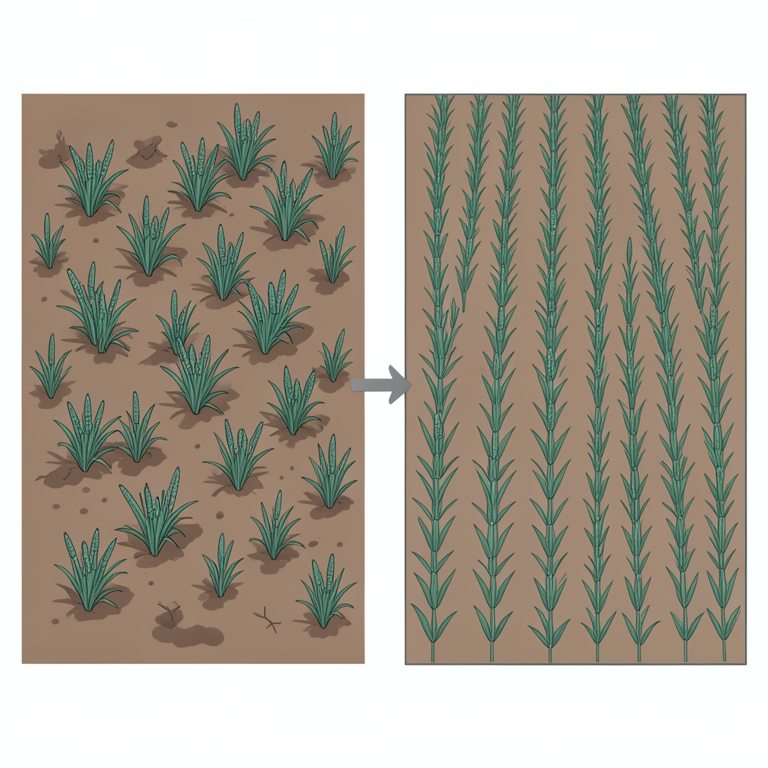
Impact of Spatial Uniformity
AI-generated conceptual illustration (rabi sorghum plants in a field). It explains the idea and does not show study data.
View source evidence ↗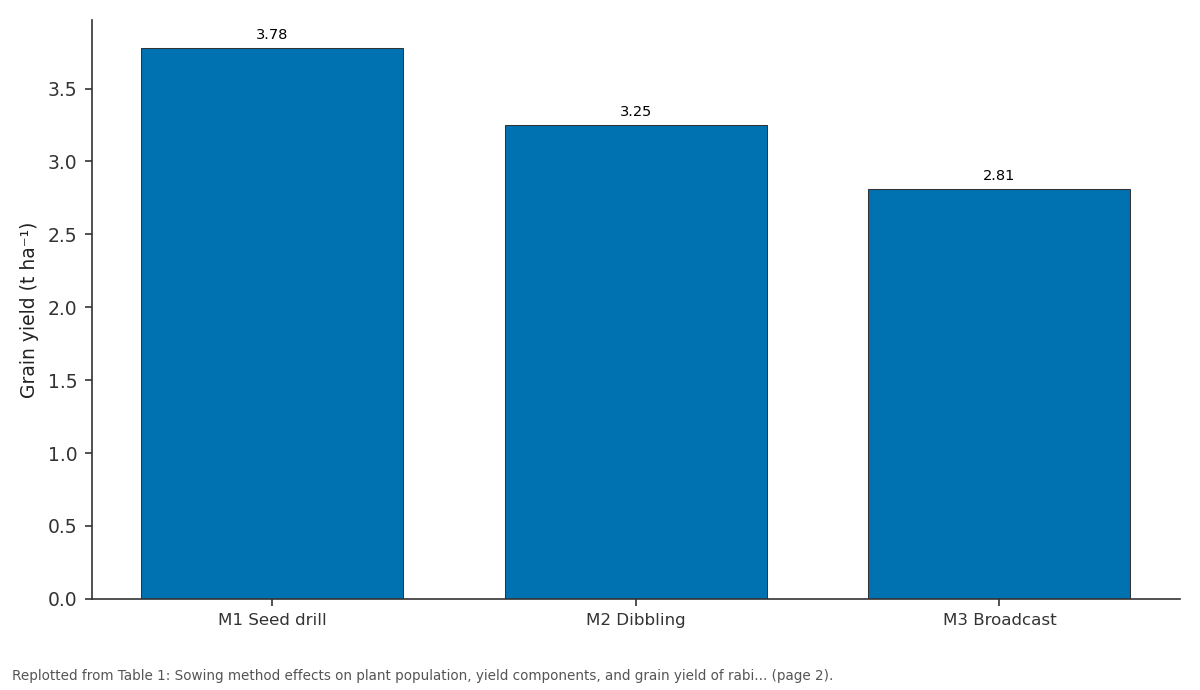
Grain yield (t ha⁻¹): M1 Seed drill vs M2 Dibbling vs M3 Broadcast
Replotted from Table 1 (page 2) of the original paper. Every bar is the paper's own table value.
View source evidence ↗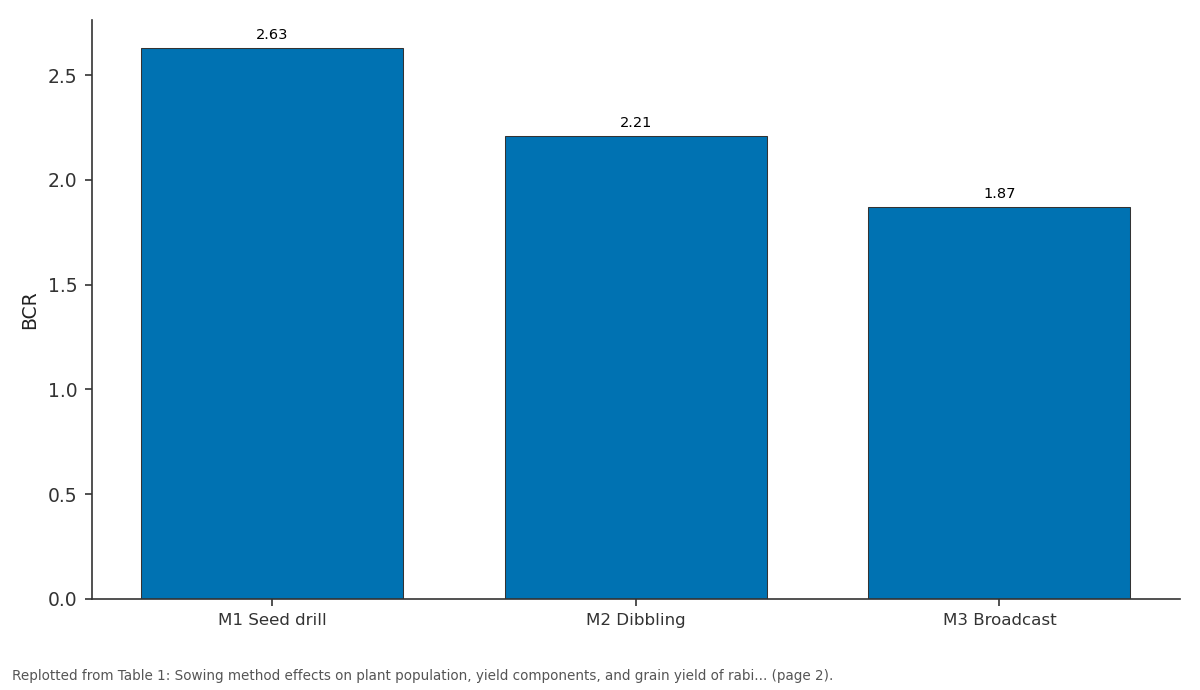
BCR: M1 Seed drill vs M2 Dibbling vs M3 Broadcast
Replotted from Table 1 (page 2) of the original paper. Every bar is the paper's own table value.
View source evidence ↗Figures & tables
From the original paper Table 1
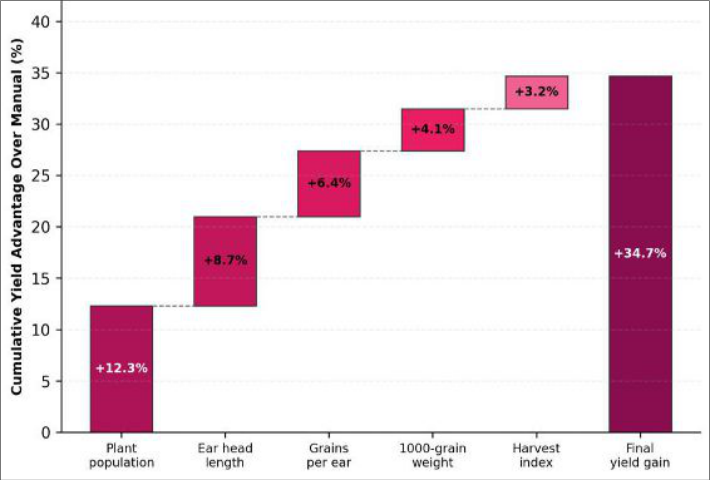 Figure 1
 Figure 2
Introduction
A farmer we met in El-Dakahlia governorate described his sowing routine this way: he fills a tin can with sorghum seed, walks across a ploughed field, and scatters handfuls at arm's length-a method unchanged since his grandfather's time [1] . The result is irregular spacing, clumped seedlings, and bare patches that weeds quickly colonise. Manual broadcasting remains the dominant sowing method for rabi sorghum in the Nile Delta, used on an estimated 70% of the 180,000 hectares planted annually [2,3] . Mechanized sowing with a seed drill places seeds at uniform depth and spacing, ensuring consistent plant population-which is the single most controllable determinant of sorghum yield after variety choice [4,5] . Trials in India and Australia have shown 15-40% yield advantages from drill sowing over broadcasting in sorghum and pearl millet, driven mainly by better stand establishment and reduced intra-row competition [6,7] . This research aimed to: (a) compare three sowing methods-tractor-drawn seed drill, manual dibbling, and broadcasting-on rabi sorghum growth and yield, (b) quantify labour and cost savings, and (c) determine which yield components benefit most from mechanized sowing.
Theoretical Background
Crop yield is a function of intercepted solar radiation, radiation-use efficiency, and harvest index [8] . Plant population density and spatial arrangement jointly govern light interception: at a given density, uniform spacing maximises canopy closure speed and minimises interplant competition for light, water, and nutrients [4] . Seed drills achieve near-uniform spacing by metering seed through a fluted roller and placing it at a consistent 3-5 cm depth, while broadcasting scatters seed randomly across the surface at variable depths [5] . The theoretical expectation, confirmed in maize and wheat, is a 10-25% yield advantage from improved spatial uniformity alone [9] . This research tested whether that advantage holds for rabi sorghum under Nile Delta conditions.
Material and Methods Material
Rabi sorghum (cv. Dorado, dual-purpose type) was sown in October 2021 and 2022 at Nile Delta Agricultural University research farm, Mansoura (31.04° N, 31.38° E; 7 m a.s.l.), on a clay loam soil (pH 7.9, OC 0.62%). Three sowing methods: (M1) tractor-drawn seed drill (7-row, 30 cm spacing, 4 cm depth), (M2) manual dibbling (30 × 15 cm, 3 seeds per hill, thinned to one), (M3) broadcasting (seed scattered and covered by one light harrowing). Target seed rate was 10 kg ha⁻¹ for all methods. Basal fertiliser: 80-40-30 kg N-P₂O₅-K₂O ha⁻¹.
Methods
A randomised complete block design with three treatments and five replications on 6 × 5 m plots was used. Plant population was counted in three 1 m² quadrats per plot at 21 DAS; CV of population was calculated as a uniformity index. Growth parameters (plant height, leaf area index) were recorded at 30-day intervals. At harvest (February), ear head length, grains per ear, 1000-grain weight, grain yield, and stover yield were recorded. Labour input (person-hours ha⁻¹) and all costs were documented. Data were analysed by two-way ANOVA (method × year) with Tukey's HSD at p≤ 0.05.
Results
Results
Comprehensive Interpretation
Seed-drill sowing produced a 34.7% yield advantage over broadcasting. The waterfall analysis shows that improved plant population accounted for 12.3 percentage points of that gain, followed by ear head length (+8.7 pp), grains per ear (+6.4 pp), 1000-grain weight (+4.1 pp), and harvest index (+3.2 pp). The population CV of 8.4% for drill sowing compared with 21.7% for broadcasting confirms that spatial uniformity was the primary driver. Labour fell from 18.3 to 4.7 person-hours ha⁻¹, a 74% reduction.
Discussion
The 34.7% yield gain aligns with the upper range of mechanized-sowing advantages reported for dryland sorghum in India (25-40%) [6,7] . The key mechanism is population uniformity: when CV drops below 10%, nearly every plant receives an equal share of resources, maximising per-plant productivity [4,9] . Broadcasting's CV of 21.7% means some patches are overcrowded while others are bare-a pattern that wastes both seed and growing space. The economic case is equally strong. At a BCR of 2.63, seed-drill sowing returns 163% over costs, compared with 87% for broadcasting. Custom-hire rates for tractormounted drills in the Nile Delta are 1,800-2,200 EGP ha⁻¹, easily offset by the yield premium of roughly 4,000 EGP ha⁻¹ [10,11] . A limitation is that only one cultivar was tested. Shortstatured varieties with different tillering habits might respond differently to spatial arrangement [12] . The trial was also on a research farm; on-farm validation across diverse soil types in the Delta would strengthen extension recommendations.
Conclusion
Tractor-drawn seed-drill sowing raised rabi sorghum yield by 34.7% over broadcasting, cut labour by 74%, and improved the benefit-cost ratio from 1.87 to 2.63. Uniform plant spacing was the main yield driver. Custom-hire promotion of seed drills is recommended for dryland sorghum in the Nile Delta, and on-farm demonstrations should be expanded to encourage adoption.
Acknowledgement
AcknowledgementsThis research was supported by Nile Delta Agricultural University. Mr. Ahmed Farouk assisted with seed-drill calibration and field operations.
Figures and tables from the paper
| Method | Plant pop. (m⁻²) | CV pop. (%) | Ear len. (cm) | Grains/ ear | 1000-gr wt (g) | Grain yield (t ha⁻¹) | BCR |
|---|---|---|---|---|---|---|---|
| M1 Seed drill | 18.7 | 8.4 | 23.8 | 1,847 | 28.3 | 3.78 | 2.63 |
| M2 Dibbling | 17.4 | 14.1 | 21.4 | 1,624 | 27.1 | 3.25 | 2.21 |
| M3 Broadcast | 14.9 | 21.7 | 18.7 | 1,389 | 25.8 | 2.81 | 1.87 |
| CD (p=0.05) | 1.3 | — | 1.6 | 127 | 1.2 | 0.29 | — |
Table text extracted from the original PDF; superscript letters are shown inline. The original table image is below.
View original table image
References
15 in the original paper- Abou-Elela AM. Traditional farming practices and mechanization potential in the Nile Delta. Egyptian Journal of Agricultural Engineering. 2017;34(2):412428.
- MALR Egypt. Agricultural statistics bulletin 2022. Cairo: Ministry of Agriculture and Land Reclamation; 2023.
- Reddy BVS, Ramesh S, Reddy PS, Kumar AA. Sorghum genetic enhancement for climate change adaptation. In: Yadav SS et al., editors. Crop adaptation to climate change. Chichester: Wiley; 2011. p. 326-339.
- Muchow RC, Carberry PS. Environmental control of phenology and leaf growth in a tropically adapted maize. Field Crops Research. 1989;20(3):221-236.
- Kepner RA, Bainer R, Barger EL. Principles of farm machinery. 3rd ed. Westport: AVI Publishing; 1978.
- Patil SL, Sheelavantar MN. Effect of moisture conservation practices, organic sources and nitrogen levels on yield of rabi sorghum in vertisols. Indian Journal of Dryland Agricultural Research and Development. 2003;18(2):125-131.
- Routley R, Broad I, McLean G, Whish J, Hammer G. The effect of row configuration on yield reliability in grain sorghum: I. Yield, water use efficiency and soil water extraction. Field Crops Research. 2003;83(3):281-296.
- Monteith JL. Climate and the efficiency of crop production in Britain. Philosophical Transactions of the Royal Society B. 1977;281(980):277-294.
- Andrade FH, Calvino P, Cirilo A, Barbieri P. Yield responses to narrow rows depend on increased radiation interception. Agronomy Journal. 2002;94(5):975-980.
- El-Shal MS, Mohamedein KS, Tawfik MA. Performance evaluation of tractor-operated seed drill for wheat sowing in Egyptian conditions. Misr Journal of Agricultural Engineering. 2019;36(1):1-18.
- Iqbal M, Hassan AU, Ali A, Rizwanullah M. Residual effect of tillage and farm manure on some soil physical properties and growth of wheat. International Journal of Agriculture and Biology. 2005;7(1):54-57.
- Saeedipour S, Moradi F. Comparison of the drought stress responses of tolerant and sensitive wheat cultivars during grain filling. Field Crops Research. 2011;120(1):164-173.
- Stickler FC, Wearden S, Pauli AW. Leaf area determination in grain sorghum. Agronomy Journal. 1961;53(3):187-188.
- House LR. A guide to sorghum breeding. 2nd ed. Patancheru: ICRISAT; 1985.
- Abubakar IU, Daneji AI, Aliyu L, Singh A. Mineral nutrition of sorghum: a review. International Journal of Agronomy and Plant Production. 2012;3(11):471-479.