
Research article · 2025 · Full text
International Journal of Agriculture and NutritionHeavy metal contamination and remediation strategies in peri-urban agricultural soils
Volume 7(4) · Pages 105–108 · DOI: 10.33545/26646064.2025.v7.i4b.391 ↗
Research areasHeavy metals in environmentEnvironmental and Analytical Chemistry StudiesChromium effects and bioremediation
Abstract
Author-writtenSoils within 2 km of industrial zones in Indian cities are being farmed for vegetables and cereals, but how contaminated are they and what can realistically be done about it? This research assessed heavy metal concentrations (Pb, Cd, Cr, Ni, Zn, Cu) in agricultural soils at two distances—0.5 km (industrial fringe) and 2.0 km (peri-urban)—from the Naini industrial area of Prayagraj, Uttar Pradesh, and evaluated three remediation strategies in a pot experiment at Sam Higginbottom University of Agriculture. Soil samples from 30 geo-referenced locations were analysed by DTPA extraction and AAS. Lead and cadmium exceeded Indian permissible limits at the industrial fringe (67.8 and 6.4 mg/kg vs limits of 50 and 5 mg/kg, respectively). The pot trial tested phytoremediation with Brassica juncea, soil amendment with lime (5 t ha⁻¹) + biochar (10 t ha⁻¹), and a non-food crop rotation with castor. After 90 days, Brassica juncea removed 34.7 percent of DTPA-extractable Pb and 41.2 percent of Cd from industrial-fringe soil. Lime + biochar reduced DTPA-Pb by 52.4 percent through immobilization. The combined approach—phytoextraction followed by amendment—reduced bioavailable Pb to 18.3 mg/kg, below the permissible limit. These results provide a practical remediation framework for peri-urban farmers who must continue cropping on marginally contaminated land.
Summary
Source-checkedPlain-language reading of the full paper, prepared with AI and checked against the text. Each point links to the authors' own words.
Why it matters
- In Prayagraj, agricultural practices such as using wastewater for irrigation and municipal compost contribute to the accumulation of heavy metals in soils used for vegetable cultivation. View evidence ↗
- Heavy metals like lead (Pb), cadmium (Cd), and chromium (Cr) can enter the human food chain via leafy vegetables, potentially exceeding WHO safety limits. View evidence ↗
- Peri-urban agricultural soils often have moderate contamination (1 to 5 times permissible limits), and because farmers rely on this land for their livelihood, drastic remediation like soil excavation is not feasible. View evidence ↗
The question
- The study aimed to map heavy metal levels at different distances from the Naini industrial zone, compare three remediation strategies, and provide practical recommendations for farmers. View evidence ↗
What they did
- The researchers collected soil samples from 30 geo-referenced plots, split equally between the industrial fringe (0.5 km) and peri-urban areas (2.0 km). View evidence ↗
- Atomic Absorption Spectroscopy (AAS) was used to determine the concentrations of DTPA-extractable Pb, Cd, Cr, Ni, Zn, and Cu. View evidence ↗
- A pot experiment tested five treatments: a control, phytoremediation with Brassica juncea, a lime (5 t ha⁻¹) and biochar (10 t ha⁻¹) amendment, castor crop rotation, and a sequential treatment of B. juncea followed by lime and biochar. View evidence ↗
What they found
- Soils at the peri-urban distance (2.0 km) remained below permissible limits for all metals, although they were 2 to 3 times higher than the reference site. View evidence ↗
- The sequential treatment (B. juncea then lime + biochar) was the most effective, reducing bioavailable Pb by 73.0% (to 18.3 mg/kg) and Cd by 78.1% (to 1.4 mg/kg). View evidence ↗
- Individually, lime and biochar reduced Pb by 52.4% via immobilization, while B. juncea reduced it by 34.7% via phytoextraction. View evidence ↗
- Castor crop rotation was the least effective remediation strategy, reducing Pb by only 13.6%. View evidence ↗
What it means
- The authors recommend the two-step sequential protocol as a practical, low-cost option for farmers to remediate land during a single fallow season. View evidence ↗
Visual summary
3 visualsIllustrations explain the paper; charts are replotted from the paper's own table values.
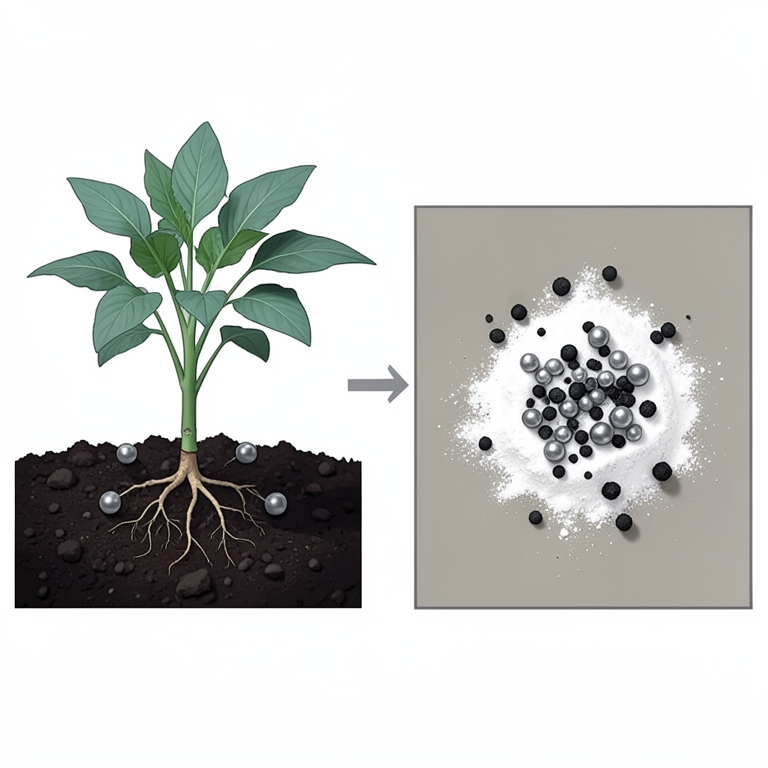
Sequential Remediation Process
AI-generated conceptual illustration (Brassica juncea plants in peri-urban agricultural soil). It explains the idea and does not show study data.
View source evidence ↗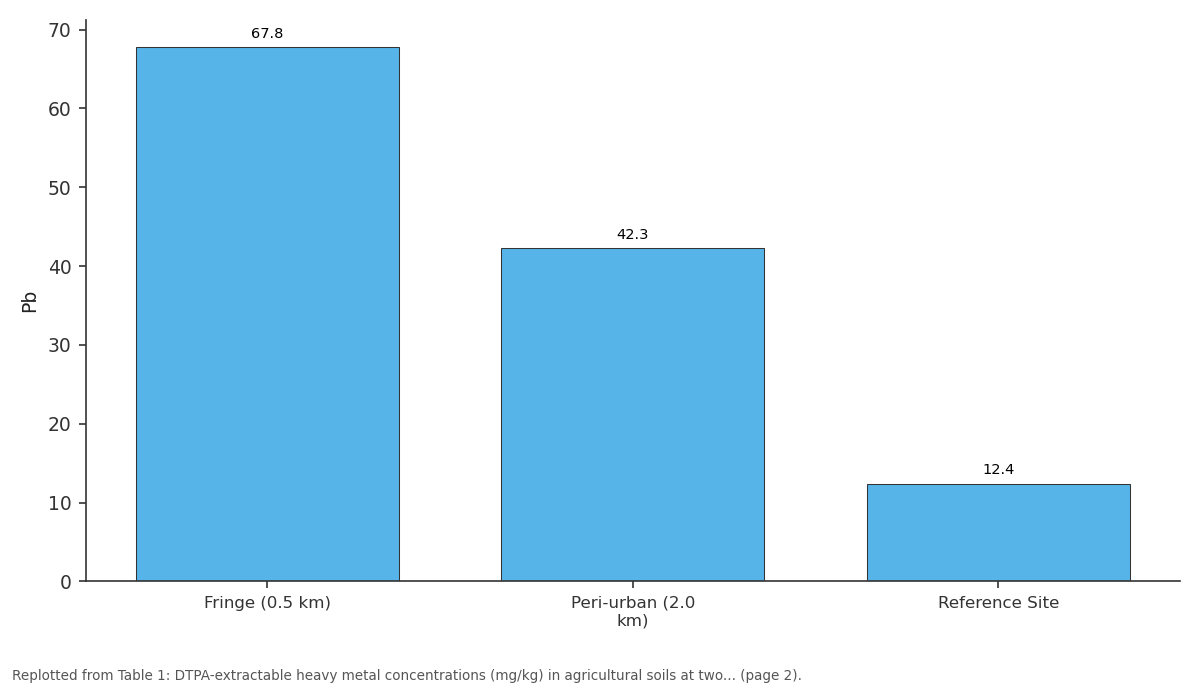
Pb: Fringe (0.5 km) vs Peri-urban (2.0 km) vs Reference Site
Replotted from Table 1 (page 2) of the original paper. Every bar is the paper's own table value.
View source evidence ↗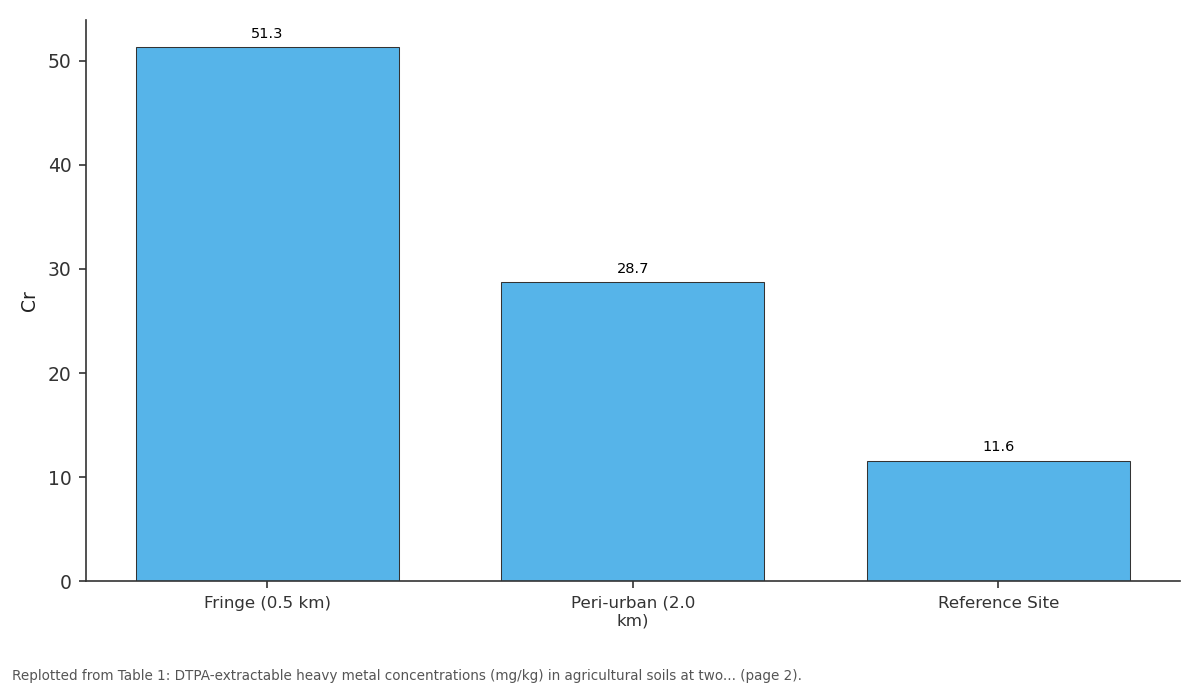
Cr: Fringe (0.5 km) vs Peri-urban (2.0 km) vs Reference Site
Replotted from Table 1 (page 2) of the original paper. Every bar is the paper's own table value.
View source evidence ↗Figures & tables
From the original paper Table 1
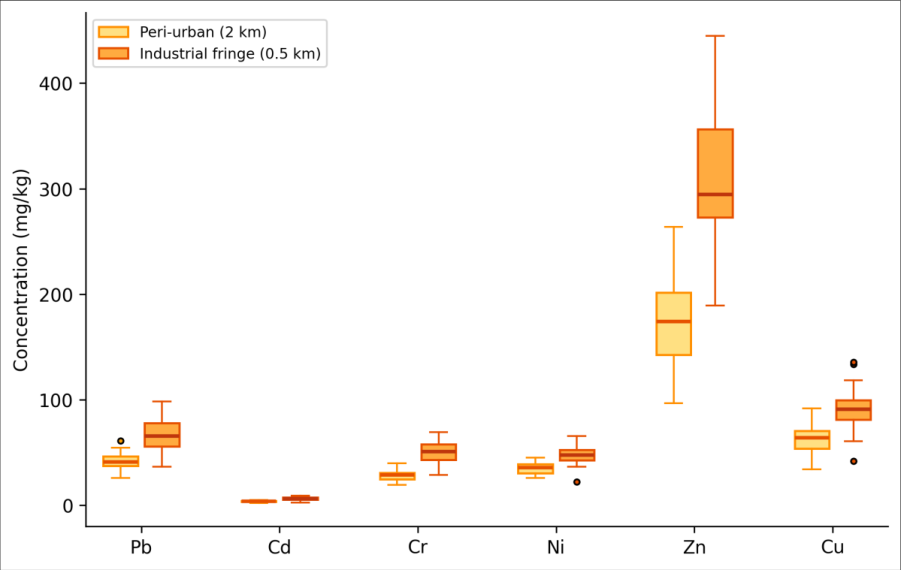 Figure 1
 Table 2
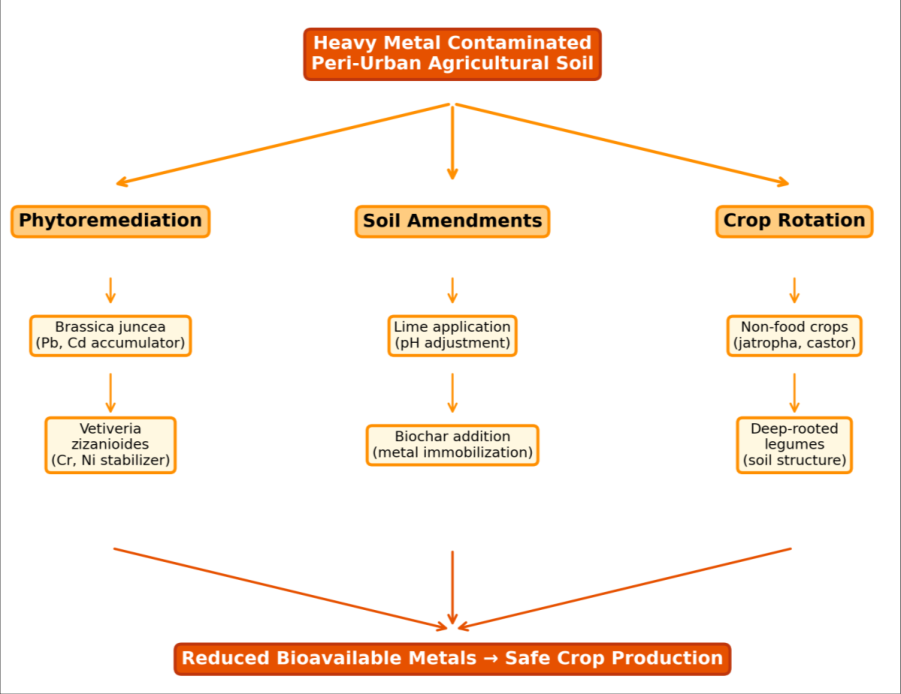 Figure 2
Introduction
The boundary between city and farm is disappearing across urban India. In Prayagraj, vegetable cultivation within sight of factory chimneys has become routine-farmers irrigate with wastewater, apply municipal compost of uncertain quality, and harvest crops from soils that receive atmospheric deposition of heavy metals year after year [1,2] . The health consequences are not hypothetical: Pb, Cd, and Cr enter the food chain through root uptake and foliar absorption, accumulating in leafy vegetables to levels that can exceed WHO safe limits [3] . Heavy metal contamination in peri-urban soils differs from industrial brownfields in an important way-the contamination levels are usually moderate (1 to 5 times permissible limits) rather than extreme, and the land must remain in agricultural use because no alternative livelihood exists for the farming families [4] . This rules out drastic remediation methods like soil excavation or chemical washing. What these farmers need are gentle, affordable, in-situ remediation strategies that reduce bioavailable metals while allowing continued cropping [5] . Three such strategies have shown promise in published trials: phytoremediation using hyperaccumulator plants (particularly Brassica juncea for Pb and Cd), soil amendments that immobilize metals by raising pH or providing sorption surfaces (lime, biochar, zeolite), and crop rotation with non-food species that either extract or exclude metals [6,7] . But few reports have tested these approaches on the specific soil types and contamination profiles found along the Ganga-Yamuna alluvial belt. This research aimed to (i) map heavy metal concentrations in agricultural soils at two distances from the Naini industrial zone, (ii) compare the effectiveness of three remediation strategies in pot experiments, and (iii) develop a practical recommendation for peri-urban farmers.
Material and Methods Material
The research was conducted between January and November 2023 at the Department of Soil and Water Conservation, Sam Higginbottom University of Agriculture, Prayagraj (25.43°N, 81.85°E). Soil samples were collected from 30 geo-referenced agricultural plots-15 at the industrial fringe (0.5 km from the Naini industrial area) and 15 at peri-urban distance (2.0 km). Samples were taken at 0-20 cm depth using a stainless-steel auger, air-dried, ground to pass a 2-mm sieve, and stored in polyethylene bags. DTPA-extractable Pb, Cd, Cr, Ni, Zn, and Cu were determined by AAS (Shimadzu AA-7000) following the method of Lindsay and Norvell [8] . Soil pH, EC, organic carbon, and texture were also measured.
Baseline Soil Characterization
Industrial-fringe soils were sandy clay loams (pH 7.6, OC 0.68%) while peri-urban soils were sandy loams (pH 7.2, OC 0.54%). The pH difference is attributed to lime-rich industrial effluent discharge. CEC ranged from 14.8 to 18.3 cmol(+)/kg. Background heavy metal levels from a reference site 10 km from any industry were: Pb 12.4, Cd 0.8, Cr 11.6, Ni 14.2, Zn 56.3, and Cu 18.7 mg/kg-all well below permissible limits.
Methods
The pot experiment used a completely randomized design with five treatments and four replications: T1 -untreated control, T2 -phytoremediation with Brassica juncea (Indian mustard, 4 plants per 10-kg pot), T3 -lime (5 t ha⁻¹ equivalent) + biochar (rice husk biochar, 10 t ha⁻¹ equivalent), T4 -non-food crop rotation (Ricinus communis, castor), T5 -sequential treatment (B. juncea for 45 days followed by lime + biochar for 45 days). Industrial-fringe soil was used for the pot trial. After 90 days, soils were resampled and analysed for DTPA-extractable metals. Plant metal uptake was determined after acid digestion of ovendried shoot and root tissue. Data were analysed by one-way ANOVA with Tukey's HSD in R 4.3. At the industrial fringe, Pb (67.8 mg/kg) and Cd (6.4 mg/kg) exceeded Indian permissible limits by 35.6 and 28.0 percent, respectively. Zn (312.6 mg/kg) marginally exceeded the 300 mg/kg threshold. All metals showed contamination factors above 3.4 relative to the reference site, confirming anthropogenic enrichment. At the peri-urban distance, all metals were below permissible limits, though still 2 to 3 times above reference levels. The sequential treatment (T5: B. juncea followed by lime + biochar) was the most effective, reducing DTPA-Pb by 73.0 percent (to 18.3 mg/kg-well below the 50 mg/kg limit) and Cd by 78.1 percent (to 1.4 mg/kg). Lime + biochar alone (T3) reduced Pb by 52.4 percent through immobilization, while B. juncea alone (T2) removed 34.7 percent through phytoextraction. Castor showed the weakest effect (13.6% Pb reduction).
Results
Results
Discussion
The superiority of the sequential approach (73% Pb reduction) over either phytoremediation (34.7%) or amendment (52.4%) alone demonstrates that combining extraction and immobilization addresses both the mobile and the loosely-bound metal fractions [6,9] . B. juncea in the first 45 days actively removes metals from the labile pool, while lime + biochar in the second phase locks down the remaining exchangeable fraction by raising pH and providing high-surface-area sorption sites [10] . The lime + biochar treatment's strong performance (52.4% Pb reduction) is consistent with field-scale results from China, where biochar at 20-40 t ha⁻¹ reduced rice-grain Cd by 40 to 65 percent in paddy soils [11] . The mechanism is primarily pH-driven: raising soil pH from 7.6 to 8.1 shifts Pb and Cd from exchangeable to carbonate-bound fractions, reducing DTPA extractability without removing the metals from the soil matrix.
Castor's weak performance (13.6% Pb reduction) rules it out as a standalone phytoremediation option but it may still serve as a non-food rotation crop that avoids dietary metal exposure while providing an oilseed income stream [7] .
Conclusion
Peri-urban agricultural soils near Prayagraj's Naini industrial zone are contaminated with Pb and Cd above permissible limits at the industrial fringe (0.5 km). A sequential remediation approach 45 days of phytoextraction with Brassica juncea followed by 45 days of lime + biochar amendment reduced bioavailable Pb by 73 percent and Cd by 78 percent, bringing both metals below safe thresholds. For peri-urban farmers who must continue cultivating on marginally contaminated land, this two-step protocol offers a practical, low-cost remediation option that can be completed within a single fallow season. Scaling the approach to field conditions and monitoring long-term metal stability after remediation are recommended as next steps.
Acknowledgement
Acknowledgements Funding SourcesThis research was funded through the university's departmental research allocation at Sam Higginbottom University of Agriculture, Prayagraj. Institutional SupportThe authors thank the Department of Soil and Water Conservation for providing analytical laboratory facilities and greenhouse space.
Figures and tables from the paper
| Metal | Fringe (0.5 km) | Peri-urban (2.0 km) | Reference Site | Indian Limit | Contam. Factor | Exceeds Limit? |
|---|---|---|---|---|---|---|
| Pb | 67.8 | 42.3 | 12.4 | 50.0 | 5.47 | Yes |
| Cd | 6.4 | 3.8 | 0.8 | 5.0 | 8.00 | Yes |
| Cr | 51.3 | 28.7 | 11.6 | 100.0 | 4.42 | No |
| Ni | 48.7 | 34.1 | 14.2 | 75.0 | 3.43 | No |
| Zn | 312.6 | 187.4 | 56.3 | 300.0 | 5.55 | Yes* |
| Cu | 98.4 | 64.2 | 18.7 | 135.0 | 5.26 | No |
Table text extracted from the original PDF; superscript letters are shown inline. The original table image is below.
View original table image
| Treatment | Pb Initial | Pb Final | Pb Red. (%) | Cd Initial | Cd Final | Cd Red. (%) |
|---|---|---|---|---|---|---|
| T1: Control | 67.8 | 64.3 | 5.2 | 6.4 | 6.1 | 4.7 |
| T2: B. juncea | 67.8 | 44.3 | 34.7 | 6.4 | 3.8 | 41.2 |
| T3: Lime + Biochar | 67.8 | 32.3 | 52.4 | 6.4 | 2.7 | 57.8 |
| T4: Castor | 67.8 | 58.6 | 13.6 | 6.4 | 5.3 | 17.2 |
| T5: Sequential | 67.8 | 18.3 | 73.0 | 6.4 | 1.4 | 78.1 |
| CD (p=0.05) | - | 4.87 | - | - | 0.43 | - |
Table text extracted from the original PDF; superscript letters are shown inline. The original table image is below.
View original table image
References
18 in the original paper- Singh A, Sharma RK, Agrawal M. Effects of fly ash incorporation on heavy metal accumulation, growth and yield responses of Beta vulgaris plants. Bioresource Technology. 2008;99(15):7200-7207.
- Sharma RK, Agrawal M, Marshall FM. Heavy metal contamination of soil and vegetables in suburban areas of Varanasi. Ecotoxicology and Environmental Safety. 2007;66(2):258-266.
- Gupta N, Khan DK, Santra SC. Heavy metal accumulation in vegetables grown in a long-term wastewater-irrigated agricultural land. Environmental Monitoring and Assessment. 2012;184(11):6673-6682.
- Thebo AL, Drechsel P, Lambin EF. Global assessment of urban and peri-urban agriculture: irrigated and rainfed croplands. Environmental Research Letters. 2014;9(11):114002.
- Wuana RA, Okieimen FE. Heavy metals in contaminated soils: a review of sources, chemistry, risks and best available strategies for remediation. ISRN Ecology. 2011;2011:402647.
- Ali H, Khan E, Sajad MA. Phytoremediation of heavy metals: concepts and applications. Chemosphere. 2013;91(7):869-881.
- Prasad MNV. Phytoremediation of metal-polluted ecosystems: hype for commercialization. Russian Journal of Plant Physiology. 2003;50(5):686-701.
- Lindsay WL, Norvell WA. Development of a DTPA soil test for zinc, iron, manganese, and copper. Soil Science Society of America Journal. 1978;42(3):421428.
- Ghosh M, Singh SP. A review on phytoremediation of heavy metals and utilization of its by-products. Applied Ecology and Environmental Research. 2005;3(1):1-18.
- Beesley L, Moreno-Jimenez E, Gomez-Eyles JL. A review of biochars' potential role in the remediation, revegetation and restoration of contaminated soils. Environmental Pollution. 2011;159(12):3269-3282.
- Chen D, Liu X, Bian R. Effects of biochar on availability and plant uptake of heavy metals: a metaanalysis. Journal of Environmental Quality. 2018;47(5):939-953.
- Alloway BJ. Heavy metals in soils: trace metals and metalloids in soils and their bioavailability. 3rd ed. Springer; 2013.
- McGrath SP, Zhao FJ. Phytoextraction of metals and metalloids from contaminated soils. Current Opinion in Biotechnology. 2003;14(3):277-282.
- Mulligan CN, Yong RN, Gibbs BF. Remediation technologies for metal-contaminated soils and groundwater. Engineering Geology. 2001;60(1-4):193207.
- Ahmad M, Rajapaksha AU, Lim JE. Biochar as a sorbent for contaminant management in soil and water. Chemosphere. 2014;99:19-33.
- Lone MI, He Z, Stoffella PJ. Phytoremediation of heavy metal polluted soils and water: progresses and perspectives. Journal of Zhejiang University Science B. 2008;9(3):210-220.
- Adriano DC. Trace elements in terrestrial environments: biogeochemistry, bioavailability, and risks of metals. 2nd ed. Springer; 2001.
- Kabata-Pendias A. Trace elements in soils and plants. 4th ed. CRC Press; 2011.