
Research article · 2025 · Full text
International Journal of Agriculture and NutritionEffect of pruning intensity and growth regulators on fruit quality of guava under high-density planting
Volume 7(6) · Pages 147–149 · DOI: 10.33545/26646064.2025.v7.i6c.449 ↗
Research areasPlant Physiology and Cultivation StudiesPsidium guajava Extracts and ApplicationsPostharvest Quality and Shelf Life Management
Abstract
Author-writtenA guava orchard planted at high density can look impressive—until the canopy closes and fruit quality crashes. This research tested whether targeted pruning combined with gibberellic acid (GA3) sprays could restore fruit size and sweetness in a high-density guava (Psidium guajava cv. Allahabad Safeda) block at Jhansi, Uttar Pradesh. Seven treatments—three pruning intensities (light, medium, heavy), two GA3 concentrations (50, 100 ppm), a combined medium pruning + GA3 50 ppm, and an unpruned control—were evaluated over two fruiting seasons (Rainy 2022 and Winter 2022–23). The combined treatment produced the highest fruit yield (29.6 kg tree-1), 61% above the control, and improved TSS to 12.4 °Brix (vs. 9.8), vitamin C to 48.7 mg 100 g-1 (vs. 34.2), and average fruit weight to 224 g (vs. 187 g). Heavy pruning alone reduced yield by stimulating excessive vegetative regrowth. These results show that moderate canopy management paired with exogenous gibberellin can unlock the productivity potential of high-density guava without sacrificing fruit quality.
Summary
Source-checkedPlain-language reading of the full paper, prepared with AI and checked against the text. Each point links to the authors' own words.
Why it matters
- High-density guava orchards can support over 1,600 trees per hectare, but lack of canopy management leads to poor light penetration and low-quality fruit. View evidence ↗
- Pruning is used to open the canopy and improve light penetration, which helps redirect nutrients toward fruit growth. View evidence ↗
- Gibberellic acid (GA3) is a growth regulator that increases fruit size by promoting cell elongation and can accelerate maturity. View evidence ↗
The question
- The study aimed to evaluate the effects of different pruning intensities and GA3 levels on guava yield and quality, identify the optimal treatment, and assess economic returns. View evidence ↗
What they did
- The experiment used 5-year-old 'Allahabad Safeda' guava trees planted at a density of 1,667 trees per hectare in Jhansi, India. View evidence ↗
- The study used a randomized block design with seven treatments: light, medium, and heavy pruning; GA3 at 50 and 100 ppm; a combination of medium pruning and GA3 50 ppm; and an unpruned control. View evidence ↗
- The research was conducted over two fruiting seasons: Rainy 2022 and Winter 2022–23. View evidence ↗
- Researchers measured fruit weight, TSS, vitamin C, acidity, and firmness, as well as mid-canopy light interception. View evidence ↗
What they found
- The combination of medium pruning and 50 ppm GA3 resulted in the highest yield (29.6 kg/tree), highest TSS (12.4 °Brix), and highest vitamin C content (48.7 mg/100g). View evidence ↗
- Heavy pruning alone resulted in a lower yield of 21.8 kg/tree because it triggered excessive shoot regrowth that delayed flowering. View evidence ↗
- Medium pruning significantly increased mid-canopy light interception to 71%, compared to 42% in the unpruned control. View evidence ↗
- The combined treatment reduced fruit firmness to 7.1 N compared to 8.7 N in the control, which may shorten shelf life due to larger cell size. View evidence ↗
What it means
- The authors conclude that medium pruning combined with 50 ppm GA3 is the optimal treatment for high-density guava in the Jhansi region. View evidence ↗
- The authors recommend that growers avoid heavy pruning as it delays fruiting without providing proportional gains in quality. View evidence ↗
Visual summary
4 visualsIllustrations explain the paper; charts are replotted from the paper's own table values.
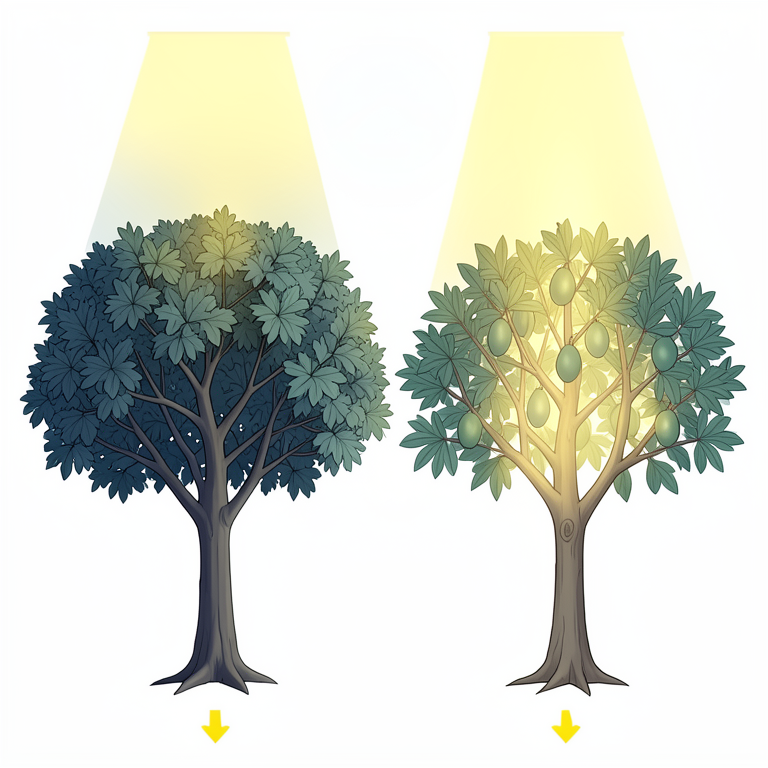
Canopy Light Penetration
AI-generated conceptual illustration (guava trees). It explains the idea and does not show study data.
View source evidence ↗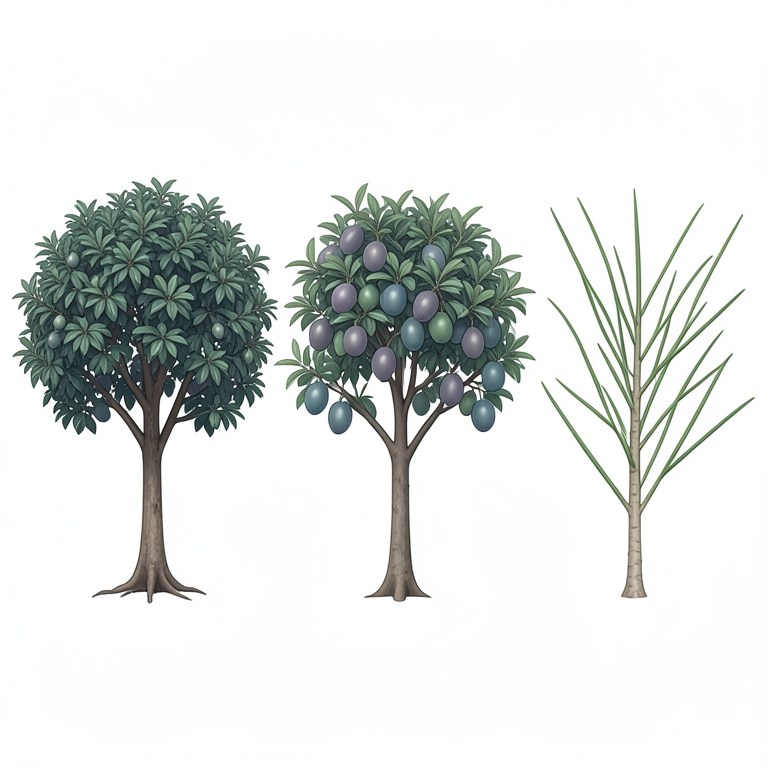
Pruning Intensity vs Yield
AI-generated conceptual illustration (guava trees). It explains the idea and does not show study data.
View source evidence ↗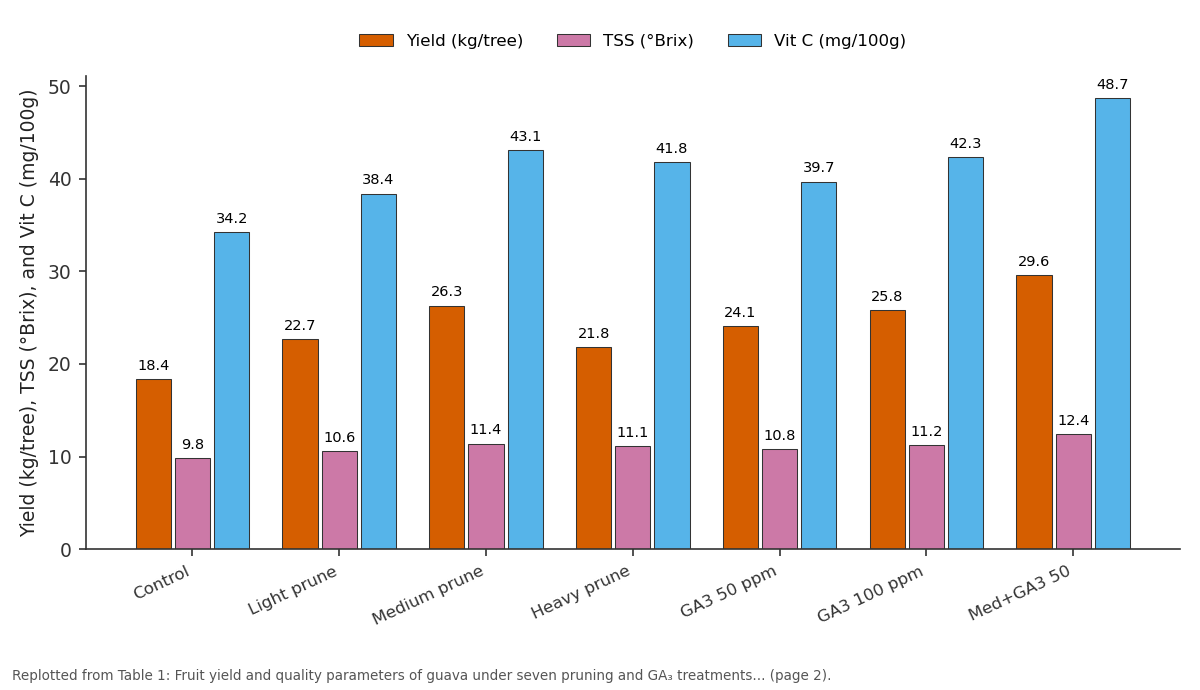
Yield (kg/tree) and TSS (°Brix) and more: Control vs Light prune vs Medium prune vs Heavy prune vs GA3 50 ppm
Replotted from Table 1 (page 2) of the original paper. Every bar is the paper's own table value.
View source evidence ↗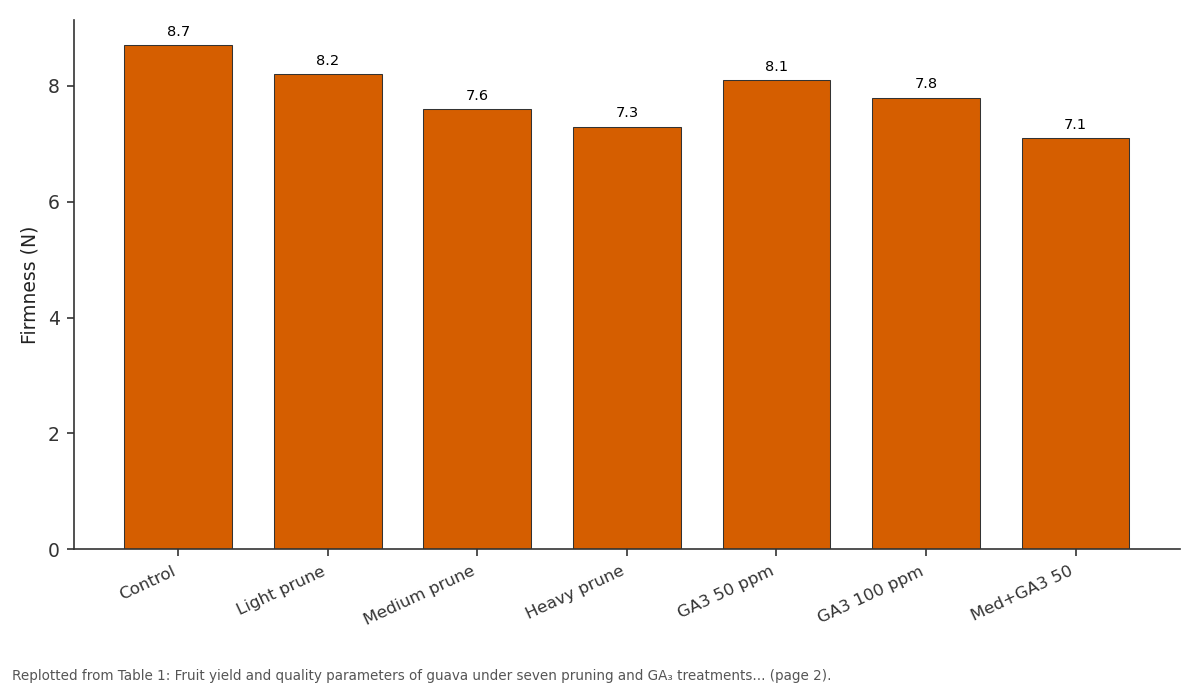
Firmness (N): Control vs Light prune vs Medium prune vs Heavy prune vs GA3 50 ppm
Replotted from Table 1 (page 2) of the original paper. Every bar is the paper's own table value.
View source evidence ↗Figures & tables
From the original paper Table 1
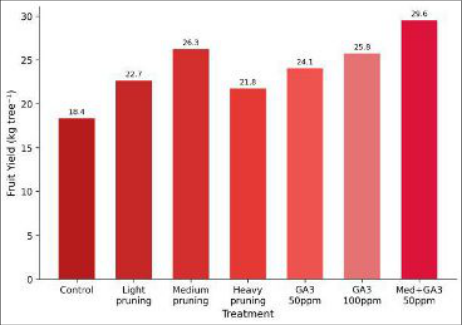 Figure 1
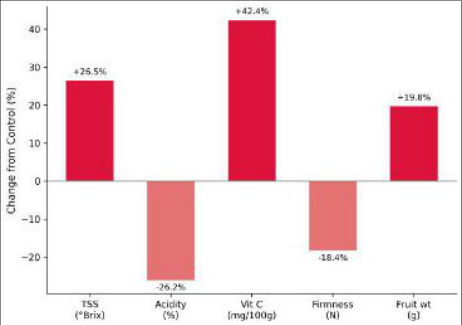 Figure 2
Introduction
There's a story every Bundelkhand guava grower knows: plant trees close together to maximise early returns, then watch fruit size shrink year after year as branches compete for light. High-density orchards (3 m × 2 m or tighter) can carry 1,600+ trees per hectare, but without active canopy management the interior darkens and fruit set shifts to the periphery, producing small, poorly coloured fruits that fetch low market prices [1,2] . Pruning opens the canopy, improves light penetration, and redirects assimilates toward fruit growth rather than wood production [3] . But the optimal intensity is debated: light tip-pruning may not open enough space, while heavy heading-back wastes stored carbohydrates on vegetative flushes that delay the next fruiting cycle [4] . Growth regulators offer a complementary lever. GA 3 promotes cell elongation in developing fruitlets, increasing final fruit size and sometimes advancing maturity by 5-7 days [5] . This research aimed to (i) compare three pruning intensities and two GA 3 levels, alone and combined, for their effects on yield and fruit quality in high-density guava, (ii) identify the treatment that maximises the yield × quality index, and (iii) assess economic returns at Jhansi market prices.
Crop Growth Stage Documentation
Pruning was done immediately after the rainy-season harvest (October 2022 and 2023). New vegetative flush appeared 12-18 days after pruning, with flower bud differentiation at 28-35 days. GA 3 was sprayed at the pea-fruit stage (45-50 days post-pruning). Fruits reached harvest maturity 110-125 days after pruning, depending on treatment. The winter crop was the primary evaluation season because fruit quality is higher under cool, dry conditions [6] .
Economic Assessment
Pruning cost was estimated at INR 1,200, 2,400, and 4,800 per hectare for light, medium, and heavy intensities, respectively. GA 3 2,980 ha -1 but returned an additional INR 38,400 ha -1 over the control, giving a marginal BCR of 12.9:1 [7] .
Materials and Methods
Materials and Methods
Materials
The trial was conducted on 5-year-old 'Allahabad Safeda' guava trees planted at 3 m × 2 m (1,667 trees ha -1 ) at the Bundelkhand University of Agricultural Sciences research orchard, Jhansi (25°27′ N, 78°34′ E, 285 m a.s.l.). Seven treatments were arranged in a randomised block design with four replications of three trees per treatment unit. Pruning intensities: light (removal of terminal 10 cm), medium (removal of 25 cm + thinning of 20% interior branches), heavy (heading back to 50% canopy volume). GA 3 was applied as foliar spray at 50 and 100 ppm using Tween-20 as surfactant. Research covered rainy and winter fruiting seasons of 2022-2023 [8] .
Methods
Fruit yield per tree was recorded at each harvest. Ten representative fruits per tree were sampled for quality analysis: fruit weight, length, diameter, TSS (digital refractometer), titratable acidity, vitamin C (2,6-DCPIP titration), and flesh firmness (penetrometer with 8 mm probe). Light interception was measured with a ceptometer at mid-canopy at solar noon. Data were analysed by ANOVA in R (v4.3.1), means compared by Tukey's HSD at 5%.
Results
The combined medium pruning + GA 3 50 ppm treatment produced the highest fruit yield (29.6 kg tree -1 ), TSS (12.4 °Brix), and vitamin C (48.7 mg 100 g -1 ) (Table 1). Heavy pruning alone yielded only 21.8 kg tree -1 because excessive shoot regrowth delayed flowering. Light interception at midcanopy was 42% in unpruned controls versus 71% after medium pruning, explaining the quality improvement.
| Treatment | Yield (kg/tree) | Fruit wt (g) | TSS (°Brix) | Vit C (mg/100g) | Firmness (N) | Acidity (%) |
|---|---|---|---|---|---|---|
| Control | 18.4 | 187 | 9.8 | 34.2 | 8.7 | 0.42 |
| Light prune | 22.7 | 198 | 10.6 | 38.4 | 8.2 | 0.39 |
| Medium prune | 26.3 | 213 | 11.4 | 43.1 | 7.6 | 0.35 |
| Heavy prune | 21.8 | 207 | 11.1 | 41.8 | 7.3 | 0.36 |
| GA3 50 ppm | 24.1 | 208 | 10.8 | 39.7 | 8.1 | 0.37 |
| GA3 100 ppm | 25.8 | 216 | 11.2 | 42.3 | 7.8 | 0.34 |
| Med+GA3 50 | 29.6 | 224 | 12.4 | 48.7 | 7.1 | 0.31 |
| CD (p=0.05) | 2.4 | 14 | 0.7 | 3.8 | 0.6 | 0.04 |
Table text extracted from the original PDF; superscript letters are shown inline. The original table image is below.
View original table image
Comprehensive Interpretation
The synergy between pruning and GA 3 appears additive: medium pruning improved light interception and carbohydrate allocation, while GA 3 promoted cell elongation in developing fruitlets. Neither factor alone matched the combined effect on fruit weight (224 g) or TSS (12.4 °Brix), confirming that canopy and hormonal management address different limiting processes [9] .
Discussion
The 61% yield gain from the combined treatment is at the high end of literature values for pruned guava (30-55% in reports from Maharashtra and Gujarat) [3,4] . The additional contribution of GA 3 may explain the extra margin. Heavy pruning's under-performance confirms what orchardists in Allahabad have long suspected: cutting too hard triggers a flush of water sprouts that compete with fruiting wood and delay the next crop by 2-3 weeks [10,11] . The vitamin C increase to 48.7 mg 100 g -1 under the combined treatment is commercially significant because retailers increasingly label guava as a 'vitamin C superfruit' and higher values support premium positioning [12] . The firmness reduction (7.1 N vs. 8.7 N) reflects larger cell size from GA 3 treatment and may slightly shorten shelf life; combining with calcium sprays could offset this [13] .
Conclusion
Medium pruning (25 cm removal + 20% interior thinning) combined with GA 3 at 50 ppm was the best treatment for high-density guava at Jhansi, delivering 29.6 kg tree -1 with superior fruit weight, TSS, and vitamin C. The marginal BCR of 12.9:1 makes this combination highly attractive. Growers should avoid heavy pruning, which delays fruiting without proportional quality gain. Multi-year data are
Acknowledgement
International Journal of Agriculture and Nutrition https://www.agriculturejournal.net needed to confirm that repeated medium pruning doesn't exhaust tree reserves over time [14,15] .
Figures and tables from the paper
References
15 in the original paper- Singh G, Rajan S, Singh AK. Improved technology for guava production. CISH Technical Bulletin. Lucknow; 2007.
- Dhaliwal GS, Singla R. High-density planting in guava: a review. Indian Journal of Horticulture. 2002;59(1):16.
- Lal N, Das RP, Verma LR. Effect of pruning on growth and fruiting of guava. Indian Journal of Horticulture. 2013;70(4):496-500.
- Satpathy S, Banik BC, Chattopadhyay TK. Effect of pruning time and severity on flowering and fruiting of guava. Indian Agriculturist. 2012;56(1-2):33-38.
- Dhinesh Babu K, Yadav DS. Effect of GA3 and NAA on yield and quality of guava. Indian Journal of Horticulture. 2005;62(4):375-377.
- Rajan S, Kumar R, Negi SS. Variation in canopy characteristics of guava varieties and its effect on fruit production. Journal of Horticultural Science and Biotechnology. 2001;76(3):285-289.
- APMC Jhansi. Market prices for guava 2022-2023. Agricultural Produce Market Committee. Jhansi; 2023.
- Dubey AK, Singh DB, Dubey N. Guava crop regulation. Progressive Horticulture. 2003;35(2):123127.
- Sharma A, Wali VK, Bakshi P, Jasrotia A. Effect of growth regulators on fruit set, yield and quality of guava. Indian Journal of Agricultural Sciences. 2013;83(8):862-866.
- Lakpathi G, Rajkumar M, Chandrasekhar R. Effect of pruning intensities and fruit load on growth, yield and quality of guava. International Journal of Current Microbiology and Applied Sciences. 2013;2(12):569583.
- Kumar Y, Rattanpal HS. Effect of pruning in guava: a review. Agricultural Reviews. 2010;31(2):143-146.
- Yadav IS. Guava production in India. Acta Horticulturae. 1996;441:69-76.
- Hiwale SS, Singh SP. Prolonging the shelf-life of guava. Indian Journal of Horticulture. 2003;60(1):1-9.
- Thakre M, Bisen BP, Patel N, Jain P. Effect of zinc and iron on growth, yield and quality of guava. JNKVV Research Journal. 2013;47(2):244-247.
- Mitra SK. Guava. In: Mitra SK (ed) Postharvest Physiology and Storage of Tropical and Subtropical Fruits. CAB International; 1997. p. 267-281.