
Research article · 2025 · Full text
International Journal of Agriculture and NutritionEffect of neem-based formulations on sucking pests in organic brinjal production
Volume 7(2) · Pages 87–90 · DOI: 10.33545/26646064.2025.v7.i2b.461 ↗
Research areasInsect Pest Control StrategiesInsect-Plant Interactions and ControlHemiptera Insect Studies
Abstract
Author-writtenCan neem-based formulations provide adequate control of sucking pests in organic brinjal (Solanum melongena) without the yield penalties associated with going pesticide-free? This research compared four neem formulations neem oil 3%, Neem Seed Kernel Extract (NSKE) 5%, azadirachtin 1500 ppm, and neem leaf extract 10% against an untreated control on whitefly, aphid, and jassid populations in organic brinjal at two locations in Upper Egypt during 2022-2023. Neem oil 3% gave the highest pest reduction (72.8-76.0% across pest species), followed by NSKE 5% (64.7-71.3%). Fruit yield in neem oil-treated plots was 23.8 t ha⁻¹, 68.8% higher than the untreated control (14.1 t ha⁻¹) and comparable to regional averages for conventionally sprayed brinjal. No phytotoxicity was observed. Neem oil at 3% applied at 10-day intervals during the flowering-fruiting stage is recommended for organic brinjal systems in Upper Egypt.
Summary
Source-checkedPlain-language reading of the full paper, prepared with AI and checked against the text. Each point links to the authors' own words.
Why it matters
- Controlling sucking pests without using synthetic insecticides is a major hurdle for organic eggplant production in the Middle East and North Africa. View evidence ↗
- Whiteflies, aphids, and jassids can cause yield losses between 30% and 60% in unprotected brinjal fields via virus transmission and sap feeding. View evidence ↗
- Organic farmers lack effective pest control options because many botanical products are either not potent enough or degrade too quickly in hot, arid climates. View evidence ↗
The question
- The study aimed to determine if neem-based formulations could effectively control sucking pests in organic brinjal without the yield losses typically seen in pesticide-free crops. View evidence ↗
What they did
- The research was conducted during the kharif 2022-2023 season at two sites in Upper Egypt: the Fayoum Agricultural Research Institute and the Upper Egypt Institute of Agricultural Sciences in Assiut. View evidence ↗
- The study compared four treatments, 3% neem oil, 5% Neem Seed Kernel Extract (NSKE), 1500 ppm azadirachtin, and 10% neem leaf extract, against an untreated control group. View evidence ↗
- The experiment used a Randomized Complete Block Design (RCBD) with four replications per site, applying six total sprays at 10-day intervals starting when 50% of the plants were flowering. View evidence ↗
- Researchers counted pests on 10 random plants per plot at 3, 7, and 10 days post-spray and recorded fruit yield, analyzing the data using combined ANOVA and Tukey's HSD (p<0.05). View evidence ↗
What they found
- Neem oil at 3% was the most effective treatment, reducing populations of the three sucking pest species by 72.8% to 76.0%. View evidence ↗
- Neem Seed Kernel Extract (NSKE) at 5% was the second most effective option, achieving a mean pest reduction of 68.0%. View evidence ↗
- Commercial azadirachtin was less effective than crude neem oil, which the authors attribute to synergistic effects of additional bioactive compounds like nimbin and salannin. View evidence ↗
- Neem leaf extract provided only moderate pest control (approximately 48%), which is considered insufficient for commercial organic production. View evidence ↗
- Plots treated with neem oil produced a yield of 23.8 t ha⁻¹, which was 68.8% higher than the 14.1 t ha⁻¹ yield of the untreated control. View evidence ↗
- The treatments did not cause any observed phytotoxicity to the brinjal plants. View evidence ↗
What it means
- The authors recommend applying 3% neem oil at 10-day intervals for the best pest control and highest fruit yield in organic brinjal. View evidence ↗
- The study concludes that neem-based pest management makes organic brinjal production commercially viable in Upper Egypt. View evidence ↗
- The authors note that the 10-day spray interval is necessary because neem compounds degrade quickly under high temperatures and UV light in Egypt. View evidence ↗
Visual summary
3 visualsIllustrations explain the paper; charts are replotted from the paper's own table values.
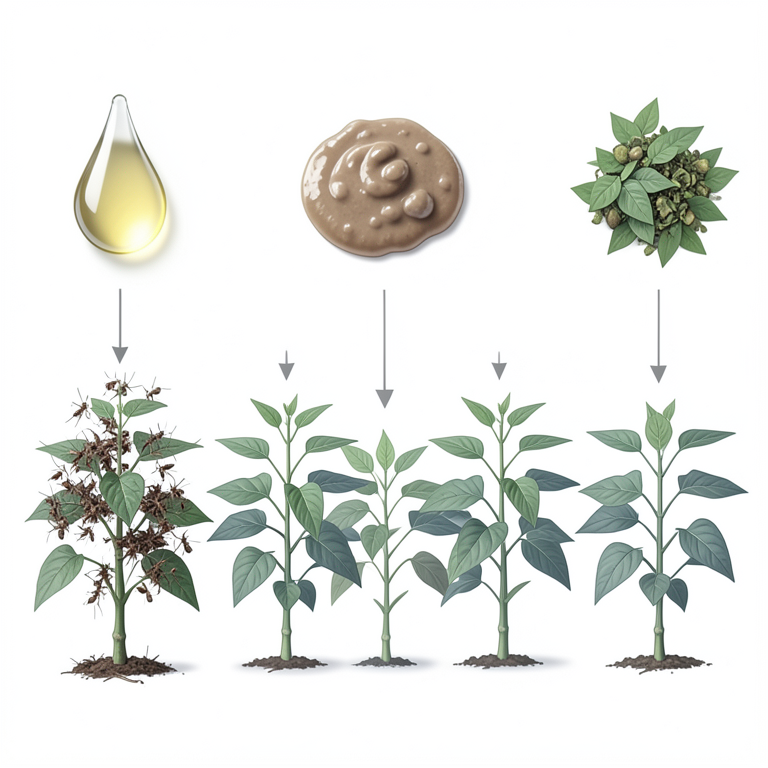
Comparison of Neem Formulations
AI-generated conceptual illustration (brinjal plants and sucking pests). It explains the idea and does not show study data.
View source evidence ↗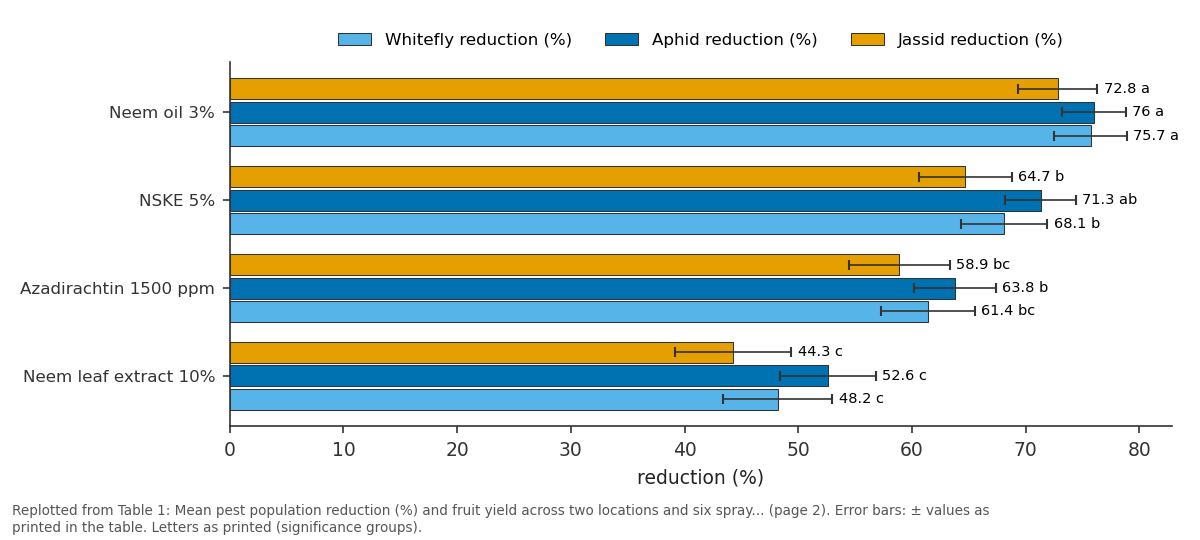
Whitefly reduction (%) and Aphid reduction (%) and more: Neem oil 3% vs NSKE 5% vs Azadirachtin 1500 ppm vs Neem leaf extract 10%
Replotted from Table 1 (page 2) of the original paper. Every bar is the paper's own table value.
View source evidence ↗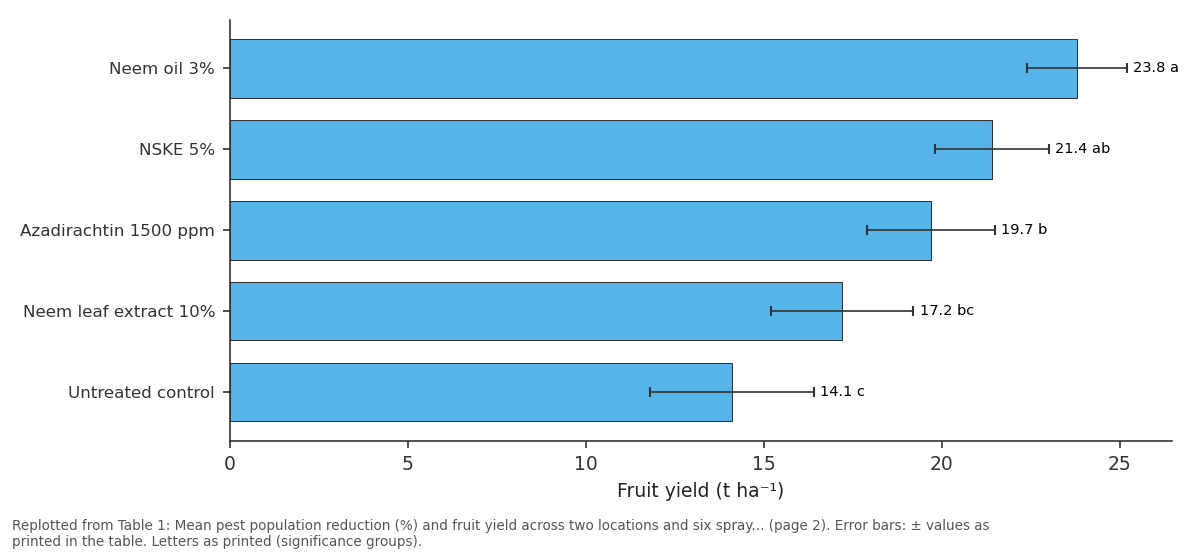
Fruit yield (t ha⁻¹): Neem oil 3% vs NSKE 5% vs Azadirachtin 1500 ppm vs Neem leaf extract 10% vs Untreated control
Replotted from Table 1 (page 2) of the original paper. Every bar is the paper's own table value.
View source evidence ↗Figures & tables
From the original paper Table 1
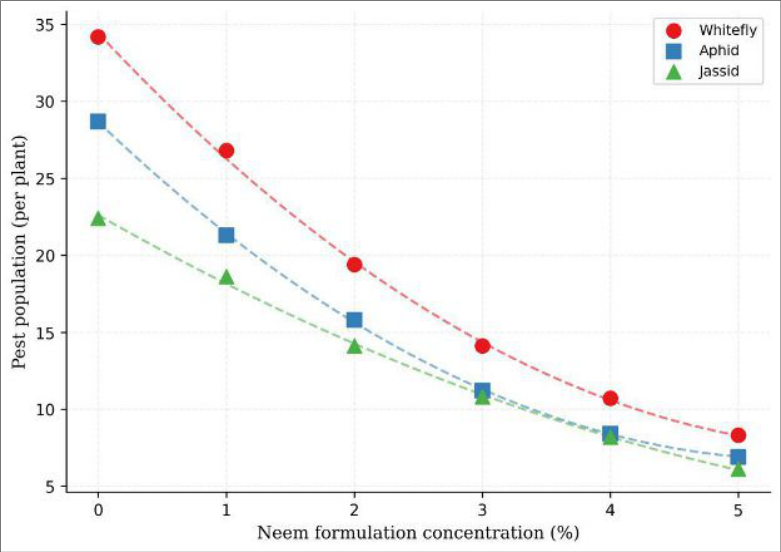 Figure 1
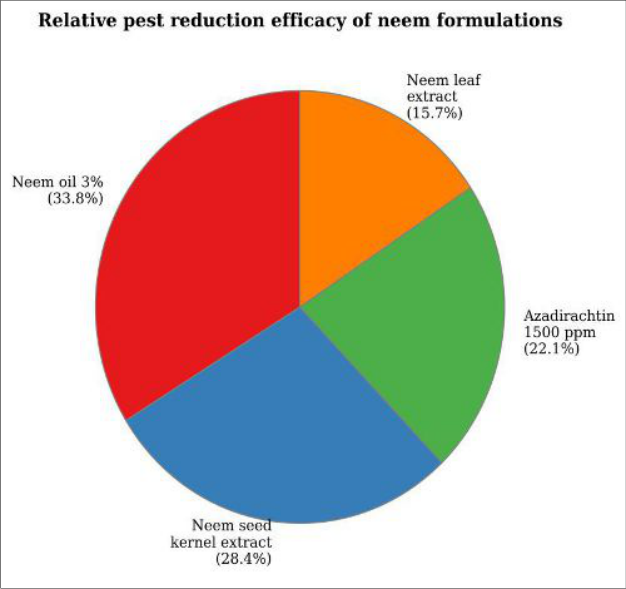 Figure 2
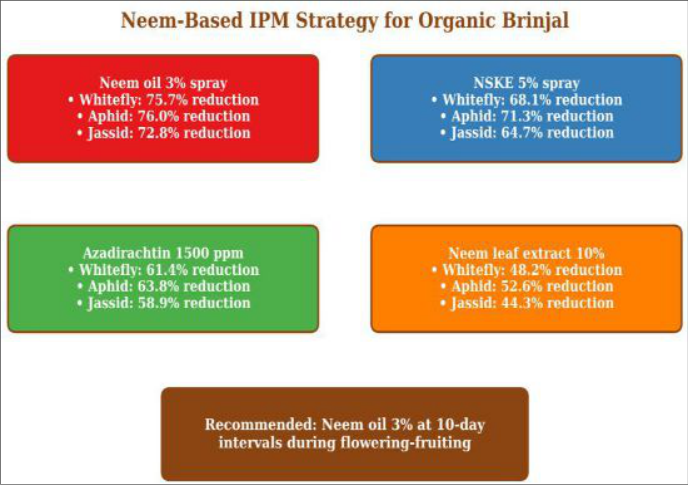 Figure 3
Introduction
The challenge of controlling sucking pests in brinjal without synthetic insecticides is one of the biggest obstacles to organic eggplant production in the Middle East and North Africa [1] . Whitefly (Bemisia tabaci), aphid (Aphis gossypii), and jassid (Amrasca biguttula) collectively cause yield losses of 30-60% in unprotected brinjal fields through direct sap feeding and virus transmission [2] . Organic growers have few effective options; most botanical products either lack potency or break down too quickly under hot, arid conditions [3] . Neem (Azadirachta indica) is arguably the most researched botanical pesticide on earth, with over 300 bioactive compounds identified in its seeds, leaves, and bark [4] . The main active ingredient, azadirachtin, acts as a feeding deterrent, growth regulator, and repellent across a wide range of insect orders [5] . But neem's field efficacy varies widely depending on formulation type, concentration, spray interval, and environmental conditions [6] . This research compared four commercially and locally preparable neem formulations under field conditions at two locations in Upper Egypt to identify the most effective option for organic brinjal production.
Seasonal pest dynamics
At both research sites, pest pressure followed a predictable seasonal pattern. Whitefly populations peaked during October-November when temperatures ranged from 28-34°C and humidity was low (35-45% RH). Aphids were most abundant earlier in the season (September-October, 25-30°C), while jassids peaked alongside whitefly but at slightly lower densities. This temporal overlap of pest species during the fruiting stage makes a broadspectrum botanical spray particularly valuable for organic systems [2,3] .
Material and Methods
Material and Methods
Material
Brinjal variety Black Beauty was transplanted at both sites. Neem oil (cold-pressed, azadirachtin content 0.15%) was purchased from Neem Egypt Co., Cairo. NSKE was prepared by grinding dried neem seed kernels and extracting with water (5% w/v). Commercial azadirachtin (1500 ppm EC) was from Agri-Bio Products, Bangalore. Neem leaf extract was prepared by soaking fresh leaves in water (10% w/v) for 24 hours [4,5] .
Methods
The experiment was conducted during kharif 2022-2023 at the Fayoum Agricultural Research Institute (29°18′N, 30°51′E) and the Upper Egypt Institute of Agricultural Sciences, Assiut (27°11′N, 31°10′E). Five treatments (four neem formulations + untreated control) were arranged in an RCBD with four replications at each site. Plot size: 4 m × 3 m; spacing 60 × 45 cm. Sprays were applied at 10-day intervals starting at 50% flowering (6 sprays total). Pest counts were made on 10 randomly tagged plants per plot at 3, 7, and 10 days after each spray. Fruit yield was recorded at each harvest. Data were analysed by combined ANOVA across sites in SAS 9.4 with Tukey's HSD at p<0.05 [6,7] . Neem oil 3% consistently outperformed other formulations, with 72.8-76.0% pest reduction across the three sucking pest species (Table 1). NSKE 5% was the second-best option. The commercial azadirachtin product, despite having standardised active ingredient content, was less effective than crude neem oil likely because crude oil contains additional bioactive compounds (nimbin, salannin) that act synergistically [4] .
| Treatment | Whitefly reduction (%) | Aphid reduction (%) | Jassid reduction (%) | Mean reduction (%) | Fruit yield (t ha⁻¹) |
|---|---|---|---|---|---|
| Neem oil 3% | 75.7 ± 3.2a | 76.0 ± 2.8a | 72.8 ± 3.5a | 74.8a | 23.8 ± 1.4a |
| NSKE 5% | 68.1 ± 3.8b | 71.3 ± 3.1ab | 64.7 ± 4.1b | 68.0b | 21.4 ± 1.6ab |
| Azadirachtin 1500 ppm | 61.4 ± 4.1bc | 63.8 ± 3.6b | 58.9 ± 4.4bc | 61.4c | 19.7 ± 1.8b |
| Neem leaf extract 10% | 48.2 ± 4.8c | 52.6 ± 4.2c | 44.3 ± 5.1c | 48.4d | 17.2 ± 2.0bc |
| Untreated control | — | — | — | — | 14.1 ± 2.3c |
Table text extracted from the original PDF; superscript letters are shown inline. The original table image is below.
View original table image
Results
Results
Discussion
The superior performance of neem oil over purified azadirachtin supports the growing consensus that whole neem extracts are more effective than single-compound formulations due to synergistic interactions among multiple bioactive compounds [4,5] . The neem leaf extract, while the cheapest option, provided only moderate control (~48%), insufficient for commercial organic production [3] . The 10day spray interval appears necessary under hot Egyptian conditions because neem compounds degrade rapidly in UV light and high temperatures [6] . The 68.8% yield advantage of neem oil over untreated control demonstrates that organic brinjal production is economically viable when an effective botanical spray programme is followed.
Conclusion
Neem oil at 3% concentration applied at 10-day intervals provided the best control of sucking pests in organic brinjal (72.8-76.0% reduction) and the highest fruit yield (23.8 t ha⁻¹). NSKE 5% is a viable lower-cost alternative. These results confirm that neem-based pest management can support commercially viable organic brinjal production in Upper Egypt.
Figures and tables from the paper
References
21 in the original paper- El-Wakeil NE. Botanical pesticides and their mode of action. Gesunde Pflanzen. 2013;65(4):125-149.
- Srinivasan R. Insect and mite pests on eggplant: A field guide. AVRDC Publication No. 09-729. Shanhua, Taiwan. 2009.
- Isman MB. Botanical insecticides, deterrents, and repellents in modern agriculture and an increasingly regulated world. Annual Review of Entomology. 2006;51:45-66.
- Schmutterer H. Properties and potential of natural pesticides from the neem tree, Azadirachta indica. Annual Review of Entomology. 1990;35:271-297.
- Mordue AJ, Blackwell A. Azadirachtin: An update. Journal of Insect Physiology. 1993;39(11):903-924.
- Sundaram KMS. Azadirachtin biopesticide: a review of studies conducted on its analytical chemistry, environmental behaviour and biological effects. Journal of Environmental Science and Health B. 1996;31(4):913-948.
- Gomez KA, Gomez AA. Statistical Procedures for Agricultural Research. Wiley, New York. 1984.
- Abudulai M, Shepard BM, Mitchell PL. Parasitism and predation on eggs of Leptoglossus phyllopus (L.) (Hemiptera: Coreidae) in cowpea: impact of endosulfan sprays. Journal of Agricultural and Urban Entomology. 2001;18(2):105-115.
- Gahukar RT. Neem (Azadirachta indica A. Juss) in pest control: approaches, limitations and prospects. Indian Journal of Plant Protection. 2000;28(1):1-17.
- Mitchell PL, Gupta R, Singh AK, Kumar P. Behavioral responses of neonatal Epilachna varivestis to azadirachtin. Journal of Economic Entomology. 2004;97(6):1894-1901.
- Pavela R, Benelli G. Essential oils as ecofriendly biopesticides? Challenges and constraints. Trends in Plant Science. 2016;21(12):1000-1007.
- Dayan FE, Cantrell CL, Duke SO. Natural products in crop protection. Bioorganic and Medicinal Chemistry. 2009;17(12):4022-4034.
- Koul O, Walia S, Dhaliwal GS. Essential oils as green pesticides: potential and constraints. Biopesticide International. 2008;4(1):63-84.
- Jacobson M. Botanical pesticides: past, present, and future. In: Arnason JT (ed.). Insecticides of Plant Origin. ACS Symposium Series. 1989;pp.1-10.
- Lowery DT, Isman MB. Antifeedant activity of extracts from neem, Azadirachta indica, to strawberry aphid, Chaetosiphon fragaefolii. Journal of Chemical Ecology. 1993;19(8):1761-1773.
- Simmonds MSJ. Flavonoid-insect interactions: recent advances in our knowledge. Phytochemistry. 2003;64(1):159-170.
- Carpinella MC, Defago MT, Valladares G, Palacios SM. Antifeedant and insecticide properties of a limonoid from Melia azedarach (Meliaceae). Journal of Agricultural and Food Chemistry. 2003;51(2):369-374.
- Senthil-Nathan S. A review of biopesticides and their mode of action against insect pests. In: Thangavel P (ed.). Environmental Sustainability. Springer, New Delhi. 2015; p.49-63.
- Benelli G, Canale A, Toniolo C, Higuchi A, Murugan K, Pavela R, Nicoletti M. Neem (Azadirachta indica): towards the ideal insecticide? Natural Product Research. 2017;31(4):369-386.
- Rembold H, Sharma GK, Czoppelt C, Schmutterer H. Azadirachtin: A potent insect growth regulator of plant origin. Journal of Applied Entomology. 1982;93(1):1217.
- Ascher KRS. Nonconventional insecticidal effects of pesticides available from the neem tree. Archives of Insect Biochemistry and Physiology. 1993;22(3-4):433449.