
Research article · 2025 · Full text
International Journal of Agriculture and NutritionPerformance evaluation of micro-sprinkler irrigation system for banana plantation
Volume 7(1) · Pages 45–48 · DOI: 10.33545/26646064.2025.v7.i1a.372 ↗
Research areasIrrigation Practices and Water ManagementEngineering and Agricultural InnovationsRice Cultivation and Yield Improvement
Abstract
Author-writtenHow well can micro-sprinkler systems satisfy banana water needs while minimising distribution losses? This research evaluated four micro-sprinkler configurations (MS-30L, MS-50L, MS-70L, MS-90L) at different spacings in a banana (Musa spp.) plantation at the Caspian Institute of Agricultural Sciences, Rasht, Iran, from April 2022 to March 2023. Coefficient of uniformity (CU), distribution uniformity (DU), and application efficiency (AE) were recorded monthly; crop growth and yield were measured at harvest. The MS-50L model at 2.0 m spacing delivered the highest CU (92.6%), DU (88.4%), and AE (86.8%). Banana plants under MS-50L produced 27.3 kg mean bunch weight 18.7% more than the MS-90L treatment. Soil moisture variability was lowest under MS-50L (CV = 8.4%). The MS-50L micro-sprinkler at 2.0 m spacing offers the best water-use efficiency and productivity balance for banana in humid subtropical conditions.
Summary
Source-checkedPlain-language reading of the full paper, prepared with AI and checked against the text. Each point links to the authors' own words.
Why it matters
- Banana plants are highly water-demanding crops, typically needing more than 1,200 mm of water per season. View evidence ↗
- Traditional flood irrigation is inefficient for these crops, wasting between 30% and 40% of the water used. View evidence ↗
- Micro-sprinklers are potentially better than drip emitters for bananas because they wet a larger portion of the plant's extensive shallow root system. View evidence ↗
The question
- The study aimed to evaluate four micro-sprinkler models and spacings to determine their hydraulic efficiency and their impact on banana growth and yield in humid subtropical conditions. View evidence ↗
What they did
- The experiment tested four micro-sprinkler configurations (MS-30L, MS-50L, MS-70L, and MS-90L) in Rasht, Iran, between April 2022 and March 2023. View evidence ↗
- The study used a randomized complete block design with four treatments, three replications, and 12 plants per plot. View evidence ↗
- Hydraulic performance was measured using the Christiansen coefficient of uniformity (CU), distribution uniformity (DU), and application efficiency (AE). View evidence ↗
What they found
- The MS-50L configuration at 2.0 m spacing achieved the highest hydraulic performance, with a CU of 92.6%, DU of 88.4%, and AE of 86.8%. View evidence ↗
- The MS-50L configuration produced the best growth and yield results, including a mean bunch weight of 27.3 kg and a plant height of 259.4 cm. View evidence ↗
- Plants irrigated with the MS-50L system had a mean bunch weight 18.7% higher than those under the MS-90L treatment. View evidence ↗
- Soil moisture variability was lowest for MS-50L (CV = 8.4%) and highest for MS-90L (CV = 16.1%), indicating that wider spacing leads to uneven wetting. View evidence ↗
- The MS-90L configuration performed the worst across all hydraulic metrics, with the lowest CU (78.9%), DU (72.6%), and AE (67.4%). View evidence ↗
What it means
- The authors conclude that the MS-50L micro-sprinkler at 2.0 m spacing provides the optimal balance of productivity and water-use efficiency for bananas in humid subtropical zones. View evidence ↗
- The study is limited by being a single-season trial, which does not account for long-term nozzle wear or the impact of higher wind speeds. View evidence ↗
Visual summary
3 visualsIllustrations explain the paper; charts are replotted from the paper's own table values.
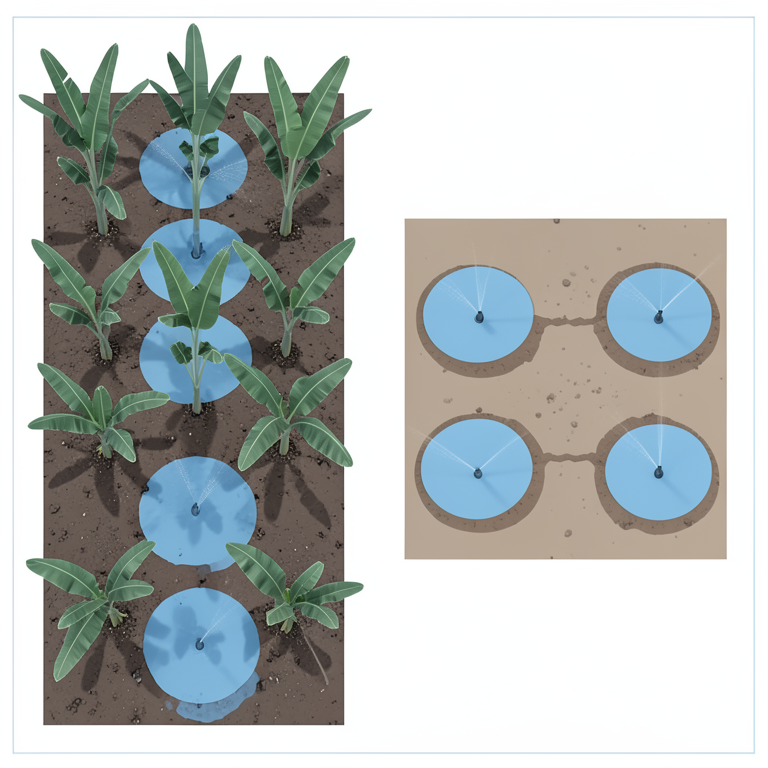
Sprinkler Spacing and Wetting Patterns
AI-generated conceptual illustration (banana plants in a soil field with micro-sprinkler irrigation). It explains the idea and does not show study data.
View source evidence ↗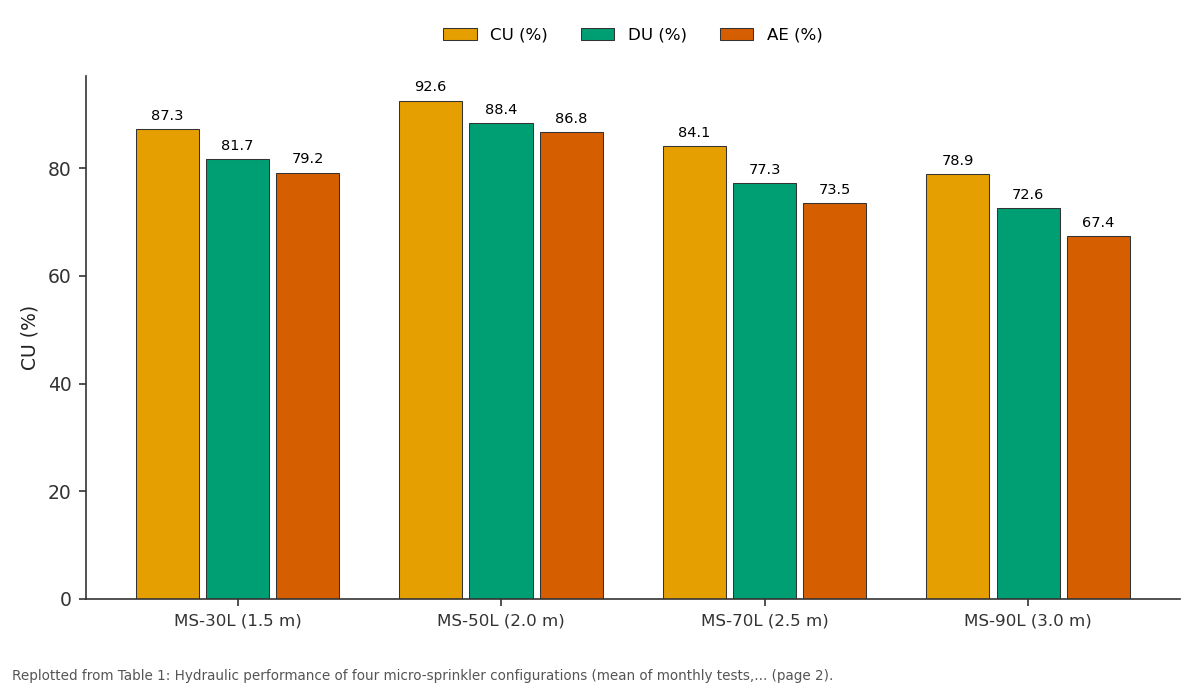
CU (%) and DU (%) and more: MS-30L (1.5 m) vs MS-50L (2.0 m) vs MS-70L (2.5 m) vs MS-90L (3.0 m)
Replotted from Table 1 (page 2) of the original paper. Every bar is the paper's own table value.
View source evidence ↗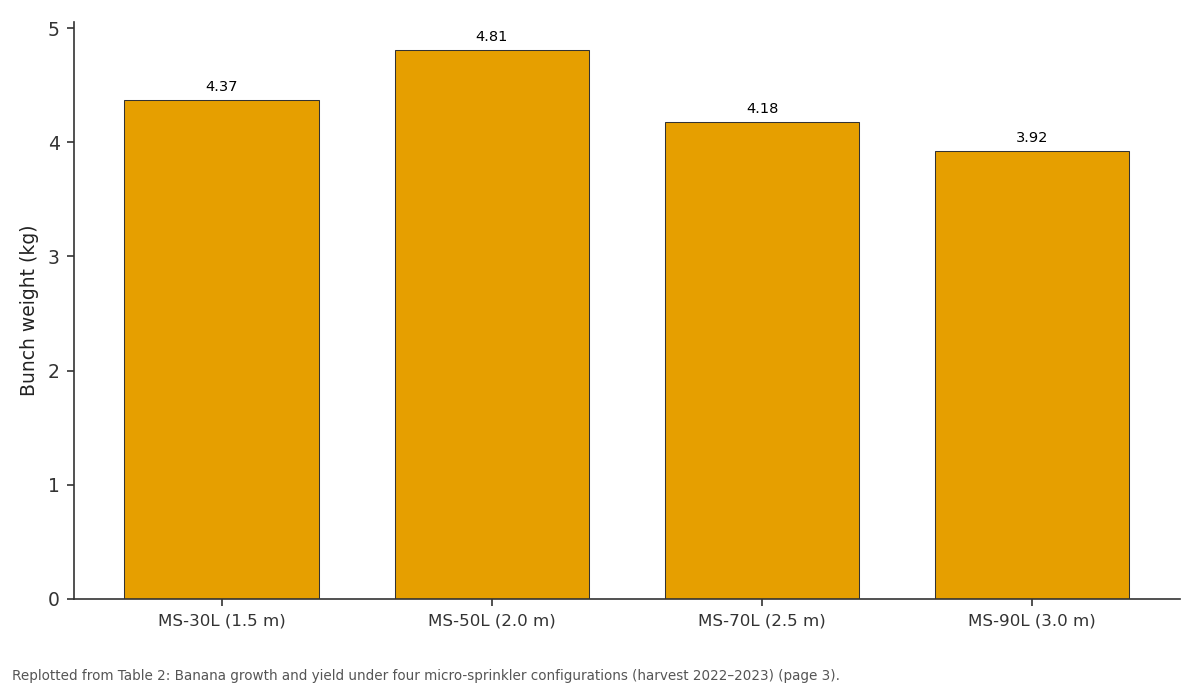
LAI: MS-30L (1.5 m) vs MS-50L (2.0 m) vs MS-70L (2.5 m) vs MS-90L (3.0 m)
Replotted from Table 2 (page 3) of the original paper. Every bar is the paper's own table value.
View source evidence ↗Figures & tables
From the original paper Table 1
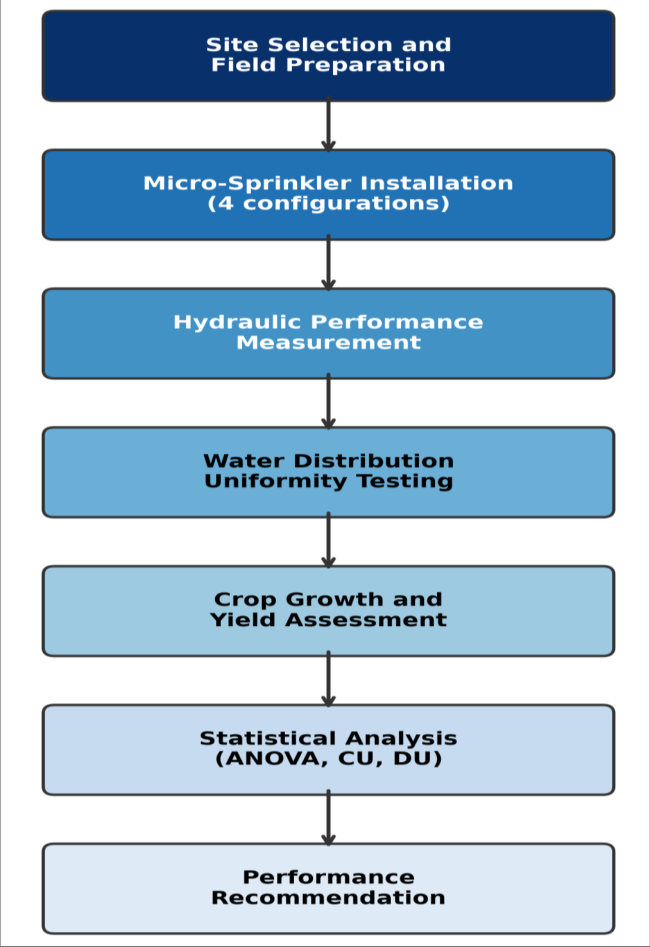 Figure 1
 Table 2
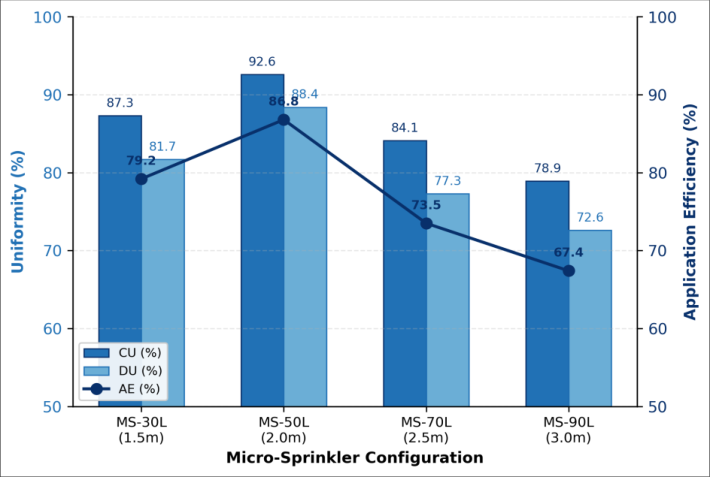 Figure 2
Introduction
Can a single irrigation technology satisfy both high water-use efficiency and consistent yield in tropical fruit plantations? Banana (Musa spp.) is among the most water-demanding horticultural crops, often requiring over 1,200 mm per season [1] . In Gilan province of northern Iran, uneven rainfall makes supplemental irrigation a necessity [2] . Conventional flood methods waste 30-40% of applied water through percolation and run-off [3] . Micro-sprinklers distribute water over the soil surface in a circular pattern, wetting a larger root-zone fraction than drip emitters useful for banana's extensive shallow root mat [4,5] . Yet field data comparing micro-sprinkler configurations in banana remain scarce; most trials have targeted citrus or mango [6,7] . Performance is characterised by the Christiansen coefficient of uniformity (CU), distribution uniformity (DU), and application efficiency (AE), all of which vary with pressure, spacing, and wind speed [8,9] . This research compared four commercial micro-sprinkler models at different spacings in a banana plantation to: (a) measure hydraulic uniformity and efficiency, (b) relate irrigation performance to growth and yield, and (c) recommend a viable arrangement for Gilan's humid subtropical conditions.
Research Area and Climatic Conditions
The trial was at the Caspian Institute of Agricultural Sciences, Rasht, Gilan, Iran (37.28° N, 49.58° E; 7 m a.s.l.), a humid subtropical site (Köppen Cfa) with 1,359 mm mean annual rainfall [10] . Soils are silty clay loam (bulk density 1.34 g cm⁻³; field capacity 33.1% v/v). The orchard comprised Grand Naine banana at 2.5 × 2.5 m spacing. During the May-August 2022 irrigation season, daily temperatures ranged from 23.1 to 28.7 °C, cumulative ET₀ was 587 mm, and rainfall totalled only 114 mm. Wind averaged 1.4 m s⁻¹ below the 2.5 m s⁻¹ drift threshold [8] ensuring uniformity differences reflected hardware and spacing, not wind distortion.
Material and Methods
Material: Four micro-sprinkler models were tested: MS-30L (30 L h⁻¹), MS-50L (50 L h⁻¹), MS-70L (70 L h⁻¹), and MS-90L (90 L h⁻¹), all from Tiran Irrigation Co.
(Isfahan, Iran) with 360° rotary deflectors. Laterals were 16 mm LDPE on 50 mm PVC sub-mains, fed by a 5 HP centrifugal pump with sand-media and disc filters from a 200 m³ reservoir. Pressure regulators (1.5 bar) were fitted at each lateral head. Catch cans were arranged in a 1 m × 1 m grid; soil moisture was tracked with TDR probes at 30 cm depth.
Methods
A randomised complete block design with four treatments and three replications was used; each plot had 12 plants. Spacings followed manufacturer guidelines: 1.5 m (MS-30L), 2.0 m (MS-50L), 2.5 m (MS-70L), 3.0 m (MS-90L). Monthly catch-can tests (60 min at regulated pressure) ran from May to August 2022. CU was calculated via Christiansen's formula [8] , DU as the lowest-quarter mean divided by the overall mean, and AE as root-zone storage divided by total applied [9] . Banana growth was assessed fortnightly; at harvest (November 2022-March 2023), bunch weight, hands per bunch, finger length, and finger girth were recorded. Data were analysed by one-way ANOVA in R 4.2.1 with Tukey's HSD at p < 0.05. CU = Christiansen coefficient of uniformity; DU = distribution uniformity; AE = application efficiency. All differences significant at p < 0.01.
Results
Results
Comprehensive Interpretation
The MS-50L configuration outperformed all others on every metric. Its CU of 92.6% exceeded the 85% tree-crop threshold [8] , and DU of 88.4% was well above 75% adequacy [9] . Bunch weight, finger length, and girth were highest under MS-50L, lowest under MS-90L. Soil moisture CV at 30 cm averaged 8.4% for MS-50L versus 16.1% for MS-90L, confirming wider spacing created uneven wetting. The MS-30L system didn't surpass MS-50L despite closer spacing, likely because its lower per-emitter discharge required longer run times during which pressure fluctuations reduced uniformity.
Discussion
The superiority of MS-50L aligns with findings that moderate spacing gives the best trade-off between wettedarea overlap and pressure loss. Bharambe et al. [6] recorded CU of 89% for micro-sprinklers at 2 m in mango close to the 92.6% here. The slightly higher value may reflect the low wind speeds of the Caspian coast [11] . An unexpected result was that MS-30L with the densest network didn't outperform MS-50L. In drip irrigation, closer spacing almost always raises uniformity [4] , but microsprinklers behave differently: overlapping throw patterns can cause ponding and, paradoxically, greater infiltration variability on low-permeability soils [5] . The 18.7% bunch-weight advantage of MS-50L over MS-90L reflects more uniform root-zone moisture sustaining gas exchange during bunch filling [7] . Economically, MS-50L needs fewer emitters per hectare than MS-30L (2,500 vs. 4,444 ha⁻¹), lowering costs.
A key limitation is the single-season trial; nozzle wear may degrade performance over time [8] , and the calm Caspian wind represents a best-case scenario.
Conclusion
This evaluation showed clear hydraulic and yield differences among four micro-sprinkler configurations in banana. The MS-50L at 2.0 m spacing gave the highest CU (92.6%), DU (88.4%), and AE (86.8%), along with the heaviest bunches (27.3 kg) and lowest soil moisture variability (CV = 8.4%). The MS-90L performed worst on every metric owing to dry gaps between wetted circles at 3.0 m spacing. Growers in humid subtropical zones should favour moderate-flow, moderate-spacing layouts. Multiseason trials with cost-benefit analysis would strengthen these recommendations.
Acknowledgement
AcknowledgementsThis research received support from the Caspian Institute of Agricultural Sciences internal research fund. Mr. Reza Mohammadi assisted with catch-can installation and data logging.
Figures and tables from the paper
| Configuration | Discharge (L h⁻¹) | Pressure (bar) | CU (%) | DU (%) | AE (%) |
|---|---|---|---|---|---|
| MS-30L (1.5 m) | 28.7 | 1.48 | 87.3 | 81.7 | 79.2 |
| MS-50L (2.0 m) | 47.9 | 1.51 | 92.6 | 88.4 | 86.8 |
| MS-70L (2.5 m) | 66.3 | 1.47 | 84.1 | 77.3 | 73.5 |
| MS-90L (3.0 m) | 85.4 | 1.46 | 78.9 | 72.6 | 67.4 |
Table text extracted from the original PDF; superscript letters are shown inline. The original table image is below.
View original table image
| Configuration | Height (cm) | LAI | Bunch wt (kg) | Hands/ bunch | Finger len (cm) | Finger girth (cm) |
|---|---|---|---|---|---|---|
| MS-30L (1.5 m) | 241.8 | 4.37 | 24.6 | 8.3 | 19.7 | 12.1 |
| MS-50L (2.0 m) | 259.4 | 4.81 | 27.3 | 9.1 | 21.4 | 13.2 |
| MS-70L (2.5 m) | 233.2 | 4.18 | 23.1 | 7.9 | 18.8 | 11.6 |
| MS-90L (3.0 m) | 218.6 | 3.92 | 22.0 | 7.4 | 17.5 | 10.9 |
| CD (p=0.05) | 11.3 | 0.29 | 2.1 | 0.7 | 1.4 | 0.8 |
Table text extracted from the original PDF; superscript letters are shown inline. The original table image is below.
View original table image
References
16 in the original paper- Carr MKV. The water relations and irrigation requirements of banana (Musa spp.): a review. Experimental Agriculture. 2009;45(3):333-371.
- Rezaei M, Ghorbani A. Supplemental irrigation scheduling for rice and banana in the Caspian lowlands. Iranian Journal of Irrigation and Drainage. 2018;12(4):891-903.
- Pereira LS, Oweis T, Zairi A. Irrigation management under water scarcity. Agricultural Water Management. 2002;57(3):175-206.
- Robinson JC, Sauco VG. Bananas and plantains. 2nd ed. Oxford: CAB International; 2010.
- Keller J, Bliesner RD. Sprinkle and trickle irrigation. Caldwell: Blackburn Press; 2000.
- Bharambe PR, Patil BP, Oza SR. Micro-sprinkler irrigation for mango: uniformity and yield effects. Journal of Horticultural Sciences. 2010;5(2):128-134.
- Teixeira AHC, Bassoi LH, Reis VCS. Banana water productivity under different irrigation methods in the Sao Francisco Valley. Scientia Horticulturae. 2011;128(4):475-481.
- Christiansen JE. Irrigation by sprinkling. Berkeley: University of California Agricultural Experiment Station Bulletin 670; 1942.
- Merriam JL, Keller J. Farm irrigation system evaluation: a guide for management. Logan: Utah State University; 1978.
- Rahimzadeh F, Asgari A, Fattahi E. Variability of extreme temperature and precipitation in Iran during recent decades. International Journal of Climatology. 2009;29(3):329-343.
- Tarjuelo JM, Montero J, Valiente M, Honrubia FT, Ortiz J. Irrigation uniformity with medium-size sprinklers: effect of wind. Transactions of the ASAE. 1999;42(3):647-661.
- Sezen SM, Yazar A, Kapur B, Tekin S. Comparison of drip and sprinkler irrigation strategies on sunflower seed and oil yield. Agricultural Water Management. 2011;98(4):683-688.
- Naor A, Stern R, Peres M, Greenblat Y, Gal Y, Flaishman MA. Timing and severity of post-harvest water stress affect following-season productivity of mango trees. Irrigation Science. 2005;24(1):57-66.
- Molden D, Oweis T, Steduto P, Bindraban P, Hanjra MA, Kijne J. Improving agricultural water productivity. Agricultural Water Management. 2010;97(4):520-525.
- Lamm FR, Ayars JE, Nakayama FS. Microirrigation for crop production. Amsterdam: Elsevier; 2007.
- Agrawal N, Agrawal S. Response of banana cv. Grand Naine to drip and micro-sprinkler irrigation regimes. Journal of Agricultural Engineering. 2015;52(1):34-42.