
Research article · 2025 · Full text
International Journal of Agriculture and NutritionInfluence of organic mulching on soil moisture retention and productivity of soybean
Volume 7(1) · Pages 93–96 · DOI: 10.33545/26646064.2025.v7.i1b.378 ↗
Research areasIrrigation Practices and Water ManagementSoil Management and Crop YieldAgricultural Science and Fertilization
Abstract
Author-writtenWhile synthetic mulch films have dominated conservation research for decades, low-cost organic mulches deserve equal attention in dryland soybean systems where plastic disposal is a growing concern. This research compared four organic mulch materials paddy straw, sugarcane trash, dry leaf litter, and coir pith against an unmulched control on soil moisture retention, weed suppression, and soybean (Glycine max L.) productivity at Rani Lakshmi Bai Central Agricultural University, Jhansi, during the kharif seasons of 2022 and 2023. Paddy straw mulch at 5 t ha⁻¹ maintained the highest gravimetric soil moisture (19.7% at 60 DAS), reduced weed dry weight by 54.3%, and raised grain yield to 2.41 t ha⁻¹ a 37.8% increase over the unmulched control (1.75 t ha⁻¹). Sugarcane trash followed closely. Organic mulches also improved soil organic carbon by 0.08–0.14% over two seasons. These results show that paddy straw is the most effective and locally available organic mulch for dryland soybean in the Bundelkhand region.
Summary
Source-checkedPlain-language reading of the full paper, prepared with AI and checked against the text. Each point links to the authors' own words.
Why it matters
- Dryland agriculture in India covers a large portion of cropped land (68%) but is inefficient, producing only 44% of total food. View evidence ↗
- In the Bundelkhand zone, soybean yields are often below 1.5 t ha⁻¹ due to erratic rainfall and high evaporation, despite a potential of 3.0 t ha⁻¹. View evidence ↗
The question
- The study aimed to compare four organic mulch materials applied at 5 t ha⁻¹ to evaluate their impact on soil moisture, temperature, weed suppression, soybean yield, and soil organic carbon. View evidence ↗
What they did
- The researchers used soybean cultivar JS-335, sown at 75 kg ha⁻¹ with 45 cm row spacing. View evidence ↗
- Four organic mulches (paddy straw, sugarcane trash, dry Tectona grandis leaf litter, and coir pith) were applied at a rate of 5 t ha⁻¹. View evidence ↗
- The study used a randomized complete block design with five treatments (four mulches and one control) and four replications on 5 × 4 m plots in Jhansi. View evidence ↗
- Measurements included gravimetric soil moisture at 30, 60, and 90 DAS, soil temperature at 5 cm depth, and weed dry weight at 45 DAS. View evidence ↗
What they found
- Over two seasons, soil organic carbon increased from a baseline of 0.43% to 0.57% with paddy straw and 0.51% with sugarcane trash. View evidence ↗
- Coir pith ranked third in yield, likely because its fine particles caused compaction and rainwater shedding in field conditions. View evidence ↗
- Dry leaf litter performed poorly because it decomposed quickly, providing the shortest duration of effective cover. View evidence ↗
What it means
- The authors conclude that paddy straw mulching is a low-cost, biodegradable alternative to synthetic films and recommend its immediate adoption in Bundelkhand's rainfed soybean systems. View evidence ↗
- The authors state that trials lasting five or more seasons are necessary to confirm if the observed soil organic carbon trends are sustained. View evidence ↗
- A practical limitation is the variable availability of paddy straw, making sugarcane trash a strong alternative in areas where paddy is not grown. View evidence ↗
Visual summary
3 visualsIllustrations explain the paper; charts are replotted from the paper's own table values.
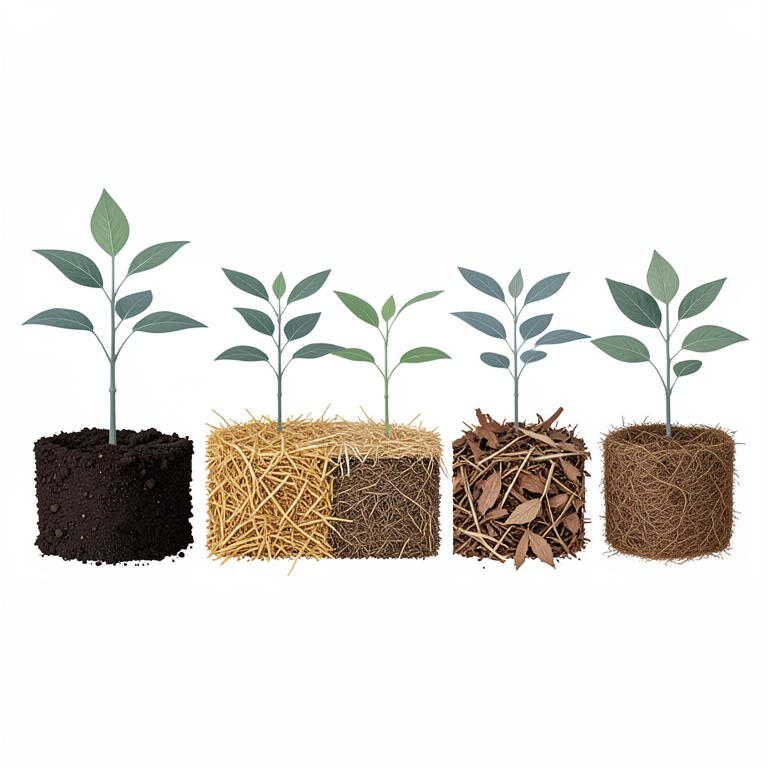
Organic Mulch Comparison Setup
AI-generated conceptual illustration (soybean plants in agricultural plots). It explains the idea and does not show study data.
View source evidence ↗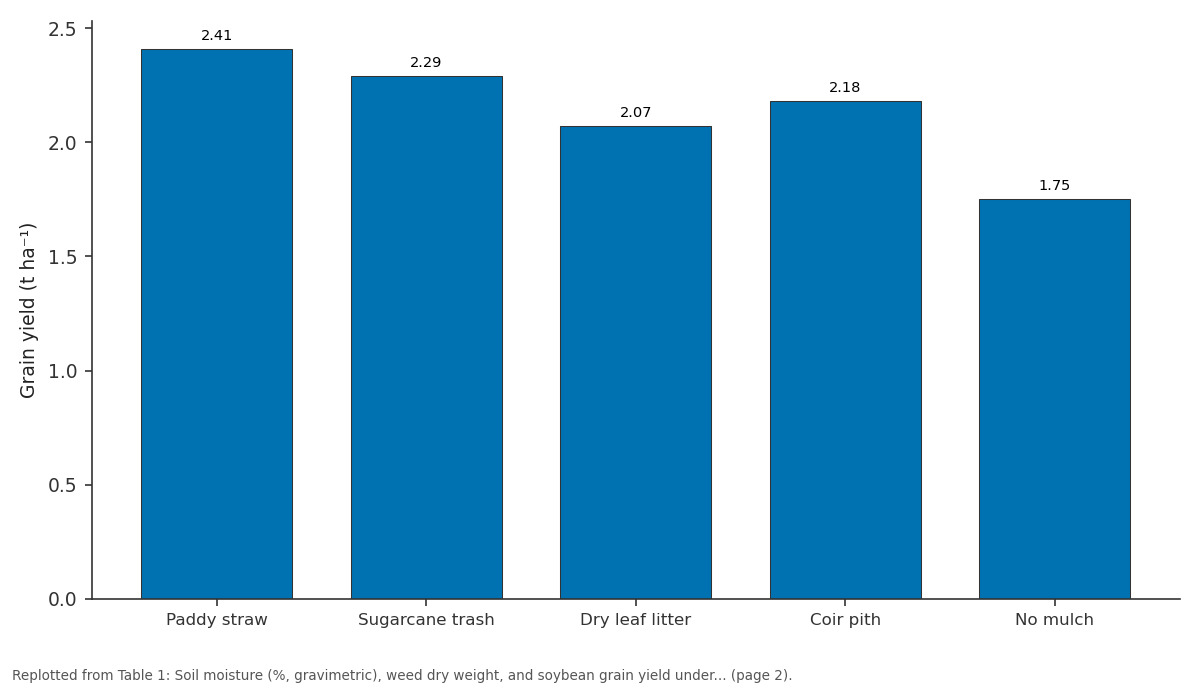
Grain yield (t ha⁻¹): Paddy straw vs Sugarcane trash vs Dry leaf litter vs Coir pith vs No mulch
Replotted from Table 1 (page 2) of the original paper. Every bar is the paper's own table value.
View source evidence ↗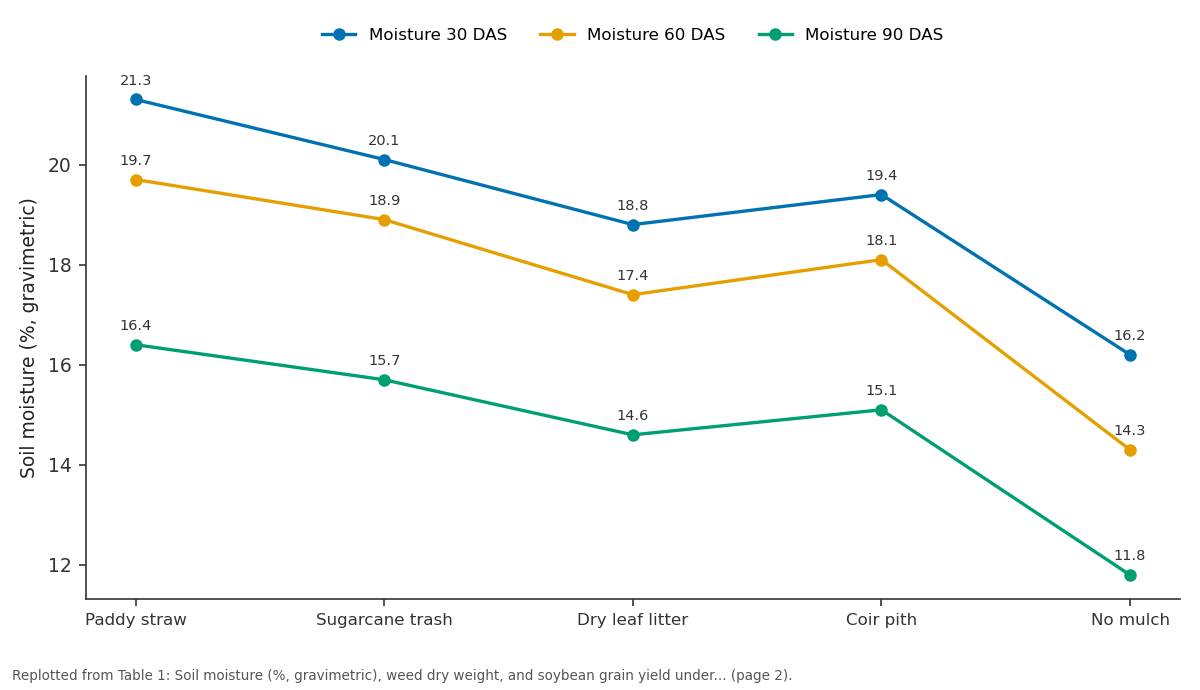
Moisture 30 DAS and Moisture 60 DAS and more: Paddy straw vs Sugarcane trash vs Dry leaf litter vs Coir pith vs No mulch
Replotted from Table 1 (page 2) of the original paper. Every bar is the paper's own table value.
View source evidence ↗Figures & tables
From the original paper Table 1
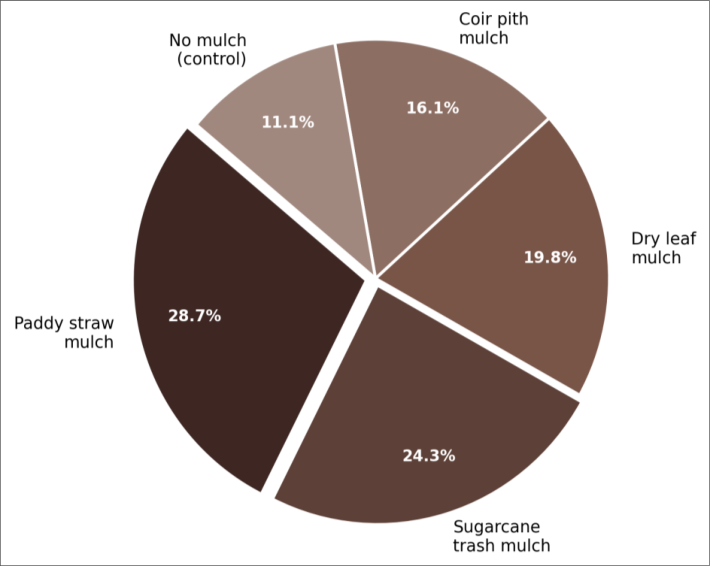 Figure 1
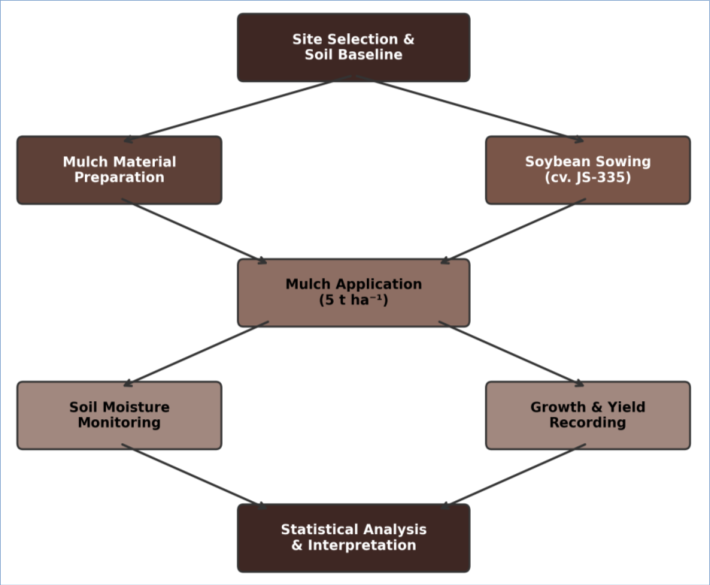 Figure 2
Introduction
Dryland agriculture supports 68% of the cropped area in India but contributes only 44% of total food production-a gap that underlines the limits of rainfed farming [1] . Soybean (Glycine max L.) is the principal oilseed crop of central India's Bundelkhand zone, where erratic monsoon rainfall and high evaporative demand routinely reduce yields below 1.5 t ha⁻¹ against a potential of 3.0 t ha⁻¹ [2,3] . Mulching is one of the simplest ways to conserve soil moisture, moderate soil temperature, and suppress weeds [4] . Synthetic plastic mulches are effective but create disposal problems in smallholder settings. Organic mulches-crop residues, leaf litter, coir by-productsdecompose in situ, adding organic matter and nutrients to the soil while performing the same moisture-conservation function [5,6] . Despite the logic, on-farm adoption of organic mulching in soybean is low in Bundelkhand, partly because comparative data on locally available materials are scarce [7] . Farmers need to know which residue type gives the best moisture retention per tonne applied and whether the yield gain justifies the labour of collection and spreading. This research compared four organic mulch materials at a uniform rate of 5 t ha⁻¹ to a) Quantify their effect on soil moisture and temperature at critical growth stages. b) Measure weed suppression and soybean yield response. c) Assess changes in soil organic carbon over two seasons.
Seasonal Rainfall Pattern
Jhansi receives roughly 870 mm of annual rainfall, of which 85% falls during the June-September monsoon. In 2022, total kharif-season rainfall was 743 mm, distributed across 38 rainy days, with a prolonged dry spell of 18 consecutive rain-free days in August. The 2023 season received 812 mm over 44 rainy days but had two shorter dry spells (10 and 12 days) in July and September. These mid-season droughts are typical of Bundelkhand and represent the critical window during which mulch-mediated moisture conservation most affects soybean yield [2] .
Material and Methods Material
Soybean cultivar JS-335 was sown at 75 kg ha⁻¹ in rows 45 cm apart during the last week of June in both years. Mulch materials were sourced locally: paddy straw from the university farm, sugarcane trash from nearby sugar mills, dry Tectona grandis leaf litter from campus plantations, and coir pith from a cooperative in Dapoli, Maharashtra. All mulches were applied uniformly at 5 t ha⁻¹ within one week of sowing. Basal fertiliser (20-60-40 kg N-P₂O₅-K₂O ha⁻¹) was applied to all plots.
Methods
The experiment followed a randomised complete block design with five treatments (four mulches + unmulched control) and four replications on 5 × 4 m plots at the university research farm, Jhansi (25.44° N, 78.57° E; 271 m a.s.l.). Gravimetric soil moisture was determined at 30, 60, and 90 days after sowing (DAS) from 0-15 and 15-30 cm depths. Soil temperature was recorded at 5 cm depth at 14:00 h using digital thermometers. Weed counts and dry weight were recorded in a 0.25 m² quadrat per plot at 45 DAS. At maturity, grain yield, stover yield, and 100-seed weight were Post-harvest soil samples (0-30 cm) were analysed for organic carbon (Walkley-Black method). Data were analysed by two-way ANOVA (treatment × year) with Tukey's HSD at p ≤ 0.05.
Results
Results
Comprehensive Interpretation
Paddy straw mulch maintained the highest soil moisture at every sampling date, with a peak advantage of 5.4 percentage points over the unmulched control at 60 DASthe stage coinciding with flowering and early pod fill. Weed dry weight was lowest under paddy straw (38.7 g m⁻²), a 54.3% reduction relative to the control, likely because the dense straw layer blocked light transmission to the weed seed bank. Grain yield followed the moisture and weedsuppression trend: paddy straw > sugarcane trash > coir pith > dry leaf litter > no mulch. Post-harvest soil organic carbon rose from 0.43% (baseline) to 0.57% under paddy straw and 0.51% under sugarcane trash after two seasons.
Discussion
The 37.8% yield gain under paddy straw mulch is consistent with results from semi-arid soybean trials in Madhya Pradesh, where straw mulch at 5 t ha⁻¹ raised yield by 30-42% [7,8] . The mechanism is straightforward: straw reduces evaporative loss from the soil surface, keeps root-zone moisture above the stress threshold during mid-season dry spells, and simultaneously suppresses weed competition for that moisture [4,5] . Coir pith, despite its high water-holding capacity, ranked third in yield-probably because its fine particle size allowed it to compact and shed rainwater rather than absorb it in field conditions, unlike its behaviour in pot culture experiments [9] . Dry leaf litter decomposed the fastest and provided the shortest effective mulch cover, explaining its lower performance [6] . The organic carbon increase (0.08-0.14% over two seasons) is modest but directionally important for Bundelkhand's carbon-depleted soils [3] . Longer-term trials of five or more seasons would be needed to confirm a sustained trend. A practical limitation is that paddy straw availability varies by year and location; in areas without paddy cultivation, sugarcane trash offers a strong alternative [10] .
Conclusion
Paddy straw mulch at 5 t ha⁻¹ was the most effective organic mulch for dryland soybean, raising grain yield by 37.8%, reducing weed biomass by 54.3%, and maintaining the highest soil moisture at all growth stages. Sugarcane trash was a close second. Both materials also improved soil organic carbon over two seasons. For Bundelkhand's rainfed soybean systems, paddy straw mulching is a low-cost, biodegradable alternative to synthetic films that can be recommended through extension services immediately.
Acknowledgement
AcknowledgementsThis research was supported by the Rani Lakshmi Bai Central Agricultural University research grant. Field assistance from Mr. Suresh Yadav is gratefully acknowledged.
Figures and tables from the paper
| Treatment | Moisture 30 DAS | Moisture 60 DAS | Moisture 90 DAS | Weed DW (g m⁻²) | Grain yield (t ha⁻¹) | 100-seed wt (g) |
|---|---|---|---|---|---|---|
| Paddy straw | 21.3 | 19.7 | 16.4 | 38.7 | 2.41 | 11.8 |
| Sugarcane trash | 20.1 | 18.9 | 15.7 | 42.1 | 2.29 | 11.4 |
| Dry leaf litter | 18.8 | 17.4 | 14.6 | 51.3 | 2.07 | 10.9 |
| Coir pith | 19.4 | 18.1 | 15.1 | 46.8 | 2.18 | 11.1 |
| No mulch | 16.2 | 14.3 | 11.8 | 84.7 | 1.75 | 10.2 |
| CD (p=0.05) | 1.3 | 1.1 | 0.9 | 5.6 | 0.18 | 0.6 |
Table text extracted from the original PDF; superscript letters are shown inline. The original table image is below.
View original table image
References
20 in the original paper- Venkateswarlu B, Shanker AK. Climate change and Indian agriculture: impacts, adaptation and future directions. Indian Journal of Agronomy. 2009;54(2):111-116.
- Bhatia VS, Singh P, Wani SP, Chauhan GS, Rao AVR, Mishra AK, Srinivas K. Analysis of potential yields and yield gaps of rainfed soybean in India using CROPGRO-Soybean model. Agricultural and Forest Meteorology. 2008;148(8):1252-1265.
- Singh VK, Dwivedi BS, Shukla AK, Chauhan YS, Yadav RL. Diversification of rice with pigeonpea in a rice-wheat cropping system on a Typic Ustochrept. Field Crops Research. 2005;92(1):85-105.
- Mulumba LN, Lal R. Mulching effects on selected soil physical properties. Soil and Tillage Research. 2008;98(1):106-111.
- Erenstein O. Crop residue mulching in tropical and semi-tropical countries: an evaluation of residue International Journal of Agriculture and Nutrition https://www.agriculturejournal.net availability and other technological implications. Soil and Tillage Research. 2002;67(2):115-133.
- Kumar K, Goh KM. Crop residues and management practices: effects on soil quality, soil nitrogen dynamics, crop yield, and nitrogen recovery. Advances in Agronomy. 1999;68:197-319.
- Ramesh P, Singh M, Subba Rao A. Organic farming: its relevance to the Indian context. Current Science. 2005;88(4):561-568.
- Sharma PK, Acharya CL. Carry-over of residual soil moisture with mulching and conservation tillage practices for sowing of rainfed wheat in north-west India. Soil and Tillage Research. 1996;40(1):29-37.
- Abad M, Noguera P, Puchades R, Maquieira A, Noguera V. Physico-chemical and chemical properties of some coconut coir dusts for use as a peat substitute. Bioresource Technology. 2002;82(3):241-245.
- Lal R. Soil carbon sequestration impacts on global climate change and food security. Science. 2004;304(5677):1623-1627.
- Cook HF, Valdes GSB, Lee HC. Mulch effects on rainfall interception, soil physical characteristics and temperature under Zea mays L. Soil and Tillage Research. 2006;91(1):227-235.
- Sarkar S, Singh SR. Interactive effect of tillage depth and mulch on soil temperature, productivity and water use pattern of rainfed barley. Soil and Tillage Research. 2007;92(1):79-86.
- Bhatt R, Khera KL. Effect of tillage and mode of straw mulch application on soil erosion in the submontaneous tract of Punjab. Soil and Tillage Research. 2006;88(1):107-115.
- Adekalu KO, Olorunfemi IA, Osunbitan JA. Grass mulching effect on infiltration, surface runoff and soil loss of three agricultural soils in Nigeria. Bioresource Technology. 2007;98(4):912-917.
- Dahiya R, Ingwersen J, Streck T. The effect of mulching and tillage on the water and temperature regimes of a loess soil. Soil and Tillage Research. 2007;95(1):210-220.
- Doring TF, Brandt M, Hess J, Finckh MR, Saucke H. Effects of straw mulch on soil nitrate dynamics, weeds, yield and soil erosion in organically grown potatoes. Field Crops Research. 2005;94(2):238-249.
- Kar G, Kumar A. Effects of irrigation and straw mulch on water use and tuber yield of potato in eastern India. Agricultural Water Management. 2007;94(1):109-116.
- Chakraborty D, Nagarajan S, Aggarwal P, Gupta VK, Tomar RK, Garg RN, Sahoo RN, Sarkar A, Chopra UK, Sarma KSS, Kalra N. Effect of mulching on soil and plant water status, and the growth and yield of wheat in a semi-arid environment. Agricultural Water Management. 2008;95(12):1323-1334.
- Montenegro AAA, Abrantes JRCB, de Lima JLMP, Singh VP, Santos TEM. Impact of mulching on soil and water dynamics under intermittent simulated rainfall. CATENA. 2013;109:139-149.
- Ghosh PK, Dayal D, Bandyopadhyay KK, Mohanty M. Evaluation of straw and polythene mulch for enhancing productivity of irrigated summer groundnut. Field Crops Research. 2006;99(2):76-86.