
Research article · 2025 · Full text
International Journal of Agriculture and NutritionSurvey and surveillance of major fungal diseases in lentil growing areas
Volume 7(6) · Pages 138–140 · DOI: 10.33545/26646064.2025.v7.i6c.446 ↗
Research areasPlant Pathogens and Fungal DiseasesGenetic and Environmental Crop StudiesPlant pathogens and resistance mechanisms
Abstract
Author-writtenLentil is Jharkhand’s most important Rabi pulse, yet field-level disease maps haven’t been updated since 2008. This research surveyed fungal diseases across five major lentil-growing districts of Jharkhand—Ranchi, Lohardaga, Gumla, Palamu, and Hazaribagh—during Rabi 2022 and 2023. A total of 120 fields (24 per district) were sampled at flowering and pod-fill stages. Rust (Uromyces viciae-fabae) was the most prevalent disease, present in 87% of fields with mean incidence of 28.4%. Fusarium wilt (Fusarium oxysporum f. sp. lentis) ranked second at 72% prevalence and 19.7% incidence. Stemphylium blight, Botrytis grey mould, and powdery mildew were also recorded. District-wise, Ranchi showed the highest rust pressure (34.1%) while Palamu had the highest wilt incidence (26.3%). Severity correlated with January rainfall (r = 0.78 for rust) and soil pH below 5.5 (r = 0.71 for wilt). These updated baseline data can guide targeted fungicide scheduling, resistant variety deployment, and future breeding priorities.
Summary
Source-checkedPlain-language reading of the full paper, prepared with AI and checked against the text. Each point links to the authors' own words.
Why it matters
- Lentil is the most significant Rabi pulse in Jharkhand, but the region's field-level disease maps are outdated, having not been revised since 2008. View evidence ↗
- In India, lentil production is most frequently limited by two specific diseases: rust and wilt. View evidence ↗
- Rust (U. viciae-fabae) reduces the photosynthetic area via pustules, while wilt (F. oxysporum f. sp. lentis) kills plants by blocking vascular bundles before pods fill. View evidence ↗
The question
- The study aimed to quantify fungal disease prevalence and incidence across five districts in Jharkhand, identify correlating environmental factors, and establish an updated baseline for breeding and extension. View evidence ↗
What they did
- The survey was conducted during the Rabi seasons of 2022 and 2023 across five districts: Ranchi, Lohardaga, Gumla, Palamu, and Hazaribagh. View evidence ↗
- Researchers sampled 120 fields in total, with 24 fields per district, during the flowering and pod-fill growth stages. View evidence ↗
- Disease incidence was estimated by evaluating 100 randomly selected plants per field using a W-shaped transect. View evidence ↗
- Pathogens were identified through morphological analysis and ITS sequencing at the Birsa Agricultural University laboratory. View evidence ↗
What they found
- Rust was the most common disease, appearing in 87% of the surveyed fields with a mean incidence of 28.4%. View evidence ↗
- Fusarium wilt was the second most prevalent disease, found in 72% of fields with a mean incidence of 19.7%. View evidence ↗
- Stemphylium blight (54% prevalence, 11.3% incidence) and Botrytis grey mould (38% prevalence, 7.8% incidence) were less frequent than rust and wilt. View evidence ↗
- Geographically, the highest rust pressure was recorded in Ranchi (34.1%) and the highest wilt incidence was in Palamu (26.3%). View evidence ↗
- Disease severity was positively correlated with January rainfall for rust (r = 0.78) and with soil pH below 5.5 for wilt (r = 0.71). View evidence ↗
- There is an inverse relationship between rust and wilt at the district level (r = -0.62), likely because rust prefers humid, cool upland conditions while wilt prefers acidic, waterlogged lowland soils. View evidence ↗
What it means
- The authors recommend rust-focused interventions for Ranchi and Lohardaga, and the use of wilt-resistant varieties and improved drainage for Palamu. View evidence ↗
- The current survey only provides a two-season baseline; the authors state that extending this to five seasons is needed to capture variability caused by El Niño–Southern Oscillation patterns. View evidence ↗
Visual summary
2 visualsIllustrations explain the paper; charts are replotted from the paper's own table values.
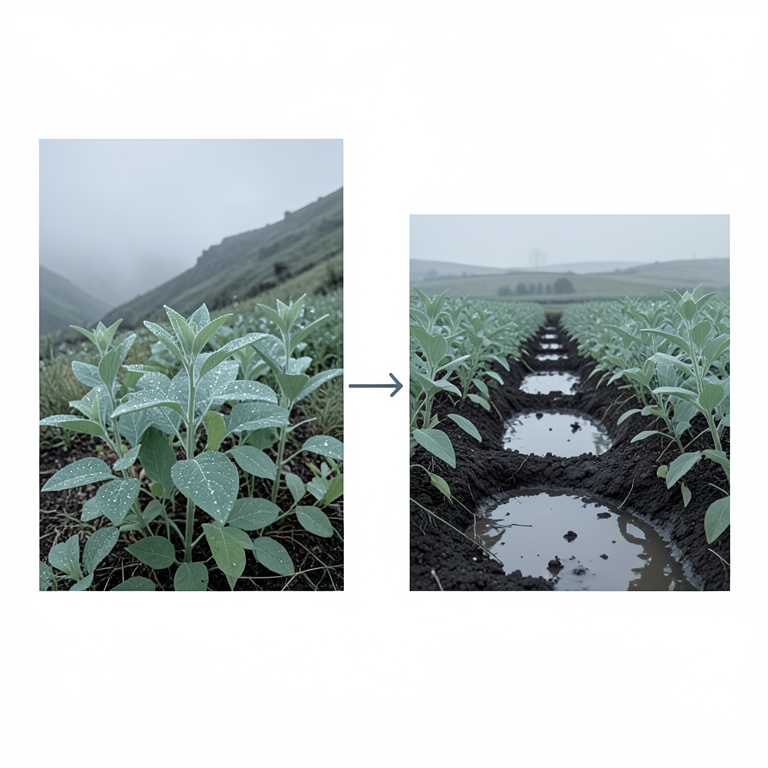
Environmental Drivers of Lentil Diseases
AI-generated conceptual illustration (lentil plants). It explains the idea and does not show study data.
View source evidence ↗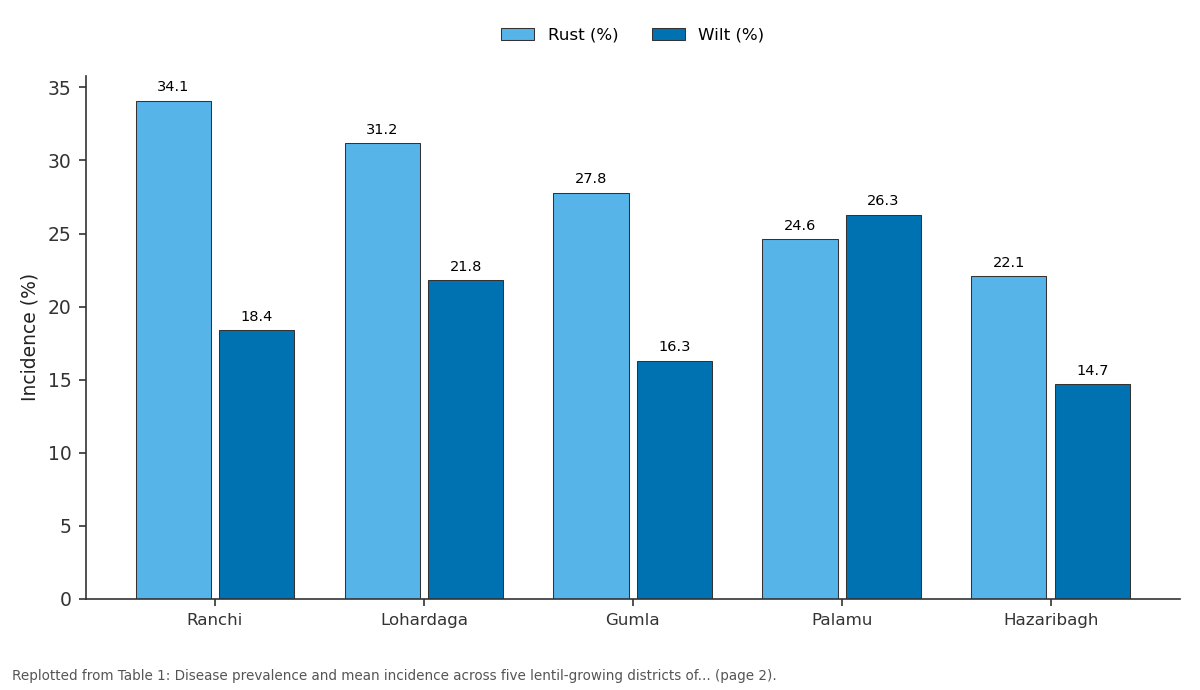
Rust (%) and Wilt (%): Ranchi vs Lohardaga vs Gumla vs Palamu vs Hazaribagh
Replotted from Table 1 (page 2) of the original paper. Every bar is the paper's own table value.
View source evidence ↗Figures & tables
From the original paper Table 1
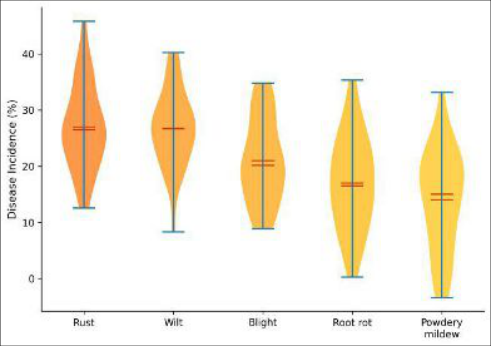 Figure 1
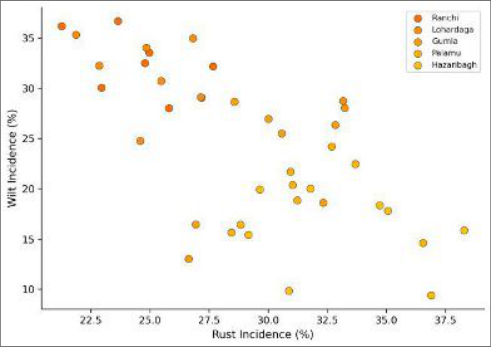 Figure 2
Introduction
Compare a healthy lentil field in Hazaribagh with one 40 km away in a low-lying pocket of Palamu, and the difference is striking: where the first shows clean green canopies, the second may have patches of wilted, yellowing plants interspersed with rust-streaked leaves [1] . This spatial variation in disease pressure exists across Jharkhand but has never been mapped systematically for lentil. Rust and wilt are the two diseases that most frequently limit lentil production in India [2,3] . Rust, caused by U. viciae-fabae, produces orange-brown pustules on leaves and stems, reducing photosynthetic area. Wilt, caused by F. oxysporum f. sp. lentis), blocks vascular bundles and kills plants before pod fill. Stemphylium blight (Stemphylium botryosum) and Botrytis grey mould are secondary concerns that spike in years with prolonged winter fog [4,5] . This research aimed to (i) quantify the prevalence and incidence of major fungal diseases of lentil across five Jharkhand districts, (ii) identify environmental factors correlated with disease severity, and (iii) provide an updated disease baseline to support extension and breeding decisions.
Research Area Description
Jharkhand's lentil belt occupies the Chota Nagpur plateau (22-24° N, 83-86° E, 200-650 m a.s.l.), characterised by undulating terrain, red lateritic to sandy loam soils (pH 4.8-6.2), and an average Rabi-season rainfall of 80-140 mm. Lentil is sown in October-November on residual soil moisture after rice harvest. The five surveyed districts together account for roughly 68% of Jharkhand's lentil area [6] .
Seasonal Weather During Survey
Rabi 2022 received 34% above-normal January rainfall in Ranchi and Lohardaga, creating conditions favouring rust epidemics. Rabi 2023, by contrast, was drier, with January rainfall 18% below normal. Mean minimum temperatures during the crop period ranged from 7.2 to 12.8 °C across districts. Fog days (visibility < 500 m) numbered 14-22 in valley locations, favouring Botrytis and Stemphylium [7] .
Materials and Methods
Materials and Methods
Materials
Surveys were conducted at the flowering (60-70 DAS) and pod-fill (85-95 DAS) stages during Rabi 2022 and 2023 across Ranchi, Lohardaga, Gumla, Palamu, and Hazaribagh districts. In each district, 24 fields were selected along predetermined transects at 5 km intervals. Fields ranged from 0.1 to 0.4 ha, representing typical smallholder plots. GPS coordinates and cropping history were recorded for each site [8] .
Methods
At each field, disease incidence was estimated on 100 randomly selected plants along a W-shaped transect. Severity was rated using published 1-9 scales for rust [2] and 0-4 scales for wilt [3] . Symptomatic samples were collected in paper bags, transported to the Birsa Agricultural University plant pathology laboratory, and identified morphologically and by ITS sequencing. Weather data were obtained from the nearest automatic weather station. Data were analysed by descriptive statistics and Pearson correlation in R (v4.3.1).
Results
Rust was found in 87% of surveyed fields with a mean incidence of 28.4% (Table 1). Wilt was present in 72% of fields at 19.7% mean incidence. Stemphylium blight (54% prevalence, 11.3% incidence) and Botrytis grey mould (38%, 7.8%) were less common. Ranchi recorded the highest rust incidence (34.1%) and Palamu the highest wilt (26.3%). January rainfall correlated positively with rust severity (r = 0.78, p < 0.01), while low soil pH correlated with wilt (r = 0.71).
| District | Rust (%) | Wilt (%) | Stemphylium (%) | Botrytis (%) | Powdery mildew (%) |
|---|---|---|---|---|---|
| Ranchi | 34.1 | 18.4 | 13.7 | 9.2 | 4.6 |
| Lohardaga | 31.2 | 21.8 | 12.4 | 8.1 | 3.8 |
| Gumla | 27.8 | 16.3 | 10.8 | 6.7 | 5.2 |
| Palamu | 24.6 | 26.3 | 9.4 | 8.4 | 3.1 |
| Hazaribagh | 22.1 | 14.7 | 11.2 | 6.8 | 4.3 |
| Overall mean | 28.4 | 19.7 | 11.3 | 7.8 | 4.2 |
Table text extracted from the original PDF; superscript letters are shown inline. The original table image is below.
View original table image
Comprehensive Interpretation
The inverse relationship between rust and wilt at the district level (r = -0.62) probably reflects differing environmental drivers: rust thrives under humid, cool conditions in upland Ranchi, while wilt is favoured by the acidic, waterlogged soils of lowland Palamu [4,9] . This spatial partitioning suggests that disease management recommendations should be district-specific rather than state-wide.
Discussion
The 87% field prevalence of rust is higher than the 65-75% reported in Madhya Pradesh [2] and 58% in Uttar Pradesh [10] , likely because Jharkhand's January fog provides extended leaf wetness that favours urediniospore germination. The wilt incidence of 19.7% aligns with national averages (15-25%) but masks the outlier status of Palamu (26.3%), where acidic soils and poor drainage create a wilt hotspot that deserves targeted intervention [3,11] . Stemphylium blight at 11.3% was lower than in Bangladesh (20-30%) [5] but still warrants monitoring because the pathogen spreads rapidly when fog persists for more than three consecutive days. The survey provides a two-season baseline; extending it to five seasons would capture year-toyear variability driven by El Niño-Southern Oscillation patterns that modulate winter rainfall in eastern India [12,13] .
Conclusion
Rust and Fusarium wilt are the dominant fungal constraints on lentil in Jharkhand, present in 87% and 72% of fields, respectively. Disease pressure varies substantially among districts, driven by rainfall patterns and soil acidity. Ranchi and Lohardaga need rust-focused interventions, while Palamu requires wilt-resistant varieties and improved drainage. These updated maps should inform district-level extension planning and breeding target-setting for
Figures and tables from the paper
References
18 in the original paper- Erskine W, Sarker A, Kumar S. Lentil: a food and feed crop for Eastern and Southern Africa. ICARDA. Aleppo; 2011.
- Srivastava SK, Singh VP, Kumar R. Epidemiology of lentil rust in India. Indian Phytopathology. 2010;63(3):263-268.
- Bayaa B, Erskine W, Hamdi A. Response of wild lentil to Fusarium oxysporum. Genetic Resources and Crop Evolution. 1998;45(1):75-80.
- Bakr MA, Ahmed F. Stemphylium blight: a new threat to lentil production in Bangladesh. Lens Newsletter. 1992;19(1):37-40.
- Podder R, Banniza S, Bhowmik P. Pathogenicity and molecular characterization of Stemphylium botryosum isolates from lentil. Canadian Journal of Plant Pathology. 2013;35(1):57-66.
- DES. Agricultural statistics of Jharkhand. Directorate of Economics and Statistics. Ranchi; 2022.
- IMD. Climate data for Jharkhand districts 2022-2023. India Meteorological Department. Pune; 2023.
- Nene YL, Haware MP, Reddy MV. Diagnosis of some wilt-like disorders of chickpea. Information Bulletin No. 13. ICRISAT; 1981.
- Chaudhary RG, Dhar V, Singh RK. Fusarium wilt of lentil: a review. Indian Journal of Pulses Research. 2009;22(2):117-124.
- Khare MN. Diseases of lentil. In: Allen DJ, Lenne JM (eds) The Pathology of Food and Pasture Legumes. CAB International; 1998. p. 505-544.
- Taylor PWJ, Ades PK, Pryor BM, Lindbeck K, Phan HTT. Genetic diversity in Australian isolates of Leptosphaeria maculans. Australasian Plant Pathology. 2006;35(6):655-661.
- Aggarwal PK, Joshi PK, Ingram JSI, Gupta RK. Adapting food systems of the Indo-Gangetic plains to global environmental change. Food Policy. 2004;29(4):371-397.
- Kumar J, Kaiser WJ, Hannan RM. Damping-off, stem rot, and root rot of chickpea caused by Rhizoctonia bataticola. Plant Disease. 1991;75(11):1140-1142.
- Pande S, Siddique KHM, Kishore GK, Bayaa B, Gaur PM, Gowda CLL. Ascochyta blight of chickpea: a review of biology, pathogenicity and disease management. Australasian Plant Pathology. 2005;34(4):467-486.
- Hwang SF, Strelkov SE, Chang KF, Turnbull GD, Howard RJ. Occurrence and management of Fusarium wilt of lentil in Alberta. Canadian Journal of Plant Pathology. 2006;28(2):288-296.
- Stoilova T, Chavdarov P. Evaluation of lentil germplasm for disease resistance to Fusarium wilt. Journal of Central European Agriculture. 2006;7(1):121-126.
- Kaiser WJ, Hannan RM. Seed transmission of Stemphylium vesicarium in lentil. Phytopathology. 1988;78(5):502-505.
- Muehlbauer FJ, Kaiser WJ, Clement SL, Summerfield RJ. Production and breeding of lentil. Advances in Agronomy. 1995;54:283-332.