
Research article · 2025 · Full text
International Journal of Agriculture and NutritionReproductive performance assessment of indigenous goat breeds under extensive management
Volume 7(6) · Pages 141–143 · DOI: 10.33545/26646064.2025.v7.i6c.447 ↗
Research areasLivestock Farming and ManagementGenetic and phenotypic traits in livestockReproductive Physiology in Livestock
Abstract
Author-writtenIn the Central Highlands of Vietnam, indigenous goats are the main livestock asset for ethnic minority households, yet their reproductive potential under traditional free-grazing management is poorly documented. This research tracked reproductive parameters of three indigenous breeds—Black, Bach Thao, and Co—plus their crossbreds across 148 does in eight villages around Buon Ma Thuot, Dak Lak, from January 2022 to December 2023. Bach Thao does had the highest kidding rate (1.84 kids doe-1 year-1) and shortest kidding interval (198 days). Co does showed the lowest prolificacy (1.24 kids per litter) but heaviest birth weights (2.03 kg). Crossbreds combined high kidding rate (1.93) with acceptable kid survival (74%). Age at first kidding averaged 10.8 months for Bach Thao versus 12.1 for Co. Kid pre-weaning mortality ranged from 14% (Co) to 26% (crossbred), with pneumonia and nutritional scour as leading causes. These baseline data can guide breed selection and targeted management interventions for smallholder goat production in Vietnam’s uplands.
Summary
Source-checkedPlain-language reading of the full paper, prepared with AI and checked against the text. Each point links to the authors' own words.
Why it matters
- Indigenous goats serve as the primary livestock asset for ethnic minority households in the Central Highlands of Vietnam. View evidence ↗
- Goats provide critical financial security for families to cover emergencies and education, making reproductive success and kid survival essential for economic returns. View evidence ↗
- Existing reproductive data often come from research stations with superior care, which may not accurately reflect the conditions of village flocks. View evidence ↗
The question
- The study aimed to document reproductive parameters for three indigenous goat breeds and their crosses in village settings, identify causes of kid mortality, and recommend breeds for smallholders. View evidence ↗
What they did
- The study tracked 148 does across four groups (42 Black, 38 Bach Thao, 34 Co, and 34 crossbred) in eight villages near Buon Ma Thuot. View evidence ↗
- Goats were managed under extensive conditions with daytime free-grazing, overnight bamboo shelter confinement, and limited dry-season supplementation of rice bran and cassava tops. View evidence ↗
- Researchers recorded kidding dates, litter size, sex, and birth weight monthly, while estimating age at first kidding via dentition and owner recall, and tracking mortality up to 90 days. View evidence ↗
What they found
- Among purebreds, Bach Thao does had the highest kidding rate (1.84 kids per doe per year) and litter size (1.52). View evidence ↗
- Co does exhibited the lowest prolificacy (1.24 kids per litter) but produced the heaviest kids at birth (2.03 kg). View evidence ↗
- Crossbreds achieved the highest overall kidding rate (1.93) and the shortest kidding interval (191 days). View evidence ↗
- Pre-weaning mortality varied by breed, peaking at 26% for crossbreds and reaching its lowest point at 14% for Co goats. View evidence ↗
- The high productivity of crossbreds was offset by a 26% mortality rate, primarily caused by pneumonia (42%) and nutritional scour (31%). View evidence ↗
- After adjusting for mortality, the net kid output per doe per year was highest for Bach Thao and crossbreds (both 1.43), followed by Black (1.33) and Co (1.26). View evidence ↗
What it means
- The authors recommend Bach Thao as the best purebred for those with basic healthcare, while Co is recommended for the most resource-constrained households. View evidence ↗
- A limitation of the study was the reliance on phenotypic assessment and owner records for breed classification due to a lack of pedigree documentation. View evidence ↗
- The two-year study period was sufficient for estimating means but not for assessing the lifetime productivity of the does. View evidence ↗
Visual summary
3 visualsIllustrations explain the paper; charts are replotted from the paper's own table values.
Breed Trade-offs Comparison
AI-generated conceptual illustration (indigenous goat breeds (Bach Thao, Co, and crossbred goats)). It explains the idea and does not show study data.
View source evidence ↗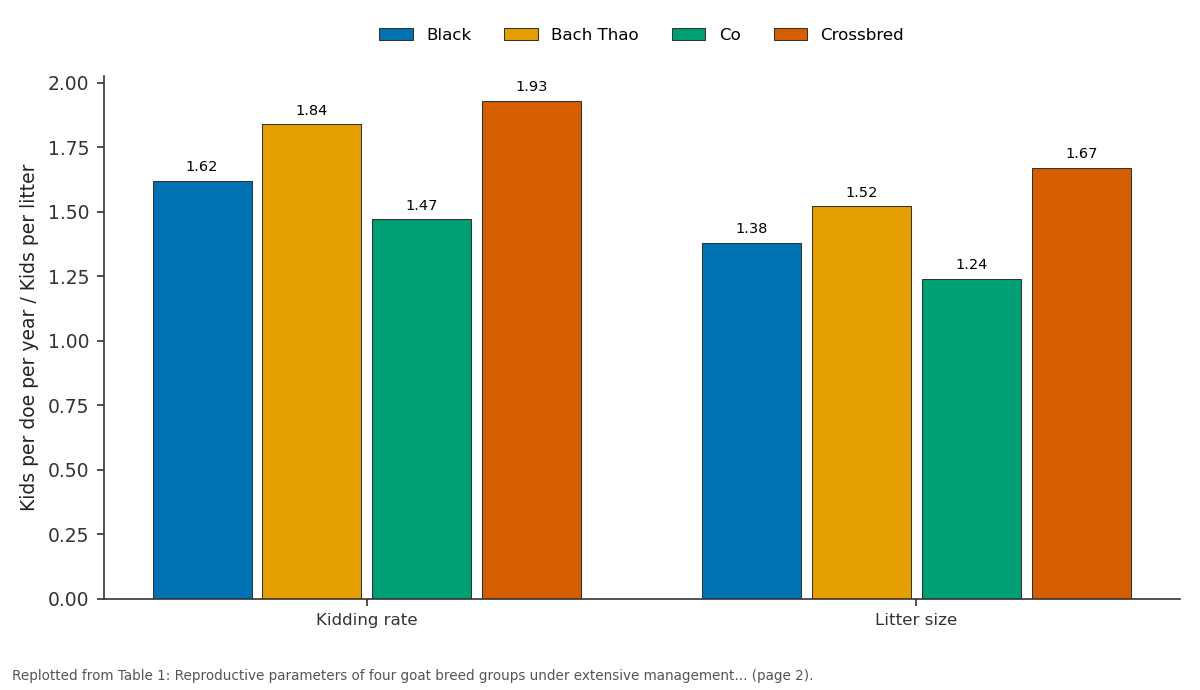
Black and Bach Thao and more: Kidding rate vs Litter size
Replotted from Table 1 (page 2) of the original paper. Every bar is the paper's own table value.
View source evidence ↗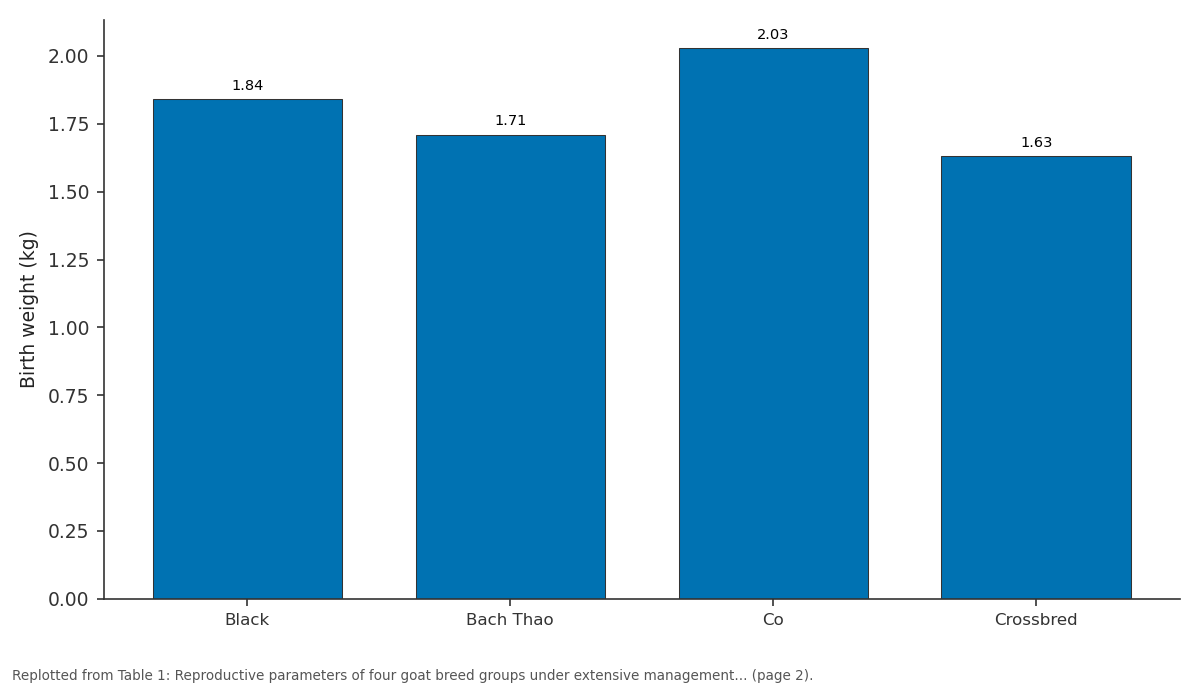
Birth weight (kg): Black vs Bach Thao vs Co vs Crossbred
Replotted from Table 1 (page 2) of the original paper. Every bar is the paper's own table value.
View source evidence ↗Figures & tables
From the original paper Table 1
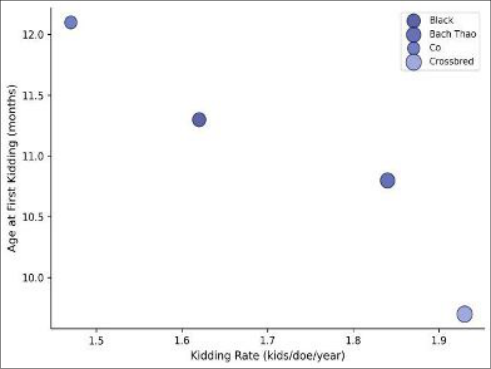 Figure 1
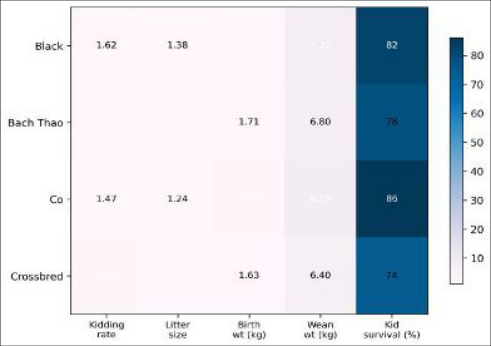 Figure 2
Introduction
In the red-earth highlands of Dak Lak province, a family's goat herd is both its savings account and its insurance policy. Goats are sold to cover school fees, medical emergencies, and wedding expenses-but the return depends directly on how many kids each doe produces and how many survive to market age [1] . Despite this economic importance, most reproductive data for Vietnamese goats come from government research stations where nutrition and health care are far better than what village flocks experience [2] . Vietnam has three main indigenous goat breeds. The Black goat (small-framed, adapted to rocky terrain) is the most numerous. Bach Thao (medium-framed, originating from northern border provinces) is reputed for higher prolificacy. Co (larger-framed, found in central and southern regions) is slower to mature but produces heavier kids [3] . Crossbreeding with these and imported Boer genetics has been encouraged by extension services, yet field-level reproductive data comparing purebreds and crosses under the same extensive management are scarce [4] . This research aimed to (i) document kidding rate, litter size, kidding interval, and age at first kidding for three indigenous breeds and their crosses under village conditions, (ii) identify the main causes of pre-weaning mortality, and (iii) provide evidence-based breed recommendations for highland smallholders.
Ethical Considerations
The research protocol was reviewed by the Animal Use Committee of the Central Highlands Agricultural College (Protocol No. CHAC-AUC/2021-14, approved 22 November 2021). No experimental interventions were imposed; the research was purely observational, recording natural reproductive events in farmer-owned flocks. Owners gave written informed consent for data collection and veterinary examinations [5] .
Limitations
Breed classification relied on phenotypic assessment and owner records because pedigree documentation is absent in village flocks. Some does classified as purebred may carry unrecorded crossbred ancestry. Nutritional intake was not measured directly; only grazing availability (estimated by pasture condition scoring) was recorded. The two-year window captures 2-3 kidding cycles per doe, which is adequate for estimating means but insufficient for assessing lifetime productivity [6] .
Materials and Methods
Materials and Methods
Materials
The research covered 148 does (42 Black, 38 Bach Thao, 34 Co, 34 crossbred) in eight villages within 30 km of Buon Ma Thuot (12°40′ N, 108°03′ E, 460 m a.s.l.). All flocks were managed under traditional free-grazing during the day with overnight confinement in bamboo shelters. Supplementation was limited to rice bran and cassava tops during the dry season (November-March). Does were identified with numbered ear tags and visited monthly by the research team for reproductive event recording [7] .
Methods
At each monthly visit, kidding dates, litter size, kid sex, and birth weight (spring balance, ±50 g) were recorded. Kidding interval was calculated between consecutive parturitions. Age at first kidding was estimated from owner recall and dentition. Pre-weaning mortality was recorded to 90 days and causes assigned by veterinary examination or postmortem when carcasses were available. Data were analysed by one-way ANOVA (breed as fixed factor) in R with Tukey's HSD at 5%.
Results
Bach Thao does achieved the highest kidding rate (1.84 kids doe -1 year -1 ) and litter size (1.52), while Co had the lowest prolificacy (1.24) but the heaviest individual birth weight (2.03 kg) (Table 1). Crossbreds reached the highest overall kidding rate (1.93) owing to a combination of good prolificacy and short kidding interval (191 days). Preweaning mortality was highest in crossbreds (26%) and lowest in Co (14%).
| Parameter | Black | Bach Thao | Co | Crossbred | CD (p=0.05) |
|---|---|---|---|---|---|
| Kidding rate | 1.62 | 1.84 | 1.47 | 1.93 | 0.18 |
| Litter size | 1.38 | 1.52 | 1.24 | 1.67 | 0.14 |
| Birth weight (kg) | 1.84 | 1.71 | 2.03 | 1.63 | 0.12 |
| Kidding interval (d) | 214 | 198 | 237 | 191 | 16 |
| Age 1st kidding (mo) | 11.3 | 10.8 | 12.1 | 9.7 | 0.9 |
| Pre-wean mortality (%) | 18 | 22 | 14 | 26 | 5 |
Table text extracted from the original PDF; superscript letters are shown inline. The original table image is below.
View original table image
Comprehensive Interpretation
When adjusted for kid mortality, net kid output (kids surviving to weaning per doe per year) was 1.33 for Black, 1.43 for Bach Thao, 1.26 for Co, and 1.43 for crossbred. The crossbred advantage in gross kidding rate was nearly wiped out by higher mortality, suggesting that crossbred kids are more susceptible to nutritional stress under extensive conditions [8] .
Discussion
The Bach Thao kidding rate of 1.84 is consistent with values (1.7-2.0) reported from northern Vietnam [2,3] and positions the breed as a productive choice for smallholders who can provide minimal dry-season supplementation. Co's lower prolificacy but heavier kids and lower mortality may suit farmers who market by live weight rather than by head count [9] . The crossbred's high gross output is offset by 26% pre-weaning loss-mostly from pneumonia (42% of deaths) and nutritional scour (31%)-conditions exacerbated by the humid, cool dry season at 460 m elevation [10] . Improving kid housing (draft-free shelters with dry bedding) and providing colostrum management training could feasibly cut mortality by 30-40%, as demonstrated in goat projects in Laos and Myanmar [11,12] . Such interventions would shift the net output ranking decisively in favour of crossbreds.
Conclusion
Bach Thao and crossbred does achieved the highest kidding rates under extensive highland management, but crossbred kids suffered the most pre-weaning mortality. Co does were the least prolific yet produced the heaviest, hardiest kids.
For Dak Lak's smallholders, Bach Thao is the best purebred option where basic healthcare is available; Co suits the most resource-constrained households. Reducing kid mortality
Acknowledgement
International Journal of Agriculture and Nutrition https://www.agriculturejournal.net through improved shelter and colostrum feeding would unlock the crossbred's genetic potential. Longer-term tracking across 5-6 kidding cycles will refine these recommendations [13,14,15,16] .
Figures and tables from the paper
References
16 in the original paper- Devendra C. Small ruminants in Asia: contribution to food security, poverty alleviation and opportunities for productivity enhancement. Small Ruminant Research. 2001;49(1):7-16.
- Vu VD, Dang VB, Phan DT, Preston TR. Goat production in the northern uplands of Vietnam: current status and potential. Livestock Research for Rural Development. 2009;21(8):article 123.
- Ngo TQ. Vietnamese native goat breeds: characterization and conservation. Animal Genetic Resources Information. 2006;38:41-47.
- Chokoe TC, Munyai PH, Muchenje V. A survey on challenges facing goat production in communal areas. Journal of Agricultural Science. 2020;12(3):214-222.
- OIE. Terrestrial animal health code: guidelines on animal welfare. World Organisation for Animal Health. Paris; 2019.
- Wilson RT. Small ruminant production and the small ruminant genetic resource in tropical Africa. FAO Animal Production and Health Paper 88. Rome; 1991.
- DARD. Dak Lak livestock census 2021. Department of Agriculture and Rural Development. Buon Ma Thuot; 2022.
- Alexandre G, Mandonnet N. Goat meat production in harsh environments. Small Ruminant Research. 2005;60(1-2):53-66.
- Lebbie SHB. Goats under household conditions. Small Ruminant Research. 2004;51(2):131-136.
- Smith MC, Sherman DM. Goat medicine. 2nd ed. Wiley-Blackwell. Ames; 2009.
- Phengsavanh P, Ogle B, Stür W, Frankow-Lindberg BE, Lindberg JE. Feeding and performance of goats in smallholder systems in Lao PDR. Tropical Animal Health and Production. 2010;42(5):867-874.
- Devendra C, Burns M. Goat production in the tropics. Commonwealth Agricultural Bureaux. Farnham Royal; 1983.
- Kosgey IS, Baker RL, Udo HMJ, van Arendonk JAM. Successes and failures of small ruminant breeding programmes in the tropics. Small Ruminant Research. 2006;61(1):13-28.
- Peacock C. Improving goat production in the tropics. Oxfam. Oxford; 1996.
- Webb EC, Mamabolo MJ. Production and reproduction characteristics of South African indigenous goats in communal farming systems. South African Journal of Animal Science. 2004;34(Suppl 1):236-239.
- Hasan MR, Akbar MA, Khandaker ZH, Rahman MM. Evaluation of some feeds for goats in Bangladesh. Asian-Australasian Journal of Animal Sciences. 2010;23(11):1466-1474.