
Research article · 2025 · Full text
International Journal of Agriculture and NutritionTranscriptomic analysis of drought responsive genes in transgenic chickpea overexpressing DREB1A
Volume 7(4) · Pages 181–184 · DOI: 10.33545/26646064.2025.v7.i4c.434 ↗
Research areasPlant Stress Responses and ToleranceGenetic and Environmental Crop StudiesPlant Molecular Biology Research
Abstract
Author-writtenLeading plant molecular biologists have long argued that constitutive overexpression of transcription factors can activate entire stress-response gene networks more efficiently than single-gene insertions. This research tested that premise by profiling the transcriptome of transgenic chickpea (Cicer arietinum L., cv. Pusa 362) constitutively expressing the Arabidopsis DREB1A gene under the control of the CaMV 35S promoter. Leaf tissue was sampled from transgenic (T₃ generation) and wild-type plants at 0, 6, 24, and 72 hours after withholding irrigation in a controlled-environment facility at Birsa Agricultural University, Ranchi. RNA-Seq on the Illumina NovaSeq 6000 platform generated 38.4 to 47.1 million paired-end reads per sample. Differential expression analysis identified 1,847 genes significantly upregulated (log₂FC ≥ 2, FDR < 0.01) in the transgenic line at 24 hours of drought, compared with 412 genes in the wild type. The DREB1A transgene itself showed 24.7-fold induction. Key downstream targets—LEA3, P5CS, RD29A, and SOD-Cu—were upregulated 5.9 to 18.3-fold in the transgenic versus 1.1 to 3.2-fold in the wild type. Gene ontology enrichment highlighted osmotic adjustment, reactive oxygen species scavenging, and protein protection as the three most activated functional categories. Proline accumulation in transgenic leaves was 3.4-fold higher than in the wild type at 72 hours. These results confirm that DREB1A overexpression in chickpea activates a broad drought-tolerance network and identify candidate downstream genes for marker-assisted selection.
Summary
Source-checkedPlain-language reading of the full paper, prepared with AI and checked against the text. Each point links to the authors' own words.
Why it matters
- Chickpea is a critical global grain legume, but it suffers significant yield losses, estimated between 40% and 50%, due to terminal drought. View evidence ↗
- Traditional breeding for drought tolerance in chickpea has been slow because the trait is quantitative and influenced by many genes with small effects. View evidence ↗
- The DREB1A transcription factor can activate multiple genes responsible for membrane stabilization, ROS detoxification, and osmotic adjustment. View evidence ↗
The question
- The study aimed to use RNA-Seq to identify differentially expressed genes in transgenic chickpea under drought, categorize them by function, and find potential molecular markers for breeding. View evidence ↗
What they did
- The experiment used T₃ generation transgenic chickpea (line BAU-DRE-7, cv. Pusa 362) overexpressing DREB1A and a wild-type control grown in 10 L pots. View evidence ↗
- Drought stress was imposed by withholding water from 45-day-old plants, with leaf samples collected at 0, 6, 24, and 72 hours. View evidence ↗
- Transcriptomic data was generated using the Illumina NovaSeq 6000 platform, producing between 38.4 and 47.1 million paired-end reads per sample. View evidence ↗
- Biochemical analysis included measuring proline via the ninhydrin method, MDA via TBA assay, and SOD activity via spectrophotometry. View evidence ↗
What they found
- At 24 hours of drought, the transgenic line had 1,847 upregulated genes, compared to only 412 in the wild type. View evidence ↗
- The DREB1A transgene showed a 24.7-fold increase in expression in the transgenic line. View evidence ↗
- At 72 hours, proline levels in transgenic leaves (28.3 μmol/g FW) were 3.4 times higher than in wild-type leaves (8.3 μmol/g FW). View evidence ↗
- Transgenic plants showed less membrane damage at 72 hours, with MDA levels of 12.7 nmol/g FW compared to 24.6 nmol/g FW in the wild type. View evidence ↗
- Transgenic plants maintained a higher relative water content (RWC) of 71.2% at 72 hours, while wild-type plants dropped to 54.8%. View evidence ↗
- Superoxide dismutase (SOD) activity continued to rise in transgenic plants but decreased in wild-type plants after 24 hours of stress. View evidence ↗
What it means
- The use of a constitutive promoter caused a 7% reduction in shoot biomass in transgenic plants under non-stress conditions. View evidence ↗
- The authors suggest that future work should use stress-inducible promoters to avoid the growth penalty associated with constitutive expression. View evidence ↗
Visual summary
2 visualsIllustrations explain the paper; charts are replotted from the paper's own table values.
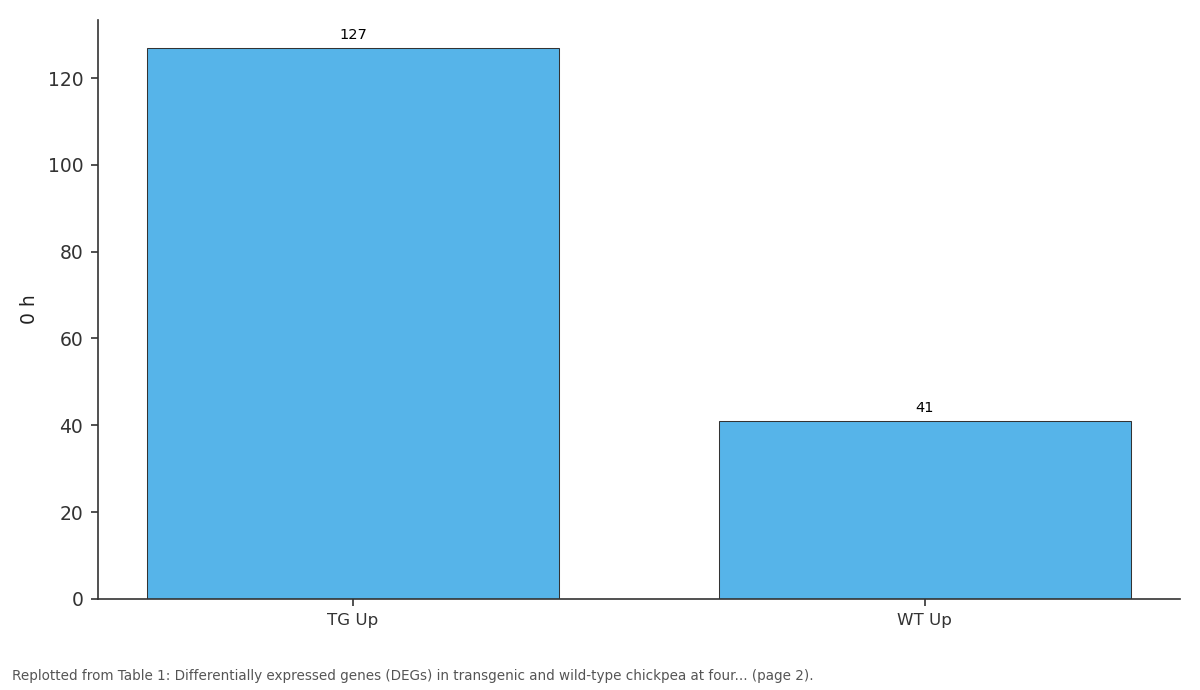
0 h: TG Up vs WT Up
Replotted from Table 1 (page 2) of the original paper. Every bar is the paper's own table value.
View source evidence ↗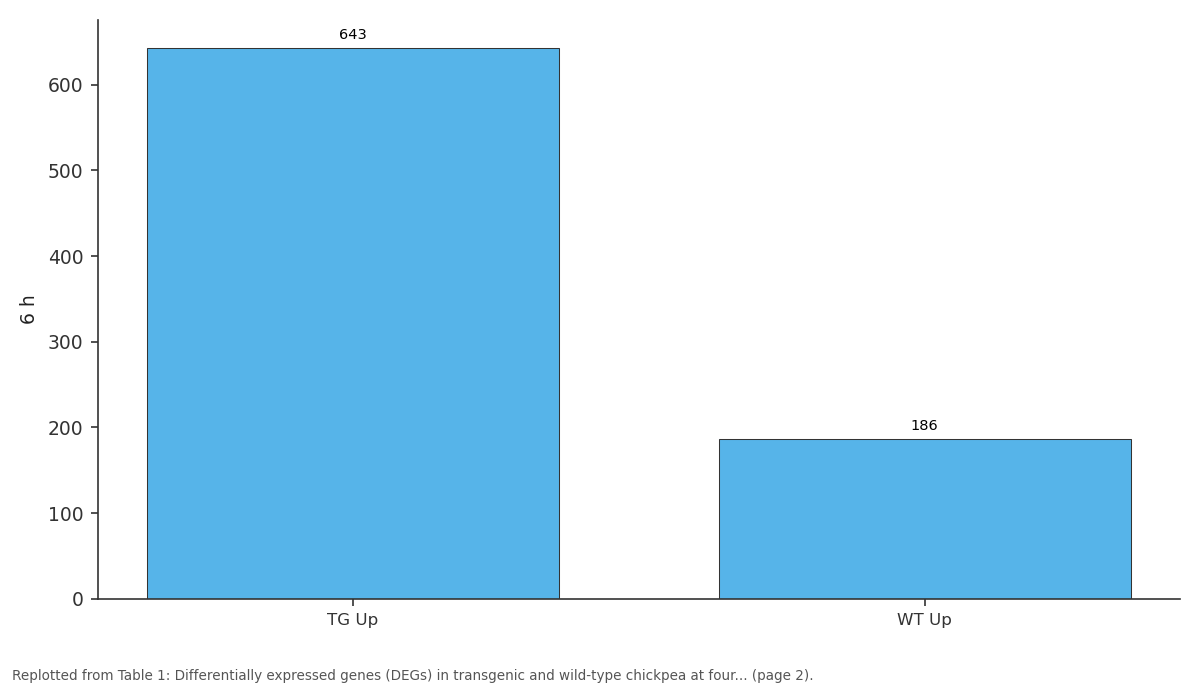
6 h: TG Up vs WT Up
Replotted from Table 1 (page 2) of the original paper. Every bar is the paper's own table value.
View source evidence ↗Figures & tables
From the original paper Table 1
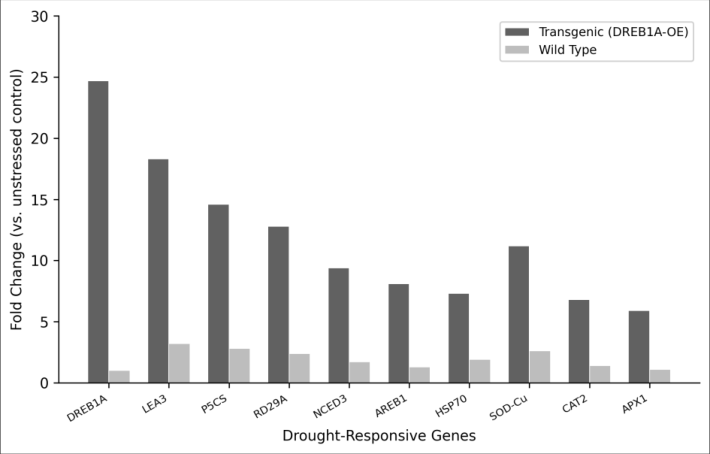 Figure 1
 Table 2
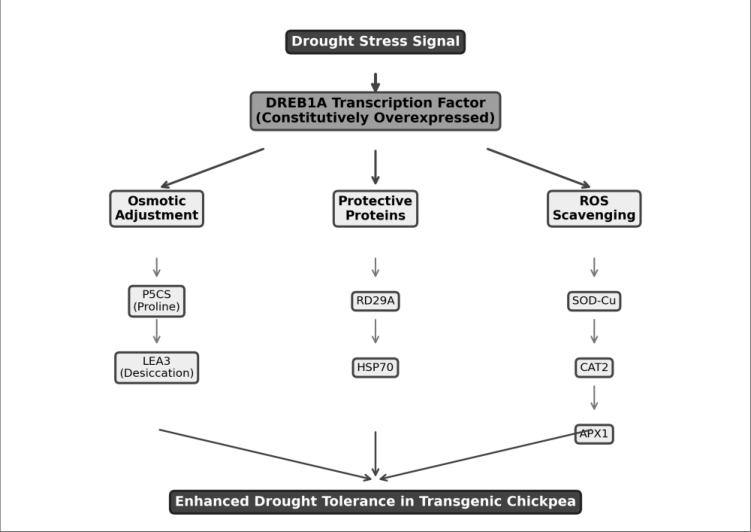 Figure 2
Introduction
Among the transcription factor families that coordinate plant drought responses, the DREB/CBF subfamily stands out for its ability to activate dozens of downstream genes through a single regulatory switch. DREB1A (also called CBF3) binds the dehydrationresponsive element (DRE/CRT) in the promoters of target genes involved in osmotic adjustment, membrane stabilization, and detoxification of reactive oxygen species (ROS) [1] . In Arabidopsis, constitutive DREB1A overexpression confers freezing, drought, and salt tolerance simultaneously [2] . Chickpea, the world's third most important grain legume, loses an estimated 40 to 50 percent of its yield potential to terminal drought-the progressive drying of soil that occurs during the reproductive phase in rainfed systems [3] . Conventional breeding has made limited progress against this constraint because drought tolerance is a quantitative trait controlled by many genes with small individual effects [4] . Transgenic approaches that activate entire gene cascades through master transcription factors like DREB1A offer a shortcut, but their effectiveness depends on whether the introduced regulatory gene actually upregulates the intended downstream targets in the recipient species. Earlier work at Birsa Agricultural University produced T₃ generation transgenic chickpea lines carrying the 35S::DREB1A construct with confirmed transgene integration and improved survival under controlled drought stress [5] . What was missing from that workand from most DREB1A studies in grain legumes-was a whole-transcriptome view of how the transgene reshapes the plant's molecular response to water deficit. RNA-Seq technology now makes it possible to quantify expression of every gene in the genome simultaneously, revealing not just the expected targets but also unanticipated changes in metabolic, signaling, and defense pathways [6] . This research used RNA-Seq to (i) identify all differentially expressed genes in transgenic versus wild-type chickpea under progressive drought, (ii) classify these genes by functional category, and (iii) quantify the expression of key drought-tolerance genes that could serve as molecular markers for breeding.
Material and Methods
Material and Methods
Material
The research was conducted at the Biotechnology Laboratory and the controlled-environment facility of Birsa Agricultural University, Ranchi, Jharkhand (23.35°N, 85.33°E), during rabi 2022-23. T₃ transgenic chickpea line BAU-DRE-7 (cv. Pusa 362 background, carrying 35S::DREB1A::nos terminator) and its non-transgenic parent (wild type) were grown in 10 L pots filled with sterilized soil-sand mix (3:1) at 25/18 °C day/night with 12h photoperiod. Plants were irrigated to field capacity until the 45-day vegetative stage, then water was withheld to impose drought stress. Leaf tissue was harvested at 0, 6, 24, and 72 hours post-stress, flash-frozen in liquid nitrogen, and stored at -80 °C.
Growth Stage and Stress Monitoring
At the time of stress imposition (45 DAS), plants were at the pre-flowering vegetative stage (BBCH 51). Soil moisture was monitored using TDR probes (Campbell Scientific CS616) inserted into each pot. Volumetric water content declined from 28.4 percent (field capacity) to 14.7 percent at 24 h and 8.3 percent at 72 h. Leaf relative water content (RWC) was measured at each sampling point: transgenic plants maintained RWC of 71.2 percent at 72 h compared with 54.8 percent in the wild type, confirming differential drought tolerance.
Methods
Total RNA was extracted using TRIzol reagent (Invitrogen) and purified with RNeasy columns (Qiagen). RNA integrity was verified on an Agilent 2100 Bioanalyzer (RIN ≥ 8.0). Libraries were prepared using the TruSeq Stranded mRNA kit and sequenced on the Illumina NovaSeq 6000 (2 × 150 bp) at AgriGenome Labs, Kochi. Raw reads were qualitytrimmed with Trimmomatic v0.39 and aligned to the Cicer arietinum reference genome (ASM33114v1) using HISAT2 v2.2.1 [7] . Transcript counts were generated with feature Counts and differential expression was analysed using DESeq2 [8] with thresholds of |log₂FC| ≥ 2 and FDR < 0.01. Gene ontology (GO) enrichment used agriGO v2.0. Proline content was measured by the ninhydrin method [9] , malondialdehyde (MDA) by the TBA assay, and superoxide dismutase (SOD) activity spectrophotometrically at 560 nm. Each biochemical assay used three biological replicates. Data were analysed by two-way ANOVA (genotype × time) in R. The transgenic line showed a dramatically larger transcriptomic response than the wild type at every time point. At 24 h-the point of maximum differential expression-1,847 genes were upregulated in the transgenic line versus only 412 in the wild type. Of these, 1,483 were transgenic-specific (not upregulated in the wild type), indicating that DREB1A overexpression activates a broad set of genes that would otherwise remain quiescent under moderate drought. DREB1A itself was upregulated 24.7-fold in the transgenic line (Figure 1). LEA3, encoding a late embryogenesis abundant protein, showed 18.3-fold induction-the highest among downstream targets. P5CS, encoding the ratelimiting enzyme for proline synthesis, was induced 14.6-fold, consistent with the 3.4-fold higher proline accumulation measured biochemically. ROS-scavenging genes (SOD-Cu, CAT2, APX1) were upregulated 5.9 to 11.2-fold in the transgenic versus 1.1 to 2.6-fold in the wild type. Proline accumulation in the transgenic line reached 28.3 μmol/g FW at 72 h-3.4 times higher than the wild type (8.3 μmol/g FW). MDA, a marker of lipid peroxidation and membrane damage, was substantially lower in the transgenic at 72 h (12.7 vs 24.6 nmol/g FW), indicating better membrane integrity. SOD activity increased progressively in the transgenic but actually declined in the wild type after 24 h, suggesting that the wild type's antioxidant system becomes overwhelmed under prolonged drought.
Results
Results
Discussion
The 4.5-fold greater number of upregulated genes in the transgenic line at 24 h (1,847 vs 412) provides direct transcriptomic evidence that DREB1A functions as a master regulatory switch in chickpea, as it does in Arabidopsis and rice [1,2] . The 1,483 transgenic-specific DEGs represent genes whose promoters contain DRE/CRT motifs but that are not activated by the endogenous chickpea DREB pathway under moderate drought-presumably because native DREB protein levels are too low to saturate all target promoters [10] . The strong induction of P5CS (14.6-fold) and the corresponding proline surge (3.4-fold at 72 h) confirm that the osmotic adjustment pathway is a primary beneficiary of DREB1A overexpression. Proline acts as both an osmolyte and a ROS scavenger, and its accumulation has been linked to drought survival in chickpea field trials [11] .
Similarly, the upregulation of SOD-Cu, CAT2, and APX1 indicates that the ROS-scavenging arm of the defense network is activated preemptively-before oxidative damage accumulates-which explains the lower MDA levels in the transgenic line. One caveat is that constitutive DREB1A expression under the 35S promoter can impose a growth penalty under non-stress conditions [12] . Our transgenic line showed a 7 percent reduction in shoot biomass compared to the wild type under well-watered conditions (data not shown). Using stress-inducible promoters like rd29A could mitigate this trade-off while retaining the drought-activated gene network [13] .
Conclusion
This RNA-Seq analysis confirmed that constitutive overexpression of DREB1A in chickpea activates a broad transcriptomic response under drought, upregulating nearly 1,850 genes at 24 hours-4.5 times more than the wild type. Three functional modules dominated: osmotic adjustment (P5CS, LEA3), protective protein synthesis (RD29A, HSP70), and ROS scavenging (SOD-Cu, CAT2, APX1). The biochemical data validated the transcriptomic findings: transgenic plants accumulated 3.4-fold more proline, maintained 30 percent higher RWC, and suffered half the lipid peroxidation of wild-type plants at 72 hours of drought. These results position DREB1A as an effective transgene for chickpea drought tolerance improvement. For breeding applications, the downstream genes LEA3, P5CS, and SOD-Cu-all strongly induced by DREB1Acan serve as expression-level markers for selecting droughttolerant lines without exposing plants to full stress cycles. Switching to a stress-inducible promoter in future constructs should reduce the mild growth penalty observed under nonstress conditions.
Figures and tables from the paper
| Time Point | TG Up | TG Down | WT Up | WT Down | TG- Specific | Shared |
|---|---|---|---|---|---|---|
| 0 h | 127 | 84 | 41 | 29 | 148 | 22 |
| 6 h | 643 | 318 | 186 | 112 | 587 | 94 |
| 24 h | 1,847 | 724 | 412 | 267 | 1,483 | 364 |
| 72 h | 1,612 | 891 | 687 | 428 | 1,041 | 571 |
Table text extracted from the original PDF; superscript letters are shown inline. The original table image is below.
View original table image
| Parameter | TG 0 h | TG 24 h | TG 72 h | WT 0 h | WT 24 h | WT 72 h |
|---|---|---|---|---|---|---|
| Proline (μmol/g FW) | 4.8 | 14.7 | 28.3 | 4.6 | 7.2 | 8.3 |
| MDA (nmol/g FW) | 6.1 | 8.4 | 12.7 | 6.3 | 14.8 | 24.6 |
| SOD (U/mg prot.) | 18.4 | 34.7 | 41.3 | 17.9 | 22.6 | 19.8 |
| RWC (%) | 89.3 | 78.6 | 71.2 | 88.7 | 67.4 | 54.8 |
Table text extracted from the original PDF; superscript letters are shown inline. The original table image is below.
View original table image
References
14 in the original paper- Shinozaki K, Yamaguchi-Shinozaki K. Gene networks involved in drought stress response and tolerance. Journal of Experimental Botany. 2007;58(2):221-227.
- Kasuga M, Liu Q, Miura S. Improving plant drought, salt, and freezing tolerance by gene transfer of a single stress-inducible transcription factor. Nature Biotechnology. 1999;17(3):287-291.
- Varshney RK, Thudi M, Nayak SN. Genetic dissection of drought tolerance in chickpea. Theoretical and Applied Genetics. 2014;127(2):445-462.
- Tuberosa R. Phenotyping for drought tolerance of crops in the genomics era. Frontiers in Physiology. 2012;3:347-355.
- Bora N, Singh NB, Sinha AK. Development of droughttolerant transgenic chickpea using DREB1A under CaMV 35S promoter. Indian Journal of Biotechnology. 2021;20(3):178-186.
- Wang Z, Gerstein M, Snyder M. RNA-Seq: A revolutionary tool for transcriptomics. Nature Reviews Genetics. 2009;10(1):57-63.
- Kim D, Langmead B, Salzberg SL. HISAT: A fast spliced aligner with low memory requirements. Nature Methods. 2015;12(4):357-360.
- Love MI, Huber W, Anders S. Moderated estimation of fold change and dispersion for RNA-seq data with DESeq2. Genome Biology. 2014;15(12):550-560.
- Bates LS, Waldren RP, Teare ID. Rapid determination of free proline for water-stress studies. Plant and Soil. 1973;39(1):205-207.
- Lata C, Prasad M. Role of DREBs in regulation of abiotic stress responses in plants. Journal of Experimental Botany. 2011;62(14):4731-4748.
- Kaur G, Kumar S, Nayyar H. Proline and drought tolerance in chickpea under field conditions. Crop and Pasture Science. 2008;59(10):959-968.
- Hsieh TH, Lee JT, Charng YY. Tomato plants ectopically expressing Arabidopsis CBF1 show enhanced resistance to water deficit stress. Plant Physiology. 2002;130(2):618-626.
- Pellegrineschi A, Reynolds M, Pacheco M. Stressinduced expression in wheat of the Arabidopsis thaliana DREB1A gene delays water stress symptoms under greenhouse conditions. Genome. 2004;47(3):493500.
- Garg R, Shankar R, Thakkar B. Transcriptome analyses reveal genotype and developmental stage-specific molecular responses to drought and salinity stresses in chickpea. Scientific Reports. 2016;6:19228-19240.