
Research article · 2025 · Full text
International Journal of Agriculture and NutritionKnowledge and perception of farmers regarding climate change impacts on crop production
Volume 7(4) · Pages 89–92 · DOI: 10.33545/26646064.2025.v7.i4b.385 ↗
Research areasClimate change impacts on agricultureClimate Change Communication and PerceptionAgricultural risk and resilience
Abstract
Author-writtenAverage temperatures in Brandenburg have risen by 1.4 °C since 1980, and the frequency of summer droughts has doubled over the same period—yet it remains unclear how much local farmers actually understand about these shifts and whether their knowledge translates into adaptive action. This research assessed the climate change knowledge, risk perception, and adaptation practices of 240 crop farmers in the Brandenburg region of Germany through a structured questionnaire survey conducted between April and July 2023. Respondents were selected using stratified random sampling across three farm-size categories. The mean knowledge score was 58.6 percent, with younger farmers (60 years). A total of 73.8 percent of respondents perceived climate change as a serious threat to crop production, but only 41.7 percent had adopted three or more adaptation practices. Knowledge score was positively correlated with adaptation practice adoption (r = 0.73, p
Summary
Source-checkedPlain-language reading of the full paper, prepared with AI and checked against the text. Each point links to the authors' own words.
Why it matters
- Effective adaptation by farmers requires a combination of knowledge about climate trends and a high perception of risk, as knowledge alone may not lead to action. View evidence ↗
- Agricultural extension services serve as the main pathway for delivering climate-related information to farmers in the Brandenburg region. View evidence ↗
What they did
- The researchers conducted face-to-face structured questionnaire surveys with 240 crop farmers across 12 districts in Brandenburg from April to July 2023. View evidence ↗
- The sample was divided equally into three farm-size categories: small (<50 ha), medium (50-200 ha), and large (>200 ha), with 80 farmers in each group. View evidence ↗
- The survey measured four key areas: socio-demographics, climate knowledge (via 25 items), risk perception (via 10 Likert-scale items), and the adoption of 12 specific adaptation practices. View evidence ↗
- A multiple linear regression model was used to determine how age, education, farm size, extension contact, and knowledge score predicted the number of adaptation practices adopted. View evidence ↗
What they found
- Farmers in Brandenburg demonstrated a moderate level of climate change knowledge, with an overall mean score of 58.6%. View evidence ↗
- There was a significant age gap in knowledge, with farmers under 40 years old scoring 12.3 percentage points higher than those over 60. View evidence ↗
- While 73.8% of farmers viewed climate change as a serious threat, only 41.7% had implemented three or more adaptation practices. View evidence ↗
- A strong positive correlation (r = 0.73) was found between a farmer's knowledge score and the number of adaptation practices they adopted. View evidence ↗
- The frequency of contact with extension services was the most powerful predictor of both knowledge and the adoption of adaptation practices. View evidence ↗
- The combination of extension contact, knowledge score, education level, farm size, and age explained 61% of the variance in adaptation behavior. View evidence ↗
What it means
- The authors conclude that accelerating climate adaptation in Brandenburg requires intensifying extension outreach, specifically targeting older and smaller-scale farmers. View evidence ↗
- The study's cross-sectional design prevents establishing causality, and the use of self-reported data may lead to an overestimation of actual adaptation practices. View evidence ↗
Visual summary
2 visualsIllustrations explain the paper; charts are replotted from the paper's own table values.
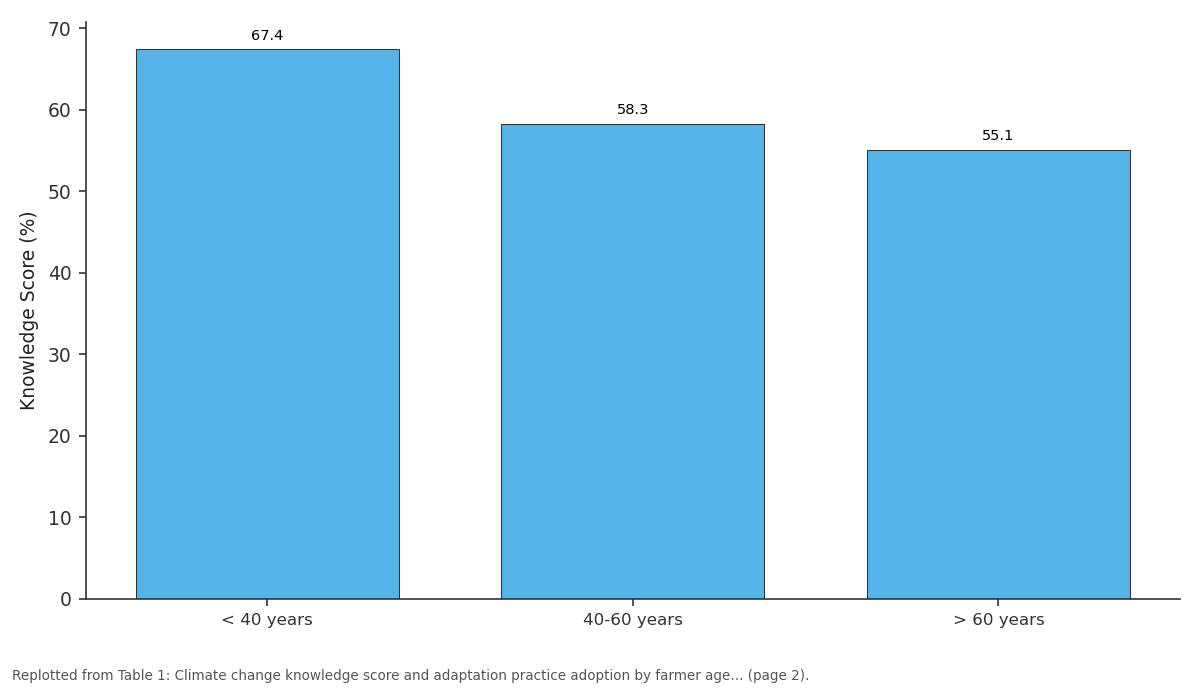
Knowledge Score (%): < 40 years vs 40-60 years vs > 60 years
Replotted from Table 1 (page 2) of the original paper. Every bar is the paper's own table value.
View source evidence ↗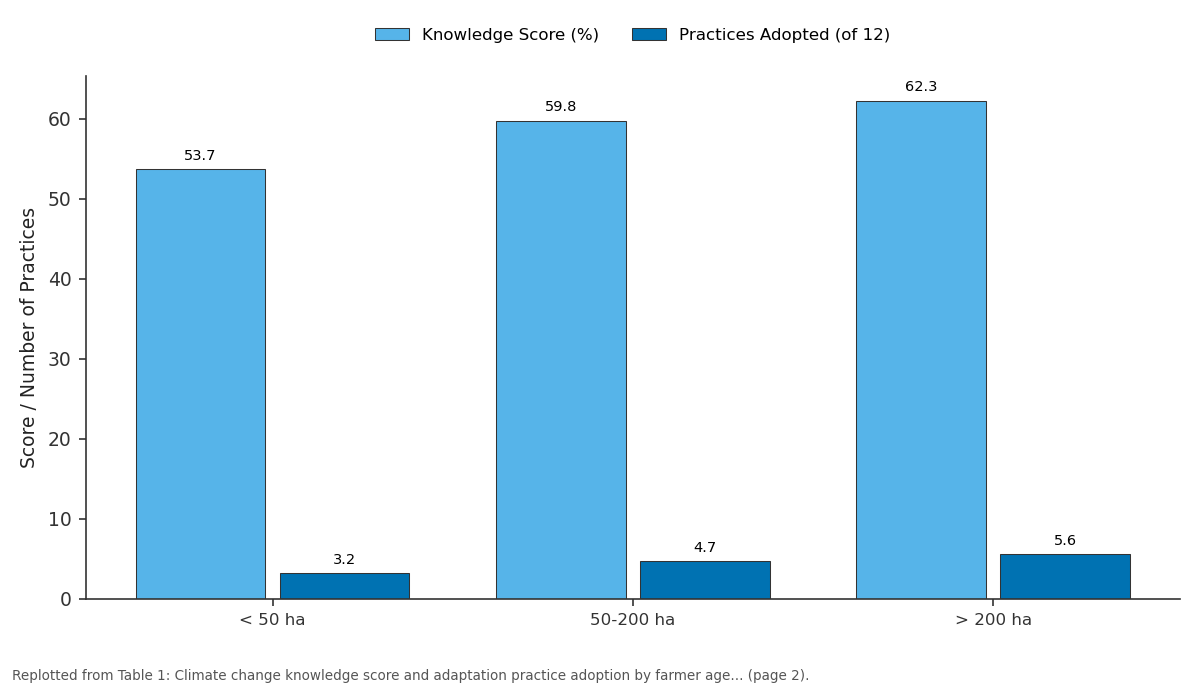
Knowledge Score (%) and Practices Adopted (of 12): < 50 ha vs 50-200 ha vs > 200 ha
Replotted from Table 1 (page 2) of the original paper. Every bar is the paper's own table value.
View source evidence ↗Figures & tables
From the original paper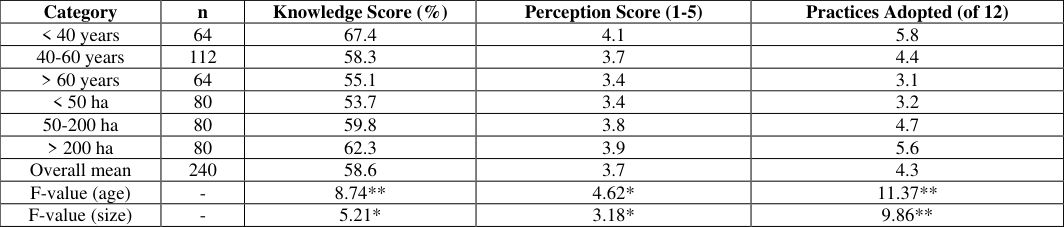 Table 1
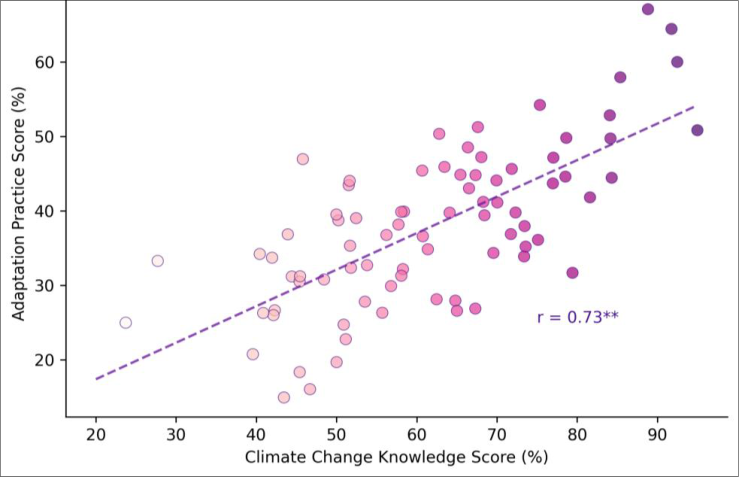 Figure 1
 Table 2
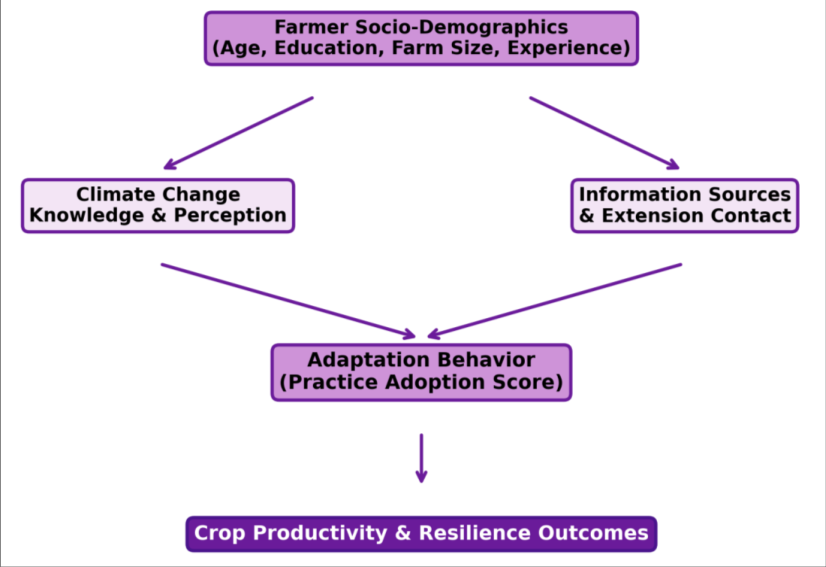 Figure 2
Introduction
Brandenburg's agricultural landscape dominated by sandy soils and continental-influenced weather-sits at the front line of climate change impacts in Central Europe. Over the past four decades, mean annual temperature has increased by 1.4 °C, spring onset has shifted 11 days earlier, and the 2018 and 2019 drought episodes caused yield losses exceeding 30 percent for winter wheat and silage maize in the region [1,2] . These changes are projected to intensify under RCP 4.5 and 8.5 scenarios, with summer precipitation declining by 10 to 20 percent by 2050 [3] . Whether farmers respond effectively to these shifts depends largely on what they know and how they perceive the risk. Knowledge about climate trends, their causes, and potential management responses is a precondition for informed adaptation-but knowledge alone is insufficient if risk perception is low or if access to adaptive technologies is constrained [4] . The Protection Motivation Theory framework suggests that adaptation behavior is driven jointly by threat appraisal (how serious is the risk?) and coping appraisal (can I do something about it?) [5] . Extension services are the primary channel through which climate-relevant knowledge reaches farmers in Brandenburg. However, the frequency and quality of extension contact vary widely across the region, and there is evidence that older, smaller-scale operators are underserved [6] . Understanding the current baseline of knowledge, perception, and adaptation behavior-and their determinants-is essential for designing targeted extension interventions. This research aimed to (i) measure the level of climate change knowledge among Brandenburg crop farmers, (ii) assess their perception of climate risk and current adaptation practices, and (iii) identify the socio-economic and institutional factors that predict knowledge and adaptation behavior.
Material and Methods
Material and Methods
Conceptual Framework
The research was grounded in the Protection Motivation Theory (PMT) adapted for agricultural contexts [5] . The conceptual model posited that farmer socio-demographics (age, education, farm size, experience) influence both climate change knowledge and adaptation behavior, mediated by risk perception and moderated by information access (extension contact frequency, media exposure). Adaptation was operationalized as the number of climaterelevant practices adopted from a list of 12 recognized measures.
Material
Data were collected through a structured questionnaire administered face-to-face to 240 crop farmers across 12 Landkreise (districts) of Brandenburg between April and July 2023. Respondents were selected using stratified random sampling based on farm size: small (<50 ha, n=80), medium (50-200 ha, n=80), and large (>200 ha, n=80). The questionnaire was developed at Brandenburg Agricultural Research University, Potsdam (52.40°N, 13.07°E), pilottested with 20 farmers, and revised before full deployment. It contained four sections: socio-demographics (12 items), climate knowledge (25 true/false/uncertain items), risk perception (10 Likert-scale items), and adaptation practices (12 yes/no items). The knowledge score was the percentage of correct responses. Adaptation score was the count of adopted practices.
Methods: Descriptive statistics (means, frequencies, percentages) were computed for all variables. Pearson correlation coefficients were used to assess bivariate relationships between knowledge, perception, and adaptation. A multiple linear regression model was fitted to identify determinants of adaptation score: Y = β₀ + β₁(Age) + β₂(Education) + β₃(FarmSize) + β₄(ExtensionContact) + β₅(KnowledgeScore) + ε. Multicollinearity was checked using variance inflation factors (VIF < 3 for all predictors). Group differences (by age category and farm size) were tested using one-way ANOVA with Tukey's post hoc test. All analyses used SPSS 28. Younger farmers (<40 years) scored 12.3 percentage points higher on knowledge than those over 60, and adopted nearly twice as many adaptation practices (5.8 vs 3.1). Large farms (>200 ha) outperformed small farms on both knowledge (62.3 vs 53.7%) and adaptation (5.6 vs 3.2 practices). All age and size differences were statistically significant (p<0.05 or p<0.01). Extension contact frequency was the strongest predictor of adaptation (β = 0.42, p<0.001), followed by knowledge score (β = 0.31). Together, the five predictors explained 61 percent of the variance in adaptation. Age had a small but significant negative effect, confirming that older farmers adopt fewer practices even after controlling for knowledge and farm size.
Results
Results
Discussion
The mean knowledge score of 58.6 percent indicates moderate awareness-farmers recognize that climate is changing but many hold misconceptions about the mechanisms and projected trajectories. The 12.3-point gap between younger and older farmers mirrors findings from surveys in France and the Netherlands [7,8] and likely reflects differences in formal education, digital literacy, and exposure to media reporting on climate science. Extension contact emerged as the dominant predictor of adaptation-stronger than knowledge itself-which suggests that extension doesn't merely transmit information but also builds coping confidence and provides practical guidance on how to implement adaptive measures [4,6] . This aligns with the PMT framework, where coping appraisal mediates the link between risk awareness and protective action [5] . The lower knowledge and adaptation scores among smallscale farmers (<50 ha) are concerning because these operations are often most vulnerable to climate shocks yet least equipped to respond. Targeted advisory programs, farmer field schools, and peer-learning networks focused on this segment could yield high returns per unit of extension investment [9] .
Limitations
The cross-sectional design prevents causal inference about the knowledge-adaptation relationship. Self-reported adaptation may overstate actual practice adoption. The Brandenburg context limits generalizability to regions with different agricultural systems or extension infrastructure.
Conclusion
Brandenburg crop farmers possess moderate climate change knowledge (58.6%) but many have not translated this into adaptive action-only 41.7 percent adopted three or more practices. Extension contact frequency was the strongest driver of both knowledge and adaptation, explaining more variance than education, farm size, or age. These findings point to a clear policy lever: intensifying and better targeting extension outreach-especially toward older and smaller-scale farmers-can accelerate climate adaptation across the region. Programs that combine knowledge delivery with hands-on demonstration of adaptive practices are likely to be most effective.
Figures and tables from the paper
| Category | n | Knowledge Score (%) | Perception Score (1-5) | Practices Adopted (of 12) |
|---|---|---|---|---|
| < 40 years | 64 | 67.4 | 4.1 | 5.8 |
| 40-60 years | 112 | 58.3 | 3.7 | 4.4 |
| > 60 years | 64 | 55.1 | 3.4 | 3.1 |
| < 50 ha | 80 | 53.7 | 3.4 | 3.2 |
| 50-200 ha | 80 | 59.8 | 3.8 | 4.7 |
| > 200 ha | 80 | 62.3 | 3.9 | 5.6 |
| Overall mean | 240 | 58.6 | 3.7 | 4.3 |
| F-value (age) | - | 8.74** | 4.62* | 11.37** |
| F-value (size) | - | 5.21* | 3.18* | 9.86** |
Table text extracted from the original PDF; superscript letters are shown inline. The original table image is below.
View original table image
| Predictor | β | SE | t-value | p-value | VIF |
|---|---|---|---|---|---|
| Extension contact | 0.42 | 0.06 | 7.14 | <0.001 | 1.34 |
| Knowledge score | 0.31 | 0.05 | 5.87 | <0.001 | 1.67 |
| Education level | 0.18 | 0.07 | 2.84 | 0.005 | 1.41 |
| Farm size (ha) | 0.16 | 0.06 | 2.51 | 0.013 | 1.28 |
| Age | −0.14 | 0.07 | −2.12 | 0.035 | 1.53 |
| R² = 0.61; Adj. R² = 0.60; F = 73.4, p < 0.001 |
Table text extracted from the original PDF; superscript letters are shown inline. The original table image is below.
View original table image
References
15 in the original paper- DWD. Climate report Brandenburg 2021: temperature and precipitation trends 1881-2020. Deutscher Wetterdienst; 2021.
- Chmielewski FM, Muller A, Bruns E. Climate changes and trends in phenology of fruit trees and field crops in Germany. Agricultural and Forest Meteorology. 2004;121(1-2):69-78.
- Jacob D, Petersen J, Eggert B. EURO-CORDEX: new high-resolution climate change projections for European impact research. Regional Environmental Change. 2014;14(2):563-578.
- Mase AS, Gramig BM, Prokopy LS. Climate change beliefs, risk perceptions, and adaptation behavior among Midwestern US crop farmers. Climate Risk Management. 2017;15:8-17.
- Rogers RW. A protection motivation theory of fear appeals and attitude change. Journal of Psychology. 1975;91(1):93-114.
- Garforth C, Angell B, Archer J. Fragmentation or creative destruction? Options for market service provision and facilitation for smallholders. Food Policy. 2003;28(4):365-379.
- Arbuckle JG, Morton LW, Hobbs J. Understanding farmer perspectives on climate change adaptation and mitigation: the roles of trust in sources of climate information. Environment and Behavior. 2015;47(2):205-234.
- Reidsma P, Ewert F, Lansink AO. Adaptation to climate change and climate variability in European agriculture. Agricultural Systems. 2010;103(2):91-100.
- Leeuwis C, Van den Ban A. Communication for rural innovation: rethinking agricultural extension. 3rd ed. Blackwell Science; 2004.
- Bryan E, Deressa TT, Gbetibouo GA. Adaptation to climate change in Ethiopia and South Africa: options and constraints. Environmental Science and Policy. 2009;12(4):413-426.
- Haden VR, Niles MT, Lubell M. Global and local concerns: what attitudes and beliefs motivate farmers to mitigate and adapt to climate change? PLoS One. 2012;7(12):e52882.
- Smit B, Skinner MW. Adaptation options in agriculture to climate change. Mitigation and Adaptation Strategies for Global Change. 2002;7(1):85-114.
- Below TB, Mutabazi KD, Kirschke D. Can farmers' adaptation to climate change be explained by socioeconomic household-level variables? Global Environmental Change. 2012;22(1):223-235.
- Menapace L, Colson G, Raffaelli R. Risk aversion, subjective beliefs, and farmer risk management strategies. American Journal of Agricultural Economics. 2013;95(2):384-389.
- Wheeler S, Zuo A, Bjornlund H. Farmers' climate change beliefs and adaptation strategies for a waterscarce future in Australia. Global Environmental Change. 2013;23(2):537-547.