
Research article · 2024 · Full text
International Journal of Agriculture and NutritionFarmers perception and adoption of boundary plantation practices for income diversification
Volume 6(1) · Pages 199–202 · DOI: 10.33545/26646064.2024.v6.i1c.414 ↗
Research areasAgricultural Innovations and PracticesAfrican Botany and Ecology StudiesForest Ecology and Conservation
Abstract
Author-writtenConvincing smallholder farmers to plant trees on their field boundaries — rather than leaving them bare or weed-infested — remains one of agroforestry's persistent challenges. This research surveyed 180 farm households across six villages in Banda district, Uttar Pradesh, to assess perceptions, adoption levels, and income contributions of boundary plantation practices. Data were collected through structured interviews during November-December 2021. Of the 180 respondents, 61% had adopted some form of boundary planting, but only 23% maintained trees on more than half their boundary length. Teak (Tectona grandis), neem (Azadirachta indica), and guava (Psidium guajava) were the most common species. Farm size was the strongest predictor of adoption (r = 0.74); marginal farmers (4 ha). Extension contact and subsidy awareness also correlated positively with adoption. Adopters reported 23% higher gross income from timber sales and 18% from fruit harvests relative to non-adopters. Perceived root competition with adjacent crops was the primary reason cited by non-adopters (68%). These results suggest that targeted extension, species-specific planting guidelines, and seedling subsidies could raise adoption rates among smaller landholders.
Summary
Source-checkedPlain-language reading of the full paper, prepared with AI and checked against the text. Each point links to the authors' own words.
Why it matters
- Dryland farmers in Bundelkhand face challenges from shrinking farm sizes, erratic rainfall, and stagnant crop incomes, which boundary tree planting could help mitigate. View evidence ↗
- Field boundaries, which typically make up 5-8% of a holding's total perimeter area, are often unproductive but can be used for income-generating trees. View evidence ↗
- Adoption of boundary planting is low among smallholders due to fears of root competition, shade suppressing yields, and the long time required for timber trees to provide returns. View evidence ↗
The question
- The study aimed to document boundary plantation adoption patterns by farm size, identify associated socio-economic and institutional factors, estimate income contributions, and record barriers for non-adopters. View evidence ↗
What they did
- The researchers randomly sampled 30 households from each of six purposively selected villages in the Banda district, totaling 180 respondents. View evidence ↗
- Data were collected via structured interviews between November and December 2021, following the kharif harvest. View evidence ↗
- The study used an adoption index (0-100), logistic regression to find adoption determinants, and Pearson correlation for continuous relationships. View evidence ↗
- Soil analysis of 20 adopter fields showed that areas under tree canopies had 14% higher organic carbon (0.53% vs 0.46%) and 11% higher available nitrogen (198 vs 178 kg/ha) than open areas. View evidence ↗
What they found
- While 61% of the 180 respondents adopted boundary planting, only 23% had trees covering more than half of their boundary length. View evidence ↗
- Adoption rates increased with farm size, with 90.9% of large farmers adopting compared to 42.6% of marginal farmers, and adoption scores rising from 38 to 71. View evidence ↗
- Farm size was a primary predictor of adoption (OR 2.39), though subsidy awareness (OR 2.51) and extension contact (OR 1.46) were also significant factors. View evidence ↗
- Compared to non-adopters, those who adopted boundary planting reported 23% higher gross income from timber and 18% higher income from fruit. View evidence ↗
- The primary barrier for non-adopters was root competition (68%), followed by the long gestation period (54%) and lack of seedlings (41%). View evidence ↗
What it means
- The authors recommend expanding targeted seedling distribution, providing species-site matching advice, and integrating short-gestation fruit species to provide quicker income. View evidence ↗
- The authors conclude that evidence of soil quality improvement under tree canopies should be used in extension messaging to counter farmers' fears of root competition. View evidence ↗
Visual summary
3 visualsIllustrations explain the paper; charts are replotted from the paper's own table values.
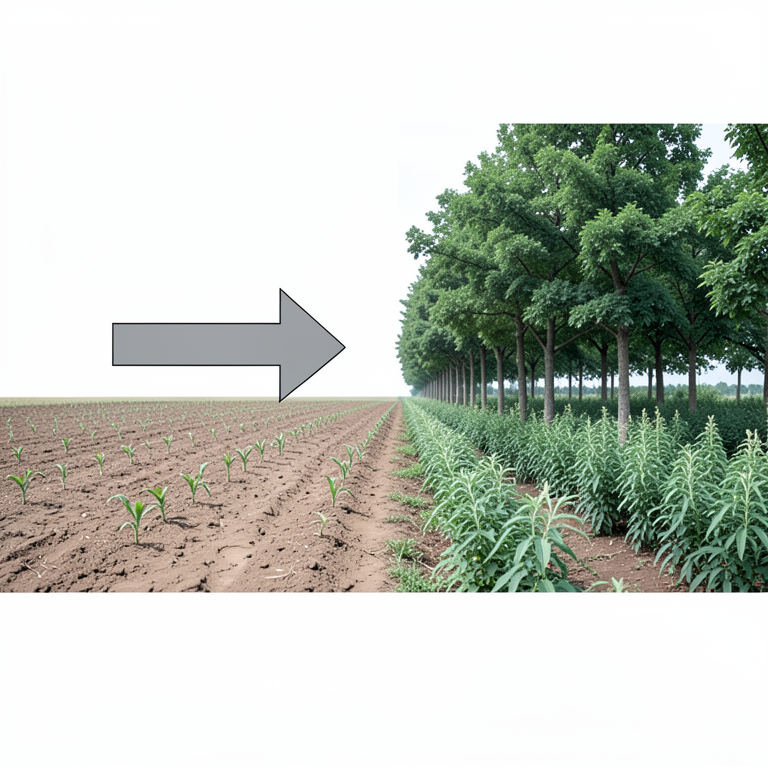
Drivers and Barriers of Adoption
AI-generated conceptual illustration (Agricultural farmland with boundary tree plantations). It explains the idea and does not show study data.
View source evidence ↗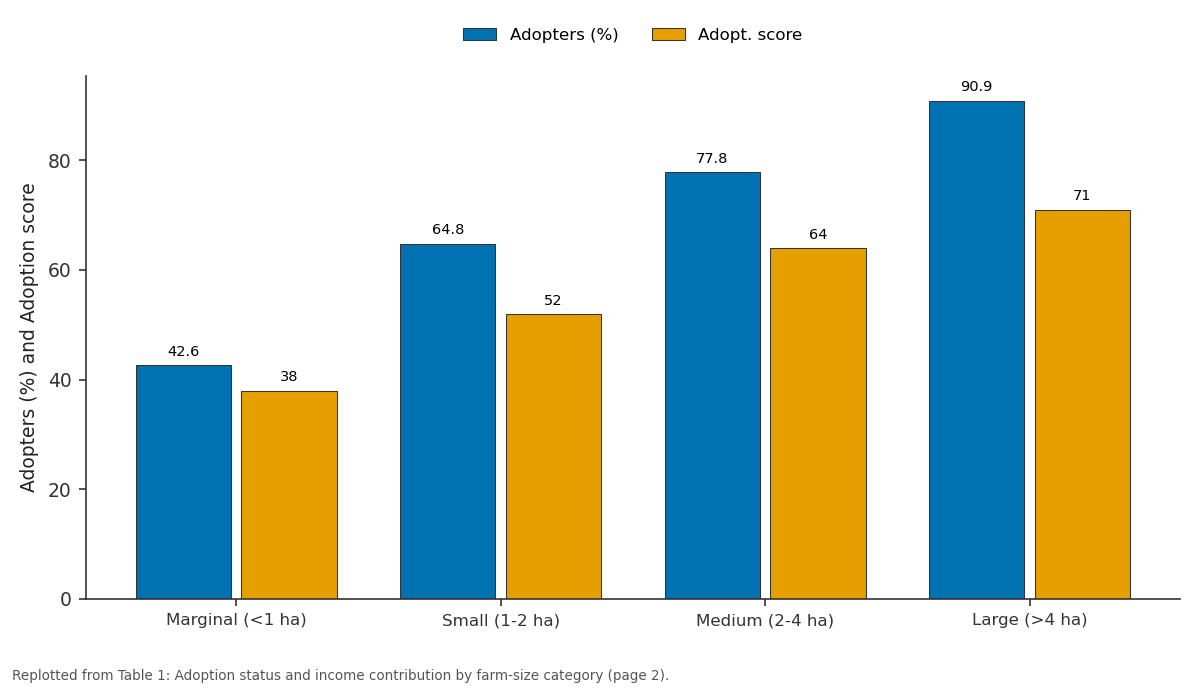
Adopters (%) and Adopt. score: Marginal (<1 ha) vs Small (1-2 ha) vs Medium (2-4 ha) vs Large (>4 ha)
Replotted from Table 1 (page 2) of the original paper. Every bar is the paper's own table value.
View source evidence ↗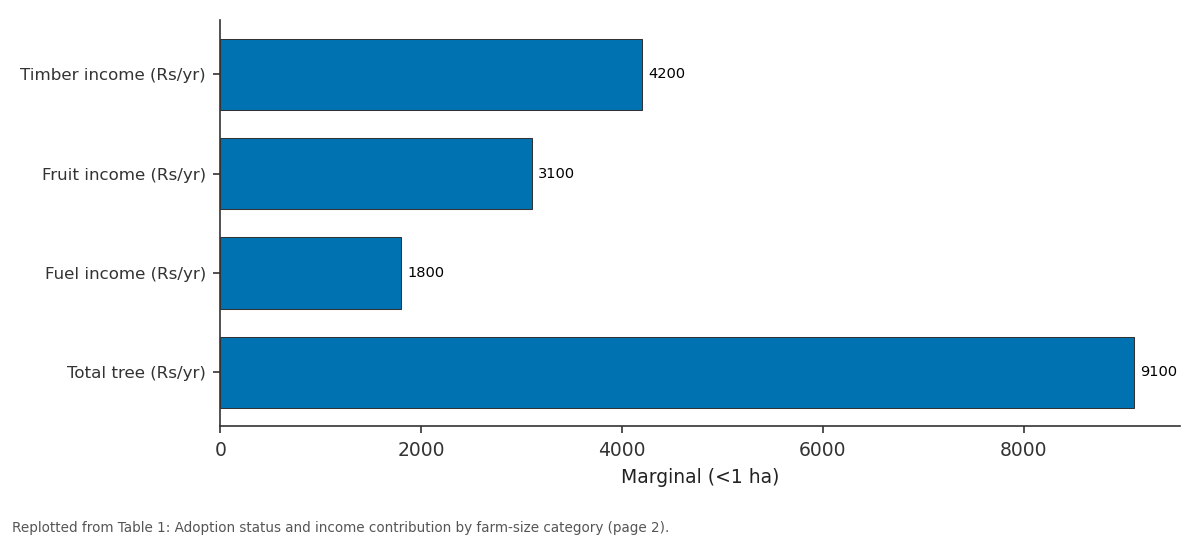
Marginal (<1 ha): Timber income (Rs/yr) vs Fruit income (Rs/yr) vs Fuel income (Rs/yr) vs Total tree (Rs/yr)
Replotted from Table 1 (page 2) of the original paper. Every bar is the paper's own table value.
View source evidence ↗Figures & tables
From the original paper Table 1
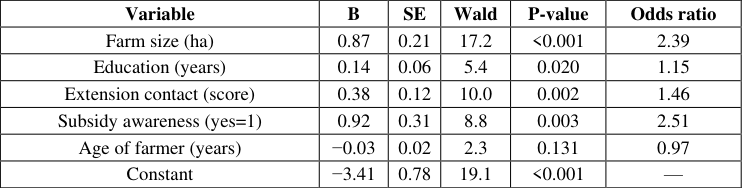 Table 2
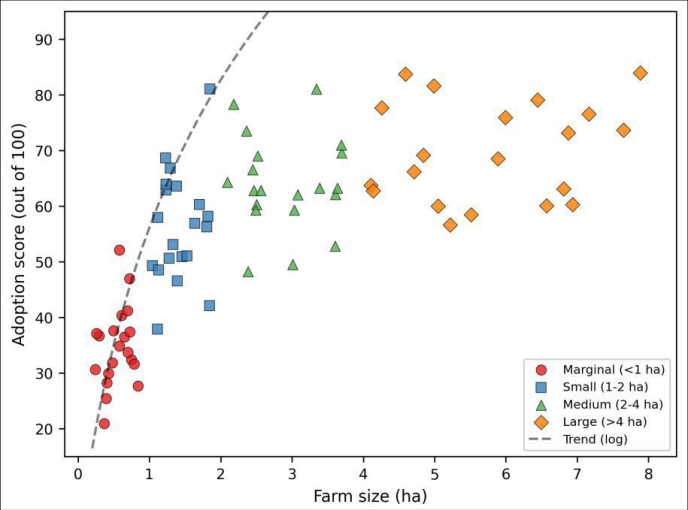 Figure 1
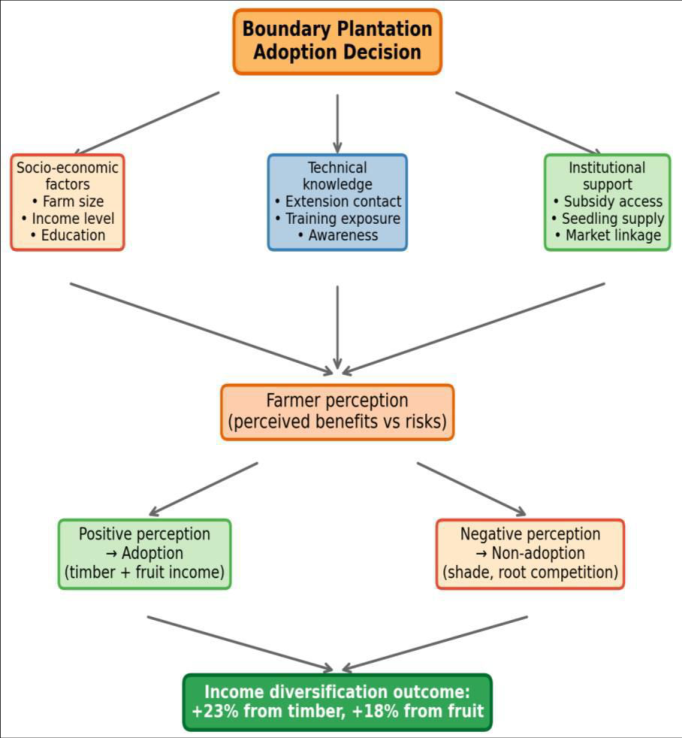 Figure 2
Introduction
Shrinking farm sizes, erratic rainfall, and stagnant crop incomes present a threefold challenge for dryland farmers in Bundelkhandone that boundary tree planting could partially address without reducing the area under annual crops. Field boundaries occupy roughly 5-8% of a holding's total perimeter area and are typically left unproductive, yet they could support timber, fuel, fruit, or fodder trees that generate income with minimal competition against the main crop [1] . The concept isn't new. Traditional farming systems across India include bund planting of species like teak, subabul, and ber. But systematic adoption has lagged, especially among smallholders who fear that tree roots will compete for moisture and nutrients, that tree shade will suppress crop yields, and that the long gestation period of timber species ties up land without immediate returns [2] . These perceptionswhether accurate or notact as powerful barriers to adoption. Extension agencies and forestry departments have promoted boundary planting through subsidised seedling distribution and farm-forestry campaigns, but adoption rates remain patchy. Part of the problem is that promotional efforts often push species chosen for timber value or ecological benefit without accounting for what farmers actually want: quick returns, low maintenance, and compatibility with existing crops [3] . A fruit tree like guava or citrus may appeal more to a marginal farmer than a teak sapling that won't yield revenue for 15 years. This research surveyed 180 farm households in Banda district to (a) document the extent and pattern of boundary plantation adoption across farm-size categories, (b) identify the socioeconomic and institutional factors most strongly associated with adoption, (c) estimate the income contribution of boundary trees among adopters, and (d) record perceived barriers among non-adopters [4] .
Material and Methods Seasonal Variations and Data Collection Timeline
Data collection was carried out during November-December 2021, immediately after the kharif harvest, when farmers were available for extended interviews and could provide fresh estimates of crop and tree income for the justconcluded season. This timing also allowed field verification of boundary tree presence and species identity during household visits [5] .
Material
Six villages in Banda district (25.48°N, 80.33°E) were selected purposively to represent a range of farm sizes and proximity to extension institutions. Within each village, 30 households were sampled randomly from voter lists, giving a total of 180 respondents. Banda district lies in the semiarid Bundelkhand plateau (mean rainfall 850 mm, rakar soils, cropping intensity 118%) and is characterised by fragmented land holdings with 72% of farmers classified as marginal or small (<2 ha) [6] .
Methods
A pre-tested structured interview schedule covering 47 items was administered in person. Variables included: sociodemographic profile (age, education, farm size, income sources), boundary plantation details (species planted, boundary length covered, age of trees), perceived benefits and constraints (Likert-scaled items), extension contact frequency, awareness of subsidy schemes, and income from tree products (timber, fruit, fuelwood) for the preceding 12 months. An adoption index (0-100 scale) was computed based on boundary coverage, species diversity, and management intensity. Logistic regression was used to identify determinants of adoption (binary: adopter vs nonadopter), and Pearson correlation was used for continuous relationships. Data were analysed in SPSS v26 [7] .
Baseline Soil Characterisation
Soil samples from boundary and non-boundary zones in 20 adopter fields showed that soils under tree canopy had 14% higher organic carbon (0.53 vs 0.46%) and 11% higher available N (198 vs 178 kg/ha) than adjacent open areas, suggesting a soil-improvement co-benefit of boundary planting that may offset perceived competition effects [8] . Adoption rose sharply with farm size: 42.6% of marginal farmers had adopted boundary planting versus 90.9% of large farmers. Mean adoption score increased from 38 (marginal) to 71 (large). Total tree income for large-farm adopters averaged Rs 37,700/yearfour times higher than for marginal adopters (Rs 9,100/year), reflecting both greater boundary length and older, more productive trees. Timber was the largest income component across all categories [1,3] . Among non-adopters, 68% cited root competition with crops as the main constraint, followed by long gestation period (54%) and lack of seedling availability (41%) [2,4] .
Results
Results
Discussion
The strong farm-size effect on adoption is consistent with agroforestry adoption research across South Asia. Larger farms have more boundary length available, lower opportunity cost per metre, and greater capacity to absorb the long wait for timber returns [2,9] . The 42.6% adoption rate among marginal farmerswhile lower than larger categoriesis still encouraging and suggests that targeted interventions could push it higher. The subsidy-awareness variable's strong odds ratio (2.51) points to a clear policy lever: simply making farmers aware that free or subsidised seedlings exist can substantially shift adoption probabilities. Root competition, cited by 68% of non-adopters, deserves nuanced attention. While teak and eucalyptus roots can indeed extend 3-5 metres into adjacent crop zones, many boundary-compatible speciessuch as drumstick (Moringa oleifera), ber (Ziziphus mauritiana), and even neem when properly prunedhave manageable root spread [10] . The soil data showing 14% higher organic carbon under tree canopy suggest that any competition effect may be partially offset by nutrient cycling benefits, at least over a 5-10 year horizon [8] .
The income contribution of boundary trees -Rs 9,100 to Rs 37,700/yearrepresents 7-12% of total household income for adopters. This isn't transformative, but it provides a buffer against crop failure years, which are common in semi-arid Bundelkhand. Guava and ber, which begin fruiting within 3-4 years, may hold particular appeal for smallholders seeking earlier returns than timber species can offer [11] .
Conclusion
Boundary plantation adoption in Banda district was strongly driven by farm size, extension contact, and awareness of subsidy schemes. Large farmers adopted at twice the rate of marginal farmers, and their tree income was four times higherreflecting both greater boundary availability and older tree stands. Root competition with adjacent crops was the dominant barrier for non-adopters, suggesting that species-specific planting guidelines emphasising low-competition species (neem, guava, moringa) could address farmer concerns directly. The soil quality improvement under tree canopy provides evidence to counter competition fears in extension messaging.
For policy, three actions appear warranted: expanding seedling distribution programmes targeted at marginal and small farmers, training extension workers to provide species-site matching advice rather than promoting a onesize-fits-all species list, and integrating short-gestation fruit species alongside timber trees to provide earlier income streams. Bundelkhand's dryland farmers need every income buffer they can get, and productive field boundaries are among the lowest-cost options available.
Figures and tables from the paper
| Farm category | n | Adopters (%) | Adopt. score | Timber income (Rs/yr) | Fruit income (Rs/yr) | Fuel income (Rs/yr) | Total tree (Rs/yr) |
|---|---|---|---|---|---|---|---|
| Marginal (<1 ha) | 68 | 42.6 | 38 | 4,200 | 3,100 | 1,800 | 9,100 |
| Small (1-2 ha) | 54 | 64.8 | 52 | 8,700 | 5,400 | 2,300 | 16,400 |
| Medium (2-4 ha) | 36 | 77.8 | 64 | 14,300 | 8,200 | 2,800 | 25,300 |
| Large (>4 ha) | 22 | 90.9 | 71 | 22,600 | 11,700 | 3,400 | 37,700 |
| Overall | 180 | 61.1 | 52 | — | — | — | — |
Table text extracted from the original PDF; superscript letters are shown inline. The original table image is below.
View original table image
| Variable | B | SE | Wald | P-value | Odds ratio |
|---|---|---|---|---|---|
| Farm size (ha) | 0.87 | 0.21 | 17.2 | <0.001 | 2.39 |
| Education (years) | 0.14 | 0.06 | 5.4 | 0.020 | 1.15 |
| Extension contact (score) | 0.38 | 0.12 | 10.0 | 0.002 | 1.46 |
| Subsidy awareness (yes=1) | 0.92 | 0.31 | 8.8 | 0.003 | 2.51 |
| Age of farmer (years) | −0.03 | 0.02 | 2.3 | 0.131 | 0.97 |
| Constant | −3.41 | 0.78 | 19.1 | <0.001 | — |
Table text extracted from the original PDF; superscript letters are shown inline. The original table image is below.
View original table image
References
14 in the original paper- Dhyani SK, Handa AK, Uma. Area under agroforestry in India: an assessment for present status and future perspective. Indian J Agrofor. 2013;15(1):1-11.
- Pattanayak SK, Mercer DE, Sills E, Yang JC. Taking stock of agroforestry adoption studies. Agrofor Syst. 2003;57(3):173-186.
- Chambers R, Conway GR. Sustainable rural livelihoods: practical concepts for the 21st century. IDS Discussion Paper 296. 1992:1-29.
- Directorate of Economics and Statistics. District Statistical Handbook Banda 2020-21. Uttar Pradesh: DES; c2021. p. 1-186.
- Jerneck A, Olsson L. Adaptation and the poor: development, resilience and transition. Clim Policy. 2008;8(2):170-182.
- Rao MR, Nair PKR, Ong CK. Biophysical interactions in tropical agroforestry systems. Agrofor Syst. 1998;38(1):3-50.
- Scherr SJ. Economic factors in farmer adoption of agroforestry: patterns observed in Western Kenya. World Dev. 1995;23(5):787-804.
- Saxena NC. What is meant by people's participation? J Rural Dev. 1998;17(1):111-113.
- Pandey DN. Multifunctional agroforestry systems in India. Curr Sci. 2007;92(4):455-463.
- Garrity DP. Agroforestry and the achievement of the Millennium Development Goals. Agrofor Syst. 2004;61(1):5-17.
- Singh G, Mutha S, Bala N, Rathod TR, Rajawat BS. Effect of tree density on productivity of a neem-based agroforestry system in Indian arid zone. J Arid Environ. 2007;70(1):152-163.
- Kareemulla K, Rizvi RH, Yadav RS, Dhyani SK, Arya R. Agroforestry for rural development: cooperative approach. Indian Farming. 2009;59(9):28-30.
- Leakey RRB, Tchoundjeu Z, Schreckenberg K, Shackleton SE, Shackleton CM. Agroforestry tree products: targeting poverty reduction and enhanced livelihoods. Int J Agric Sustain. 2005;3(1):1-23.
- Khadka D, Aryal A, Bhatta KP, Dhakal BP, Baral H. Agroforestry systems and their contribution to supplying forest products to communities in the Chure range, Central Nepal. Agrofor Syst. 2021;95(5):807819.