
Research article · 2025 · Full text
International Journal of Agriculture and NutritionComparative research of housing systems on egg production and quality in layer hens
Volume 7(6) · Pages 99–101 · DOI: 10.33545/26646064.2025.v7.i6b.440 ↗
Research areasAnimal Behavior and Welfare StudiesLivestock and Poultry ManagementAnimal Nutrition and Physiology
Abstract
Author-writtenConsumer preference for cage-free eggs is growing in India, but do alternative housing systems actually produce better eggs? This research compared conventional battery cages, deep-litter houses, and free-range paddocks for their effects on egg production, egg quality, and bird welfare indicators using 450 BV-300 layer hens (150 per system) over a full laying cycle (20–72 weeks) at Dr. PDKV, Akola, during 2022–2023. Cage hens laid 278 eggs hen-1 year-1, 7.4% more than deep-litter (259) and 14.5% more than free-range (243). However, free-range eggs had heavier yolks (17.8 g vs. 15.3 g), stronger shells (4.21 kg cm-2 vs. 3.47), and higher Haugh units (82.6 vs. 74.1). Feed conversion ratio was best in cages (2.08 kg feed per kg egg). Feather score and foot-pad condition were significantly better in free-range birds. These results highlight a clear trade-off: cages maximise output per bird, while free-range improves egg quality and welfare metrics.
Summary
Source-checkedPlain-language reading of the full paper, prepared with AI and checked against the text. Each point links to the authors' own words.
Why it matters
- There is an increasing consumer preference for cage-free eggs in India, raising questions about whether alternative housing systems actually improve egg quality. View evidence ↗
- There is a lack of comparative data in Indian poultry science regarding the impact of housing types on productivity and internal egg quality in tropical environments. View evidence ↗
The question
- The study aimed to compare lifetime egg production, feed efficiency, mortality, egg quality, and welfare indicators across three different housing systems in semi-arid tropical conditions. View evidence ↗
What they did
- The study used 450 BV-300 pullets divided equally into three systems: conventional battery cages (550 cm² per bird), deep-litter houses (1,400 cm² per bird), and free-range paddocks (1,400 cm² indoor and 1,000 cm² outdoor). View evidence ↗
- Each housing system contained 150 hens in three replicates of 50, all fed the same commercial layer feed from August 2022 to September 2023. View evidence ↗
- Egg quality was analyzed every two weeks using 30 eggs per system, measuring parameters such as weight, shell thickness, shell strength, yolk weight, yolk color, albumen height, and Haugh units. View evidence ↗
What they found
- Cage hens had the highest productivity, producing 278 eggs per hen per year, which was 7.4% more than deep-litter hens and 14.5% more than free-range hens. View evidence ↗
- The most efficient feed conversion ratio was observed in the cage system at 2.08 kg feed per kg egg. View evidence ↗
- Free-range eggs exhibited superior quality compared to cage eggs, with higher average weight (64.8 g vs 59.3 g), thicker shells (0.387 mm vs 0.341 mm), and higher Haugh units (82.6 vs 74.1). View evidence ↗
- Free-range eggs had a higher yolk color score of 10.2 compared to 7.8 in cages, attributed to carotenoids from foraging. View evidence ↗
- Welfare indicators were better in free-range birds, with a feather score of 3.6 at 60 weeks compared to 2.1 in caged birds. View evidence ↗
What it means
- The authors conclude that while cages maximize quantity and efficiency, free-range and deep-litter systems provide better egg quality and animal welfare. View evidence ↗
- The authors recommend deep-litter housing as a practical middle ground for Indian producers targeting premium markets. View evidence ↗
- The study is limited by the use of a single commercial strain at one location, meaning results may not apply to indigenous breeds or different climates. View evidence ↗
- The free-range paddock size was smaller than EU organic standards, which may have limited the birds' natural behavior. View evidence ↗
Visual summary
3 visualsIllustrations explain the paper; charts are replotted from the paper's own table values.
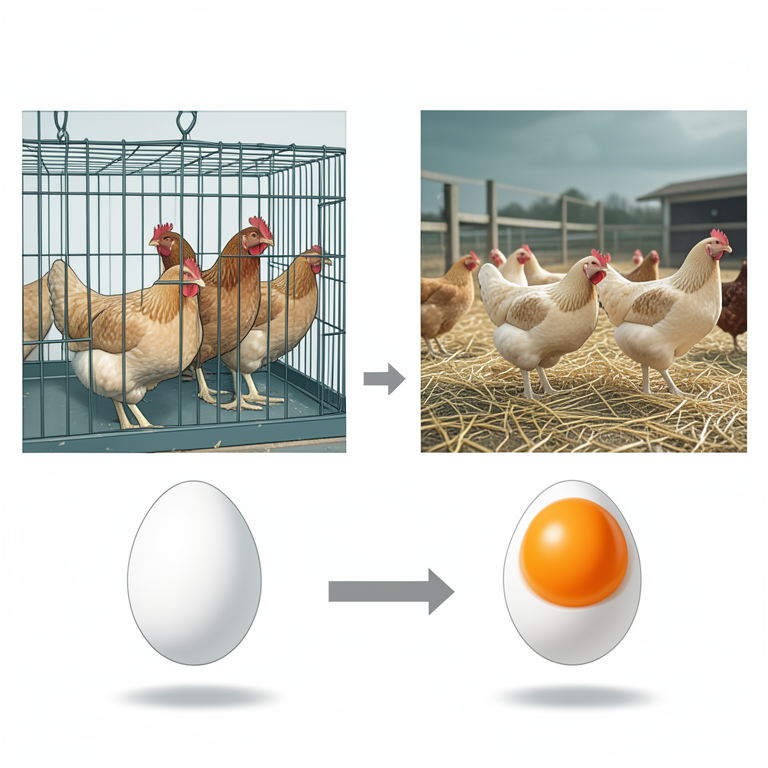
Housing System Trade-off
AI-generated conceptual illustration (layer hens). It explains the idea and does not show study data.
View source evidence ↗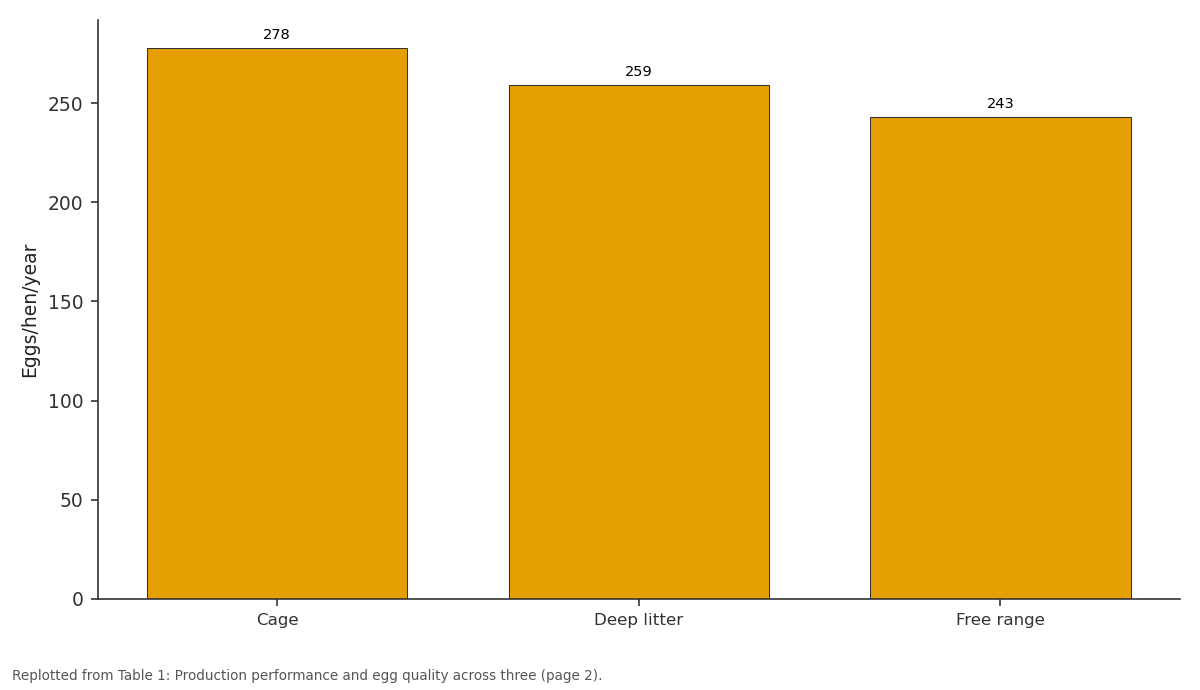
Eggs/hen/year: Cage vs Deep litter vs Free range
Replotted from Table 1 (page 2) of the original paper. Every bar is the paper's own table value.
View source evidence ↗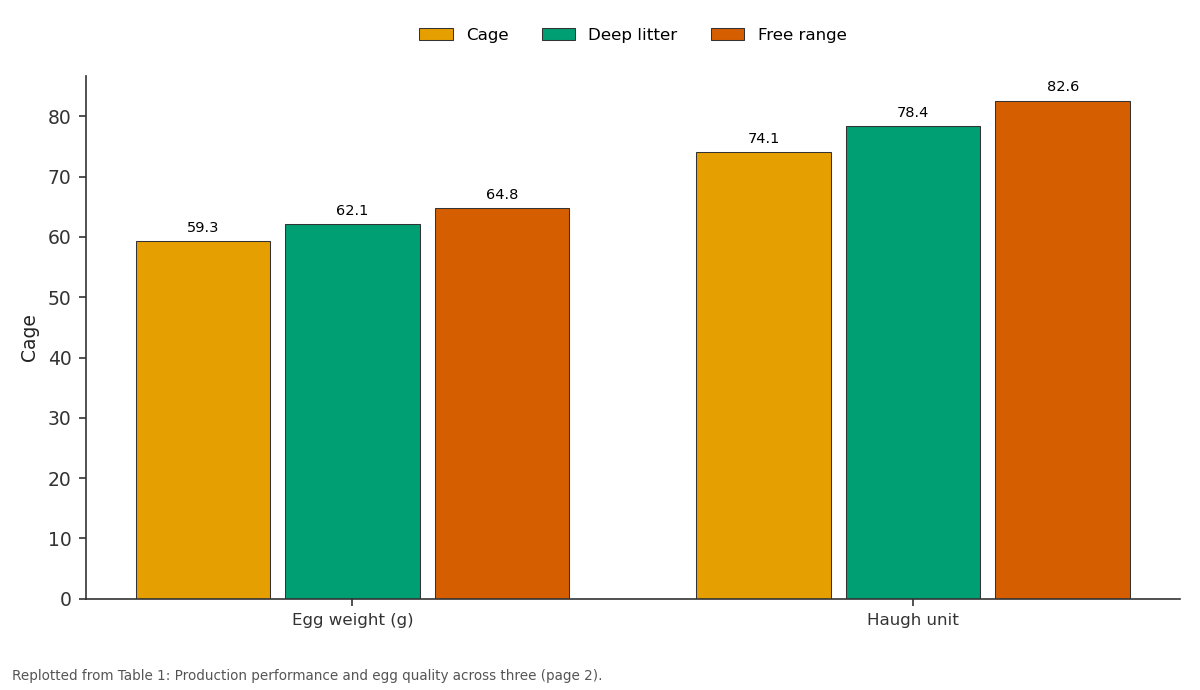
Cage and Deep litter and more: Egg weight (g) vs Haugh unit
Replotted from Table 1 (page 2) of the original paper. Every bar is the paper's own table value.
View source evidence ↗Figures & tables
From the original paper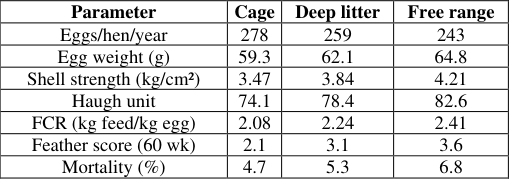 Table 1
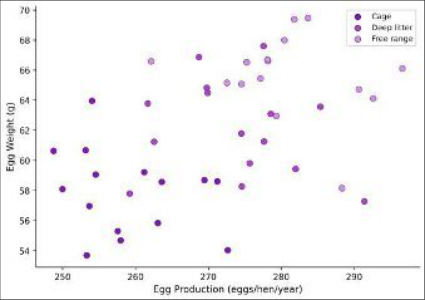 Figure 1
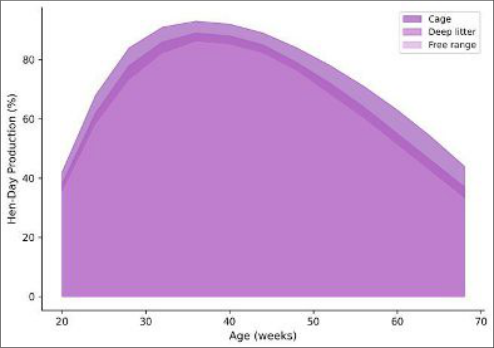 Figure 2
Introduction
A quiet revolution is reshaping India's egg industry. Between 2020 and 2024, several major food retailers announced phase-outs of cage-sourced eggs, driven by animal welfare campaigns and shifting urban consumer sentiment [1] . Yet Indian poultry science has generated surprisingly little comparative data on how housing type affects both productivity and internal egg quality under tropical conditions [2] . Cage systems confine hens to 450-550 cm 2 each and minimise floor-egg losses, but restrict natural behaviours like dust-bathing, perching, and foraging [3] . Deep-litter housing offers more space (typically 1,400 cm 2 per bird) and substrate for scratching, while free-range adds outdoor access and a wider movement repertoire [4] . European data consistently show that cage hens produce 5-15% more eggs per year but that alternative-system eggs score higher on shell strength, yolk colour, and Haugh units [5] . This research aimed to (i) compare lifetime egg production, feed efficiency, and mortality across three housing systems under semi-arid tropical conditions, (ii) evaluate internal and external egg quality parameters, and (iii) assess basic welfare indicators including feather and foot-pad health.
Considerations
The protocol was reviewed and approved by the Institutional Animal Ethics Committee of Dr. Panjabrao Deshmukh Krishi Vidyapeeth (Protocol No. IAEC/PDKV/2022-07, dated 14 March 2022). Birds were handled following the guidelines of the Committee for the Purpose of Control and Supervision of Experiments on Animals (CPCSEA), Government of India. Veterinary inspection was carried out weekly, and any bird showing clinical signs of distress was removed to an isolation pen and treated [6] .
Limitations
This research used a single commercial strain (BV-300) at one location, so the results may not transfer directly to indigenous breeds or coastal climates with different heat-stress profiles. The free-range paddock was fenced at 0.1 ha, smaller than the 4 m 2 per bird recommended by EU organic standards, which may have constrained natural behaviour expression. Disease challenge was low during the trial period; higher pathogen pressure could shift the mortality and production rankings [7] .
Materials Methods Materials
A total of 450 day-old BV-300 pullets were brooded together and assigned at 18 weeks of age to three systems at the poultry research unit of Dr. PDKV, Akola (20°42′ N, 77°02′ E, 282 m a.s.l.): (i) conventional three-tier battery cages (550 cm 2 per bird), (ii) deep-litter house with ricehusk bedding (1,400 cm 2 per bird), and (iii) free-range paddock with night shelter (1,400 cm 2 indoor + 1,000 cm 2 outdoor). Each system housed 150 hens in three replicates of 50. All birds received the same commercial layer feed (18% CP, 2,750 kcal ME kg -1 ). The trial ran from August 2022 to September 2023 [8] .
Methods
Egg production was recorded daily. Every fortnight, 30 eggs per system were collected for quality analysis: egg weight, shell thickness (micrometer), shell strength (Instron force gauge), yolk weight, yolk colour (Roche fan), albumen height, and Haugh unit. Feed intake was measured weekly. Feather score (1-4 scale) and foot-pad dermatitis score (0-4) were assessed on 30 birds per system at 40 and 60 weeks. Data were analysed by one-way ANOVA in R (v4.3.1) with Tukey's HSD at 5%.
Results
Cage hens produced 278 eggs hen -1 year -1 , 7.4% more than deep-litter and 14.5% more than free-range (Table 1). Feed conversion ratio was lowest (best) in cages at 2.08. But egg quality parameters favoured alternative systems: free-range eggs averaged 64.8 g (vs. 59.3 g caged), had thicker shells (0.387 mm vs. 0.341 mm), and scored 82.6 Haugh units against 74.1 for cage eggs. Feather score at 60 weeks was 3.6 (good) in free-range versus 2.1 (poor) in cages.
| Parameter | Cage | Deep litter | Free range |
|---|---|---|---|
| Eggs/hen/year | 278 | 259 | 243 |
| Egg weight (g) | 59.3 | 62.1 | 64.8 |
| Shell strength (kg/cm²) | 3.47 | 3.84 | 4.21 |
| Haugh unit | 74.1 | 78.4 | 82.6 |
| FCR (kg feed/kg egg) | 2.08 | 2.24 | 2.41 |
| Feather score (60 wk) | 2.1 | 3.1 | 3.6 |
| Mortality (%) | 4.7 | 5.3 | 6.8 |
Table text extracted from the original PDF; superscript letters are shown inline. The original table image is below.
View original table image
Comprehensive Interpretation
When production is expressed as total egg mass (eggs × weight) rather than number, the cage advantage narrows to 3.8% over deep-litter and 9.2% over free-range, because alternative-system eggs are heavier. Yolk colour score was 10.2 (Roche fan) in free-range versus 7.8 in cages, reflecting dietary carotenoids from outdoor foraging [9] .
Discussion
The 14.5% production gap between cages and free-range is wider than the 6-10% gap reported in temperate Europe [5,10] , probably because the semi-arid heat at Akola (peak 43 °C in May) affects free-range birds more than confined ones with fan-cooled housing [11] . The shell-strength advantage of free-range eggs likely reflects greater calcium absorption driven by exercise-induced bone turnover [12] . From an economic standpoint, cage systems remain cheaper per egg, but the premium that welfare-labelled eggs command in Indian metro markets (20-35% above standard) can offset the higher production cost of free-range [13] . The poorer feather condition in cages, while not directly affecting egg output, is increasingly viewed as a consumerfacing welfare indicator that retailers monitor [14] .
Conclusion
Cage housing maximised egg number and feed efficiency, but free-range and deep-litter systems produced heavier eggs with superior shell strength, Haugh units, and yolk colour, along with better welfare metrics. For Indian producers targeting premium markets, deep-litter offers a practical middle ground-retaining most of the productivity of cages while improving quality and welfare. Multi-strain and multi-location trials will strengthen these recommendations [15] .
Figures and tables from the paper
References
15 in the original paper- Compassion in World Farming. India cage-free commitments tracker 2020-2024. CIWF Report. 2024.
- Chatterjee RN, Rajkumar U. An overview of poultry production in India. World's Poultry Science Journal. 2015;71(2):265-274.
- Appleby MC, Hughes BO, Elson HA. Poultry production systems: behaviour, management and welfare. CAB International. Wallingford; 1992.
- Lay DC, Fulton RM, Hester PY, Karcher DM, Kjaer JB, Mench JA. Hen welfare in different housing International Journal of Agriculture and Nutrition https://www.agriculturejournal.net systems. Poultry Science. 2011;90(1):278-294.
- Holt PS, Davies RH, Dewulf J, Gast RK, Huwe JK, Jones DR. The impact of different housing systems on egg safety and quality. Science. 2011;90(1):251-262.
- CPCSEA. Standard operating procedures for IAEC. Committee for the Purpose of Control and Supervision of Experiments on Animals. New Delhi; 2018.
- Dikmen S, Hansen PJ. Is the temperature-humidity index the best indicator of heat stress in lactating dairy cows in a subtropical environment? Journal of Dairy Science. 2009;92(1):109-116.
- BIS. Indian standard specification for poultry feeds IS 1374. Bureau of Indian Standards. New Delhi; 2007.
- Hammershoj M, Johansen NF. Review: the effect of grass and herbs in organic egg production on egg fatty acid composition, egg yolk colour and sensory properties. Livestock Science. 2016;194:37-43.
- Sherwin CM, Richards GJ, Nicol CJ. Comparison of the welfare of layer hens in 4 housing systems in the UK. British Poultry Science. 2010;51(4):488-499.
- Lara LJ, Rostagno MH. Impact of heat stress on poultry production. Animals. 2013;3(2):356-369.
- Fleming RH, McCormack HA, McTeir L, Whitehead CC. Relationships between genetic, environmental and nutritional factors influencing osteoporosis in laying hens. British Poultry Science. 2006;47(6):742-755.
- NABARD. Poultry farming in India: economics and marketing. National Bank for Agriculture and Rural Development Occasional Paper. Mumbai; 2021.
- Blokhuis HJ, Jones RB, Geers R, Miele M, Veissier I. Measuring and monitoring animal welfare: transparency in the food product quality chain. Animal Welfare. 2003;12(4):445-455.
- Singh M, Cowieson AJ. Range use and pasture consumption in free-range poultry production. Animal Production Science. 2013;53(11):1139-1144.