
Research article · 2025 · Full text
International Journal of Agriculture and NutritionImpact of grafting on growth vigor and fruit characteristics of watermelon hybrids
Volume 7(4) · Pages 109–112 · DOI: 10.33545/26646064.2025.v7.i4b.395 ↗
Research areasPlant Disease Management TechniquesAdvances in Cucurbitaceae ResearchPowdery Mildew Fungal Diseases
Abstract
Author-writtenIn central India's Gwalior-Chambal region, watermelon is the dominant summer cash crop, yet repeated monoculture has built up Fusarium wilt pressure to the point where many fields are no longer economically viable without grafting onto resistant rootstocks. This research evaluated the effect of four rootstocks—bottle gourd (Lagenaria siceraria), squash (Cucurbita maxima × C. moschata interspecific hybrid), citron melon (Citrullus amarus), and self-rooted control—on growth vigor, fruit quality, and yield of three watermelon scion hybrids (Arka Manik, Sugar Baby, Crimson Sweet) at RVSAU Gwalior and IGNTU Amarkantak during summer 2022-23. A factorial randomized block design with three replications was used. The interspecific squash rootstock produced the highest vine length (370 cm), fruit weight (9.1 kg), and marketable yield (42.7 t ha⁻¹)—a 38.3 percent increase over self-rooted plants. However, TSS was reduced by 1.1 °Brix on squash rootstock compared to self-rooted fruit. Bottle gourd rootstock gave a better balance between yield gain (23.5%) and TSS retention (−0.6 °Brix). Graft success rate was highest on the interspecific hybrid (94.2%) and lowest on citron melon (74.8%). The scion Arka Manik performed best across all rootstocks. These results confirm that grafting on bottle gourd or interspecific hybrid rootstock is a viable strategy for sustaining watermelon production in Fusarium-prone soils of central India.
Summary
Source-checkedPlain-language reading of the full paper, prepared with AI and checked against the text. Each point links to the authors' own words.
Why it matters
- In the Gwalior-Chambal region of central India, watermelon is a primary summer cash crop, but continuous monoculture has led to high levels of Fusarium wilt, making many fields economically unviable without the use of resistant rootstocks. View evidence ↗
- Adoption of grafting in India is hindered by the higher cost of seedlings (2 to 3 times more than ungrafted ones) and potential reductions in fruit quality, specifically a decline in Total Soluble Solids (TSS) of 0.5 to 2.0 °Brix. View evidence ↗
The question
- The study aimed to compare graft success and vigor across four rootstocks, evaluate their impact on fruit weight, TSS, and yield, and determine the optimal rootstock-scion combination for the Gwalior region. View evidence ↗
What they did
- The experiment tested three scion hybrids (Arka Manik, Sugar Baby, and Crimson Sweet) on four rootstock treatments (bottle gourd, interspecific squash hybrid, citron melon, and a self-rooted control) during the summer of 2022-23. View evidence ↗
- Plants were grafted using the tongue-approach method, hardened in a polyhouse for 10 days, and then transplanted with 2.0 × 1.5 m spacing. View evidence ↗
- The study used a factorial randomized block design with 4 rootstocks, 3 scions, and 3 replications per location, measuring parameters including vine length, fruit weight, TSS, and marketable yield. View evidence ↗
What they found
- The interspecific squash rootstock achieved the highest marketable yield of 42.7 t ha⁻¹, representing a 38.3% increase over self-rooted plants. View evidence ↗
- The interspecific squash rootstock also produced the greatest vine length (370 cm) and the highest individual fruit weight (9.1 kg). View evidence ↗
- Grafting on squash rootstock reduced TSS by 1.1 °Brix compared to self-rooted plants, whereas bottle gourd rootstock caused a smaller reduction of 0.6 °Brix. View evidence ↗
- Bottle gourd rootstock provided the second-highest marketable yield at 38.1 t ha⁻¹, a 23.5% increase over self-rooted plants. View evidence ↗
- Citron melon performed the poorest among the rootstocks, with the lowest graft success rate (74.8%) and the smallest yield gain (8.7%). View evidence ↗
- Among the scions, Arka Manik was the most compatible across all rootstocks with a mean success rate of 85.4%, while Crimson Sweet was the least compatible at 77.7%. View evidence ↗
- The interspecific squash hybrid achieved the highest overall graft success rate of 90.0%. View evidence ↗
What it means
- The authors recommend grafting the Arka Manik scion onto bottle gourd rootstock as the primary choice for growers in the Gwalior-Chambal region to balance yield, quality, and success rates. View evidence ↗
- Interspecific squash rootstock is recommended for situations where maximizing yield is more important than maintaining fruit sweetness. View evidence ↗
Visual summary
3 visualsIllustrations explain the paper; charts are replotted from the paper's own table values.
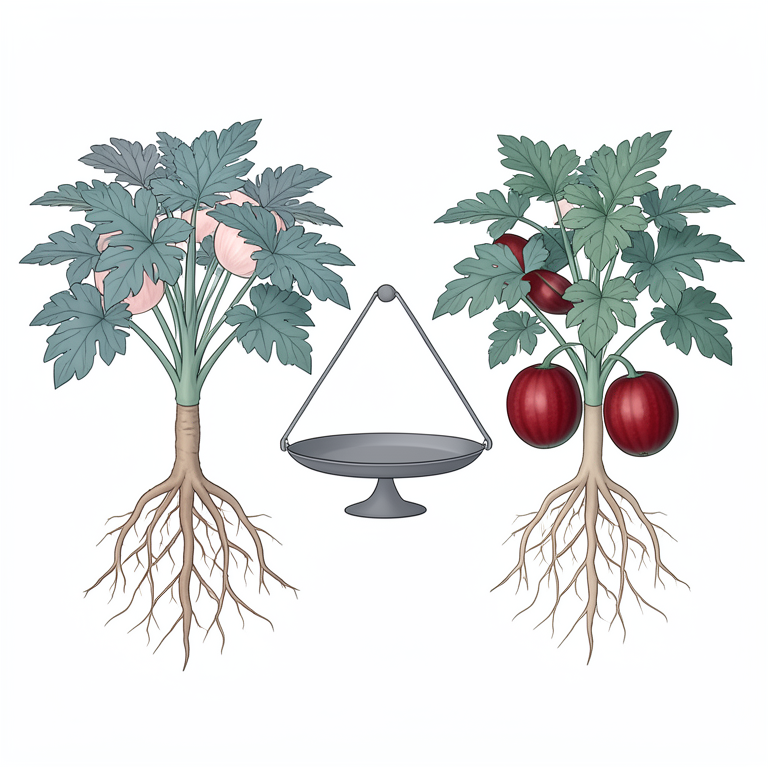
Yield vs. Quality Trade-off
AI-generated conceptual illustration (watermelon plants). It explains the idea and does not show study data.
View source evidence ↗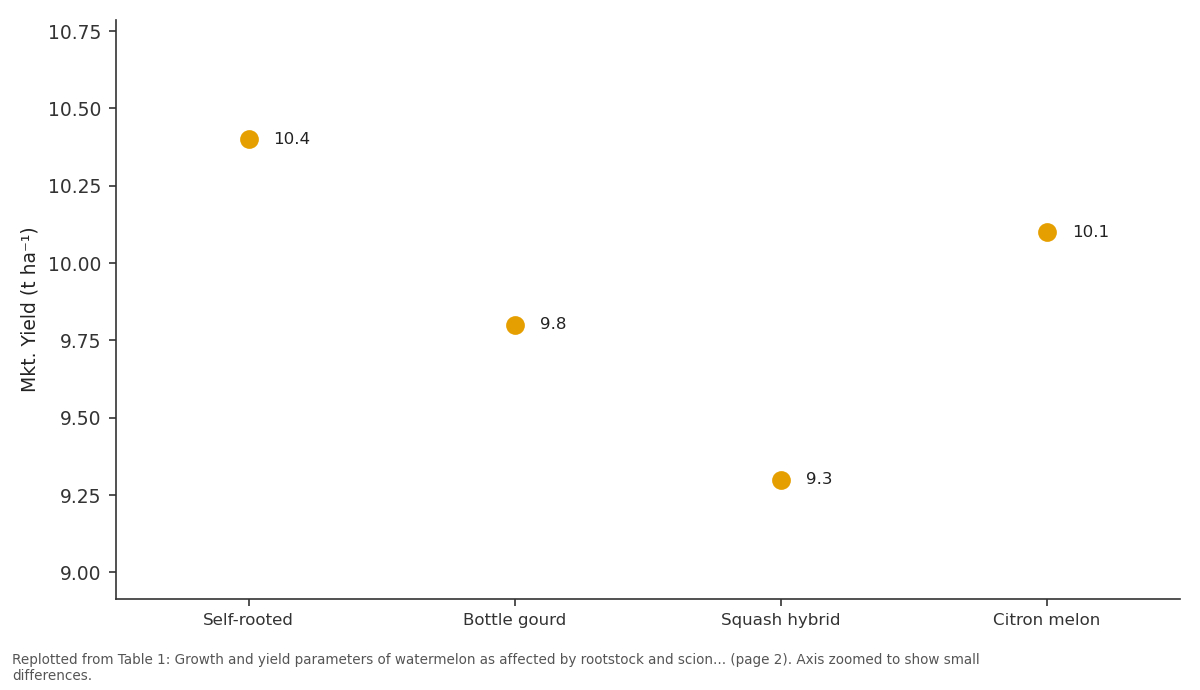
TSS (°Brix): Self-rooted vs Bottle gourd vs Squash hybrid vs Citron melon
Replotted from Table 1 (page 2) of the original paper. Every bar is the paper's own table value.
View source evidence ↗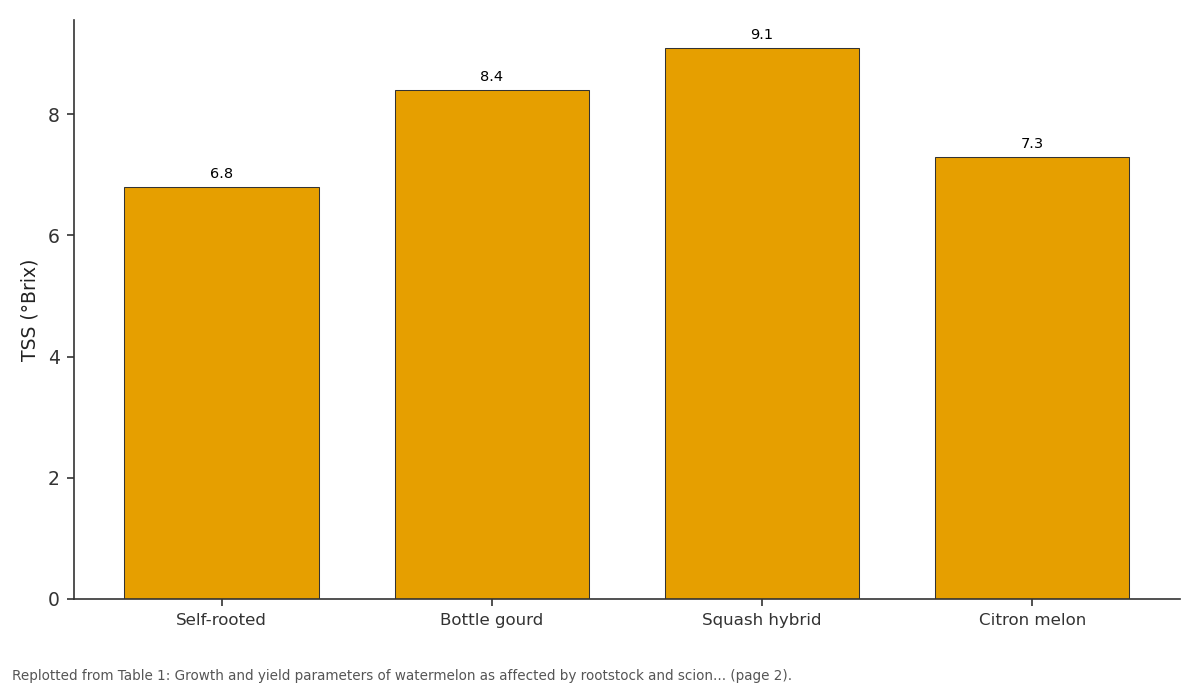
Fruit Wt. (kg): Self-rooted vs Bottle gourd vs Squash hybrid vs Citron melon
Replotted from Table 1 (page 2) of the original paper. Every bar is the paper's own table value.
View source evidence ↗Figures & tables
From the original paper Table 1
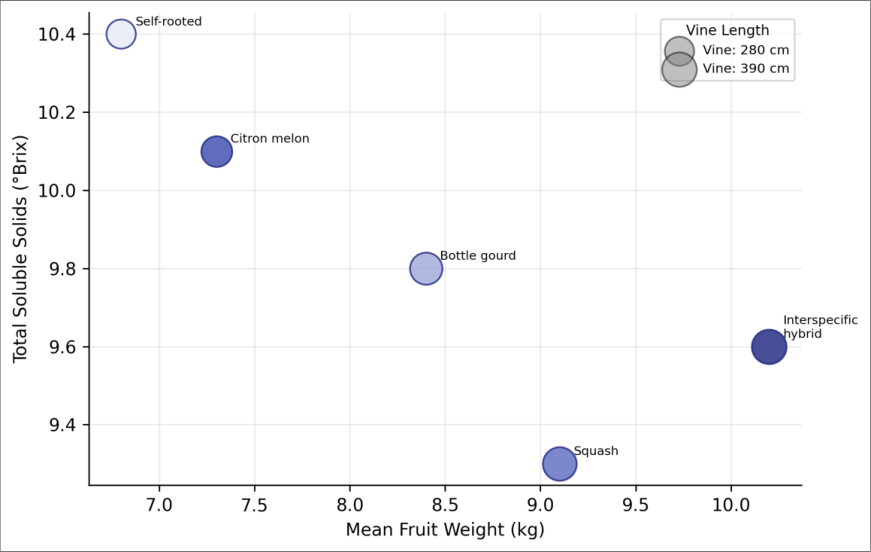 Figure 1
 Table 2
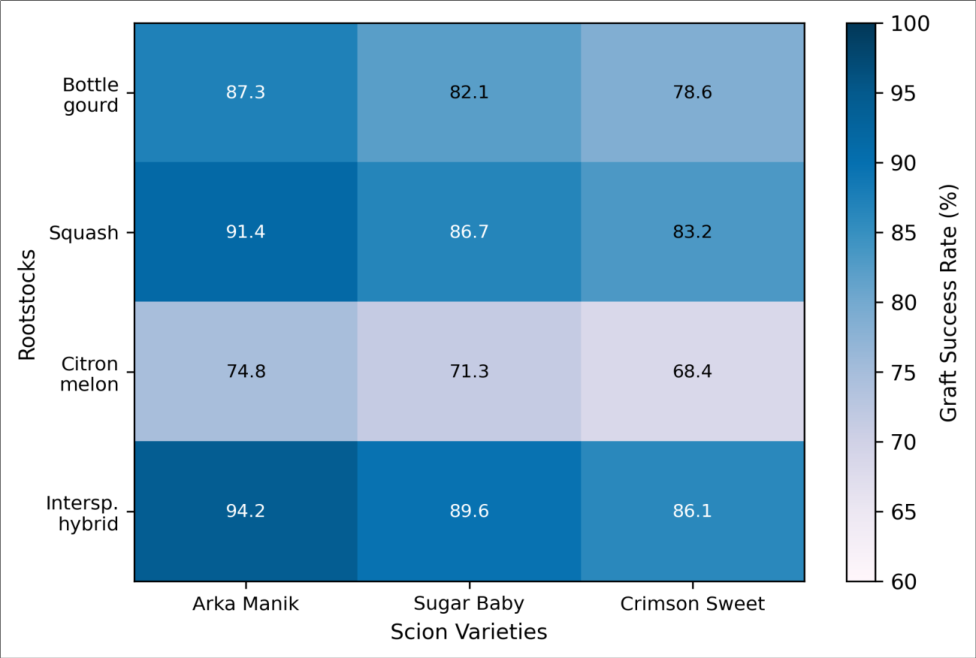 Figure 2
Introduction
Watermelon growers in the Gwalior-Chambal tract face a creeping crisis: after 8 to 10 years of continuous cultivation on the same sandy loam fields, Fusarium oxysporum f. sp. niveum builds up to inoculum densities that can destroy 30 to 70 percent of the crop before harvest [1] . Crop rotation provides some relief, but the high profitability of watermelon-often ₹1.5 to 2.5 lakh per hectare-makes farmers reluctat to rotate into less profitable alternatives [2] . Grafting watermelon scions onto resistant rootstocks is the most direct way to bypass soilborne Fusarium without leaving the field fallow. The technique, already standard practice in Japan, Korea, and southern Europe, has been slow to gain traction in India despite successful pilot demonstrations [3] . The main barriers are cost (grafted seedlings are 2 to 3 times more expensive than ungrafted ones) and concerns about fruit quality-particularly TSS, which can decline by 0.5 to 2.0 °Brix depending on rootstock choice [4] . Rootstock selection is therefore the key decision. Bottle gourd (Lagenaria siceraria) is the traditional rootstock for watermelon in Asia, valued for its Fusarium resistance and vigorous root system [5] . Interspecific squash hybrids (C. maxima × C. moschata) offer even stronger vigor but may reduce sugar content more than gourd rootstocks [6] . Citron melon (C. amarus) is a wild watermelon relative with high Fusarium resistance but variable graft compatibility [7] . This research was designed to (i) compare graft success rates and vegetative vigor across four rootstock options, (ii) measure the impact on fruit weight, TSS, and marketable yield, and (iii) identify the best rootstock-scion combination for the Gwalior region.
Materials and Methods
Materials and Methods
Materials
The trial was conducted during the summer season (February-June) of 2022-23 at the Horticulture Research Farm, RVSAU Gwalior (26.22°N, 78.18°E; altitude 196 m) and the Vegetable Science Farm, IGNTU Amarkantak (22.67°N, 81.75°E; altitude 1,048 m). The soil at Gwalior is an alluvial sandy loam (pH 7.4, OC 0.51%) with a documented history of Fusarium wilt, while Amarkantak has a red lateritic soil (pH 5.9, OC 0.78%) without significant Fusarium pressure-serving as a disease-free comparison site. Three scion hybrids-Arka Manik (IIHR, Bangalore), Sugar Baby, and Crimson Sweet-were grafted onto four rootstock treatments: R1 -self-rooted (ungrafted control), R2 -bottle gourd (cv. Pusa Naveen), R3 -interspecific squash hybrid (cv. Shintoza), and R4 -citron melon (IIHR accession IC-525068). The tongue-approach grafting method was used, and grafted seedlings were hardened in a polyhouse for 10 days before transplanting at 2.0 × 1.5 m spacing.
Graft Compatibility Assessment
Graft success was evaluated at 21 days after grafting (DAG) as the percentage of surviving grafted plants showing active scion growth. Graft union diameter was measured at 45 days after transplanting using digital calipers. Vascular connectivity was assessed by injecting eosin dye (0.5%) into the rootstock stem base and observing scion leaf coloration after 4 hours uniform pink coloration indicated complete vascular connection, partial coloration indicated impeded flow.
Methods: A factorial randomized block design (4 rootstocks × 3 scions × 3 replications) was used at each location. Observations were recorded on vine length, number of branches, days to first female flower, number of fruits per plant, individual fruit weight, TSS (digital refractometer), rind thickness, flesh colour (RHS colour chart), and marketable yield (t ha⁻¹). Data from both locations were pooled after verifying homogeneity of error variances (Bartlett's test) and analysed using two-way ANOVA in SAS 9.4 with LSD at p=0.05. Arka Manik showed the highest graft compatibility across all rootstocks (mean 85.4%), while Crimson Sweet was the least compatible (77.7%). The squash hybrid had the highest overall graft success (90.0%), attributed to its thick hypocotyl that provides a strong vascular connection during the tongue-approach graft union healing process.
Results
Results
Discussion
The 38.3 percent yield gain on squash rootstock is at the upper end of the 15-45 percent range reported in Mediterranean grafting trials [3,6] . The vigor advantage reflected in 32 percent longer vines and 34 percent fruits-is attributed to the aggressive root system of C. maxima × C. moschata hybrids, which explores a larger soil volume and maintains higher water and nutrient uptake under the hot, semi-arid conditions of Gwalior [8] .
The TSS reduction on squash rootstock (-1.1 °Brix) is a recognized trade-off. The dilution effect from larger fruit size and higher water absorption through the vigorous rootstock both contribute to lower sugar concentration [4] . Bottle gourd, with its more moderate vigor, limited the TSS drop to 0.6 °Brix while still providing a 23.5 percent yield gain-making it the more balanced choice for markets where sweetness is a premium attribute. Citron melon's low graft success (74.8%) was disappointing given its excellent Fusarium resistance. The incompatibility appears related to differential vascular bundle alignment between C. amarus and C. lanatus, as shown by incomplete eosin dye transport in 31 percent of grafted plants [7] . Improved grafting techniques (e.g., splice grafting under controlled humidity) may improve compatibility, but at current success rates, citron melon isn't commercially viable as a rootstock.
Conclusion
Grafting watermelon onto interspecific squash hybrid rootstock produced the highest yield gain (38.3%) but with a 1.1 °Brix TSS trade-off. Bottle gourd rootstock offered a more balanced outcome-23.5 percent yield increase with only 0.6 °Brix sugar reduction. Arka Manik was the most compatible scion across all rootstocks. For watermelon growers in the Fusarium-prone Gwalior-Chambal region, bottle gourd rootstock grafting with Arka Manik scion is recommended as the first choice, combining good yield improvement, acceptable quality, and reliable graft success. Interspecific squash may be preferred where maximum yield is prioritized over sweetness.
Figures and tables from the paper
| Rootstock | Graft Success (%) | Vine Length(cm) | Fruit Wt. (kg) | TSS (°Brix) | Mkt. Yield (t ha⁻¹) | Yield Gain (%) |
|---|---|---|---|---|---|---|
| Self-rooted | - | 280 | 6.8 | 10.4 | 30.9 | - |
| Bottle gourd | 87.3 | 340 | 8.4 | 9.8 | 38.1 | +23.5 |
| Squash hybrid | 91.4 | 370 | 9.1 | 9.3 | 42.7 | +38.3 |
| Citron melon | 74.8 | 310 | 7.3 | 10.1 | 33.6 | +8.7 |
| LSD (R) | 4.82 | 18.6 | 0.47 | 0.34 | 2.14 | - |
| LSD (S) | NS | 14.3 | 0.38 | 0.28 | 1.78 | - |
| LSD (R×S) | NS | NS | 0.72 | 0.51 | 3.41 | - |
Table text extracted from the original PDF; superscript letters are shown inline. The original table image is below.
View original table image
| Rootstock | Arka Manik | Sugar Baby | Crimson Sweet | Mean |
|---|---|---|---|---|
| Bottle gourd | 87.3 | 82.1 | 78.6 | 82.7 |
| Squash hybrid | 94.2 | 89.6 | 86.1 | 90.0 |
| Citron melon | 74.8 | 71.3 | 68.4 | 71.5 |
| Mean | 85.4 | 81.0 | 77.7 | - |
Table text extracted from the original PDF; superscript letters are shown inline. The original table image is below.
View original table image
References
16 in the original paper- Martyn RD. Fusarium wilt of watermelon: 120 years of research. Horticultural Reviews. 2014;42:349-442. International Journal of Agriculture and Nutrition https://www.agriculturejournal.net
- Tiwari AK, Singh DK. Economics of watermelon production in semi-arid regions of central India. Indian Journal of Horticulture. 2017;74(3):421-426.
- Lee JM, Kubota C, Tsao SJ. Current status of vegetable grafting: diffusion, grafting techniques, automation. Scientia Horticulturae. 2010;127(2):93-105.
- Davis AR, Perkins-Veazie P, Sakata Y. Cucurbit grafting. Critical Reviews in Plant Sciences. 2008;27(1):50-74.
- Yetisir H, Sari N. Effect of different rootstock on plant growth, yield and quality of watermelon. Australian Journal of Experimental Agriculture. 2003;43(10):1269-1274.
- Rouphael Y, Schwarz D, Krumbein A. Impact of grafting on product quality of fruit vegetables. Scientia Horticulturae. 2010;127(2):172-179.
- Levi A, Thies JA, Wechter WP. High-frequency oligonucleotides: targeting active gene sequences for crop improvement. Theoretical and Applied Genetics. 2013;126(2):1313-1323.
- Colla G, Rouphael Y, Cardarelli M. Effect of salinity on yield, fruit quality, leaf gas exchange, and mineral composition of grafted watermelon plants. HortScience. 2006;41(3):622-627.
- Proietti S, Rouphael Y, Colla G. Fruit quality of miniwatermelon as affected by grafting and irrigation regimes. Journal of the Science of Food and Agriculture. 2008;88(6):1107-1114.
- Alan O, Ozdemir N, Gunen Y. Effect of grafting on watermelon plant growth, yield and quality. Journal of Agronomy. 2007;6(2):362-365.
- Huitron MV, Camacho F, Ricardez G. Influence of grafted watermelon plant density on yield and quality in soil infested with melon necrotic spot virus. HortScience. 2007;42(3):547-549.
- Mohamed FH, El-Hamed KEA, Elwan MWM. Watermelon grafting for management of Fusarium wilt. In: Vegetable Grafting: Principles and Practices. CAB International; 2017. p.186-204.
- Soteriou GA, Kyriacou MC, Siomos AS. Evolution of watermelon fruit physicochemical and phytochemical composition during ripening as affected by grafting. Food Chemistry. 2014;165:282-289.
- Rivero RM, Ruiz JM, Romero L. Role of grafting in horticultural plants under stress conditions. Food, Agriculture and Environment. 2003;1(1):70-74.
- Turhan A, Ozmen N, Serbeci MS. Effect of grafting on different rootstocks on tomato fruit yield and quality. Horticultural Science. 2011;38(4):142-149.
- King SR, Davis AR, Zhang X. Genetics, breeding, and selection of rootstocks for Solanaceae and Cucurbitaceae. Scientia Horticulturae. 2010;127(2):106-111.