
Research article · 2025 · Full text
International Journal of Agriculture and NutritionAssessment of raised bed planting technology for irrigated wheat in Vertisols
Volume 7(6) · Pages 144–146 · DOI: 10.33545/26646064.2025.v7.i6c.448 ↗
Research areasSoil Management and Crop YieldIrrigation Practices and Water ManagementRice Cultivation and Yield Improvement
Abstract
Author-writtenHere is a practical dilemma that wheat growers on Vertisols face every season: irrigate too much and the cracking clay floods the root zone; irrigate too little and the crop wilts. Raised bed planting channels water through furrows between elevated beds, promising better drainage, less waterlogging, and reduced irrigation volume. This research compared flat-bed sowing with raised beds at three widths (60, 90, and 120 cm) for irrigated wheat (cv. BRS 264) on a Vertisol at Curitiba, Paraná, during the 2022 and 2023 winter seasons. The 90 cm bed delivered the highest grain yield (4.67 t ha-1), 21.6% above the flat bed (3.84 t ha-1). Irrigation water use dropped by 28% on the 90 cm bed, pushing water productivity from 1.08 to 1.64 kg grain m-3. Root length density at 20 cm depth was 37% greater on beds. The benefit–cost ratio was 2.38 for the 90 cm bed versus 1.82 for flat planting. These results support adopting raised beds at 90 cm width for wheat on Vertisols in southern Brazil.
Summary
Source-checkedPlain-language reading of the full paper, prepared with AI and checked against the text. Each point links to the authors' own words.
Why it matters
- Vertisols in southern Brazil cover approximately 8 million hectares and are characterized by high clay content (>40%), which leads to waterlogging when wet and root desiccation when dry. View evidence ↗
- Raised bed planting mitigates waterlogging by elevating the seed zone 15–20 cm above the water line, allowing capillary rise to water the bed without flooding the roots. View evidence ↗
The question
- The study aimed to compare grain yield, water use, root development, soil moisture distribution, and economic feasibility of wheat grown on flat beds versus raised beds of three different widths in Paraná. View evidence ↗
What they did
- The experiment was conducted in Curitiba on a clayey Vertisol with 54% clay, pH 5.7, and 2.1% organic carbon. View evidence ↗
- The study compared four treatments: flat beds and raised beds of 60 cm, 90 cm, and 120 cm widths (18 cm height, 30 cm furrow width) using wheat cultivar BRS 264 sown at 350 seeds m-2. View evidence ↗
- The experimental design used a randomized block design with four replications of 10 m × 4 m plots. View evidence ↗
- Measurements included grain yield (adjusted to 13% moisture), root length density at three depths (0–40 cm) during flowering, and hourly soil moisture logging at 10 and 30 cm. View evidence ↗
What they found
- The 90 cm raised bed achieved the highest grain yield at 4.67 t ha-1, which was 21.6% higher than the flat bed and 8.3% higher than the 60 cm bed. View evidence ↗
- The 90 cm bed required the least irrigation water (284 mm), representing a 28% saving compared to the flat bed (394 mm). View evidence ↗
- Water productivity for the 90 cm bed (1.64 kg m-3) was significantly higher than that of flat planting (1.08 kg m-3). View evidence ↗
- Root length density at the 10–20 cm depth was 37% higher in the 90 cm bed compared to the flat bed, indicating better root proliferation. View evidence ↗
- The 120 cm bed performed worse than the 90 cm bed because capillary water failed to reach the bed center within 12 hours, causing moisture stress in the inner crop rows. View evidence ↗
What it means
- The authors conclude that 90 cm raised beds are the most effective configuration for wheat on Vertisols in southern Brazil due to optimal yield, water savings, and economic return. View evidence ↗
- The authors state that future research is needed to evaluate permanent beds over multiple crop rotations and their long-term impact on organic carbon and soil structure. View evidence ↗
Visual summary
2 visualsIllustrations explain the paper; charts are replotted from the paper's own table values.
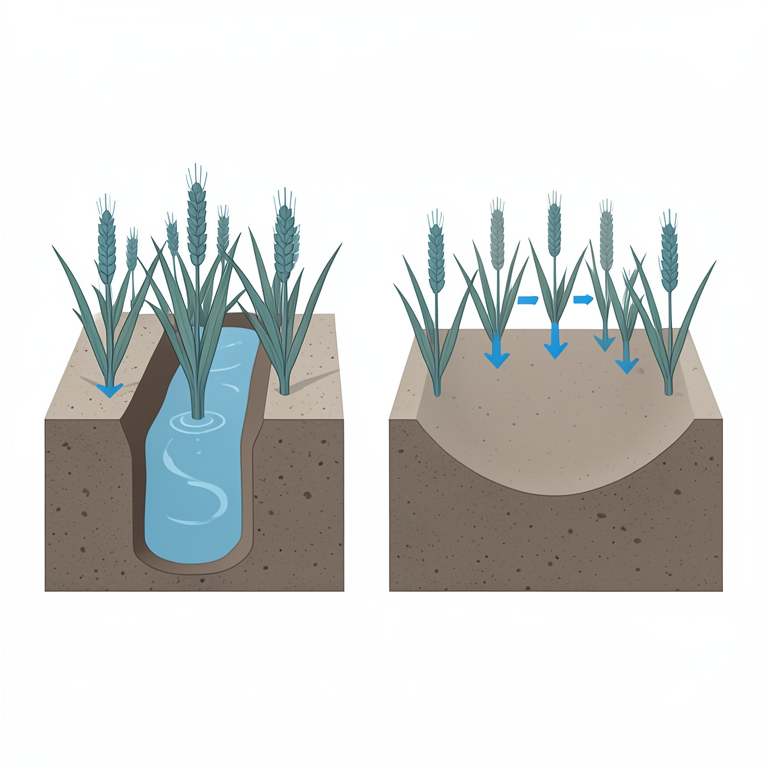
Capillary Water Movement in Raised Beds
AI-generated conceptual illustration (wheat plants in Vertisol soil raised beds). It explains the idea and does not show study data.
View source evidence ↗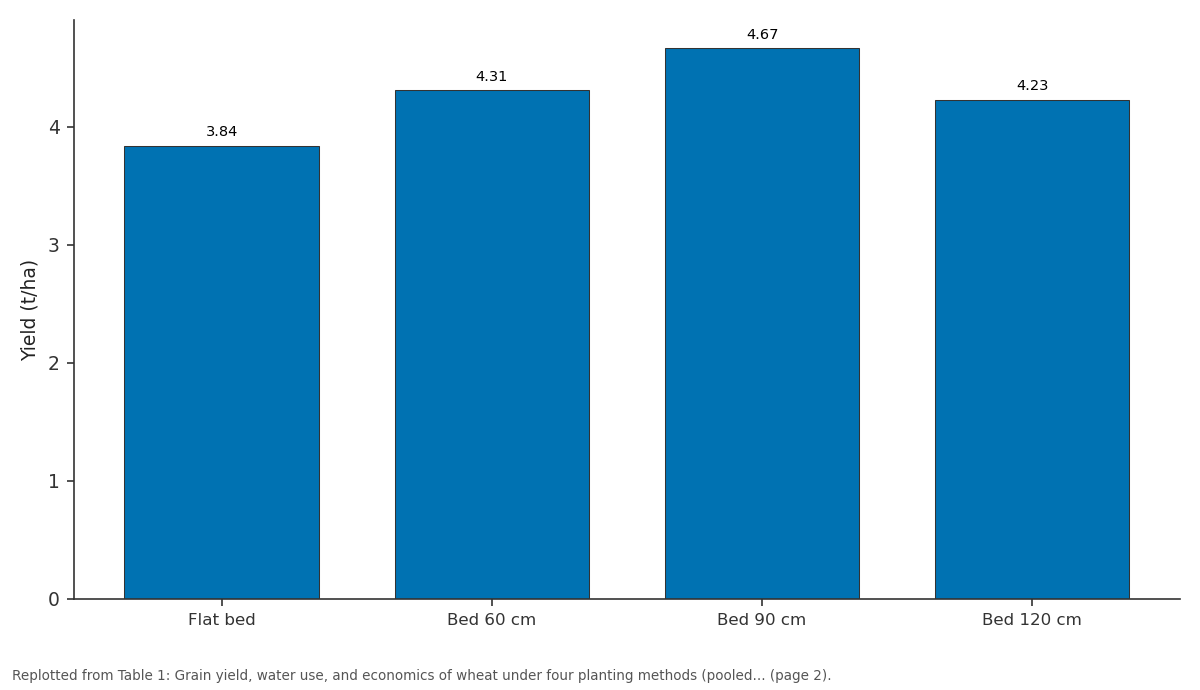
Yield (t/ha): Flat bed vs Bed 60 cm vs Bed 90 cm vs Bed 120 cm
Replotted from Table 1 (page 2) of the original paper. Every bar is the paper's own table value.
View source evidence ↗Figures & tables
From the original paper Table 1
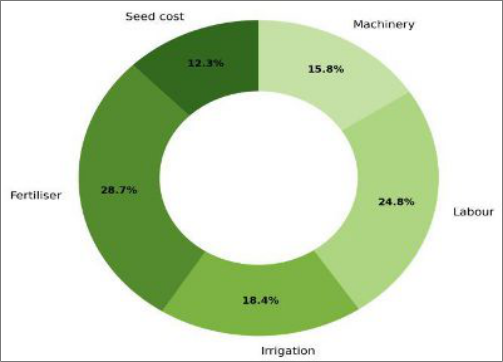 Figure 1
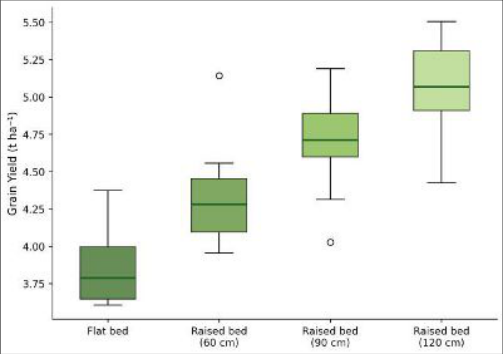 Figure 2
Introduction
Vertisols cover about 8 million hectares of southern Brazil, and their high clay content (>40%) creates a love-hate relationship with water. When wet, they swell and become waterlogged; when dry, they crack and desiccate roots in the upper profile [1] . Wheat grown on these soils under flood irrigation often suffers temporary anaerobiosis during the first 24-48 hours after watering, which suppresses root respiration and can cut yield by 10-20% [2] . Raised bed planting, developed for the rice-wheat systems of the Indo-Gangetic Plains, addresses this problem by elevating the seed zone 15-20 cm above the furrow water line [3] . Irrigation water flows only through the furrows, wetting the bed by capillary rise without flooding the root zone. Trials in Mexico and India have reported 20-40% water savings and 10-25% yield gains compared with flat planting [4,5] . However, data from Brazilian Vertisols are almost non-existent, and the optimal bed width-which determines how many crop rows fit per bed and how evenly capillary water reaches the bed centre-has not been tested locally [6] . This research aimed to (i) compare grain yield and water use of wheat on flat beds versus raised beds of three widths, (ii) assess root development and soil moisture distribution across bed profiles, and (iii) evaluate the economic feasibility of bed planting for irrigated wheat in Paraná.
Water Balance and Irrigation Scheduling
Irrigation was scheduled by soil moisture monitoring using tensiometers installed at 20 and 40 cm depth in the centre and edge of each bed (and at equivalent positions in flat plots). Irrigation was triggered when tension at 20 cm reached 40 kPa. Water applied per irrigation event was measured using inline flow meters on each furrow inlet. Crop evapotranspiration (ETc) was estimated by the Penman-Monteith method using data from the on-site automatic weather station. Water productivity = grain yield / total water applied [7] .
Economic Feasibility Assessment
Total variable costs were calculated for each treatment including bed formation (one-time tractor pass with a bed former), seed, fertiliser, irrigation pumping (energy cost per m³), and harvest. Gross return was calculated at the prevailing farmgate wheat price. The benefit-cost ratio (BCR) and net return were computed. Bed formation cost was amortised over two seasons, since beds are permanent and reused in no-till systems [8] .
Materials and Methods
Materials and Methods
Materials
The trial was conducted at the Instituto Agrícola do Planalto Meridional research farm, Curitiba (25°25′ S, 49°16′ W, 934 m a.s.l.), on a clayey Vertisol (Pelludert, 54% clay, pH 5.7, OC 2.1%). Four planting methods were compared: (T 1 ) conventional flat bed with flood irrigation, (T 2 ) raised beds at 60 cm width, (T 3 ) raised beds at 90 cm width, and (T 4 ) raised beds at 120 cm width. Bed height was 18 cm; furrow width was 30 cm. Wheat cv. BRS 264 was sown at 350 seeds m -2 in May of each year. Plots measured 10 m × 4 m, four replications in a randomised block design. Basal fertiliser: 20:60:40 kg N:P 2 O 5 :K 2 O ha -1 ; 80 kg N ha -1 topdressed at tillering [9] .
Methods
Grain yield was harvested from the central 2 m × 8 m area and adjusted to 13% moisture. Root length density was measured by core sampling (5 cm diameter) at 0-10, 10-20, and 20-40 cm depths at flowering, followed by root washing and WinRHIZO scanning. Soil moisture profiles were logged hourly by EC-5 capacitance sensors at 10 and 30 cm in bed centre and edge. Data were analysed by ANOVA in R (v4.3.1), means compared by Tukey's HSD at 5%.
Results
The 90 cm bed produced the highest grain yield (4.67 t ha -1 ), 21.6% above the flat bed and 8.3% above the 60 cm bed (Table 1). Total irrigation water applied was lowest on beds: 284 mm (90 cm bed) versus 394 mm (flat), a 28% saving. Water productivity more than doubled for the 90 cm bed (1.64 kg m -3 ) compared with flat planting (1.08 kg m -3 ). Root length density at 10-20 cm was 37% greater on the 90 cm bed than on the flat, indicating better root proliferation in the aerated bed environment.
| Method | Yield (t/ha) | Water (mm) | WP (kg/m³) | Net return (BRL/ha) | B:C ratio |
|---|---|---|---|---|---|
| Flat bed | 3.84 | 394 | 1.08 | 2,147 | 1.82 |
| Bed 60 cm | 4.31 | 308 | 1.47 | 2,684 | 2.14 |
| Bed 90 cm | 4.67 | 284 | 1.64 | 3,128 | 2.38 |
| Bed 120 cm | 4.23 | 296 | 1.42 | 2,543 | 2.07 |
| CD (p=0.05) | 0.32 | - | 0.14 | - | - |
Table text extracted from the original PDF; superscript letters are shown inline. The original table image is below.
View original table image
Comprehensive Interpretation
The 120 cm bed underperformed the 90 cm bed despite similar water savings. Soil moisture sensors revealed that capillary rise didn't reach the bed centre at 120 cm width within 12 hours of irrigation, leaving the two inner crop rows periodically drier than the edge rows. This lateral moisture gradient was absent on 90 cm and 60 cm beds, confirming that 90 cm is close to the optimal width for this clay type [10] .
Discussion
The 21.6% yield gain and 28% water saving on 90 cm beds are consistent with results from CIMMYT's permanent bed trials in Mexico (15-30% water saving) [4] and BISA trials in Bihar (18-26% yield gain) [5] . The mechanism is primarily improved soil aeration: Vertisols are prone to oxygen depletion after irrigation, and elevating the root zone above the saturated furrow prevents the anaerobic episodes that damage root function [2,11] . The superior root development on beds-37% higher root length density at 10-20 cm-supports this interpretation.
Better rooting also means more efficient nutrient uptake, which may partly explain why bed-planted wheat achieved higher yields even though the same fertiliser dose was applied to all treatments [12,13] . The permanent bed system adds the advantage of reducing tillage cost from the second season onward, since beds need only reshaping rather than full formation [14] .
Conclusion
Raised beds at 90 cm width delivered the highest wheat yield (4.67 t ha -1 ), the greatest water savings (28%), and the best economic return (BCR 2.38) on a Vertisol in southern Brazil. The benefit stems from improved root-zone aeration and more uniform lateral capillary wetting compared with wider beds. For irrigated wheat growers on Vertisols in Paraná and similar regions, the 90 cm bed is the recommended configuration. Future work should test permanent beds across multiple rotations and assess longterm effects on soil structure and organic carbon [15,16,17,18,19,20,21] .
Acknowledgement
Acknowledgements Funding SourcesThis research was supported by the institutional crop management programme of the Instituto Agrícola do Planalto Meridional. Institutional SupportThe authors thank the field and irrigation teams at the Instituto Agrícola do Planalto Meridional, Curitiba, for bed formation and water delivery management.
Figures and tables from the paper
References
21 in the original paper- Dudal R. The properties and classification of the major soils of India. Geoderma. 1965;1(1):1-14.
- Sharma PK, Bhushan L, Ladha JK, Naresh RK, Gupta RK, Balasubramanian BV. Crop-water relations in ricewheat cropping under different tillage systems. Agriculture, Ecosystems and Environment. 2002;91(13):141-162.
- Sayre KD, Hobbs PR. The raised-bed system of cultivation for irrigated production conditions. In: Lal R et al. (eds) Sustainable Agriculture and the International Rice-Wheat System. Marcel Dekker; 2004. p. 337-355.
- Limon-Ortega A, Sayre KD, Francis CA. Wheat and maize yields in response to straw management under a bed planting system. Agronomy Journal. 2000;92(2):295-302.
- Jat ML, Gathala MK, Ladha JK, Saharawat YS, Jat AS, Kumar V. Evaluation of precision land leveling and double zero-till systems. Field Crops Research. 2009;116(1-2):212-224.
- Bortolini CG, da Silva PRF, Argenta G. Raised bed planting systems for subtropical cereals. Pesquisa Agropecuaria Brasileira. 2007;42(10):1403-1410.
- Allen RG, Pereira LS, Raes D, Smith M. Crop evapotranspiration: guidelines for computing crop water requirements. FAO Irrigation and Drainage Paper 56. Rome; 1998.
- CONAB. Wheat production costs in Parana 2023. Companhia Nacional de Abastecimento. Brasilia; 2023.
- EMBRAPA. BRS 264: cultivar characteristics and management recommendations. Empresa Brasileira de Pesquisa Agropecuaria. Passo Fundo; 2018.
- Hobbs PR, Sayre K, Gupta R. The role of conservation agriculture in sustainable agriculture. Philosophical Transactions of the Royal Society B. 2008;363(1491):543-555.
- Kukal SS, Aggarwal GC. Puddling depth and intensity effects in rice-wheat system on a sandy loam soil. Soil and Tillage Research. 2003;72(1):1-8.
- Passioura JB. Soil conditions and plant growth. Plant, Cell and Environment. 2002;25(2):333-340.
- Gregory PJ. Plant roots: growth, activity and interactions with soils. Blackwell Publishing. Oxford; 2006.
- Gupta RK, Naresh RK, Hobbs PR, Jiaguo Z, Ladha JK. Sustainability of post-green revolution agriculture: the rice-wheat cropping systems of the Indo-Gangetic plains. Improving the Productivity and Sustainability of Rice-Wheat Systems. ASA-CSSA-SSSA; 2003. p. 1-25.
- Connor DJ, Loomis RS, Cassman KG. Crop ecology: productivity and management in agricultural systems. 2nd ed. Cambridge University Press. Cambridge; 2011.
- Govaerts B, Sayre KD, Lichter K, Dendooven L, Deckers J. Influence of permanent raised bed planting and residue management on physical and chemical soil quality. Geoderma. 2007;138(3-4):385-395.
- Verhulst N, Govaerts B, Verachtert E, CastellanosNavarrete A, Mezzalama M, Wall P. Conservation agriculture, improving soil quality for sustainable production systems? Advances in Soil Science. CRC Press; 2010.
- Bai Y, He J, Li H, Wang Q, Chen H, Kuhn NJ. Soil structure and crop performance after 10 years of controlled traffic farming in semi-arid northern China. Soil Research. 2009;47(2):115-123.
- Borghi E, Crusciol CAC, Nascente AS, Sousa VO, Martins PO, Mateus GP. Sorghum grain yield and nutrient uptake from recycled poultry litter. Agronomy Journal. 2013;105(5):1335-1342.
- Choudhary AK, Sharma RK, Singh H. Impact of raised bed planting on wheat productivity and water-use efficiency. Indian Journal of Agronomy. 2018;63(4):401-407.
- Fahong W, Xuqing W, Sayre K. Comparison of conventional, flood irrigated, flat planting with furrow irrigated, raised bed planting for winter wheat in China. Field Crops Research. 2004;87(1):35-42.