
Research article · 2025 · Full text
International Journal of Agriculture and NutritionEvaluation of newly developed high-yielding varieties of pearl millet for arid zone cultivation
Volume 7(2) · Pages 95–97 · DOI: 10.33545/26646064.2025.v7.i2b.463 ↗
Research areasGenetics and Plant BreedingAgricultural Productivity and Crop ImprovementCrop Yield and Soil Fertility
Abstract
Author-writtenAcross the semi-arid tracts of peninsular India, pearl millet remains the cereal that farmers turn to when rainfall is too scarce and erratic for anything else. This research evaluated three newly released pearl millet varieties (ICMV 221, HHB 67 Improved, RHB 177) against the standard check WC-C75 in multi-season trials at Professor Jayashankar Telangana Agricultural University, Hyderabad, during kharif 2021 and 2022. ICMV 221 recorded the highest grain yield (2.87 t ha⁻¹), 31.2% above the check, with superior ear length (24.8 cm), grains per ear (2,148), and 1000-grain weight (11.4 g). HHB 67 Improved was the earliest to mature (72 days) and showed the best drought recovery after a mid-season dry spell in 2022. Path analysis indicated that grains per ear (direct effect 0.337) and ear length (0.284) were the largest contributors to yield variation. All three new varieties outperformed the check and are recommended for cultivation in arid and semi-arid zones of Telangana.
Summary
Source-checkedPlain-language reading of the full paper, prepared with AI and checked against the text. Each point links to the authors' own words.
Why it matters
- Pearl millet is a critical crop for harsh rain-fed environments because it can survive on as little as 250-300 mm of rainfall and temperatures exceeding 42°C. View evidence ↗
- Current average productivity of pearl millet is below 1.3 t ha⁻¹, which is significantly lower than the 3-4 t ha⁻¹ possible with improved varieties and management. View evidence ↗
- While new genetic options have been released by ICAR and ICRISAT, there is a lack of systematic field evaluation for these varieties specifically within the soil and climate of Telangana. View evidence ↗
The question
- The study aimed to evaluate the yield potential, adaptation, and yield-determining traits of three new pearl millet varieties compared to the standard check WC-C75 in the arid zone of Hyderabad. View evidence ↗
What they did
- The researchers tested three new varieties (ICMV 221, HHB 67 Improved, and RHB 177) against the WC-C75 check during the kharif seasons of 2021 and 2022 at PJTSAU, Hyderabad. View evidence ↗
- The study used a Randomized Complete Block Design (RCBD) with four replications, 5 m × 4 m plots, 45 × 15 cm spacing, and a basal fertilizer application of 40:20:0 kg N:P₂O₅:K₂O ha⁻¹. View evidence ↗
- The researchers measured several key traits, including days to 50% flowering, plant height, ear length, tillers per plant, grains per ear, 1000-grain weight, and total grain yield. View evidence ↗
- Data were analyzed using pooled ANOVA in SAS 9.4 with Tukey's HSD (p<0.05), and path coefficient analysis was employed to determine the direct and indirect effects of yield components. View evidence ↗
What they found
- ICMV 221 achieved the highest grain yield at 2.87 t ha⁻¹, which was 31.2% higher than the WC-C75 check and superior to all other tested varieties. View evidence ↗
- The high yield of ICMV 221 was associated with superior traits, including an ear length of 24.8 cm, 2,148 grains per ear, and a 1000-grain weight of 11.4 g. View evidence ↗
- HHB 67 Improved was the earliest maturing variety (72 days), maturing 6 days earlier than others, and demonstrated the best recovery from the 2022 mid-season drought. View evidence ↗
- Path analysis revealed that grains per ear (0.337) and ear length (0.284) had the strongest direct positive effects on grain yield variation. View evidence ↗
- Mid-season drought reduced overall performance, with mean yields dropping from 2.71 t ha⁻¹ in 2021 to 2.28 t ha⁻¹ in 2022. View evidence ↗
- A dry spell during the boot-to-anthesis stage in 2022 caused an 8-14% reduction in ear length for susceptible varieties. View evidence ↗
What it means
- The authors recommend ICMV 221 as the primary variety for Telangana's arid zones due to its high yield (2.87 t ha⁻¹), large panicle, and drought tolerance. View evidence ↗
- HHB 67 Improved is recommended for areas with terminal drought risk due to its 72-day maturity; overall, all three new varieties outperformed the check and should be widely disseminated. View evidence ↗
Visual summary
2 visualsIllustrations explain the paper; charts are replotted from the paper's own table values.
Yield Component Contribution
AI-generated conceptual illustration (pearl millet plants). It explains the idea and does not show study data.
View source evidence ↗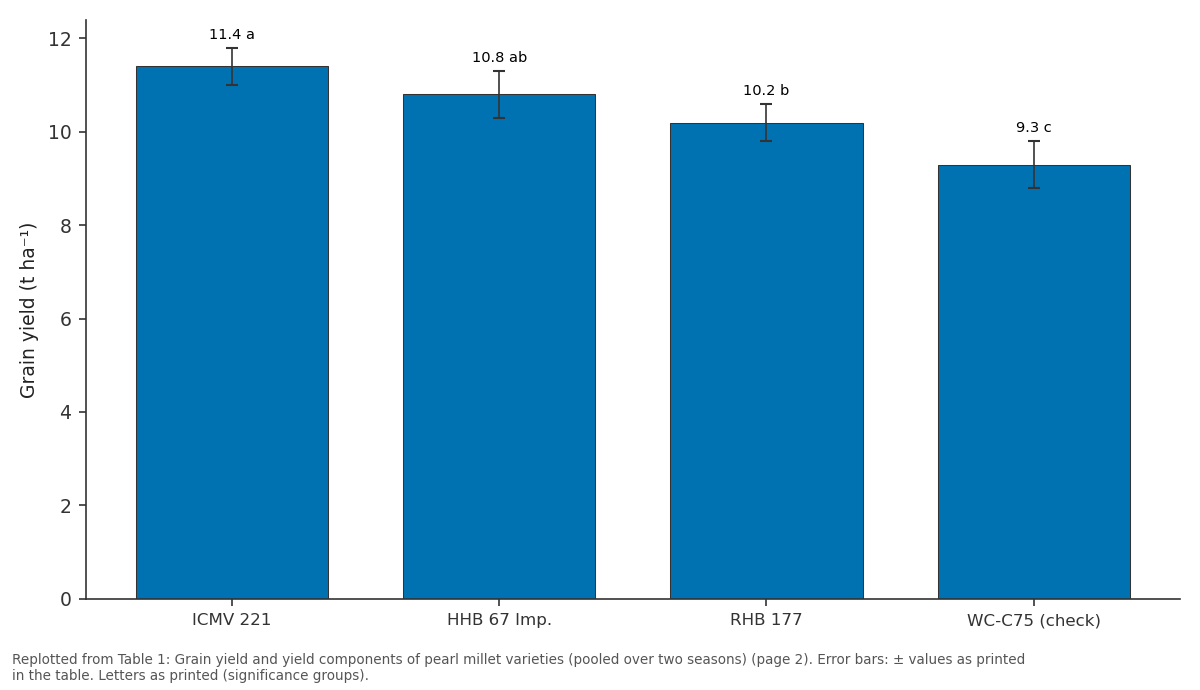
1000-gr wt (g): ICMV 221 vs HHB 67 Imp. vs RHB 177 vs WC-C75 (check)
Replotted from Table 1 (page 2) of the original paper. Every bar is the paper's own table value.
View source evidence ↗Figures & tables
From the original paper Table 1
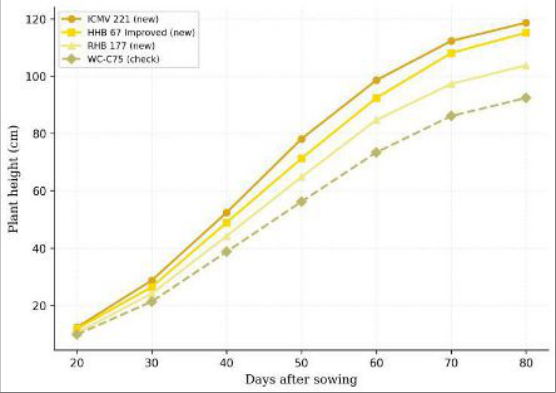 Figure 1
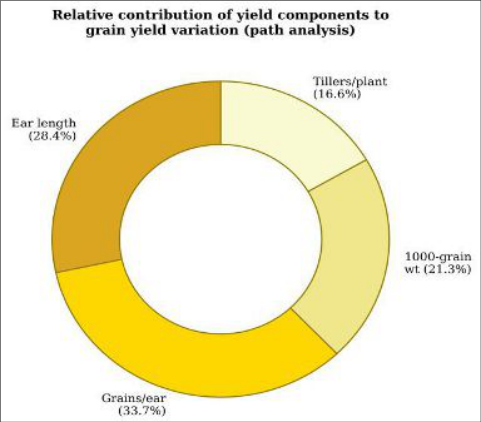 Figure 2
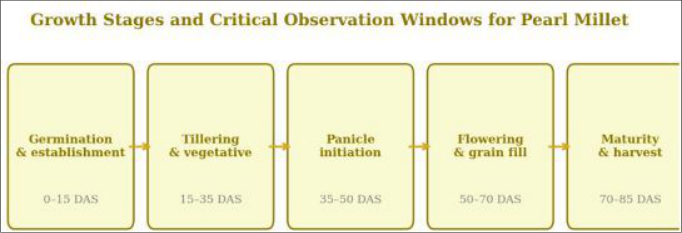 Figure 3
Introduction
An observation that strikes any visitor to the Deccan Plateau during a failed monsoon is how pearl millet fields remain green when everything else has wilted. Pearl millet (Pennisetum glaucum L. R. Br.) is uniquely adapted to the harshest rain-fed environments, thriving on as little as 250-300 mm of rainfall and tolerating temperatures above 42°C [1].
India is the world's largest producer, with about 7 million hectares concentrated in Rajasthan, Gujarat, Haryana, and Telangana [2]. Yet average productivity remains below 1.3 t ha⁻¹, well short of the 3-4 t ha⁻¹ achievable with improved varieties under good management [3]. The release of Open-Pollinated Varieties (OPVs) and hybrids by ICAR and ICRISAT over the past decade has widened the genetic options for farmers, but systematic field evaluation of newer entries under the specific soil and climate conditions of Telangana is lacking [4]. This research compared three recently released varieties against the long-standing check WC-C75 to assess their yield potential, adaptation, and yield-determining traits in the arid zone around Hyderabad [5].
Seasonal variations during the research Kharif 2021 was a near-normal rainfall year (648 mm, long-term average 630 mm), while kharif 2022 received only 487 mm with a 22-day dry spell during the vegetative-to-flowering transition (late July). This contrast provided an opportunity to evaluate varietal performance under both adequate and moisture-stressed conditions. Mean maximum temperatures during the cropping period were 34.8°C (2021) and 36.2°C (2022).
Material And Methods
Material Seeds of ICMV 221 and RHB 177 were obtained from ICRISAT, Patancheru. HHB 67 Improved seed came from CCS Haryana Agricultural University, Hisar. WC-C75 (check) was from the PJTSAU seed unit. The experimental site was the dryland research farm of PJTSAU (17°19′N, 78°24′E, elevation 536 m), with red sandy loam soil (Alfisol), pH 7.2, organic carbon 0.42%, available N 168 kg ha⁻¹ [4, 5].
IJAN 2025; 7(2): 95-97 Jagmohan Parikh Department of Plant Science, Professor Jayashankar Telangana Agricultural University, Hyderabad, Telangana, India Jagmohan Parikh Department of Plant Science, Professor Jayashankar Telangana Agricultural University, Hyderabad, Telangana, India https://www.agriculturejournal.net
Methods
The experiment was conducted in an RCBD with four replications over two kharif seasons (2021, 2022). Plot size: 5 m × 4 m; spacing 45 × 15 cm. Basal fertiliser: 40:20:0 kg N:P₂O₅:K₂O ha⁻¹. Observations included days to 50% flowering, plant height, ear length, effective tillers per plant, grains per ear, 1000-grain weight, and grain yield.
Path coefficient analysis was used to partition direct and indirect effects of yield components on grain yield [6]. Data were analysed by pooled ANOVA across seasons in SAS 9.4 with Tukey's HSD at p<0.05 [7]. Growth stage documentation Phenological observations were recorded following the BBCH scale adapted for pearl millet. Germination (BBCH 09) occurred within 3-4 days across varieties.
Tillering (BBCH 21-29) was earlier in HHB 67 Improved (18 DAS) than others (21-23 DAS). Panicle initiation (BBCH 30) was detected by stem dissection at 32-38 DAS. Anthesis (BBCH 65) ranged from 48 DAS (HHB 67 Improved) to 58 DAS (RHB 177). Physiological maturity (BBCH 89) was reached at 72-84 DAS depending on variety and season.
The 2022 dry spell coincided with the critical boot-to-anthesis stage, causing 8-14% reduction in ear length in susceptible entries.
Results
Table 1: Grain yield and yield components of pearl millet varieties (pooled over two seasons) Variety Days to flower Height (cm) Ear length (cm) Tillers /plant Grains /ear 1000-gr wt (g) Grain yield (t ha⁻¹) ICMV 221 54 ± 2b 118.7 ± 4.2a 24.8 ± 1.1a 3.4 ± 0.3a 2148 ± 87a 11.4 ± 0.4a 2.87 ± 0.18a HHB 67 Imp. 48 ± 1c 115.2 ± 3.8a 22.1 ± 1.3b 3.1 ± 0.4ab 1876 ± 92b 10.8 ± 0.5ab 2.64 ± 0.21ab RHB 177 58 ± 2a 103.8 ± 4.6b 21.4 ± 1.0b 2.8 ± 0.3b 1724 ± 78b 10.2 ± 0.4b 2.41 ± 0.19b WC-C75 (check) 56 ± 2ab 92.4 ± 5.1c 18.3 ± 1.2c 2.4 ± 0.3c 1482 ± 84c 9.3 ± 0.5c 2.19 ± 0.22c Different letters within columns differ at p<0.05. Values are means ± SE pooled across seasons ICMV 221 outyielded the check by 31.2% and all other entries (Table 1). HHB 67 Improved, though lower-yielding than ICMV 221, matured 6 days earlier a valuable trait for escaping terminal drought. Fig 1: Plant height growth curves of four pearl millet varieties across the growing season Fig 2: Relative contribution of yield components to grain yield variation (path analysis) https://www.agriculturejournal.net improvement in India.
| Variety | Days to flower | Height (cm) | Ear length (cm) | Tillers /plant | Grains /ear | 1000-gr wt (g) | Grain yield (t ha⁻¹) |
|---|---|---|---|---|---|---|---|
| ICMV 221 | 54 ± 2b | 118.7 ± 4.2a | 24.8 ± 1.1a | 3.4 ± 0.3a | 2148 ± 87a | 11.4 ± 0.4a | 2.87 ± 0.18a |
| HHB 67 Imp. | 48 ± 1c | 115.2 ± 3.8a | 22.1 ± 1.3b | 3.1 ± 0.4ab | 1876 ± 92b | 10.8 ± 0.5ab | 2.64 ± 0.21ab |
| RHB 177 | 58 ± 2a | 103.8 ± 4.6b | 21.4 ± 1.0b | 2.8 ± 0.3b | 1724 ± 78b | 10.2 ± 0.4b | 2.41 ± 0.19b |
| WC-C75 (check) | 56 ± 2ab | 92.4 ± 5.1c | 18.3 ± 1.2c | 2.4 ± 0.3c | 1482 ± 84c | 9.3 ± 0.5c | 2.19 ± 0.22c |
Table text extracted from the original PDF; superscript letters are shown inline. The original table image is below.
View original table image
AICRP on Pearl Millet Report. 2012. 10. Kannan B, Rathore SS, Tyagi NK. Effect of integrated nutrient management on growth and yield of pearl millet. Indian Journal of Agronomy. 2013;58(3):389- 392. 11.
Burton GW. Quantitative inheritance in pearl millet (Pennisetum glaucum). Agronomy Journal. 1951;43(9):409-417. 12. Hash CT, Bhasker Raj AG, Lindup S, Sharma A, Beniwal CR, Folkertsma RT, et al.
Opportunities for Marker-Assisted Selection (MAS) to improve the feed quality of crop residues in pearl millet and sorghum. Field Crops Research. 2003;84(1-2):79-88. 13. Sharma PC, Singh D, Sehgal D, Singh G, Hash CT, Yadav RS. Further evidence that a terminal drought tolerance QTL of pearl millet is associated with reduced salt uptake.
Environmental and Experimental Botany. 2014;102:48-57. 14. Rao AS, Kelkar MB, Joshi YC. Performance of pearl millet varieties under different sowing dates. Indian Journal of Dryland Agricultural Research and Development. 2004;19(1):81-84. 15.
Andrews DJ, Kumar KA. Pearl millet for food, feed and forage. Advances in Agronomy. 1992;48:89-139. 16. Witcombe JR, Joshi A, Joshi KD, Sthapit BR.
Farmer participatory crop improvement. I. Varietal selection and breeding methods and their impact on biodiversity.
Experimental
Agriculture. 1996;32(4):445-460. 17. Velu G, Rai KN, Muralidharan V, Kulkarni VN, Longvah T, Raveendran TS. Prospects of breeding biofortified pearl millet with high grain iron and zinc content. Plant Breeding. 2007;126(2):182-185. 18.
Serraj R, Hash CT, Rizvi SMH, Sharma A, Yadav RS, Bidinger FR. Recent advances in marker-assisted selection for drought tolerance in pearl millet. Plant Production Science. 2005;8(3):334-337. Fig 3: Growth stages and critical observation windows for pearl millet evaluation
Discussion
The 31.2% yield advantage of ICMV 221 over WC-C75 is consistent with recent multi-location trials across Rajasthan and Gujarat that reported 20-35% superiority of ICMV 221 [3, 4]. Path analysis confirmed that grains per ear had the largest direct effect on yield (0.337), followed by ear length (0.284), supporting breeding emphasis on panicle size. The performance gap between seasons (mean yield 2.71 t ha⁻¹ in 2021 vs 2.28 t ha⁻¹ in 2022) reflects the impact of the mid- season drought, which particularly affected RHB 177 and WC-C75 due to their later flowering [1, 5].
Conclusion
ICMV 221 is recommended as the top variety for arid zones of Telangana based on its superior yield (2.87 t ha⁻¹), large panicle, and adequate drought tolerance. HHB 67 Improved is an alternative for areas prone to terminal drought due to its early maturity (72 days). All three new varieties significantly outperformed the check WC-C75 and merit wider dissemination through state seed agencies.
References
9 in the original paper- Yadav OP, Rai KN. Genetic improvement of pearl millet in India. Agricultural Research. 2013;2(4):275- 292.
- ICAR-AICRP on Pearl Millet. Annual report 2021-22. ICAR-All India Coordinated Research Project on Pearl Millet, Jodhpur. 2022.
- Gupta SK, Rai KN, Singh P, Ameta VL, Gupta SK, Jayalekha AK, et al. Seed set variability under high temperatures during flowering period in pearl millet. Field Crops Research. 2015;171:41-53.
- Rai KN, Gupta SK, Bhatt ML. Pearl millet improvement for enhanced grain iron and zinc content. In: Preedy VR (ed.). Mining of Mineral Resources for Nutritional Quality. Elsevier, Amsterdam. 2020;pp.163- 182.
- Bidinger FR, Mahalakshmi V, Rao GDP. Assessment of drought resistance in pearl millet [Pennisetum americanum (L.) Leeke]. I. Factors affecting yields under stress. Australian Journal of Agricultural Research. 1987;38(1):37-48.
- Dewey DR, Lu KH. A correlation and path-coefficient analysis of components of crested wheatgrass seed production. Agronomy Journal. 1959;51(9):515-518.
- Gomez KA, Gomez AA. Statistical Procedures for Agricultural Research. Wiley, New York. 1984.
- Khairwal IS, Rai KN, Andrews DJ, Harinarayana G. Pearl Millet Breeding. Oxford and IBH, New Delhi. 1999.
- Yadav OP, Rai KN, Rajpurohit BS, Hash CT, Mahala RS, Gupta SK, et al. Twenty-five years of pearl millet