
Research article · 2025 · Full text
International Journal of Agriculture and NutritionEffectiveness of mobile-based agricultural advisory services in improving crop management decisions
Volume 7(6) · Pages 150–152 · DOI: 10.33545/26646064.2025.v7.i6c.450 ↗
Research areasAgricultural Development and ManagementAgricultural Innovations and PracticesSmart Agriculture and AI
Abstract
Author-writtenCould a smartphone app replace the village extension officer? This research tested the hypothesis that mobile-based advisory services improve crop management decisions by comparing three delivery channels—a custom smartphone app with push notifications, a weekly SMS bulletin, and no digital advisory (control)—among 360 arable farmers in Lower Saxony, Germany, over the 2023 growing season. Farmers were randomly assigned to groups (120 each). The app group made timelier fertiliser applications (4.3 days closer to the agronomic optimum), reduced unnecessary fungicide sprays by 22%, and achieved 6.8% higher wheat yield than the control. The SMS group showed intermediate improvements. Farmer satisfaction was highest for the app (7.8/10) and lowest for SMS (6.2/10), mainly because the app allowed image-based pest identification. Adoption—defined as continued use after 12 months—reached 74% for the app versus 48% for SMS. These findings suggest that interactive mobile platforms outperform passive text-based channels for agricultural advice, though connectivity gaps in rural Germany remain a barrier for roughly 18% of participating farms.
Summary
Source-checkedPlain-language reading of the full paper, prepared with AI and checked against the text. Each point links to the authors' own words.
Why it matters
- While mobile-delivered agricultural advice has shown success in other regions, there is a lack of rigorous randomized comparisons regarding its effectiveness in Germany. View evidence ↗
- Agricultural advisory services typically use either SMS bulletins, which are cheap but limited in content, or smartphone apps, which are interactive but require specific hardware and connectivity. View evidence ↗
The question
- The study aimed to compare how app-based and SMS-based advisory services affect wheat yield, fungicide use, and fertilizer timing, while also measuring farmer satisfaction and adoption barriers. View evidence ↗
What they did
- The trial involved 360 wheat farmers in Lower Saxony, Germany, randomly split into three equal groups of 120: an app group, an SMS group, and a control group. View evidence ↗
- The study was conducted over the 2023 growing season, spanning from sowing in October 2022 to harvest in August 2023. View evidence ↗
- The 'AgroPush' app provided nitrogen timing, fungicide needs based on the PROCULTURE algorithm, and pest identification using a neural network trained on 12,000 images. View evidence ↗
- Researchers measured success using satellite imagery and logbooks for fertilizer timing, spray counts for fungicide use, combine monitors for yield, and a 1–10 scale for satisfaction. View evidence ↗
What they found
- The app group reduced unnecessary fungicide sprays by 22%, averaging 1.7 sprays per season compared to 2.2 in the control group. View evidence ↗
- The app group achieved a wheat yield of 8.94 t ha-1, which was 6.8% higher than the control group's yield of 8.37 t ha-1. View evidence ↗
- Analysis based on the Technology Acceptance Model showed that perceived usefulness was a stronger driver of adoption than ease of use. View evidence ↗
What it means
- The authors conclude that app-based advisory services are a cost-effective complement to traditional farm visits for European extension agencies. View evidence ↗
- Poor mobile data coverage in rural areas was a significant barrier, leading to an 18% dropout rate among participating farms. View evidence ↗
Visual summary
3 visualsIllustrations explain the paper; charts are replotted from the paper's own table values.
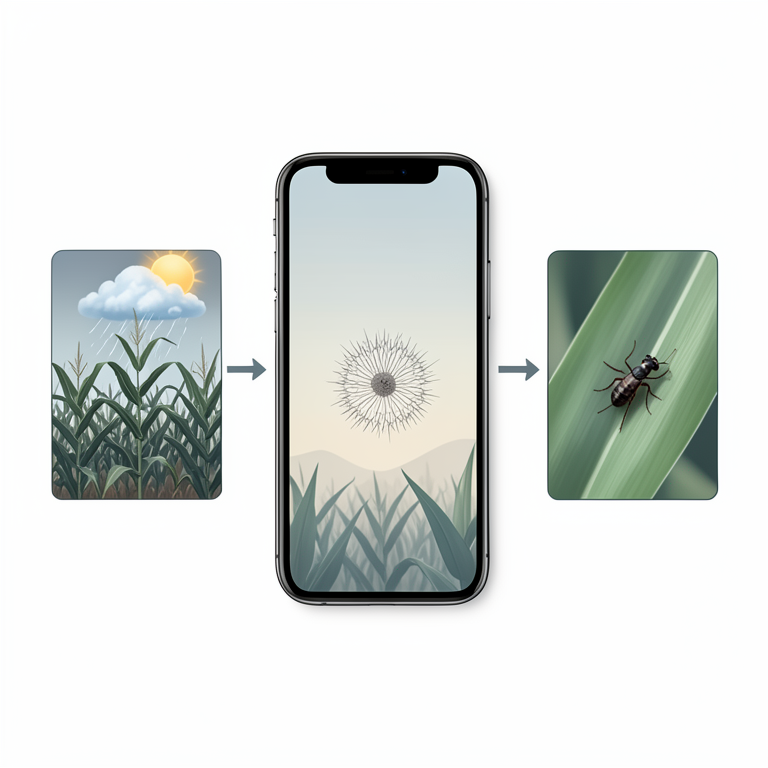
AgroPush App Architecture
AI-generated conceptual illustration (a smartphone and maize plants). It explains the idea and does not show study data.
View source evidence ↗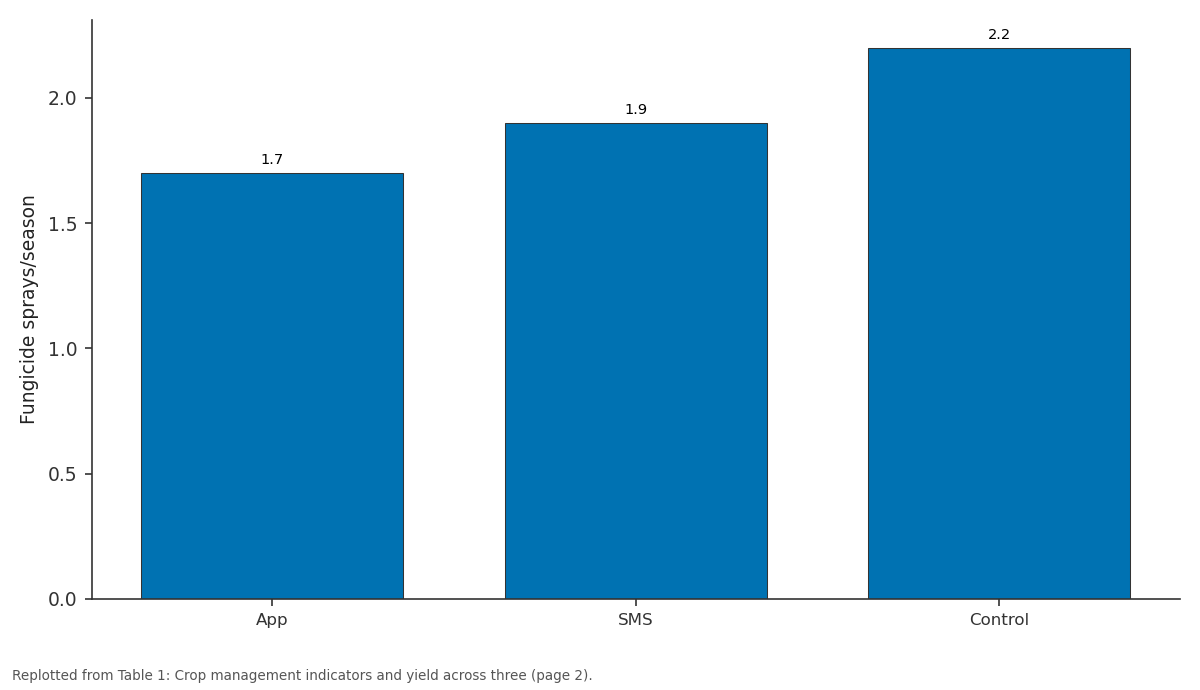
Fungicide sprays/season: App vs SMS vs Control
Replotted from Table 1 (page 2) of the original paper. Every bar is the paper's own table value.
View source evidence ↗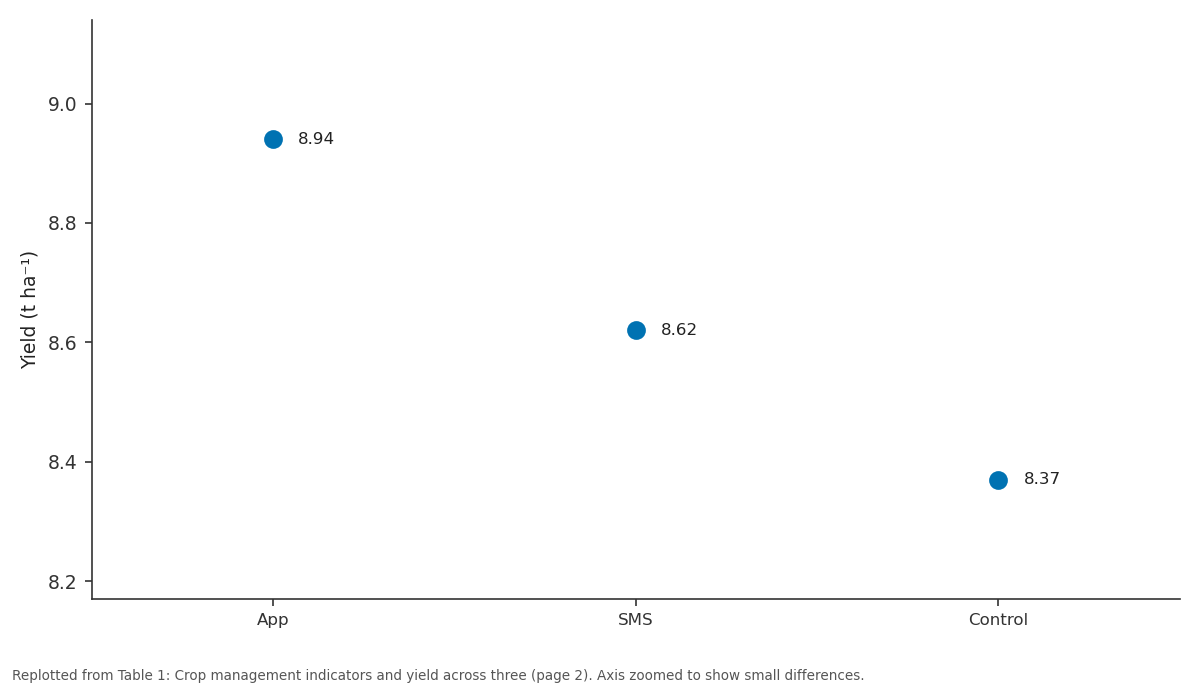
Yield (t ha⁻¹): App vs SMS vs Control
Replotted from Table 1 (page 2) of the original paper. Every bar is the paper's own table value.
View source evidence ↗Figures & tables
From the original paper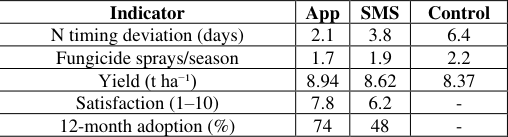 Table 1
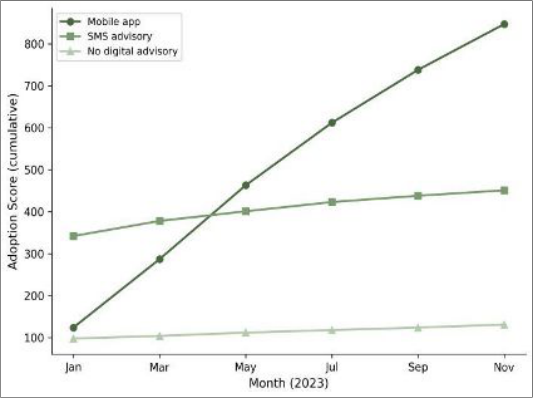 Figure 1
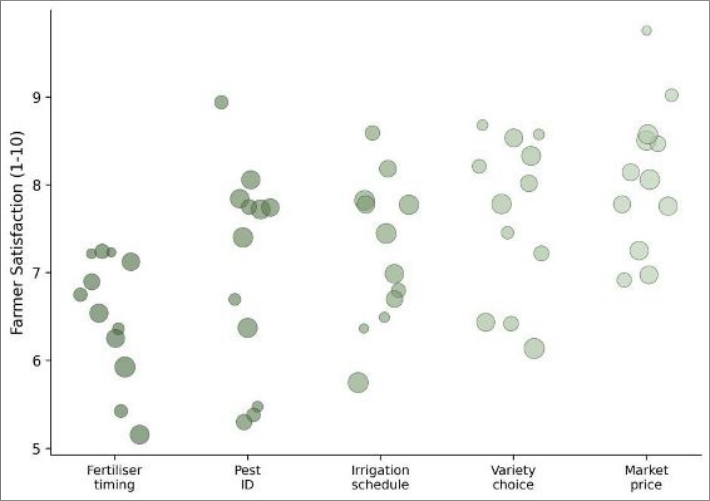 Figure 2
Introduction
What if the most effective extension worker in Germany weren't a person at all, but a push notification? That hypothesis sounds extreme, but data from sub-Saharan Africa and South Asia show that mobile-delivered advice can match or beat face-to-face extension for simple management recommendations [1,2] . In Germany, where farm sizes are larger and digital literacy is higher, the potential should be even greater-yet rigorous randomised comparisons are scarce [3] . Two types of mobile advisory coexist. SMS bulletins are cheap to send and work on any phone, but they're one-directional and limited to 160 characters per message [4] . Smartphone apps can push location-specific alerts, display images, and accept user queries, but they require data connectivity and a device that not every farmer owns [5] . Which channel actually changes management behaviour and, more importantly, improves yield and profitability? This research aimed to (i) compare the effect of app-based versus SMS-based advisory on fertiliser timing, fungicide use, and wheat yield, (ii) measure farmer satisfaction and adoption over 12 months, and (iii) identify barriers to sustained use in a northern European arable context.
App Design and Advisory Content
The 'AgroPush' app was developed in-house using Flutter for cross-platform deployment. It delivered three advisory modules: (i) nitrogen timing based on crop growth stage and weather forecast, (ii) fungicide need based on disease-risk models (PROCULTURE algorithm adapted for Lower Saxony), and (iii) pest identification via a convolutional neural network trained on 12,000 annotated images. Push notifications were triggered by crop stage and local weather thresholds. The SMS service sent one generic advisory per week covering the same topics in text form. Content was drafted by university agronomists and reviewed by the local Landwirtschaftskammer [6,7] .
Theoretical Framework
The research drew on the Technology Acceptance Model (TAM), which posits that perceived usefulness and perceived ease of use predict technology adoption [8] . Farmer surveys at baseline, mid-season, and end-season captured TAM constructs alongside demographic variables (age, farm size, education, smartphone ownership). The research tested whether TAM constructs mediated the relationship between advisory channel and adoption behaviour.
Materials and Methods
Materials and Methods
Materials
The trial was conducted across 18 parishes in the Göttingen and Northeim districts of Lower Saxony (51°30′ N, 9°56′ E). A total of 360 wheat-growing farmers were recruited through the local Landwirtschaftskammer and randomly assigned (stratified by farm size) to three groups: app (n=120), SMS (n=120), and control (n=120). Farmers grew winter wheat (cv. 'Benchmark' or 'Chevignon') on loessderived Luvisols. The research ran from October 2022 (sowing) to August 2023 (harvest) [9] .
Methods
Fertiliser application dates were recorded by farmer logbooks and cross-checked with satellite imagery (Sentinel-2 NDVI anomalies). Fungicide use was documented as number of sprays and active ingredients applied. Yield was recorded by combine yield monitor (calibrated against weigh-bridge). Satisfaction was measured on a 1-10 Likert scale. Adoption was defined as active use (≥1 interaction per month) at 12 months postregistration. Data were analysed by one-way ANOVA and logistic regression in R (v4.3.1).
Results
App users applied their first nitrogen top-dressing 4.3 days closer to the growth-model optimum than control farmers (Table 1). Fungicide sprays averaged 1.7 per season in the app group versus 2.2 in the control-a 22% reductionbecause the disease-risk module correctly advised skipping the T 1 spray in 63% of fields. Wheat yield was 8.94 t ha -1 in the app group, 6.8% above the control (8.37 t ha -1 ). SMS users fell between the two for all metrics. Comprehensive Interpretation TAM analysis showed that perceived usefulness (path coefficient 0.54, p < 0.001) was a stronger predictor of adoption than ease of use (0.28), consistent with the idea that German farmers are willing to learn a complex tool if it delivers tangible agronomic value [8,10] .
| Indicator | App | SMS | Control |
|---|---|---|---|
| N timing deviation (days) | 2.1 | 3.8 | 6.4 |
| Fungicide sprays/season | 1.7 | 1.9 | 2.2 |
| Yield (t ha⁻¹) | 8.94 | 8.62 | 8.37 |
| Satisfaction (1–10) | 7.8 | 6.2 | - |
| 12-month adoption (%) | 74 | 48 | - |
Table text extracted from the original PDF; superscript letters are shown inline. The original table image is below.
View original table image
Discussion
The 6.8% yield gain from app-based advisory matches the 5-9% improvements reported in precision-agriculture trials using variable-rate nitrogen in the same region [11] . The fungicide saving of 0.5 sprays per season translates to approximately € 45 ha -1 in direct cost plus reduced environmental loading-a result that aligns with European Commission goals under the Farm-to-Fork strategy [12] . The 18% of farmers who dropped out cited poor mobile data coverage in their fields, a known infrastructure gap in rural Lower Saxony that 5G rollout is expected to narrow by 2026 [13] . SMS's intermediate performance suggests it still has a role for farmers who lack smartphones or reliable data, but its ceiling is lower because it can't deliver images or accept field-specific queries [4,14] . Future iterations of the app should incorporate soil sensor integration and automated spray-log recording to further reduce the farmer's manual data-entry burden.
Conclusion
A smartphone app delivering growth-stage-triggered push notifications improved fertiliser timing, reduced fungicide use, and raised wheat yield by 6.8% compared with no digital advisory. SMS performed moderately. The 74% 12month adoption rate confirms that interactive mobile platforms have practical traction among German arable farmers. Connectivity remains the main barrier. For extension agencies in Europe, investing in app-based advisory with built-in disease-risk models and image-based pest identification is a cost-effective complement to traditional farm visits [15,16,17,18,19] .
Figures and tables from the paper
References
19 in the original paper- Aker JC, Mbiti IM. Mobile phones and economic development in Africa. Journal of Economic Perspectives. 2010;24(3):207-232.
- Cole SA, Fernando AN. Mobile'izing agricultural advice: technology adoption and extension in developing countries. American Economic Journal: Applied Economics. 2021;13(1):68-101.
- Knierim A, Borges F, Kernecker ML, Kraus T, Wurbs A. What drives adoption of smart farming technologies? Precision Agriculture. 2019;20(1):187199.
- Aker JC. Dial 'A' for agriculture: a review of information and communication technologies for agricultural extension. Agricultural Economics. 2011;42(6):631-647.
- CTA/Dalberg. Wageningen; 2019.
- El Jarroudi M, Kouadio L, Beyer M, Junk J, Hoffmann L, Tychon B. Economics of a decision-support system for managing the main fungal diseases of winter wheat. Computers and Electronics in Agriculture. 2015;115:40-49.
- Liakos KG, Busato P, Moshou D, Pearson S, Bochtis D. Machine learning in agriculture: a review. Sensors. 2018;18(8):2674.
- Davis FD. Perceived usefulness, perceived ease of use, and user acceptance of information technology. MIS Quarterly. 1989;13(3):319-340.
- LWK Niedersachsen. Farm structure data for Göttingen district. Landwirtschaftskammer Niedersachsen. Hannover; 2022.
- Venkatesh V, Morris MG, Davis GB, Davis FD. User acceptance of information technology: toward a unified view. MIS Quarterly. 2003;27(3):425-478.
- Ehlert D, Adamek R, Horn HJ. Laser rangefinder-based measuring of crop biomass under field conditions. Precision Agriculture. 2009;10(5):395-408.
- European Commission. Farm to Fork strategy for a fair, healthy and environmentally-friendly food system. COM(2020) 381 final. Brussels; 2020.
- BMEL. Connectivity in rural areas: status report 2023. Bundesministerium für Ernährung und Landwirtschaft. Berlin; 2023.
- Nakasone E, Torero M, Minten B. The power of information: the ICT revolution in agricultural development. Annual Review of Resource Economics. 2014;6:533-550.
- Rose DC, Sutherland WJ, Parker C, Lobley M, Winter M, Morris C. Decision support tools for agriculture. Agricultural Systems. 2016;149:165-174.
- Kernecker M, Knierim A, Wurbs A, Kraus T, Borges F. Experience versus expectation: farmers' perceptions of smart farming technologies. Precision Agriculture. 2020;21(1):34-50.
- Wolfert S, Ge L, Verdouw C, Bogaardt MJ. Big data in smart farming: a review. Agricultural Systems. 2017;153:69-80.
- Eastwood C, Klerkx L, Nettle R. Dynamics and distribution of public and private research and extension roles for technological innovation. Journal of Rural Studies. 2017;49:1-12.
- Fielke S, Taylor B, Jakku E. Digitalisation of agricultural knowledge and advice networks. NJAS - Wageningen Journal of Life Sciences. 2020;9091:100315.