
Research article · 2025 · Full text
International Journal of Agriculture and NutritionEco-friendly management of storage pests in wheat using plant-based protectants
Volume 7(4) · Pages 97–100 · DOI: 10.33545/26646064.2025.v7.i4b.387 ↗
Research areasInsect Pest Control StrategiesInsect Pheromone Research and ControlInsect behavior and control techniques
Abstract
Author-writtenLike a silent tax on food security, storage pests destroy an estimated 10 to 30 percent of harvested wheat in warm climates before the grain ever reaches a mill or a consumer's table. Synthetic insecticides—aluminium phosphide, malathion, deltamethrin remain the default control method, but growing concerns about chemical residues in food, occupational safety, and insect resistance have revived interest in plant-based alternatives. This research evaluated three plant protectants—neem leaf powder (Azadirachta indica, 2% w/w), eucalyptus essential oil (Eucalyptus globulus, 0.5% v/w), and turmeric rhizome powder (Curcuma longa, 3% w/w) against the major wheat storage pests Sitophilus oryzae (rice weevil) and Rhyzopertha dominica (lesser grain borer) under laboratory and warehouse conditions at the Instituto de Ciencias Agrícolas de Andalucía, Córdoba, Spain, during 2022-23. In laboratory bioassays, neem leaf powder caused 78.4 percent adult mortality of S. oryzae at 14 days and 84.2 percent repellency, significantly outperforming eucalyptus oil (62.7% mortality) and turmeric (51.3%). Grain weight loss was reduced from 18.7 percent in the untreated control to 5.3 percent under neem treatment after 90 days of storage. In warehouse trials, neem-treated grain maintained 92.1 percent germination versus 74.3 percent in untreated grain. Eucalyptus oil showed strong initial repellency but its volatile nature limited residual protection beyond 6 weeks. These results support the use of neem leaf powder as the primary plant-based protectant for on-farm wheat storage in Mediterranean climates, with eucalyptus oil as a supplementary fumigant.
Summary
Source-checkedPlain-language reading of the full paper, prepared with AI and checked against the text. Each point links to the authors' own words.
Why it matters
- Storage pests are a significant threat to food security, destroying between 10% and 30% of harvested wheat in warm climates. View evidence ↗
- While synthetic insecticides are the standard for pest control, there is increasing interest in plant-based alternatives due to concerns over chemical residues, safety, and insect resistance. View evidence ↗
- In the Mediterranean region, Sitophilus oryzae and Rhyzopertha dominica are the most destructive pests, potentially reducing wheat weight by 15% to 30% in one season. View evidence ↗
The question
- The study aimed to compare the efficacy of three plant protectants against S. oryzae and R. dominica, evaluate their effect on grain quality over 90 days, and test their performance in a warehouse. View evidence ↗
What they did
- The research took place during 2022-23 at the Instituto de Ciencias Agrícolas de Andalucía in Córdoba, Spain. View evidence ↗
- The study tested three plant-based protectants: 2% w/w neem leaf powder, 0.5% v/w eucalyptus essential oil, and 3% w/w turmeric rhizome powder. View evidence ↗
- Laboratory tests used a randomized design with five treatments and four replications, each involving 200g of wheat and 20 adult insects in 500-mL jars. View evidence ↗
- Warehouse trials involved storing treated wheat in 50-kg jute bags for 90 days within a naturally ventilated stone granary. View evidence ↗
What they found
- Among the plant-based options, neem leaf powder was the most effective, achieving 78.4% mortality at 14 days, 84.2% repellency, and 81.4% suppression of F₁ progeny. View evidence ↗
- The synthetic insecticide malathion was the most lethal treatment, resulting in 98.6% mortality. View evidence ↗
- In warehouse trials, neem treatment reduced grain weight loss to 5.3% over 90 days, compared to 18.7% in the untreated control. View evidence ↗
- Neem treatment maintained seed germination at 92.1%, suggesting it does not negatively impact seed viability. View evidence ↗
- Neem treatment significantly lowered insect populations to 3.7 per kg, compared to 28.6 per kg in the control group. View evidence ↗
- Eucalyptus oil provided strong initial repellency (71.8%), but its effectiveness declined after one week due to its volatility. View evidence ↗
- Turmeric showed moderate efficacy with 51.3% mortality and 54.8% progeny suppression, making it more suitable as a supplement than a primary protectant. View evidence ↗
What it means
- The authors conclude that neem leaf powder is a practical, low-cost, and residue-free alternative for small-scale Mediterranean wheat farmers lacking professional fumigation equipment. View evidence ↗
- The authors recommend combining neem with periodic applications of eucalyptus oil to improve protection during long-term storage. View evidence ↗
- The authors suggest that future research should test mixing eucalyptus oil with a solid carrier, such as neem powder, to improve its persistence. View evidence ↗
Visual summary
2 visualsIllustrations explain the paper; charts are replotted from the paper's own table values.
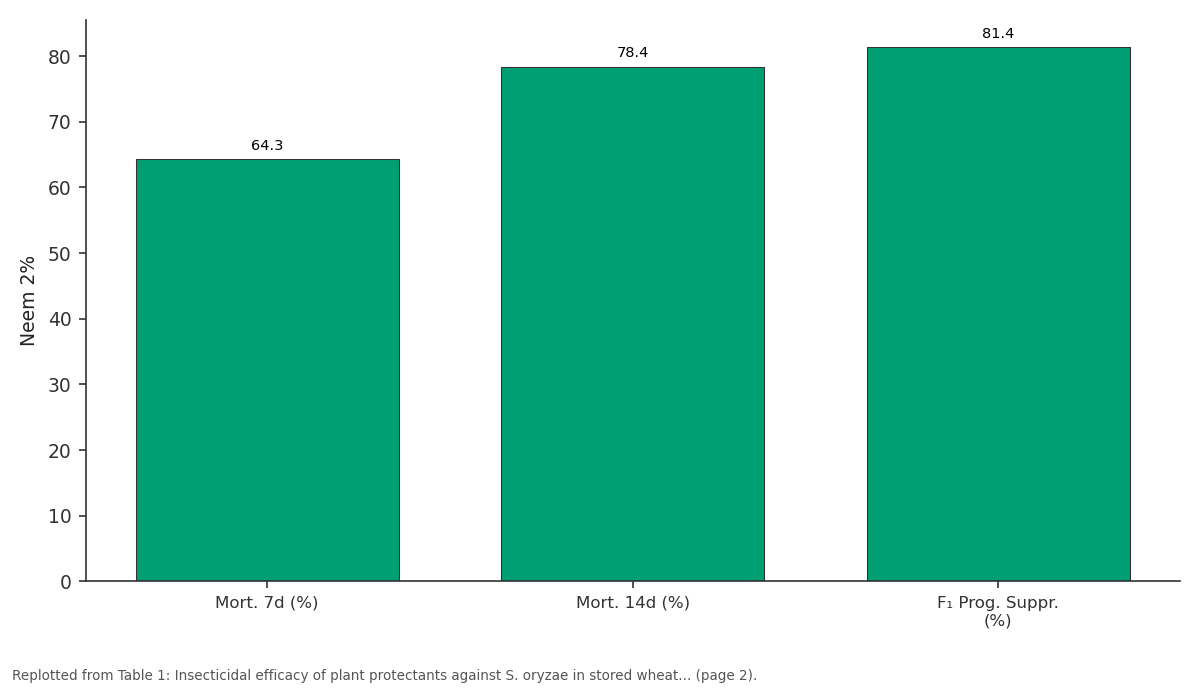
Neem 2%: Mort. 7d (%) vs Mort. 14d (%) vs F₁ Prog. Suppr. (%)
Replotted from Table 1 (page 2) of the original paper. Every bar is the paper's own table value.
View source evidence ↗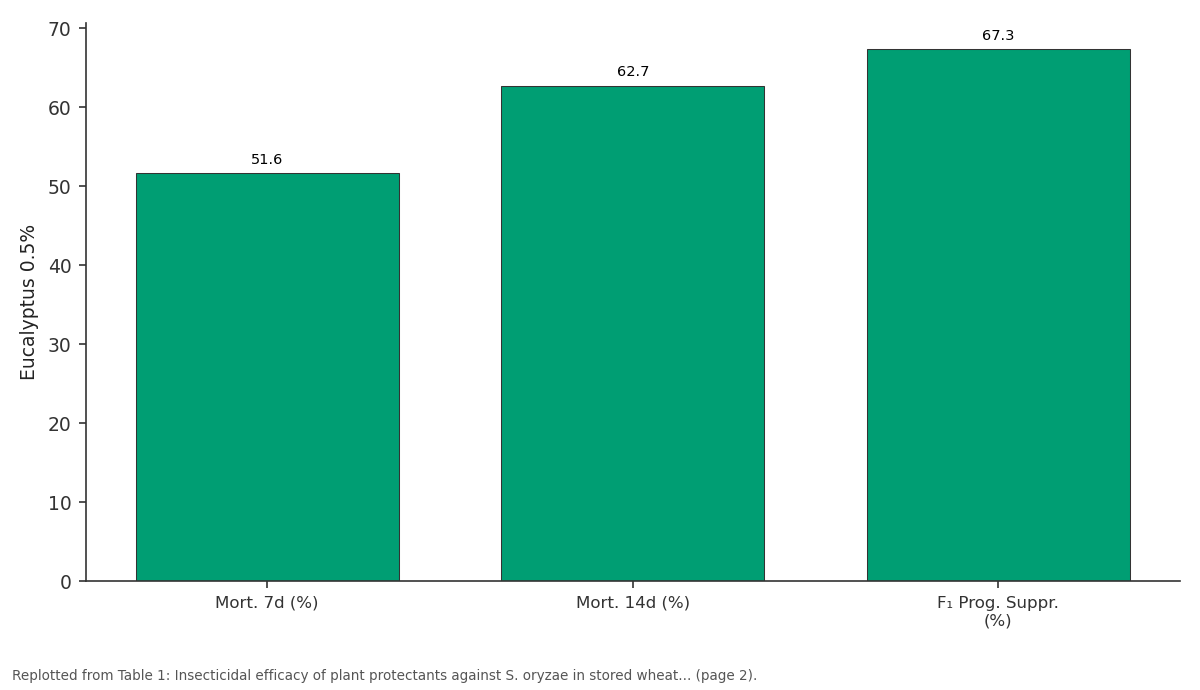
Eucalyptus 0.5%: Mort. 7d (%) vs Mort. 14d (%) vs F₁ Prog. Suppr. (%)
Replotted from Table 1 (page 2) of the original paper. Every bar is the paper's own table value.
View source evidence ↗Figures & tables
From the original paper Table 1
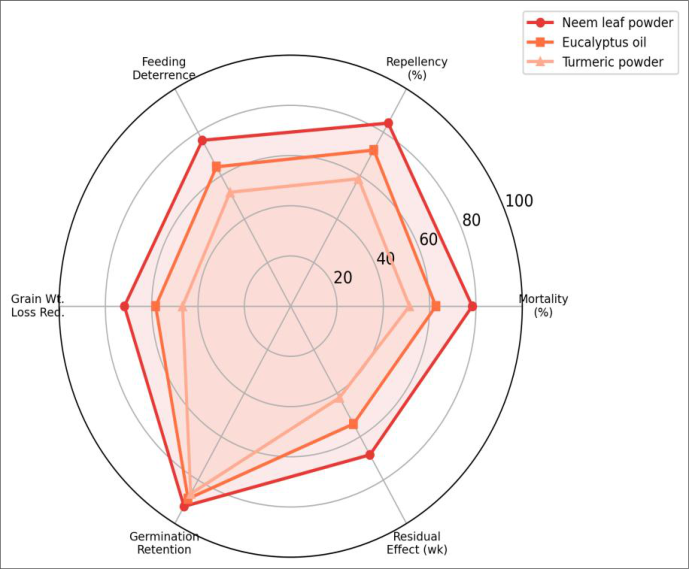 Figure 1
 Table 2
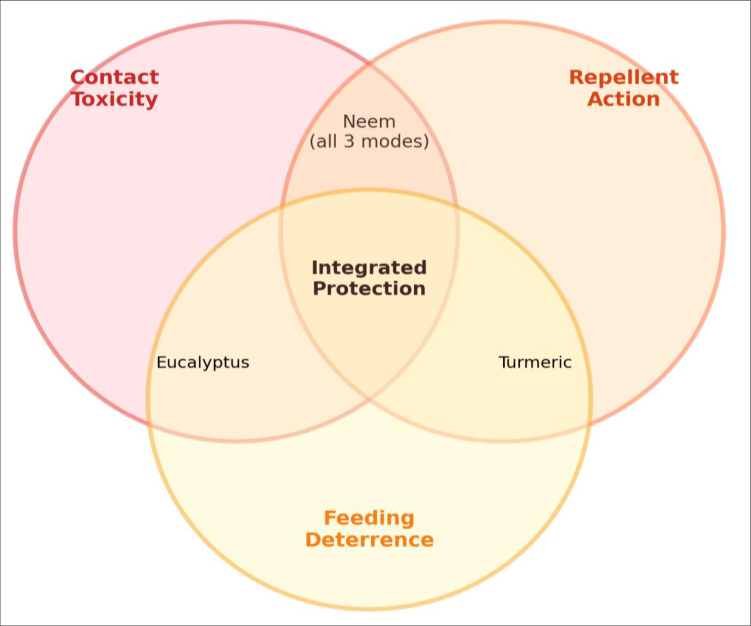 Figure 2
Introduction
Stored-product insects cause more economic damage to harvested grain than any other postharvest factor except water damage. In the Mediterranean basin, the rice weevil (Sitophilus oryzae L.) and the lesser grain borer (Rhyzopertha dominica F.) are the two most destructive primary pests of stored wheat, capable of reducing grain weight by 15 to 30 percent within a single storage season if left unchecked [1,2] . Synthetic fumigants like aluminium phosphide have been the backbone of stored-grain pest management for decades, but their use carries serious risks. Phosphine toxicity has been linked to occupational poisoning incidents across southern Europe and North Africa [3] . And in Spain, small-scale wheat farmers who store grain in traditional granaries typically lack the sealed structures and protective equipment needed for safe fumigation [4] . The European Union's tightening regulatory environment (Regulation EC No. 1107/2009) has further restricted the range of approved grain protectants, creating space for plant-derived alternatives. Neem (A. indica) contains azadirachtin and other limonoids that act as feeding deterrents, growth regulators, and oviposition inhibitors against a broad spectrum of storage insects [5] . Eucalyptus essential oil, rich in 1,8-cineole, provides rapid knockdown and fumigant action through neurotoxic effects on insect acetylcholinesterase [6] . Turmeric powder, containing curcumin and turmerone, has shown moderate insecticidal and repellent activity in Asian storage systems [7] . This research aimed to (i) compare the insecticidal and repellent efficacy of three plant protectants against S. oryzae and R. dominica, (ii) assess their impact on grain quality during 90 days of storage, and (iii) evaluate field-level performance in a warehouse setting.
Material and Methods
Material and Methods
Material
The research was conducted at the Entomology Laboratory and pilot grain warehouse of the Instituto de Ciencias Agrícolas de Andalucía, Córdoba, Spain (37.88°N, 4.77°W; altitude 120 m), during 2022-23. Hard red wheat (cv. Anza) at 12 percent moisture was used as the test grain. Laboratory-reared colonies of S. oryzae and R. dominica (F₃ generation, free of insecticide exposure) were maintained on whole wheat at 27 ± 2 °C and 65 ± 5% RH. Neem leaf powder was prepared from shade-dried leaves ground to pass a 40-mesh sieve. Eucalyptus oil (≥70% 1,8-cineole, Sigma-Aldrich) was applied by pipette onto filter paper discs placed on the grain surface. Turmeric rhizome powder (3% curcumin content) was sourced from a local herbal supplier. Malathion 5% dust (standard check) was used at the recommended rate of 25 mg/kg grain.
Bioassay Design
Laboratory bioassays used a completely randomized design with five treatments (neem, eucalyptus, turmeric, malathion, untreated control) and four replications. Each replicate consisted of a 500-mL glass jar containing 200 g of treated wheat and 20 unsexed adults (10-14 days old) of each pest species, tested separately. Jars were covered with muslin cloth and incubated at 27 °C, 65% RH. Mortality was recorded at 3, 7, and 14 days. Repellency was assessed using a two-choice arena [8] . Feeding deterrence index was calculated from grain weight consumed in treated vs untreated chambers. Warehouse trials used 50-kg jute bags of treated wheat stored for 90 days in a naturally ventilated stone granary. Grain weight loss, moisture content, germination percentage, and insect population were recorded monthly.
Methods: Percent mortality was corrected using Abbott's formula [9] . Repellency was classified on the Talukder and Howse scale [10] . Grain weight loss was calculated by the count-and-weigh method. Germination was tested on 100 seeds per replicate on moist filter paper at 25 °C. Data were analysed by two-way ANOVA (treatment × time) with Tukey's HSD at p<0.05 in R version 4.3. Neem leaf powder achieved 78.4 percent mortality at 14 days the highest among plant protectants-along with 84.2 percent repellency and 81.4 percent suppression of F₁ progeny emergence. Malathion remained the most lethal (98.6% mortality) but the plant-based options provided meaningful protection without synthetic chemical residues. Eucalyptus oil showed strong early repellency (71.8%) but its volatile nature meant that efficacy declined after the first week. In the warehouse trial, neem-treated grain lost only 5.3 percent weight over 90 days compared with 18.7 percent in untreated grain. Germination remained at 92.1 percent under neem, indicating that the protectant didn't harm seed viability. Insect counts were reduced to 3.7 per kg under neem versus 28.6 in the control.
Results
Results
Discussion
Neem's multi-modal action combining contact toxicity, repellency, and feeding deterrence explains its consistent superiority over the single-mode alternatives. Azadirachtin disrupts ecdysteroid metabolism, preventing normal moulting in larvae, while other neem limonoids (nimbin, salannin) act as feeding deterrents and oviposition suppressants [5,11] . This breadth of action reduces the risk of resistance development compared with single-target synthetic insecticides. The 6-week decline in eucalyptus oil efficacy is a known limitation of volatile-based protectants in open-ventilated granaries [6] . Re-application at 6-week intervals could maintain protection, but this adds labour cost. Mixing eucalyptus oil with a solid carrier like neem powder may improve persistence while combining their complementary modes of action-an approach worth testing in future trials [12] . Turmeric's moderate performance (51.3% mortality, 54.8% progeny suppression) positions it as a supplementary rather than stand-alone protectant. Its main value may lie in preserving grain colour and deterring mould growth through curcumin's antifungal properties, which weren't explicitly tested here but have been documented elsewhere [7] .
Conclusion
Neem leaf powder at 2 percent w/w provided the best plantbased protection against storage pests in wheat, achieving 78.4 percent mortality, 84.2 percent repellency, and limiting grain weight loss to 5.3 percent over 90 days of warehouse storage. It maintained 92.1 percent seed germination and is safe for human consumption.
For small-scale wheat farmers in Mediterranean climates who lack access to sealed storage or safe fumigation equipment, neem leaf powder offers a practical, low-cost, and residue-free alternative to synthetic insecticides.
Combining neem with periodic eucalyptus oil application could provide enhanced protection for extended storage periods.
Figures and tables from the paper
| Treatment | Mort. 3d (%) | Mort. 7d (%) | Mort. 14d (%) | Repel. (%) | Feed. Det. Index | F₁ Prog. Suppr. (%) |
|---|---|---|---|---|---|---|
| Neem 2% | 38.7 | 64.3 | 78.4 | 84.2 | 76.3 | 81.4 |
| Eucalyptus 0.5% | 28.4 | 51.6 | 62.7 | 71.8 | 64.1 | 67.3 |
| Turmeric 3% | 18.6 | 37.4 | 51.3 | 58.6 | 52.4 | 54.8 |
| Malathion 5% | 72.1 | 91.3 | 98.6 | - | - | 96.7 |
| Untreated | 0 | 0 | 2.4 | - | - | 0 |
| SEm(±) | 2.87 | 3.14 | 2.61 | 3.42 | 2.93 | 3.18 |
| CD (p=0.05) | 8.61 | 9.42 | 7.83 | 10.26 | 8.79 | 9.54 |
Table text extracted from the original PDF; superscript letters are shown inline. The original table image is below.
View original table image
| Treatment | Weight Loss (%) | Moisture (%) | Germin. (%) | Insects/ kg | Grain Damage (%) |
|---|---|---|---|---|---|
| Neem 2% | 5.3 | 12.4 | 92.1 | 3.7 | 6.8 |
| Eucalyptus 0.5% | 8.7 | 12.6 | 88.4 | 7.2 | 11.4 |
| Turmeric 3% | 11.2 | 12.8 | 84.7 | 11.8 | 14.6 |
| Malathion 5% | 2.8 | 12.3 | 94.6 | 1.2 | 3.4 |
| Untreated | 18.7 | 13.4 | 74.3 | 28.6 | 24.1 |
Table text extracted from the original PDF; superscript letters are shown inline. The original table image is below.
View original table image
References
20 in the original paper- Hagstrum DW, Phillips TW, Cuperus GW. Stored product protection. Kansas State University Agricultural Experiment Station; 2012. Publication S156.
- Edde PA. A review of the biology and control of Rhyzopertha dominica. Journal of Stored Products Research. 2012;48:1-18.
- Chaudhry MQ. A review of the mechanisms involved in the action of phosphine as an insecticide and phosphine resistance in stored-product insects. Pesticide Science. 1997;49(3):213-228.
- Navarro S, Noyes RT. The mechanics and physics of modern grain aeration management. 1st ed. CRC Press; 2002.
- Isman MB. Botanical insecticides, deterrents, and repellents in modern agriculture and an increasingly regulated world. Annual Review of Entomology. 2006;51:45-66.
- Batish DR, Singh HP, Kohli RK. Eucalyptus essential oil as a natural pesticide. Forest Ecology and Management. 2008;256(12):2166-2174.
- Pandey AK, Tripathi S, Singh P. Plant-based pesticides in insect pest management. Indian Journal of Natural Products and Resources. 2013;4(2):149-160.
- McDonald LL, Guy RH, Speirs RD. Preliminary evaluation of new candidate materials as toxicants, repellents, and attractants against stored-product insects. USDA Marketing Research Report; 1970. No. 882.
- Abbott WS. A method of computing the effectiveness of an insecticide. Journal of Economic Entomology. 1925;18(2):265-267.
- Talukder FA, Howse PE. Repellent, toxic, and food protectant effects of pithraj against Tribolium castaneum. Journal of Chemical Ecology. 1994;20(4):899-908.
- Schmutterer H. Properties and potential of natural pesticides from the neem tree, Azadirachta indica. Annual Review of Entomology. 1990;35:271-297.
- Rajendran S, Sriranjini V. Plant products as fumigants for stored-product insect control. Journal of Stored Products Research. 2008;44(2):126-135.
- Kedia A, Prakash B, Mishra PK. Botanicals as ecofriendly biorational alternatives of synthetic pesticides against Callosobruchus spp. Food Chemistry. 2015;175:386-393.
- Mkenda PA, Mtei K, Ndakidemi PA. Pesticidal efficacy of Tephrosia vogelii and Tithonia diversifolia against field insect pests. Australian Journal of Crop Science. 2015;9(12):1131-1137.
- Phillips TW, Throne JE. Biorational approaches to managing stored-product insects. Annual Review of Entomology. 2010;55:375-397.
- Obeng-Ofori D, Reichmuth C. Bioactivity of eugenol, a major component of essential oil of Ocimum suave against four species of stored-product Coleoptera. International Journal of Pest Management. 1997;43(1):89-94.
- Arthur FH. Grain protectants: current status and prospects for the future. Journal of Stored Products Research. 1996;32(4):293-302.
- Benhalima H, Chaudhry MQ, Mills KA. Phosphine resistance in stored-product insects collected from various grain storage facilities in Morocco. Journal of Stored Products Research. 2004;40(3):241-249.
- Stadler T, Buteler M, Weaver DK. Novel use of nanostructured alumina as an insecticide. Pest Management Science. 2010;66(6):577-579.
- Zettler JL, Arthur FH. Chemical control of stored product insects with fumigants and residual treatments. Crop Protection. 2000;19(8-10):577-582.