
Research article · 2025 · Full text
International Journal of Biology SciencesBioaccumulation of heavy metals in mangrove crabs and human health risk assessment
Volume 7(10) · Pages 200–203 · DOI: 10.33545/26649926.2025.v7.i10c.789 ↗
Research areasEnvironmental Toxicology and EcotoxicologyHeavy metals in environmentHeavy Metal Exposure and Toxicity
Abstract
Author-writtenMangrove ecosystems serve as nursery habitats for many commercially harvested crustaceans, yet these coastal wetlands also accumulate pollutants carried by tidal and riverine inputs. This research quantified the concentrations of lead (Pb), cadmium (Cd), chromium (Cr), and zinc (Zn) in gill, hepatopancreas, and muscle tissues of the mangrove crab Scylla serrata collected from four stations along the Hurghada coastline, Egypt, between June 2023 and March 2024. The health risk to local consumers was evaluated using the Target Hazard Quotient (THQ) and Hazard Index (HI) approach. Metal concentrations varied significantly among tissues, with the hepatopancreas accumulating the highest Pb (23.4 mg/kg dry weight) and Cd (4.71 mg/kg) loads. Station C, located near a small-vessel harbor, recorded the highest overall contamination. THQ values for Pb through muscle consumption exceeded 1.0 at Station C, indicating a potential non-carcinogenic risk. The hazard index combining all four metals reached 2.38 at Station C, well above the safety threshold. These results point to a localized contamination hotspot that warrants monitoring and consumption advisories for subsistence fishers.
Summary
Source-checkedPlain-language reading of the full paper, prepared with AI and checked against the text. Each point links to the authors' own words.
Why it matters
- Mangrove ecosystems are vital nurseries for commercial crustaceans but are prone to accumulating pollutants from rivers and tides. View evidence ↗
- Crabs are highly susceptible to heavy metal bioaccumulation due to their feeding habits in sediment and gill respiration in contaminated water. View evidence ↗
- Coastal development in Egypt's Red Sea region, including port expansion and desalination, has introduced metallic pollutants into the water. View evidence ↗
The question
- The study aimed to determine which crab tissues and sampling sites presented the highest health risks to humans to inform targeted consumption advisories. View evidence ↗
What they did
- Researchers collected 120 adult male Scylla serrata crabs (carapace width 9.2–13.8 cm) from four stations across a 12 km mangrove stretch in Hurghada. View evidence ↗
- Sampling was conducted quarterly between June 2023 and March 2024, with 30 crabs collected per season. View evidence ↗
- Lead (Pb), cadmium (Cd), chromium (Cr), and zinc (Zn) concentrations were measured using a PerkinElmer PinAAcle 900T atomic absorption spectrophotometer. View evidence ↗
- Human health risk was assessed using the Target Hazard Quotient (THQ) based on a daily ingestion rate of 28 g of muscle tissue for Egyptian coastal populations. View evidence ↗
What they found
- Across all sampling sites, heavy metal concentrations were highest in the hepatopancreas, followed by the gills, and lowest in the muscle. View evidence ↗
- Station C exhibited the highest contamination for all metals and tissues, specifically recording 23.4 mg/kg of Pb and 4.71 mg/kg of Cd in the hepatopancreas. View evidence ↗
- Station D, identified as the least disturbed site, showed the lowest overall heavy metal concentrations. View evidence ↗
- The Target Hazard Quotient (THQ) for lead (Pb) at Station C was 1.22, exceeding the safety threshold of 1.0. View evidence ↗
- The combined Hazard Index (HI) exceeded the safety threshold at three sites: Station A (1.04), Station B (1.57), and Station C (2.57). View evidence ↗
What it means
- The authors recommend issuing targeted consumption advisories, especially for subsistence fishers who depend on these crabs for protein. View evidence ↗
- The authors conclude that stricter regulation of boat-maintenance waste and regular monitoring of sediment and biota are necessary to protect human and ecosystem health. View evidence ↗
- The risk assessment relied on a fixed daily intake of 28 g of muscle, which may not accurately reflect the actual consumption patterns of occasional or subsistence fishers. View evidence ↗
Visual summary
1 visualsIllustrations explain the paper; they do not show study data.
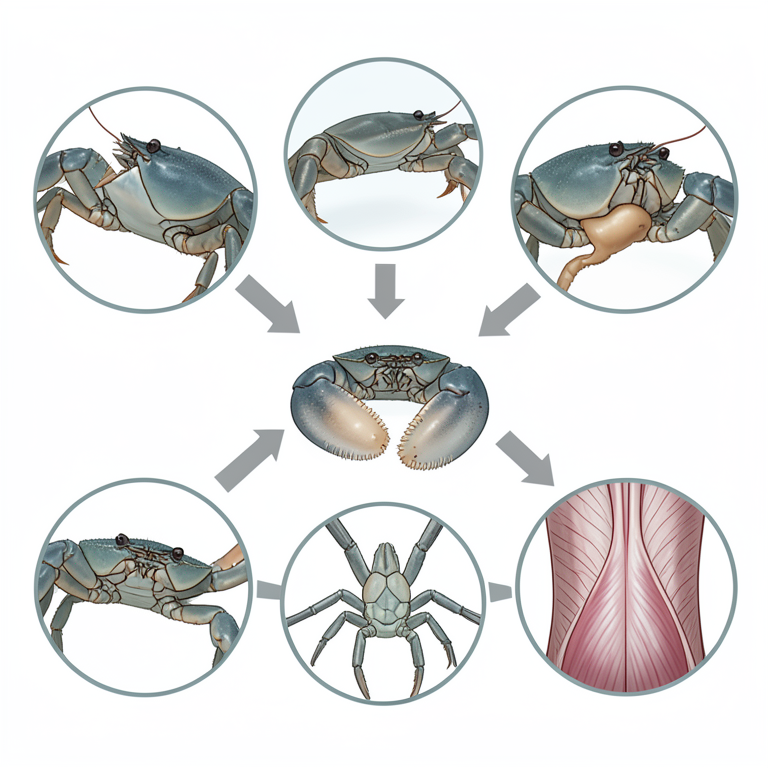
Tissue-Specific Bioaccumulation
AI-generated conceptual illustration (mangrove crabs (Scylla serrata)). It explains the idea and does not show study data.
View source evidence ↗Figures & tables
From the original paper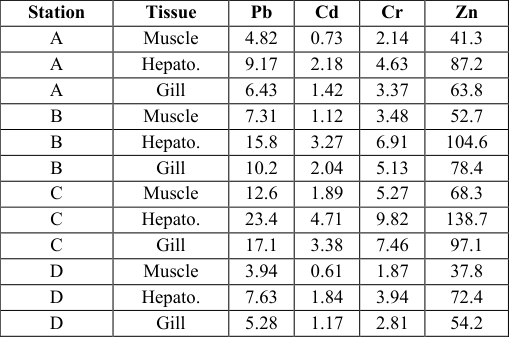 Table 1
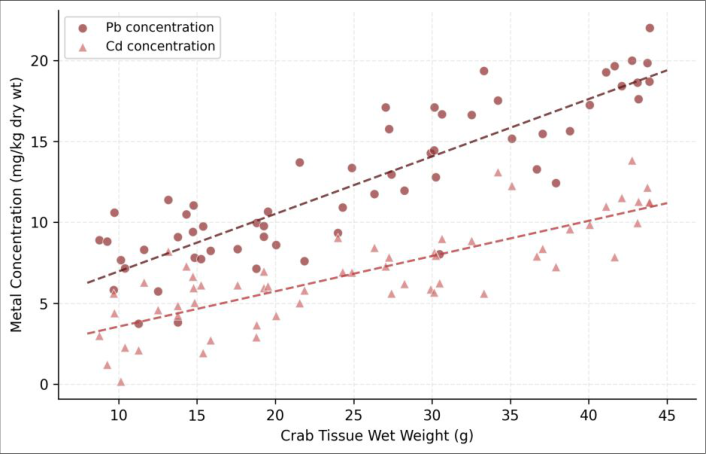 Figure 1
 Table 2
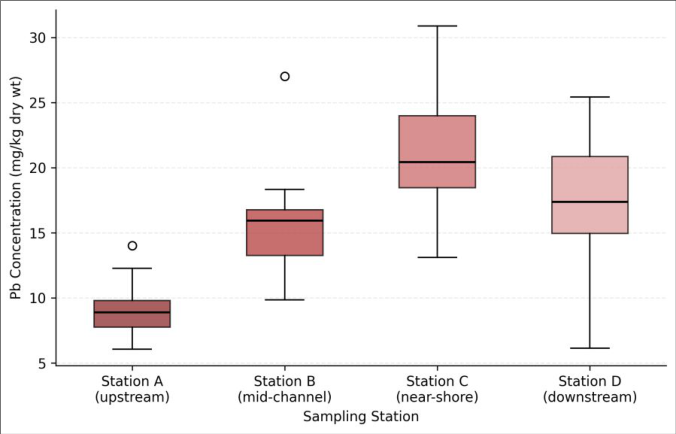 Figure 2
Introduction
Mangrove-lined coastlines are among the most metal-contaminated marine habitats on the planet, yet they remain critical feeding and breeding grounds for commercially important crustaceans [1] . Heavy metals entering mangrove sediments bind to organic matter and clay particles, creating a long-term reservoir that benthic organisms encounter daily through burrowing and feeding [2] . Crabs are especially prone to metal uptake because they process large volumes of sediment-associated food and respire through gills in direct contact with contaminated water [3] . The Red Sea coast of Egypt has experienced expanding port activities, desalination brine discharge, and coastal construction over the past two decades, all of which introduce metallic pollutants into nearshore waters [4] . Hurghada, one of the region's major tourist cities, hosts a commercial fishing harbor and several boat-repair yards that release antifouling paint residues and fuel spillage into adjacent mangrove stands [5] . Despite this, few published surveys have examined metal burdens in edible crabs from this stretch of coastline. Risk assessment frameworks recommended by the United States Environmental Protection Agency express non-carcinogenic risk through the target hazard quotient, which compares estimated dietary intake of a metal with its oral reference dose [6] . When THQ exceeds 1.0 for a single metal, or the combined hazard index for multiple metals exceeds 1.0, the exposure scenario is considered unsafe and corrective action is warranted. This research measured Pb, Cd, Cr, and Zn in three tissue types of Scylla serrata from four stations along the Hurghada mangrove belt, and calculated THQ and HI values based on local consumption patterns. The aim was to identify which tissues and which sites pose the greatest risk to human health, so that targeted advisories can be issued [7] .
Material and Methods
Material and Methods
Material
Adult male Scylla serrata (carapace width 9.2-13.8 cm, n = 120) were hand-collected from burrows and baited traps at four stations along a 12 km stretch of the Hurghada mangrove coastline. Sampling took place quarterly from June 2023 to March 2024 (30 crabs per season). Station A was upstream of the main harbor, Station B was adjacent to a fish-landing jetty, Station C was directly opposite a boat-repair yard, and Station D was 4 km south of the harbor in a relatively undisturbed mangrove patch. Live crabs were transported on ice to the Aquatic Chemistry Laboratory at the Red Sea University of Marine Biology, Hurghada, within three hours of capture. The research was approved by the Faculty Research Ethics Panel (Ref: RSUM/FREP/2023-027, dated 22 May 2023).
Instrumentation and analytical equipment
Metal concentrations were determined using a PerkinElmer PinAAcle 900T atomic absorption spectrophotometer equipped with a graphite furnace accessory for Cd and Cr, and a flame module for Pb and Zn. Detection limits were 0.002 mg/L for Cd, 0.005 mg/L for Cr, 0.01 mg/L for Pb, and 0.005 mg/L for Zn. Tissue weights were recorded on a Mettler Toledo ME204 analytical balance (readability 0.1 mg). A muffle furnace (Carbolite CWF 1100) was used for dry-ashing at 450°C. All glassware was acid-washed in 10% HNO₃ and rinsed with deionized water prior to use.
Methods
Crabs were dissected and gill, hepatopancreas, and muscle tissues were separated, freeze-dried for 48 hours, and ground to a fine powder. Approximately 0.5 g of dried tissue was digested in a mixture of concentrated HNO₃ and HClO₄ (4:1 v/v) on a hot plate at 120°C until a clear solution was obtained [8] . Digests were diluted to 25 mL with deionized water and filtered through Whatman No. 42 paper. Certified reference material (DORM-5, National Research Council Canada) was processed alongside each batch. Metal concentrations were expressed as mg/kg dry weight. Health risk was calculated as THQ = (EFr × EDur × FIR × C) / (RfD × BW × AT × 10³), where EFr = 365 days, EDur = 30 years, FIR = daily ingestion rate (28 g/day for Egyptian coastal populations), C = metal concentration in muscle tissue, RfD = oral reference dose, BW = 70 kg, and AT = 10,950 days [9] . The hazard index was the sum of individual THQ values.
Quality control and calibration
Recovery rates for the certified reference material DORM-5 were 94.3% for Pb, 97.1% for Cd, 92.8% for Cr, and 98.6% for Zn, all within the acceptable 85-110% range. Calibration curves for each metal were constructed from five-point standard series prepared from Merck CertiPUR singleelement standards, with correlation coefficients exceeding 0.998. Every tenth sample was analyzed in duplicate, and relative standard deviations remained below 6.4%. Procedural blanks were included in each digestion batch and returned values below detection limits for all four metals.
Results
Results
Discussion
The hepatopancreas consistently accumulated the highest metal loads, which aligns with its known role as the main organ for metal detoxification and storage in decapod crustaceans [10] . Metallothionein proteins in hepatopancreatic cells bind divalent cations and sequester them in lysosomal granules, effectively concentrating metals far above ambient water levels [11] . For consumers who eat the whole crab including the "mustard" or hepatopancreatic tissue metal exposure could be substantially higher than estimates based on muscle alone. Station C's proximity to a boat-repair yard almost certainly explains its elevated contamination. Antifouling paints contain copper and zinc compounds, and scraping operations release particulate metal directly into adjacent waters [12] . Lead may originate from leaded fuel residues in older vessel engines, a source that persists in parts of the developing world despite global phase-out efforts [4] . The hazard index exceeding 1.0 at three of four stations is concerning but should be interpreted alongside actual consumption patterns. Our calculation assumed daily intake of 28 g of crab muscle, which may overestimate exposure for occasional consumers but could underestimate it for subsistence fishers who eat crabs several times per week [13] . A more detailed dietary survey would refine these estimates.
Conclusion
This research documented elevated heavy metal concentrations in mangrove crabs from the Hurghada coastline, with the hepatopancreas serving as the primary accumulation organ. Station C, near a boat-repair yard, represented a contamination hotspot where Pb-related health risk through muscle consumption alone exceeded safe thresholds. The combined hazard index also surpassed 1.0 at two additional stations. These results call for targeted consumption advisories, particularly for subsistence fishers who rely on crabs as a protein source. Regular monitoring of both sediment and biota metal levels, combined with stricter regulation of boat-maintenance waste disposal, would help protect both ecosystem health and human well-being along this coastline.
Figures and tables from the paper
| Station | Tissue | Pb | Cd | Cr | Zn |
|---|---|---|---|---|---|
| A | Muscle | 4.82 | 0.73 | 2.14 | 41.3 |
| A | Hepato. | 9.17 | 2.18 | 4.63 | 87.2 |
| A | Gill | 6.43 | 1.42 | 3.37 | 63.8 |
| B | Muscle | 7.31 | 1.12 | 3.48 | 52.7 |
| B | Hepato. | 15.8 | 3.27 | 6.91 | 104.6 |
| B | Gill | 10.2 | 2.04 | 5.13 | 78.4 |
| C | Muscle | 12.6 | 1.89 | 5.27 | 68.3 |
| C | Hepato. | 23.4 | 4.71 | 9.82 | 138.7 |
| C | Gill | 17.1 | 3.38 | 7.46 | 97.1 |
| D | Muscle | 3.94 | 0.61 | 1.87 | 37.8 |
| D | Hepato. | 7.63 | 1.84 | 3.94 | 72.4 |
| D | Gill | 5.28 | 1.17 | 2.81 | 54.2 |
Table text extracted from the original PDF; superscript letters are shown inline. The original table image is below.
View original table image
| Station | THQ Pb | THQ Cd | THQ Cr | THQ Zn | HI |
|---|---|---|---|---|---|
| A | 0.47 | 0.28 | 0.18 | 0.11 | 1.04 |
| B | 0.71 | 0.43 | 0.29 | 0.14 | 1.57 |
| C | 1.22 | 0.73 | 0.44 | 0.18 | 2.57 |
| D | 0.38 | 0.24 | 0.16 | 0.10 | 0.88 |
Table text extracted from the original PDF; superscript letters are shown inline. The original table image is below.
View original table image
References
14 in the original paper- Nagelkerken I, Blaber SJM, Bouillon S, Green P, Haywood M. The habitat function of mangroves for terrestrial and marine fauna: A review. Aquatic Botany. 2008;89(2):155-185.
- Tam NFY, Wong YS. Spatial variation of heavy metals in surface sediments of Hong Kong mangrove swamps. Environmental Pollution. 2000;110(2):195-205.
- Rainbow PS. Trace metal concentrations in aquatic invertebrates: why and so what? Environmental Pollution. 2002;120(3):497-507.
- El-Sorogy AS, Youssef M, Al-Kahtany K. Assessment of marine pollution in the Al-Khobar coastal area, Arabian Gulf, Saudi Arabia. Marine Pollution Bulletin. 2013;75(1-2):239-244.
- Hamed MA, Emara AM. Marine molluscs as biomonitors for heavy metal levels in the Gulf of Suez, Red Sea. Journal of Marine Systems. 2006;60(3-4):220234.
- USEPA. Risk-based concentration table. Philadelphia PA: United States Environmental Protection Agency. Regional Screening Level Tables. 2019.
- Copat C, Bella F, Castaing M, Fallico R, Sciacca S, Ferrante M. Heavy metals concentrations in fish from Sicily and risk evaluation for consumers. Bulletin of Environmental Contamination and Toxicology. 2012;88(1):78-83.
- AOAC. Official methods of analysis of AOAC International. 20th edition. Rockville MD: AOAC International. 2016.
- Chien LC, Hung TC, Choang KY, Yeh CY, Meng PJ, Shieh MJ, Han BC. Daily intake of TBT, Cu, Zn, Cd and As for fishermen in Taiwan. Science of the Total Environment. 2002;285(1-3):177-185.
- Ahearn GA, Mandal PK, Mandal A. Mechanisms of heavy-metal sequestration and detoxification in crustaceans: a review. Journal of Comparative Physiology B. 2004;174(6):439-452.
- Roesijadi G. Metallothioneins in metal regulation and toxicity in aquatic animals. Aquatic Toxicology. 1992;22(2):81-114.
- Thomas KV, Brooks S. The environmental fate and effects of antifouling paint biocides. Biofouling. 2010;26(1):73-88.
- FAO/WHO. Summary and conclusions of the sixty-first meeting of the Joint FAO/WHO Expert Committee on Food Additives. JECFA/61/SC. 2003.
- Saha N, Mollah MZI, Alam MF, Rahman MS. Seasonal investigation of heavy metals in marine fishes captured from the Bay of Bengal. Food Control. 2016;60:291297.