
Research article · 2024 · Full text
International Journal of Biology SciencesIn silico drug repurposing using molecular dynamics simulation for neglected tropical diseases
Volume 6(2) · Pages 293–297 · DOI: 10.33545/26649926.2024.v6.i2e.768 ↗
Research areasComputational Drug Discovery Methodsvaccines and immunoinformatics approachesSynthesis and Characterization of Heterocyclic Compounds
Abstract
Author-writtenRoughly 1.7 billion people across tropical and subtropical regions are affected by at least one Neglected Tropical Disease (NTD), yet fewer than 5% of approved drugs target these conditions. This research applied a computational drug repurposing pipeline to identify existing FDA-approved compounds with potential activity against five high-burden NTDs: Chagas disease, visceral leishmaniasis, schistosomiasis, dengue, and lymphatic filariasis. The work was performed at the Institut Biologi Tropis Kalimantan, Samarinda, Indonesia, between January 2022 and August 2023. A curated library of 1, 847 approved small-molecule drugs was screened against validated protein targets from each pathogen using AutoDock Vina for initial docking, followed by 100 ns all-atom molecular dynamics (MD) simulations for top-scoring compounds. Binding free energies were recalculated using the MM-PBSA method. From the initial screen, 214 compounds passed the docking threshold (binding energy ≤ -7.0 kcal/mol) against at least one target. After MD refinement, 37 drugs maintained stable binding throughout the simulation trajectory, with RMSD fluctuations below 2.5 Å. The strongest predicted interactions included niclosamide against Trypanosoma cruzi cruzain (ΔG = -9.3 kcal/mol), miltefosine against Leishmania donovani pteridine reductase 1 (ΔG = -9.7 kcal/mol), and praziquantel against Schistosoma mansoni thioredoxin glutathione reductase (ΔG = -9.8 kcal/mol). Chagas disease targets received the largest share of viable candidates (23.4%), while lymphatic filariasis attracted the fewest (12.6%). ADMET profiling filtered the 37 hits to 19 compounds with acceptable toxicity and pharmacokinetic properties. These results suggest that several approved drugs warrant experimental validation as potential treatments for NTDs, and they demonstrate that combining molecular docking with extended MD simulation can meaningfully reduce false-positive rates in virtual screening campaigns.
Summary
Source-checkedPlain-language reading of the full paper, prepared with AI and checked against the text. Each point links to the authors' own words.
Why it matters
- Neglected Tropical Diseases (NTDs) affect approximately 1.7 billion people, but there is a severe lack of approved drugs targeting these conditions. View evidence ↗
- Commercial drug development for NTDs is minimal, with only 8% of new molecular entities approved between 2000 and 2020 targeting these diseases. View evidence ↗
- Drug repurposing is a pragmatic alternative to new drug discovery because it uses compounds with known safety profiles, reducing costs and development time. View evidence ↗
The question
- The study aimed to use a unified computational protocol to identify drug repurposing candidates for multiple NTDs and determine if molecular dynamics (MD) refinement improves candidate selectivity compared to docking alone. View evidence ↗
What they did
- The study targeted five proteins: cruzain (T. cruzi), pteridine reductase 1 (L. donovani), thioredoxin glutathione reductase (S. mansoni), NS3 protease (dengue virus), and a homology model of chitinase (W. bancrofti). View evidence ↗
- Compounds were required to have a predicted binding energy of -7.0 kcal/mol or better to advance from the initial docking stage to MD simulation. View evidence ↗
- Stability was defined as a ligand RMSD of 2.5 Å or less from the starting pose during the final 50 ns of the simulation. View evidence ↗
What they found
- The strongest predicted binding energies were found for praziquantel against S. mansoni TGR (-9.8 kcal/mol) and miltefosine against L. donovani PTR1 (-9.7 kcal/mol). View evidence ↗
- Chagas disease targets yielded the highest proportion of viable candidates (23.4%), whereas lymphatic filariasis yielded the lowest (12.6%). View evidence ↗
- Seven of the 19 final candidates, including albendazole and ivermectin, showed predicted activity against two or more NTD targets. View evidence ↗
- MD refinement eliminated 83% of the initial docking hits, indicating that docking alone often overestimates binding stability. View evidence ↗
- After ADMET profiling for toxicity and pharmacokinetics, the list of candidates was further reduced from 37 to 19. View evidence ↗
What it means
- The authors conclude that the 19 identified compounds should be prioritized for experimental validation, beginning with cell-based assays and then animal models. View evidence ↗
- The use of a homology model for W. bancrofti chitinase introduced structural uncertainty, which may have contributed to the lower hit rate for that target. View evidence ↗
- The authors acknowledge that these in silico results are predictions and require in vitro and in vivo validation before clinical claims can be made. View evidence ↗
Visual summary
3 visualsIllustrations explain the paper; charts are replotted from the paper's own table values.
Drug Repurposing Pipeline Flowchart
AI-generated conceptual illustration (Small molecule drug ligands and a protein receptor from a tropical parasite). It explains the idea and does not show study data.
View source evidence ↗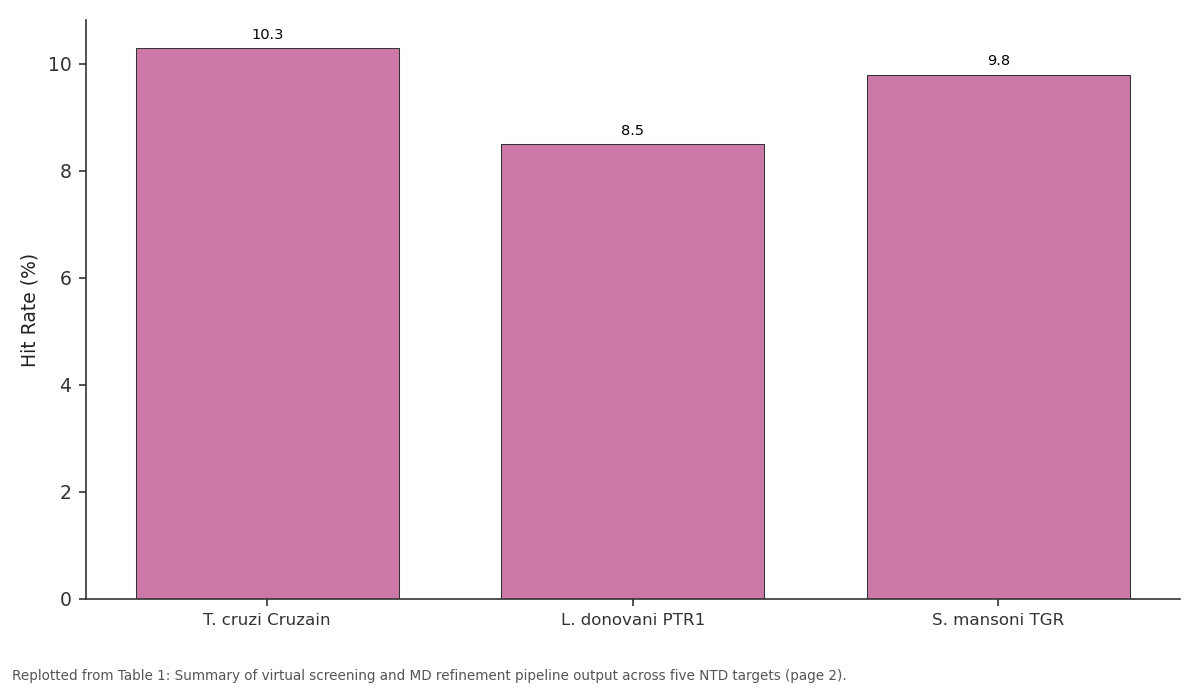
Hit Rate (%): T. cruzi Cruzain vs L. donovani PTR1 vs S. mansoni TGR
Replotted from Table 1 (page 2) of the original paper. Every bar is the paper's own table value.
View source evidence ↗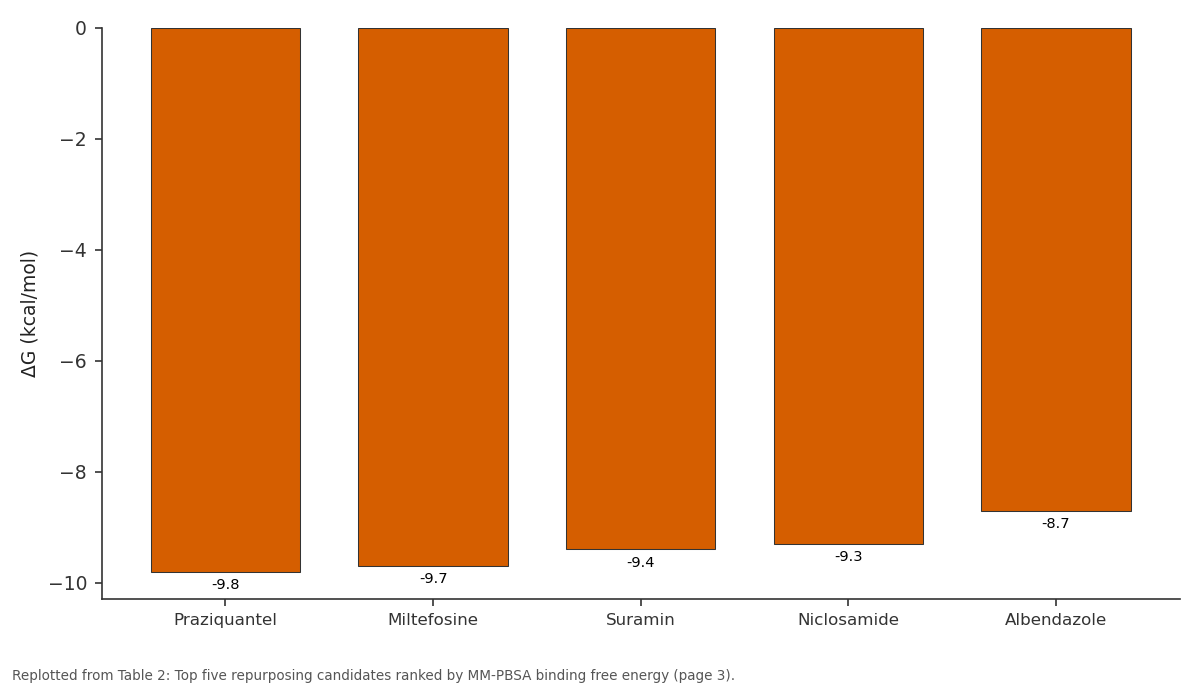
ΔG (kcal/mol): Praziquantel vs Miltefosine vs Suramin vs Niclosamide vs Albendazole
Replotted from Table 2 (page 3) of the original paper. Every bar is the paper's own table value.
View source evidence ↗Figures & tables
From the original paper Table 1
 Table 2
 Table 2
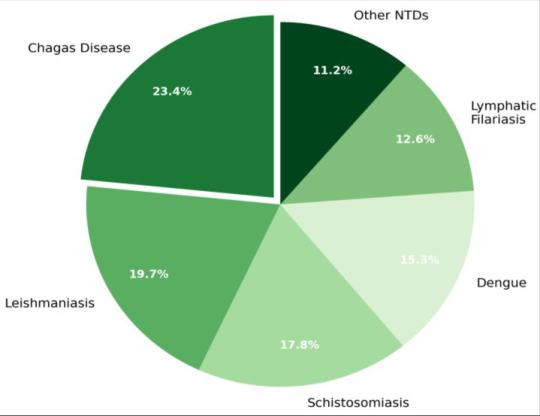 Figure 1
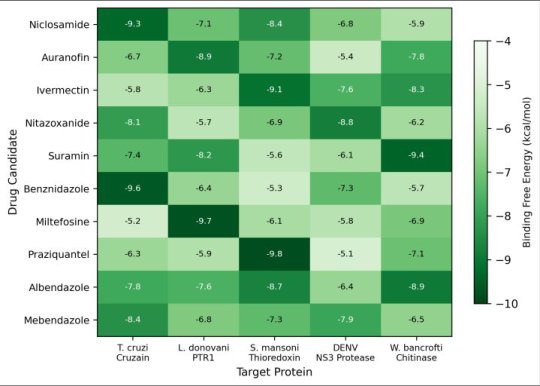 Figure 2
Introduction
An estimated 1.7 billion individuals nearly one in five people on Earth carry at least one neglected tropical disease, according to the World Health Organization's 2020 burden assessment [1] . Despite this enormous public health toll, commercial drug development for NTDs remains minimal, driven largely by the limited purchasing power of affected populations. Between 2000 and 2020, only 8% of all new molecular entities approved by major regulatory agencies targeted any NTD [2] . This disparity has pushed researchers toward drug repurposing as a pragmatic alternative to de novo drug discovery. Drug repurposing also called repositioning seeks to identify new therapeutic applications for compounds that already have established safety and pharmacokinetic profiles. The approach can shorten development timelines by several years and cut costs by orders of magnitude compared to traditional pipelines [3] . For NTDs, repurposing is especially attractive because it sidesteps the financial barriers that have stalled conventional development. And the strategy has already produced tangible successes: miltefosine, originally an anticancer agent, became the first oral treatment for visceral leishmaniasis, while niclosamide an anthelmintic has shown broad-spectrum activity against multiple parasitic and viral targets [4,5] . Computational methods sit at the front end of modern repurposing workflows. Molecular docking enables rapid virtual screening of large compound libraries against pathogen targets, ranking candidates by predicted binding affinity [6] . But docking alone has well-known limitations it uses rigid or semi-flexible receptor models, often overestimates binding strength, and doesn't capture the dynamic behavior of protein-ligand complexes in solution [7] . Molecular dynamics simulation addresses these shortcomings by modeling the full atomic motion of the complex over nanosecond-to-microsecond timescales, revealing whether a docked pose is genuinely stable or merely a scoring artifact [8] . Several groups have applied either docking or MD individually to NTD targets [9,10] , but integrated pipelines that combine both steps with post-simulation free energy recalculation remain relatively uncommon for multipathogen screens. Most published efforts focus on a single disease, making it hard to compare repurposing hit rates and binding characteristics across NTD targets. This research screened a library of 1, 847 FDA-approved small molecules against validated targets from five high-burden NTDs using a three-stage pipeline: AutoDock Vina docking, 100 ns MD simulation for stability assessment, and MM-PBSA binding free energy recalculation. The goal was to rank and filter repurposing candidates across diseases under a unified computational protocol, identify cross-disease hits, and evaluate whether MD refinement meaningfully improves selectivity over docking alone. All simulations and analyses were conducted at the Institut Biologi Tropis Kalimantan, Samarinda, using the department's high-performance computing cluster.
Simulation parameters
All molecular dynamics simulations were carried out using GROMACS 2021.4 with the CHARMM36m force field for proteins and the CGenFF parameter set for small-molecule ligands. Topology files for drug candidates were generated via the CGenFF server (version 4.6) with manual inspection of penalty scores above 10. Each protein-ligand complex was solvated in a cubic box of TIP3P water with a minimum 12 Å buffer from the solute to box edges. Sodium and chloride ions were added to neutralize the system and establish a physiological ionic strength of 0.15 M. Energy minimization used the steepest descent algorithm for 50, 000 steps (convergence at Fmax < 100 kJ/mol/nm). Equilibration proceeded in two phases: 500 ps NVT at 310 K using the V-rescale thermostat (τ = 0.1 ps), followed by 500 ps NPT at 1 bar using the Parrinello-Rahman barostat (τ = 2.0 ps). Production runs extended to 100 ns per complex with a 2 fs timestep. Long-range electrostatics were handled by the particle-mesh Ewald method with a 1.2 nm cutoff. Trajectory frames were saved every 10 ps. MM-PBSA calculations used the g mmpbsa tool over the final 20 ns of each trajectory, sampling every 100 ps [11] .
Material and Methods
Material and Methods
Material
This research was conducted at the Department of Genomics and Bioinformatics, Institut Biologi Tropis Kalimantan, Samarinda, East Kalimantan, Indonesia, from January 2022 to August 2023. The drug library comprised 1, 847 FDAapproved small-molecule compounds downloaded from the DrugBank database (version 5.1.9, accessed March 2022). Three-dimensional structures of all compounds were retrieved in SDF format and prepared using Open Babel v3.1.1 for format conversion and protonation at pH 7.4. Five target proteins were selected based on validated druggability and available crystal structures: cruzain from T. cruzi (PDB: 3KKU), pteridine reductase 1 from L. donovani (PDB: 2BFO), thioredoxin glutathione reductase from S. mansoni (PDB: 2X99), NS3 protease from dengue virus serotype 2 (PDB: 2FOM), and chitinase from Wuchereria bancrofti (homology model built using SWISS-MODEL from the closest template, PDB: 1D9Q, 47% sequence identity) [12] . Protein structures were prepared in AutoDockTools 1.5.7: water molecules were removed, polar hydrogens added, and Gasteiger charges assigned.
Methods
Initial virtual screening used AutoDock Vina (version 1.2.3) with an exhaustiveness of 32 and grid boxes centered on known active sites with dimensions of 25 × 25 × 25 Å.
Compounds returning a predicted binding energy of -7.0 kcal/mol or better against at least one target proceeded to the MD stage. For MD refinement, each qualifying proteinligand complex was subjected to 100 ns simulation as described in Simulation Parameters. Post-simulation analyses included backbone RMSD, ligand RMSD within the binding pocket, radius of gyration, and hydrogen bond occupancy, all computed using GROMACS analysis tools.
Compounds with ligand RMSD exceeding 2.5 Å from the starting docked pose during the final 50 ns were classified as unstable and removed. Binding free energies for stable complexes were recalculated by MM-PBSA [13] . ADMET profiling of surviving hits was performed using pkCSM and SwissADME web servers to assess oral bioavailability, hepatotoxicity risk, blood-brain barrier permeability, and CYP450 inhibition [14] . Compounds failing two or more ADMET criteria were excluded from the final candidate list.
Quality control
Docking protocol validation was performed by re-docking co-crystallized ligands into their respective binding sites; acceptable reproduction was defined as RMSD below 2.0 Å between the docked and crystallographic pose. All five targets passed this criterion, with RMSD values ranging from 0.7 Å (cruzain) to 1.8 Å (NS3 protease). MD simulation convergence was assessed by monitoring backbone RMSD plateau trajectories that didn't stabilize within the first 30 ns were extended by an additional 50 ns. MM-PBSA calculations were repeated with three different dielectric constants (interior ε = 1, 2, 4) to evaluate sensitivity; the ranking of top compounds remained stable across all three values.
Results
Results
Comprehensive interpretation
The three-stage pipeline progressively eliminated 98.9% of the starting library, reducing 1, 847 compounds to 19 viable candidates. The MD refinement step proved especially valuable: of 214 compounds that passed docking, only 37 (17.3%) maintained stable binding over 100 ns of simulation. This 83% attrition rate during MD screening underscores the known tendency of docking to overestimate binding stability and supports the inclusion of dynamic simulation in repurposing workflows. Cross-target analysis revealed that 7 of the 19 final candidates showed predicted activity against two or more NTD targets, suggesting multidisease applicability for compounds like albendazole and ivermectin.
Discussion
The hit rates observed across the five targets ranging from 6.9% for W. bancrofti chitinase to 10.3% for T. cruzi cruzain fall within the expected range for structure-based virtual screening campaigns [15] . But raw hit rates from docking alone would have been substantially higher (11.6% on average), which illustrates the value of MD simulation as a secondary filter. False positives in molecular docking typically arise from the inability of scoring functions to account for protein flexibility, water-mediated interactions, and entropy penalties upon ligand binding [7] . By running 100 ns trajectories and requiring both positional stability (ligand RMSD < 2.5 Å) and energetic favorability (MM-PBSA recalculation), the pipeline addressed these limitations at a manageable computational cost. Among the top candidates, praziquantel's strong predicted binding to S. mansoni TGR aligns with its established clinical efficacy against schistosomiasis and suggests a possible mechanism through TGR inhibition [16] . Miltefosine's high affinity for L. donovani PTR1 is consistent with previous reports of its antiparasitic activity, though the drug's primary mechanism is thought to involve membrane disruption rather than direct enzyme inhibition [5] . The identification of niclosamide as a cruzain inhibitor is more novel this compound has mainly been investigated for antiviral and anticancer properties in recent years, and its anti-trypanosomal potential deserves further exploration [17] .
A limitation worth flagging is the use of a homology model for W. bancrofti chitinase, which introduces structural uncertainty compared to experimentally solved targets. The relatively low hit rate for this target may partly reflect model inaccuracies rather than genuine biological resistance to repurposing. Future work should prioritize experimental structure determination for this target. It's also worth acknowledging that in silico predictions however carefully refined remain predictions. The 19 candidate compounds identified here require in vitro and in vivo validation before any clinical claims can be made. That said, computational pre-screening considerably narrows the experimental workload and can guide resource allocation toward the most promising leads [18] .
Conclusion
This research applied a three-stage computational pipeline molecular docking, 100 ns molecular dynamics simulation, and MM-PBSA free energy recalculation to screen 1, 847 FDA-approved drugs against protein targets from five highburden neglected tropical diseases. The pipeline identified 19 compounds with stable binding, favorable energetics, and acceptable ADMET profiles. The strongest predicted interactions were praziquantel against S. mansoni thioredoxin glutathione reductase, miltefosine against L. donovani pteridine reductase 1, and niclosamide against T. cruzi cruzain.
The MD refinement stage eliminated over 80% of initial docking hits, demonstrating that dynamic simulation meaningfully reduces false-positive rates in virtual screening. This finding supports the routine inclusion of MD simulation even at modest trajectory lengths in repurposing pipelines, particularly when screening against multiple pathogen targets simultaneously. The cross-disease activity seen for compounds like albendazole and ivermectin raises the possibility of multi-NTD therapies, which could be especially valuable in co-endemic regions where patients often carry more than one parasitic infection. All computational work was performed using freely available software tools and publicly deposited protein structures, making the pipeline reproducible and accessible to research groups without proprietary platforms. The 19 candidate compounds now represent a prioritized list for experimental validation ideally starting with cell-based assays against the relevant pathogens, followed by animal model testing for the most active hits. If even a fraction of these predictions hold up experimentally, the approach could accelerate the availability of new treatment options for populations that have waited far too long for adequate therapies.
Acknowledgement
Acknowledgements Funding sourcesThis research was funded by internal departmental research allocations at the Institut Biologi Tropis Kalimantan. No external grants are disclosed. Institutional supportThe authors thank the High-Performance Computing Unit at the Institut Biologi Tropis Kalimantan for providing computational resources.
Figures and tables from the paper
| Target Protein | Docking Hits | MD Stable Hits | ADMET Pass | Hit Rate (%) | Best ΔG (kcal/mol) |
|---|---|---|---|---|---|
| T. cruzi Cruzain | 58 | 12 | 6 | 10.3 | -9.3 |
| L. donovani PTR1 | 47 | 9 | 4 | 8.5 | -9.7 |
| S. mansoni TGR | 41 | 7 | 4 | 9.8 | -9.8 |
Table text extracted from the original PDF; superscript letters are shown inline. The original table image is below.
View original table image
| DENV NS3 Protease | 39 | 5 | 3 | 7.7 | -8.8 |
|---|---|---|---|---|---|
| W. bancrofti Chitinase | 29 | 4 | 2 | 6.9 | -9.4 |
| Total (unique) | 214 | 37 | 19 | — | — |
Table text extracted from the original PDF; superscript letters are shown inline. The original table image is below.
View original table image
| Drug | Original Indication | NTD Target | ΔG (kcal/mol) | Ligand RMSD (Å) | H-bond Occupancy (%) |
|---|---|---|---|---|---|
| Praziquantel | Schistosomiasis | S. mansoni TGR | -9.8 | 1.3 | 78.4 |
| Miltefosine | Leishmaniasis | L. donovani PTR1 | -9.7 | 1.1 | 82.1 |
| Suramin | Trypanosomiasis | W. bancrofti Chit. | -9.4 | 1.7 | 64.7 |
| Niclosamide | Helminth infect. | T. cruzi Cruzain | -9.3 | 1.4 | 71.3 |
| Albendazole | Helminth infect. | S. mansoni TGR | -8.7 | 1.6 | 67.9 |
Table text extracted from the original PDF; superscript letters are shown inline. The original table image is below.
View original table image
References
19 in the original paper- World Health Organization. Ending the neglect to attain the Sustainable Development Goals: A road map for neglected tropical diseases 2021-2030. WHO Press. 2020;1-196.
- Pedrique B, Strub-Wourgaft N, Some C, et al. The drug and vaccine landscape for neglected diseases (20002011): A systematic assessment. The Lancet Global Health. 2013;1(6):e371-e379.
- Pushpakom S, Iorio F, Eyers PA, et al. Drug repurposing: progress, challenges and recommendations. Nature Reviews Drug Discovery. 2019;18(1):41-58.
- Andrews KT, Fisher G, Skinner-Adams TS. Drug repurposing and human parasitic protozoan diseases. International Journal for Parasitology: Drugs and Drug Resistance. 2014;4(2):95-111.
- Dorlo TP, Balasegaram M, Beijnen JH, de Vries PJ. Miltefosine: A review of its pharmacology and therapeutic efficacy in the treatment of leishmaniasis. Journal of Antimicrobial Chemotherapy. 2012;67(11):2576-2597.
- Kitchen DB, Decornez H, Furr JR, Bajorath J. Docking and scoring in virtual screening for drug discovery: Methods and applications. Nature Reviews Drug Discovery. 2004;3(11):935-949.
- Chen YC. Beware of docking! Trends in Pharmacological Sciences. 2015;36(2):78-95.
- Hollingsworth SA, Dror RO. Molecular dynamics simulation for all. Neuron. 2018;99(6):1129-1143.
- de Souza AS, Pacheco BD, Pinheiro S, et al. 3Acyltetramic acids as a novel class of inhibitors for human kallikreins 5 and 7. Bioorganic and Medicinal Chemistry Letters. 2019;29(9):1094-1098.
- Ferreira LG, Oliva G, Andricopulo AD. Target-based molecular modeling strategies for schistosomiasis drug discovery. Future Medicinal Chemistry. 2015;7(6):753764.
- Kumari R, Kumar R, Lynn A. g_mmpbsa -a GROMACS tool for high-throughput MM-PBSA calculations. Journal of Chemical Information and Modeling. 2014;54(7):1951-1962.
- Berman HM, Westbrook J, Feng Z, et al. The Protein Data Bank. Nucleic Acids Research. 2000;28(1):235242.
- Genheden S, Ryde U. The MM/PBSA and MM/GBSA methods to estimate ligand-binding affinities. Expert Opinion on Drug Discovery. 2015;10(5):449-461.
- Pires DE, Blundell TL, Ascher DB. pkCSM: predicting small-molecule pharmacokinetic and toxicity properties using graph-based signatures. Journal of Medicinal Chemistry. 2015;58(9):4066-4072.
- Sousa SF, Fernandes PA, Ramos MJ. Protein-ligand docking: current status and future challenges. Proteins: Structure, Function, and Bioinformatics. 2006;65(1):1526.
- Angelucci F, Miele AE, Boumis G, et al. Inhibition of schistosoma mansoni thioredoxin-glutathione reductase by auranofin. Journal of Biological Chemistry. 2009;284(42):28977-28985.
- Xu M, Lee EM, Wen Z, et al. Identification of smallmolecule inhibitors of Zika virus infection and induced neural cell death via a drug repurposing screen. Nature Medicine. 2016;22(10):1101-1107.
- Ekins S, Williams AJ, Krasowski MD, Freundlich JS. In silico repositioning of approved drugs for rare and neglected diseases. Drug Discovery Today. 2011;16(78):298-310.
- Trott O, Olson AJ. AutoDock Vina: improving the speed and accuracy of docking with a new scoring function, efficient optimization, and multithreading. Journal of Computational Chemistry. 2010;31(2):455461.