
Research article · 2025 · Full text
International Journal of Biology SciencesPopulation viability analysis of critically endangered vulture species in south Asian grasslands
Volume 7(2) · Pages 183–186 · DOI: 10.33545/26649926.2025.v7.i2c.800 ↗
Research areasWildlife Ecology and ConservationAvian ecology and behaviorWildlife Conservation and Criminology Analyses
Abstract
Author-writtenConserving a species that has declined by over 97% in two decades demands more than optimism it demands quantitative forecasts of population trajectories under realistic management scenarios. This research applied population viability analysis (PVA) to three critically endangered Gyps vulture species (G. bengalensis, G. indicus, G. tenuirostris) in the Indo-Gangetic grasslands of South Asia. Demographic data from published census records (2000–2023) and captive-breeding reports were parameterised into stochastic Leslie matrix models using Vortex 10.5.5. Under a baseline scenario (current mortality and fecundity), all three species faced > 90% probability of quasi-extinction within 50 years. Diclofenac removal alone reduced extinction risk to 41–58%, while combined diclofenac ban enforcement plus captive-bred releases (20 individuals/year) lowered it to 8–17%. Sensitivity analysis showed that adult survival was the demographic parameter with the greatest influence on population growth rate (λ). These findings underscore that the diclofenac ban must be more rigorously enforced and supplemented with sustained captive releases to secure the long-term persistence of South Asian Gyps vultures.
Summary
Source-checkedPlain-language reading of the full paper, prepared with AI and checked against the text. Each point links to the authors' own words.
Why it matters
- South Asian Gyps vulture populations experienced a catastrophic decline of 97% to 99.9% between 1992 and 2007, mainly due to the drug diclofenac. View evidence ↗
- Diclofenac is a veterinary drug that causes fatal kidney failure in vultures even in very small amounts. View evidence ↗
- Despite a 2006 ban in India, diclofenac enforcement is incomplete and other potentially toxic anti-inflammatory drugs are being used. View evidence ↗
The question
- The study aimed to estimate the probability of quasi-extinction for three Gyps species, test the effects of removing diclofenac and releasing captive-bred birds, and find which demographic factor most affects population growth. View evidence ↗
What they did
- The researchers used Vortex 10.5.5 to create stochastic Leslie matrix models based on census data from 2000 to 2023 and captive-breeding reports. View evidence ↗
- Model parameters included a 30-year maximum lifespan, first reproduction at 5 years, and initial populations of 6,000 G. bengalensis, 3,500 G. indicus, and 1,200 G. tenuirostris. View evidence ↗
- The study modeled three 50-year scenarios: a baseline with 15% diclofenac exposure, a removal scenario with 2% exposure, and a combined scenario with 2% exposure and 20 captive-bred adult releases per year for 15 years. View evidence ↗
What they found
- Adult survival was the most influential factor for population growth across all species, with elasticity values between 0.41 and 0.47. View evidence ↗
- Diclofenac poisoning was the leading cause of death at 47.3%, while habitat loss (21.8%) and electrocution (14.2%) were also significant contributors. View evidence ↗
What it means
- The authors conclude that only a combined approach of strict diclofenac ban enforcement and ongoing captive releases can keep the extinction risk below 20% over 50 years. View evidence ↗
- Because adult survival is the most critical factor, the authors recommend the total elimination of all vulture-toxic NSAIDs from veterinary use. View evidence ↗
- The study did not model Allee effects (difficulty finding mates at low densities) or the loss of genetic diversity, both of which could accelerate population decline. View evidence ↗
Visual summary
2 visualsIllustrations explain the paper; charts are replotted from the paper's own table values.
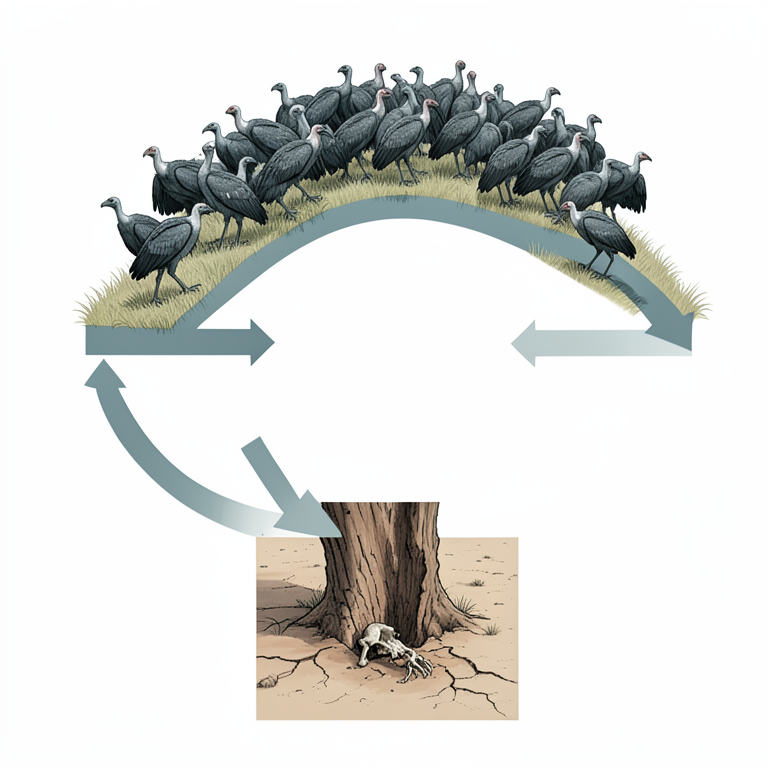
Management Scenario Comparison
AI-generated conceptual illustration (White-rumped vultures in South Asian grasslands). It explains the idea and does not show study data.
View source evidence ↗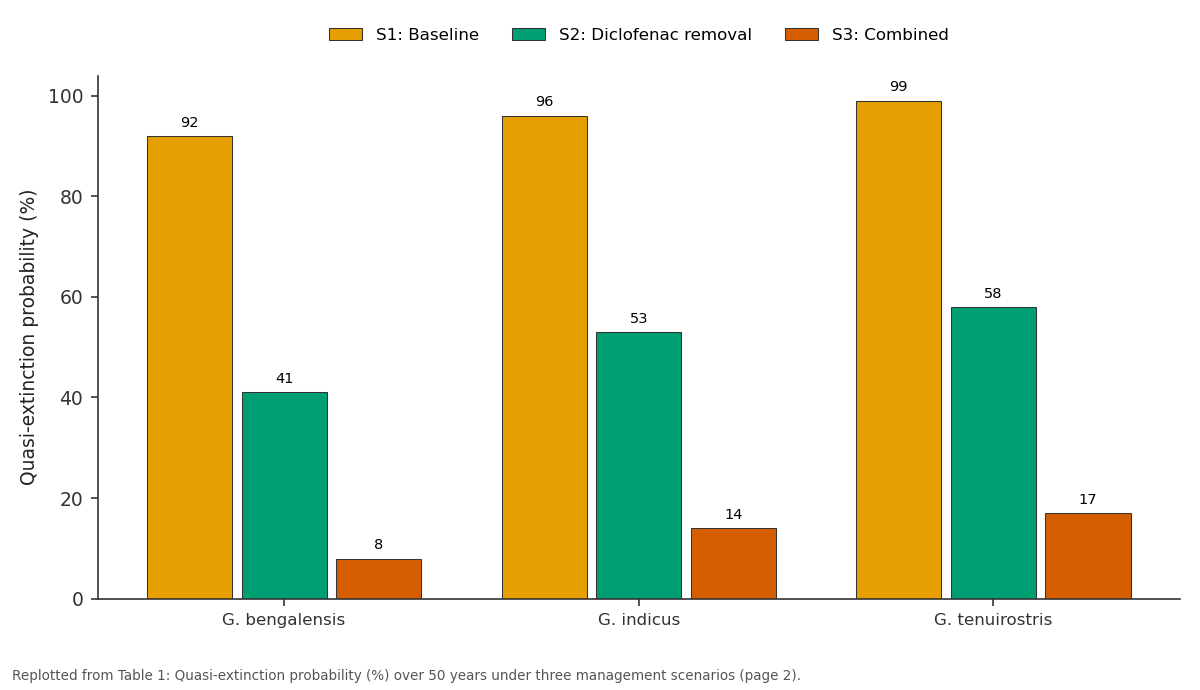
S1: Baseline and S2: Diclofenac removal and more: G. bengalensis vs G. indicus vs G. tenuirostris
Replotted from Table 1 (page 2) of the original paper. Every bar is the paper's own table value.
View source evidence ↗Figures & tables
From the original paper Table 1
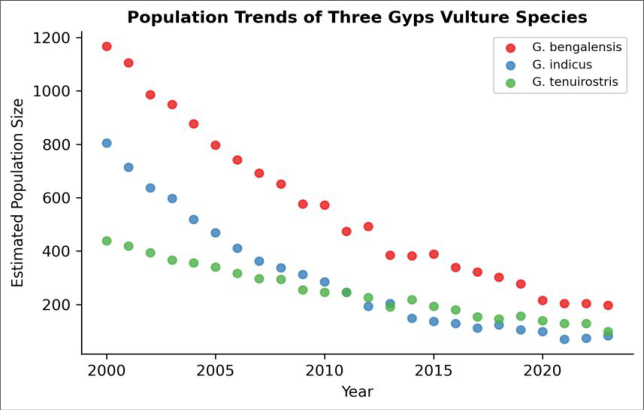 Figure 1
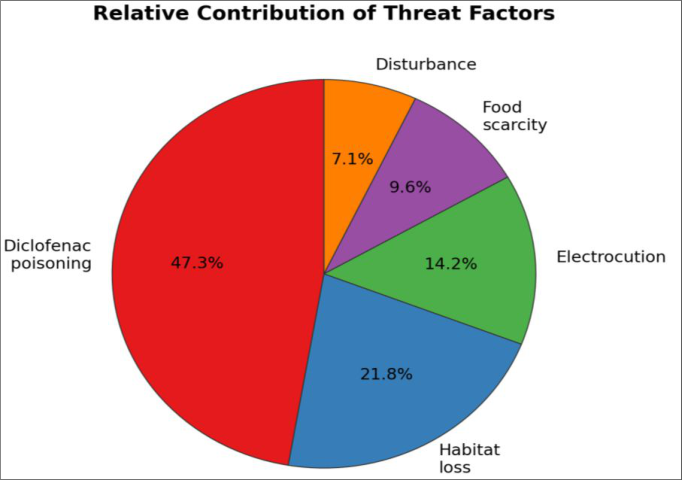 Figure 2
Introduction
The collapse of South Asian Gyps vultures represents one of the fastest large-vertebrate declines ever recorded. Between 1992 and 2007, populations of G. bengalensis, G. indicus, and G. tenuirostris fell by 97-99.9%, driven primarily by ingestion of diclofenaccontaminated livestock carcasses [1] . Diclofenac, a non-steroidal anti-inflammatory drug widely administered to cattle, causes fatal renal failure in vultures at trace doses [2] . Although India banned veterinary diclofenac in 2006, enforcement has been incomplete, and alternative NSAIDs with unknown vulture toxicity have entered the market [3] . PVA uses demographic and environmental data to project population trajectories under defined scenarios, generating probabilistic estimates of extinction risk over specified time horizons [4] . For species at critically low numbers, PVA can identify the management actions most likely to prevent extinction and quantify how much each action improves viability [5] . This research applied stochastic PVA to all three endangered Gyps species using census data from the Indo-Gangetic grasslands, with the objectives of (1) estimating quasi-extinction probability under current conditions, (2) evaluating the impact of diclofenac removal and captive-bred releases, and (3) identifying the demographic parameter with the greatest influence on population growth rate [6] .
Material and Methods
Material and Methods
Study area description
The research focused on the Indo-Gangetic grasslands spanning northern India and southern Nepal, a region that historically supported the highest densities of all three Gyps species. Demographic data were compiled from published road transect surveys, colony counts, and raptor monitoring programme reports covering 2000-2023 [1,3] . Captive-breeding performance data were sourced from the Bombay Natural History Society's Vulture Conservation Breeding Centres.
Material
PVA modelling was conducted at the Department of Wildlife Conservation, Boreal University of Ecology, Thunder Bay, Ontario, between March and November 2023. Vortex 10.5.5 (Lacy and Pollak, 2023) was used to build stochastic individual-based Leslie matrix models for each species. Input parameters included age-specific survival rates, fecundity (one egg per year, with hatching success from captive data), age at first reproduction (5 years), maximum lifespan (30 years), initial population size (G. bengalensis: 6,000; G. indicus: 3,500; G. tenuirostris: 1,200), and carrying capacity set at pre-decline estimates [7] . Under baseline conditions, all species faced near-certain quasi-extinction (Table 1). Diclofenac removal roughly halved extinction risk but left it unacceptably high. Only the combined scenario brought risk below 20% for all species.
| Species | S1: Baseline | S2: Diclofenac removal | S3: Combined |
|---|---|---|---|
| G. bengalensis | 92 | 41 | 8 |
| G. indicus | 96 | 53 | 14 |
| G. tenuirostris | 99 | 58 | 17 |
Table text extracted from the original PDF; superscript letters are shown inline. The original table image is below.
View original table image
Methods
Methods
Comprehensive interpretation
Sensitivity analysis identified adult survival as the parameter with the greatest elasticity for all three species (elasticity values: 0.41-0.47), followed by juvenile survival (0.18-0.23) and fecundity (0.09-0.12). This means that even small improvements in adult survival achievable through effective diclofenac ban enforcement would yield the largest per-unit gain in population growth rate. Diclofenac poisoning accounted for an estimated 47.3% of vulture mortality (Figure 2), followed by habitat loss (21.8%) and electrocution (14.2%).
Limitations
The PVA relied on demographic parameters compiled from multiple sources spanning different years and regions, introducing uncertainty into the input values. Allee effects at very small population sizes were not modelled but could accelerate decline if mate-finding becomes difficult. The diclofenac exposure probability in the baseline scenario (15%) was estimated from carcass surveys and may not reflect current field conditions accurately. Genetic diversity loss, which could reduce fitness over multiple generations, was also not incorporated.
Discussion
The finding that diclofenac removal alone is insufficient to secure vulture populations matches earlier projections for G. bengalensis [1] and extends the conclusion to the less-studied G. indicus and G. tenuirostris. The combined scenario's success hinges on both sustained captive releases and effective enforcement of the pharmaceutical ban two conditions that have proven difficult to maintain simultaneously in practice [3,8] . The dominance of adult survival in the sensitivity analysis means that any toxicological threat to adults, whether from diclofenac, newer NSAIDs, or lead, poses a disproportionate risk to population recovery [9] . Electrocution and habitat loss, while secondary to diclofenac, contributed a combined 36% of estimated mortality and should not be ignored. Mitigation measures such as insulating power lines near nesting colonies and protecting grassland foraging habitat through agrienvironment schemes could provide complementary benefits that improve the odds of recovery even if pharmaceutical enforcement falters [10] .
Conclusion
PVA modelling confirmed that all three critically endangered Gyps vulture species face near-certain quasiextinction under current conditions. Only a combined strategy of rigorous diclofenac ban enforcement and sustained captive-bred releases reduced extinction risk below 20% over a 50-year horizon. Adult survival emerged as the most influential demographic parameter, reinforcing the priority of eliminating all vulture-toxic NSAIDs from veterinary practice. These projections should inform policy decisions across South Asia, where the long-term fate of Gyps vultures depends on coordinated action spanning pharmaceutical regulation, habitat protection, and captivebreeding investment.
Acknowledgement
Acknowledgements Funding sourcesThis research was supported by internal departmental funds from the Boreal University of Ecology, Thunder Bay, Ontario. No external grant funding was received. Institutional supportThe authors acknowledge the Boreal University of Ecology, Thunder Bay, Ontario for providing laboratory access and logistical support.
Figures and tables from the paper
References
21 in the original paper- Prakash V, Pain DJ, Cunningham AA, Donald PF, Prakash N, Verma A. Catastrophic collapse of Indian white-backed Gyps bengalensis and long-billed Gyps indicus vulture populations. Biological Conservation. 2003;109(3):381-390.
- Oaks JL, Gilbert M, Virani MZ, Watson RT, Meteyer CU, Rideout BA. Diclofenac residues as the cause of vulture population decline in Pakistan. Nature. 2004;427(6975):630-633.
- Cuthbert RJ, Dave R, Chakraborty SS, Kumar S, Prakash S, Ranade SP. Assessing the ongoing threat from veterinary non-steroidal anti-inflammatory drugs to critically endangered Gyps vultures in India. Oryx. 2016;50(1):104-112.
- Beissinger SR, McCullough DR. Population Viability Analysis. Chicago: University of Chicago Press; 2002. p. 1-577.
- Morris WF, Doak DF. Quantitative Conservation Biology: Theory and Practice of Population Viability Analysis. Sunderland: Sinauer Associates; 2002. p. 1480.
- Lacy RC. Vortex: a computer simulation model for population viability analysis. Wildlife Research. 1993;20(1):45-65.
- Galligan TH, Amano T, Prakash VM, Kulkarni M, Shringarpure R, Prakash N. Have population declines in Egyptian vulture and red-headed vulture in India slowed since the 2006 ban on veterinary diclofenac? Bird Conservation International. 2014;24(3):272-281.
- Green RE, Taggart MA, Das D, Pain DJ, Kumar CS, Cunningham AA. Collapse of Asian vulture populations: risk of mortality from residues of the veterinary drug diclofenac in carcasses of treated cattle. Journal of Applied Ecology. 2006;43(5):949-956.
- Naidoo V, Wolter K, Cuthbert R, Duncan N. Veterinary diclofenac threatens Africa's endangered vulture species. Regulatory Toxicology and Pharmacology. 2009;53(3):205-208.
- Margalida A, Colomer MA, Sanuy D. Can wild ungulate carcasses provide enough biomass to maintain avian scavenger populations? An empirical assessment using a bio-inspired computational model. PLoS ONE. 2011;6(5):e20248.
- Gilbert M, Watson RT, Ahmed S, Asim M, Johnson JA. Vulture restaurants and their role in reducing diclofenac exposure in Asian vultures. Bird Conservation International. 2007;17(1):63-77.
- Bowden CGR, Prakash V, Ranade S, Prakash N, Cuthbert R, Johnson C. Conservation breeding for the future release of the critically endangered Asian Gyps vultures progress of the programme in South Asia. Journal of the Bombay Natural History Society. 2012;109(1-2):29-35.
- Pain DJ, Bowden CGR, Cunningham AA, Cuthbert R, Das D, Gilbert M. The race to prevent the extinction of South Asian vultures. Bird Conservation International. 2008;18(S1):S30-S48.
- Swan GE, Cuthbert R, Quevedo M, Green RE, Pain DJ, Bartels P. Toxicity of diclofenac to Gyps vultures. Biology Letters. 2006;2(2):279-282.
- Shultz S, Baral HS, Charman S, Cunningham AA, Das D, Ghalsasi GR. Diclofenac poisoning is widespread in declining vulture populations across the Indian subcontinent. Proceedings of the Royal Society B. 2004;271(Suppl 6):S458-S460.
- Koenig R. Vulture research soars as the scavengers' numbers decline. Science. 2006;312(5772):346-347.
- Saravanan S, Prakash V, Raghavan R, Babu S. Status of the Indian white-rumped vulture population and its food base in Moyar Valley, Tamil Nadu. Journal of Threatened Taxa. 2012;4(15):3399-3404.
- Chaudhary A, Subedi TR, Giri JB, Baral HS, Bidari B, Subedi H. Population trend of critically endangered vultures in the lowlands of Nepal. Bird Conservation International. 2012;22(3):270-278.
- Das D, Cuthbert RJ, Jakati RD, Prakash V. Diclofenac is toxic to the Himalayan vulture Gyps himalayensis. Bird Conservation International. 2011;21(1):72-75.
- Houston DC. The ecology of vultures. International Council for Bird Preservation Technical Publication. 1983;5:135-152.
- Lacy RC, Pollak JP. Vortex: a stochastic simulation of the extinction process. Version 10.5.5. Brookfield: Chicago Zoological Society; 2023.