
Research article · 2024 · Full text
International Journal of Biology SciencesDecomposition rates and nutrient release from leaf litter in mixed-species plantation forests
Volume 6(2) · Pages 320–323 · DOI: 10.33545/26649926.2024.v6.i2e.774 ↗
Research areasSoil Carbon and Nitrogen DynamicsEnvironmental and biological studiesForest Ecology and Biodiversity Studies
Abstract
Author-writtenConsider a forest floor where three tree species drop their leaves together does the mix decompose faster, slower, or the same as each species alone? This research measured litter decomposition rates and nutrient release dynamics in monoculture and mixed-species litterbag treatments across a plantation forest in central Turkey. The experiment ran from October 2021 to October 2022 at a 15-year-old plantation near the Central Anatolian University of Life Sciences, Konya. Litterbags containing leaf litter from Pinus nigra, Quercus robur, and Fagus orientalis alone and in all two- and three-species combinations were deployed on the forest floor and retrieved at 3, 6, 9, and 12 months. Decomposition rate constants (k) ranged from 0.31 yr⁻¹ for pine monoculture to 0.61 yr⁻¹ for the oak-beech mixture. Mixed-species treatments decomposed 12-39% faster than predicted from monoculture rates, indicating synergistic non-additive effects. Nutrient release followed a similar pattern: nitrogen, phosphorus, and potassium were released 24-38% faster from mixed litter. The three-species mixture showed intermediate decomposition (k = 0.57) but the fastest potassium release (72.3% of initial content). These findings support the hypothesis that species mixing accelerates nutrient cycling in plantation forests through litter diversity effects.
Summary
Source-checkedPlain-language reading of the full paper, prepared with AI and checked against the text. Each point links to the authors' own words.
Why it matters
- Plantation forests cover more than 130 million hectares worldwide and have traditionally relied on monocultures to simplify management and ensure uniform timber. View evidence ↗
- There is a shift toward mixed-species plantation designs due to the ecological drawbacks of monocultures, such as biodiversity loss, pest vulnerability, and slower nutrient cycling. View evidence ↗
- In the semi-arid climate of Central Anatolia, low precipitation restricts microbial activity, which makes the rate of litter decomposition highly dependent on microhabitat conditions and litter quality. View evidence ↗
The question
- The study aimed to determine if mixing leaf litter from three different tree species creates non-additive decomposition effects and if nutrient release rates follow a similar pattern. View evidence ↗
What they did
- The experiment was conducted from October 2021 to October 2022 at a 15-year-old plantation site in Konya, Turkey. View evidence ↗
- Researchers used 20 x 20 cm nylon mesh bags containing 10 g of litter across seven treatments: three monocultures (Pinus nigra, Quercus robur, Fagus orientalis), three two-species mixes, and one three-species mix. View evidence ↗
- A total of 140 bags were deployed, with five replicates per treatment collected at four different harvest dates. View evidence ↗
What they found
- Decomposition rate constants (k) varied by treatment, with the slowest rate in pine monocultures (0.31 yr⁻¹) and the fastest in the oak-beech mixture (0.61 yr⁻¹). View evidence ↗
- Mixed-species litter decomposed 12% to 39% faster than predicted based on monoculture rates, demonstrating synergistic non-additive effects. View evidence ↗
- Nutrient release was also synergistic, with nitrogen, phosphorus, and potassium being released 24% to 38% faster from mixed litter than from monocultures. View evidence ↗
- The three-species mixture exhibited the strongest synergistic effect, decomposing 21.1% faster than the predicted rate. View evidence ↗
What it means
- The authors recommend adopting mixed-species planting designs in central Anatolian plantations to practically improve soil fertility and nutrient cycling. View evidence ↗
- Because decomposition is limited to a short seasonal window in this climate, species mixing is concluded to be a valuable management tool for maximizing nutrient return. View evidence ↗
Visual summary
3 visualsIllustrations explain the paper; charts are replotted from the paper's own table values.
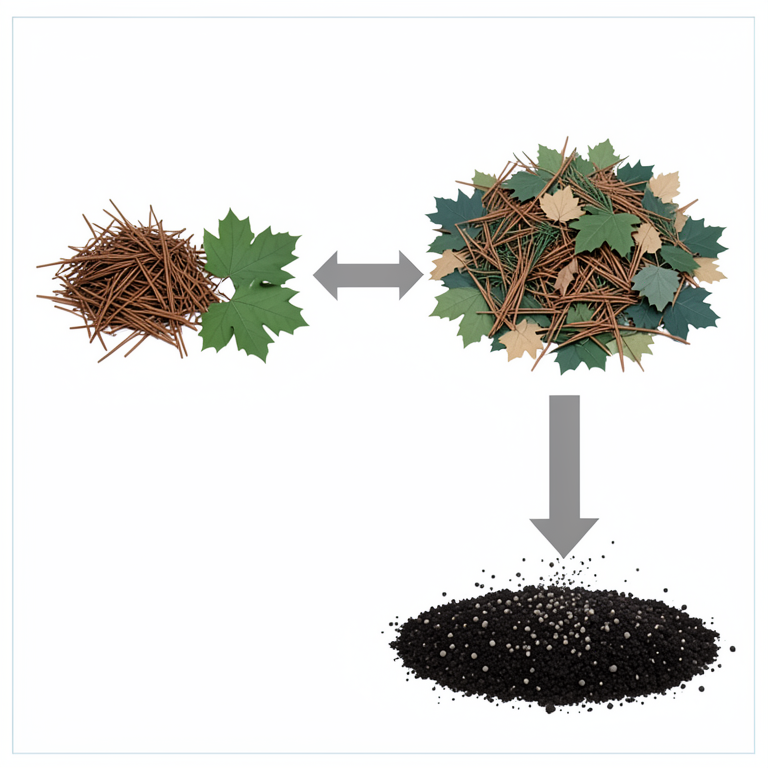
Synergistic Effect of Litter Mixing
AI-generated conceptual illustration (mixed pine needles and broadleaf maple leaves on a forest floor). It explains the idea and does not show study data.
View source evidence ↗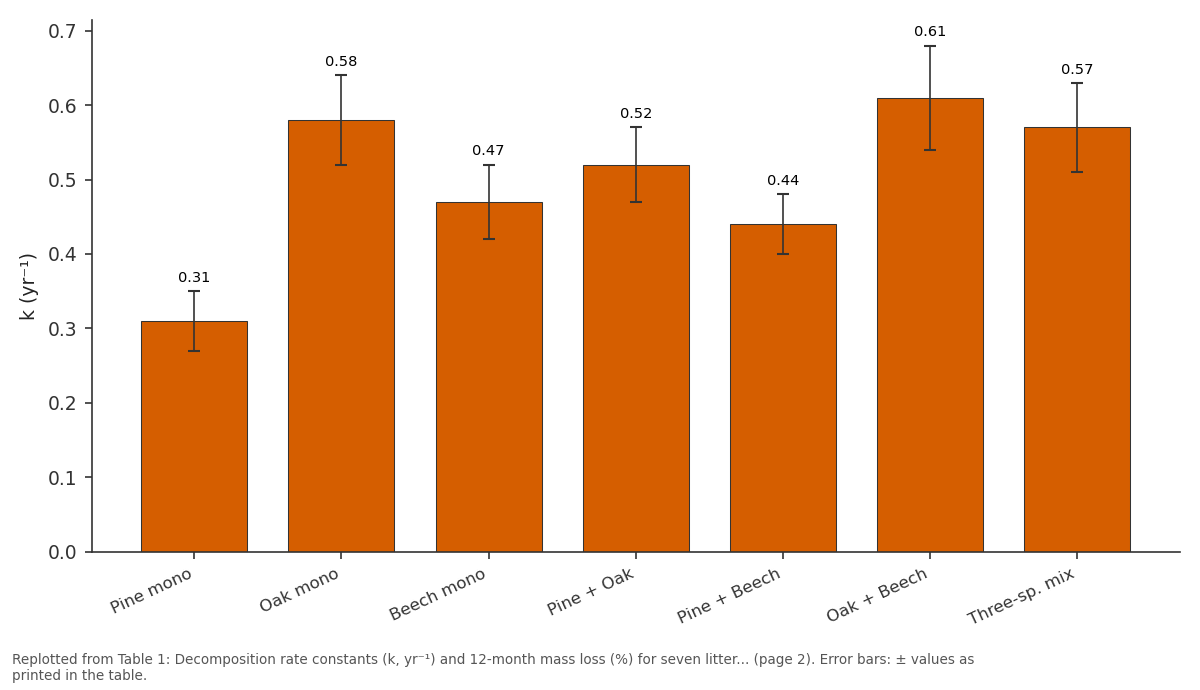
k (yr⁻¹): Pine mono vs Oak mono vs Beech mono vs Pine + Oak vs Pine + Beech
Replotted from Table 1 (page 2) of the original paper. Every bar is the paper's own table value.
View source evidence ↗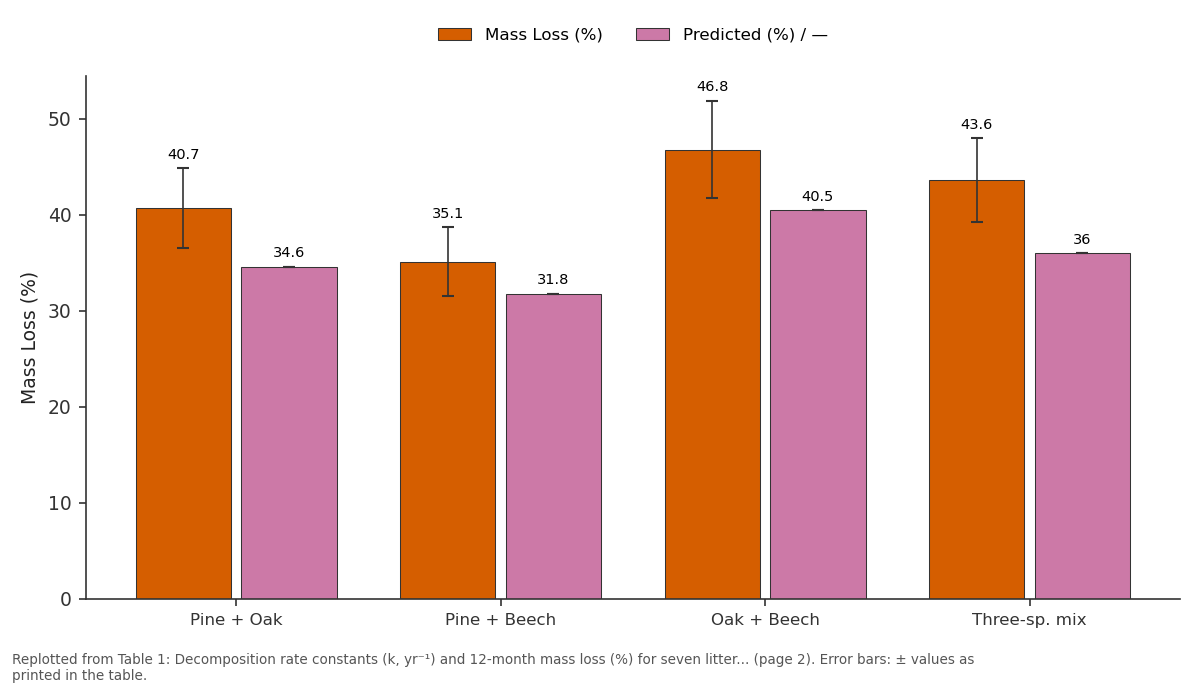
Mass Loss (%) and Predicted (%) /: Pine + Oak vs Pine + Beech vs Oak + Beech vs Three-sp. mix
Replotted from Table 1 (page 2) of the original paper. Every bar is the paper's own table value.
View source evidence ↗Figures & tables
From the original paper Table 1
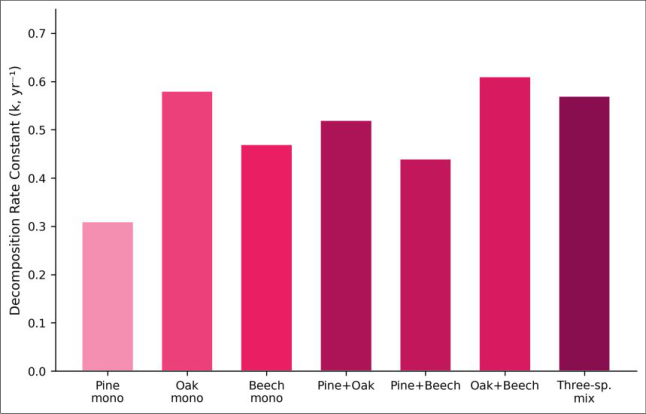 Figure 1
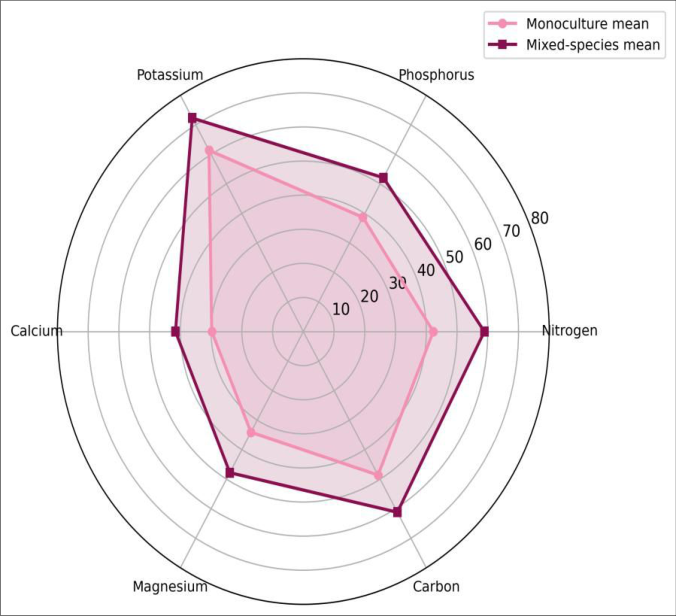 Figure 2
Introduction
A simple observation by foresters in mixed plantations sparked decades of ecological inquiry: leaf litter in mixed stands seemed to disappear faster than in monocultures. This observation has since been formalized as the "litter mixing effect" the phenomenon where decomposition of mixed-species litter deviates from predictions based on component species rates [1] . When the deviation is positive (faster than expected), it's attributed to synergistic interactions among litter types, including complementary nutrient content, improved moisture retention, and altered microbial community composition [2] . Plantation forests, which cover over 130 million hectares globally, have historically favored monocultures for ease of management and timber uniformity. But growing awareness of ecological limitations including slower nutrient cycling, pest vulnerability, and biodiversity loss has driven a shift toward mixed-species designs [3,4] . Understanding whether species mixing improves litter decomposition and nutrient return is directly relevant to plantation management decisions. The evidence so far is mixed: some combinations produce strong synergistic effects while others show no departure from additive expectations [5,6] . Central Anatolia, with its semi-arid continental climate, presents a particularly interesting test case. Low precipitation limits microbial activity, making decomposition rates highly sensitive to litter quality and microhabitat conditions [7] . The dominant plantation species in the region Pinus nigra, Quercus robur, and Fagus orientalis differ substantially in litter chemistry, with pine producing acidic, lignin-rich needles and oak and beech producing nutrient-richer broadleaves [8] . This research tested whether mixing these three litter types produces non-additive decomposition effects and whether nutrient release rates respond similarly. All field work was conducted at a plantation site managed by the Central Anatolian University of Life Sciences, Konya.
Study area description
The experimental site was a 15-year-old mixed plantation located 18 km south of Konya, Turkey (37°44′N, 32°30′E, elevation 1, 140 m). The climate is semi-arid continental with mean annual temperature of 11.6°C and precipitation of 327 mm, concentrated in winter and spring. Soil is a calcareous cambisol (pH 7.8, organic matter 2.3%, total N 0.14%). The plantation was established in 2006 with alternating rows of P. nigra, Q. robur, and F. orientalis at 3 × 3 m spacing. Canopy closure reached approximately 65% at the time of the experiment.
Material and Methods
Material and Methods
Material
This research was conducted at the Department of Ecology and Environmental Biology, Central Anatolian University of Life Sciences, Konya, Turkey, from October 2021 to October 2022. Freshly fallen leaf litter was collected from the plantation floor in September 2021, air-dried for two weeks, and sorted by species. Litterbags (20 × 20 cm, 1 mm nylon mesh) were filled with 10 g of air-dried litter in seven treatments: three monocultures (pine, oak, beech), three two-species mixtures (pine+oak, pine+beech, oak+beech at 5:5 g ratios), and one three-species mixture (3.33 g each).
Five replicate bags per treatment per harvest date (4 dates) yielded 140 bags deployed on the forest floor.
Methods
Bags were pinned to the soil surface in a randomized block design across five blocks. Retrievals occurred at 3, 6, 9, and 12 months. Retrieved bags were cleaned of adhering soil and root ingrowth, oven-dried at 65°C for 48 hours, and weighed. Mass loss was calculated as percentage of initial dry weight. Decomposition rate constants (k) were derived by fitting the single-exponential decay model: Mt/M0 = e^(-kt), where Mt is remaining mass at time t [9] . Subsamples were analyzed for total nitrogen (Kjeldahl), phosphorus (ascorbic acid-molybdenum blue), potassium (flame photometry), calcium, and magnesium (atomic absorption). Nutrient release was expressed as percentage of initial nutrient content lost. Non-additive effects were tested by comparing observed mixed-litter decomposition against predicted values (weighted averages of monoculture rates). Statistical analysis used repeated-measures ANOVA with Tukey's HSD in R v4.2.1 [10] .
Seasonal variations
Decomposition proceeded most rapidly during the March-June period (spring), when soil moisture from snowmelt combined with rising temperatures to create favorable microbial conditions. Over 45% of annual mass loss occurred during this three-month window. Summer months (July-September) showed minimal decomposition due to soil desiccation (volumetric moisture < 8%). Autumn rains partially restored decomposition activity, though declining temperatures limited the recovery. This strongly seasonal pattern meant that cumulative 12-month decomposition in Konya was lower than reported for humid temperate plantation sites with similar species [11] .
Results
Results
Comprehensive interpretation
The consistent positive non-additive effects across all mixed treatments ranging from 10.4% to 21.1% above predicted rates suggest that litter diversity genuinely accelerates decomposition in this semi-arid plantation system. The nutrient complementarity between nitrogen-poor pine litter and nitrogen-richer oak and beech litter likely drives part of this effect by relieving microbial nutrient limitation. The radar chart reveals that potassium showed the strongest mixing response, possibly because K is highly soluble and its release benefits from the improved moisture retention provided by mixed-species litter layers.
Discussion
The synergistic decomposition effects observed here align with the "nutrient transfer" hypothesis, which proposes that nutrients leaching from high-quality litter components can stimulate microbial activity on adjacent low-quality substrates [2,12] . Pine needles, with their high C:N ratio (~58:1) and recalcitrant lignin, decompose slowly in isolation because microbial decomposers face nitrogen limitation. When mixed with oak litter (C:N ~32:1) or beech litter (C:N ~37:1), nitrogen becomes locally available through leaching, removing the constraint [13] . The 21% synergistic effect for the three-species mixture is among the higher values reported for temperate plantation systems, where meta-analyses typically find 5-15% positive deviations [5] . The semi-arid climate may amplify the mixing effect because decomposition is more tightly nutrientlimited than in humid systems where moisture is the primary driver. The seasonal pattern with most decomposition concentrated in a three-month spring window also means that any factor accelerating early colonization and nutrient availability during that window has outsized effects on annual totals [14] . For plantation management in central Anatolia, these results argue that mixed-species designs deliver measurable benefits for nutrient cycling. The oakbeech combination, with the highest k value (0.61 yr⁻¹), may be particularly effective for accelerating nutrient return to soil in sites where pine monocultures currently dominate [15] .
Conclusion
This research demonstrates that leaf litter from mixedspecies treatments decomposed 10-21% faster than predicted from monoculture rates in a semi-arid Turkish plantation. Nutrient release followed the same synergistic pattern, with nitrogen, phosphorus, and potassium returning to the soil 24-38% faster from mixed litter. The oak-beech combination produced the highest decomposition rate, while the three-species mix generated the strongest non-additive effect. These findings support the adoption of mixed-species planting designs in central Anatolian plantations as a practical strategy for improving nutrient cycling and soil fertility. The strong seasonal constraint on decomposition in this climate underscores the importance of litter quality effects species mixing offers a management tool for maximizing nutrient return during the limited decomposition window.
Figures and tables from the paper
| Treatment | k (yr⁻¹) | Mass Loss (%) | Predicted (%) | Obs/Pred (%) |
|---|---|---|---|---|
| Pine mono | 0.31 ± 0.04 | 27.3 ± 3.1 | — | — |
| Oak mono | 0.58 ± 0.06 | 44.1 ± 4.7 | — | — |
| Beech mono | 0.47 ± 0.05 | 37.2 ± 3.8 | — | — |
| Pine + Oak | 0.52 ± 0.05 | 40.7 ± 4.2 | 34.6 | 117.6* |
| Pine + Beech | 0.44 ± 0.04 | 35.1 ± 3.6 | 31.8 | 110.4* |
| Oak + Beech | 0.61 ± 0.07 | 46.8 ± 5.1 | 40.5 | 115.6* |
| Three-sp. mix | 0.57 ± 0.06 | 43.6 ± 4.4 | 36.0 | 121.1* |
Table text extracted from the original PDF; superscript letters are shown inline. The original table image is below.
View original table image
References
18 in the original paper- Gartner TB, Cardon ZG. Decomposition dynamics in mixed-species leaf litter. Oikos. 2004;104(2):230-246.
- Hattenschwiler S, Tiunov AV, Scheu S. Biodiversity and litter decomposition in terrestrial ecosystems. Annual Review of Ecology Evolution and Systematics. 2005;36:191-218.
- Payn T, Carnus JM, Freer-Smith P, et al. Changes in planted forests and future global implications. Forest Ecology and Management. 2015;352:57-67.
- Brockerhoff EG, Barbaro L, Castagneyrol B, et al. Forest biodiversity, ecosystem functioning and the provision of ecosystem services. Biodiversity and Conservation. 2017;26(13):3005-3035.
- Lecerf A, Marie G, Kominoski JS, et al. Incubation time, functional litter diversity, and habitat characteristics predict litter-mixing effects on decomposition. Ecology. 2011;92(1):160-169.
- Vos VC, van Ruijven J, Berg MP, Peeters ET, Berendse F. Macro-detritivore identity drives leaf litter diversity effects. Oikos. 2013;122(7):1023-1032.
- Bocock KL, Gilbert OJ. The disappearance of leaf litter under different woodland conditions. Plant and Soil. 1957;9(2):179-185.
- Berg B, McClaugherty C. Plant litter: decomposition, humus formation, carbon sequestration. 3rd ed. Springer. 2014;1-315.
- Olson JS. Energy storage and the balance of producers and decomposers in ecological systems. Ecology. 1963;44(2):322-331.
- R Core Team. R: A language and environment for statistical computing. R Foundation for Statistical Computing. 2022.
- Gholz HL, Wedin DA, Smitherman SM, Harmon ME, Parton WJ. Long-term dynamics of pine and hardwood litter in contrasting environments: toward a global model of decomposition. Global Change Biology. 2000;6(7):751-765.
- Wardle DA, Bonner KI, Nicholson KS. Biodiversity and plant litter: experimental evidence which does not support the view that enhanced species richness improves ecosystem function. Oikos. 1997;79(2):247258.
- Prescott CE, Zabek LM, Staley CL, Kabzems R. Decomposition of broadleaf and needle litter in forests of British Columbia: influences of litter type, forest type, and litter mixtures. Canadian Journal of Forest Research. 2000;30(10):1742-1750.
- Aerts R. Climate, leaf litter chemistry and leaf litter decomposition in terrestrial ecosystems: a triangular relationship. Oikos. 1997;79(3):439-449.
- Paquette A, Messier C. The effect of biodiversity on tree productivity: from temperate to boreal forests. Global Ecology and Biogeography. 2011;20(1):170180.
- Cornelissen JH, Quested HM, Gwynn-Jones D, et al. Leaf digestibility and litter decomposability are related in a wide range of subarctic plant species and types. Functional Ecology. 2004;18(6):779-786.
- Hobbie SE, Reich PB, Oleksyn J, et al. Tree species effects on decomposition and forest floor dynamics in a common garden. Ecology. 2006;87(9):2288-2297.
- Vivanco L, Austin AT. Tree species identity alters forest litter decomposition through long-term plant and soil interactions in Patagonia, Argentina. Journal of Ecology. 2008;96(4):727-736.