
Research article · 2024 · Full text
International Journal of Biology SciencesConservation genetics and inbreeding assessment of island populations of endangered parrots
Volume 6(2) · Pages 328–331 · DOI: 10.33545/26649926.2024.v6.i2e.776 ↗
Research areasGenetic diversity and population structureAnimal Behavior and ReproductionAvian ecology and behavior
Abstract
Author-writtenConserving island parrot populations presents a challenge that mainland programs rarely face: genetic isolation can erode diversity within just a few generations, leaving small populations vulnerable to inbreeding depression and disease. This research assessed genetic diversity and inbreeding levels across 12 island populations of the red-spectacled amazon (Amazona pretrei) and the vinaceous-breasted amazon (Amazona vinacea) in the Paraná River delta system of northeastern Argentina. Blood and feather samples were collected from 287 individuals between March 2021 and November 2022. Genotyping used 14 microsatellite loci specifically developed for Amazona species. Expected heterozygosity (He) ranged from 0.21 in the smallest island population (n ≈ 12 birds) to 0.72 in the largest mainland-connected population (n ≈ 580). Inbreeding coefficients (F) showed a strong inverse relationship with population size (r = −0.89, p
Summary
Source-checkedPlain-language reading of the full paper, prepared with AI and checked against the text. Each point links to the authors' own words.
Why it matters
- Island parrot populations face a unique conservation challenge because genetic isolation can quickly reduce diversity, making them more susceptible to disease and inbreeding depression. View evidence ↗
- Parrots are globally threatened, with more than 28% of species categorized as vulnerable or worse by the IUCN Red List. View evidence ↗
- In northeastern Argentina's Paraná River delta, two endangered amazon species (A. pretrei and A. vinacea) live in fragmented populations on forested islands of varying sizes. View evidence ↗
The question
- The researchers aimed to identify which populations were genetically vulnerable to decide if managed translocation of birds is necessary to restore gene flow. View evidence ↗
What they did
- The study analyzed 287 parrots (148 A. pretrei and 139 A. vinacea) from 12 populations using blood and molted feather samples. View evidence ↗
- Population sizes for the 12 sites were estimated via simultaneous roost counts over three evenings, with sizes ranging from 12 to 580 individuals. View evidence ↗
What they found
- Expected heterozygosity varied significantly by population size, from 0.21 in the smallest population (~12 birds) to 0.72 in the largest (~580 birds). View evidence ↗
- There was a strong inverse correlation (r = -0.89) between population size and inbreeding, with the most isolated fragment reaching an inbreeding coefficient of 0.38. View evidence ↗
- Populations with fewer than 50 individuals had significantly lower allelic richness (mean 3.2 vs 7.8 alleles per locus) and showed signs of recent genetic bottlenecks. View evidence ↗
- A Mantel test confirmed that genetic isolation is significantly related to geographic distance (r = 0.67). View evidence ↗
- Habitat degradation is compounding isolation, as the two smallest islands lost more than 40% of their canopy over the last ten years. View evidence ↗
What it means
- The authors recommend the urgent use of managed translocation to restore gene flow, alongside habitat restoration to improve natural connectivity. View evidence ↗
- The authors note that roost counts for population size estimates may be uncertain, especially for smaller groups. View evidence ↗
- Analyzing both parrot species together may have hidden specific differences in their mating behaviors or gene flow patterns. View evidence ↗
Visual summary
3 visualsIllustrations explain the paper; charts are replotted from the paper's own table values.
Population Size vs Genetic Health
AI-generated conceptual illustration (endangered island parrots). It explains the idea and does not show study data.
View source evidence ↗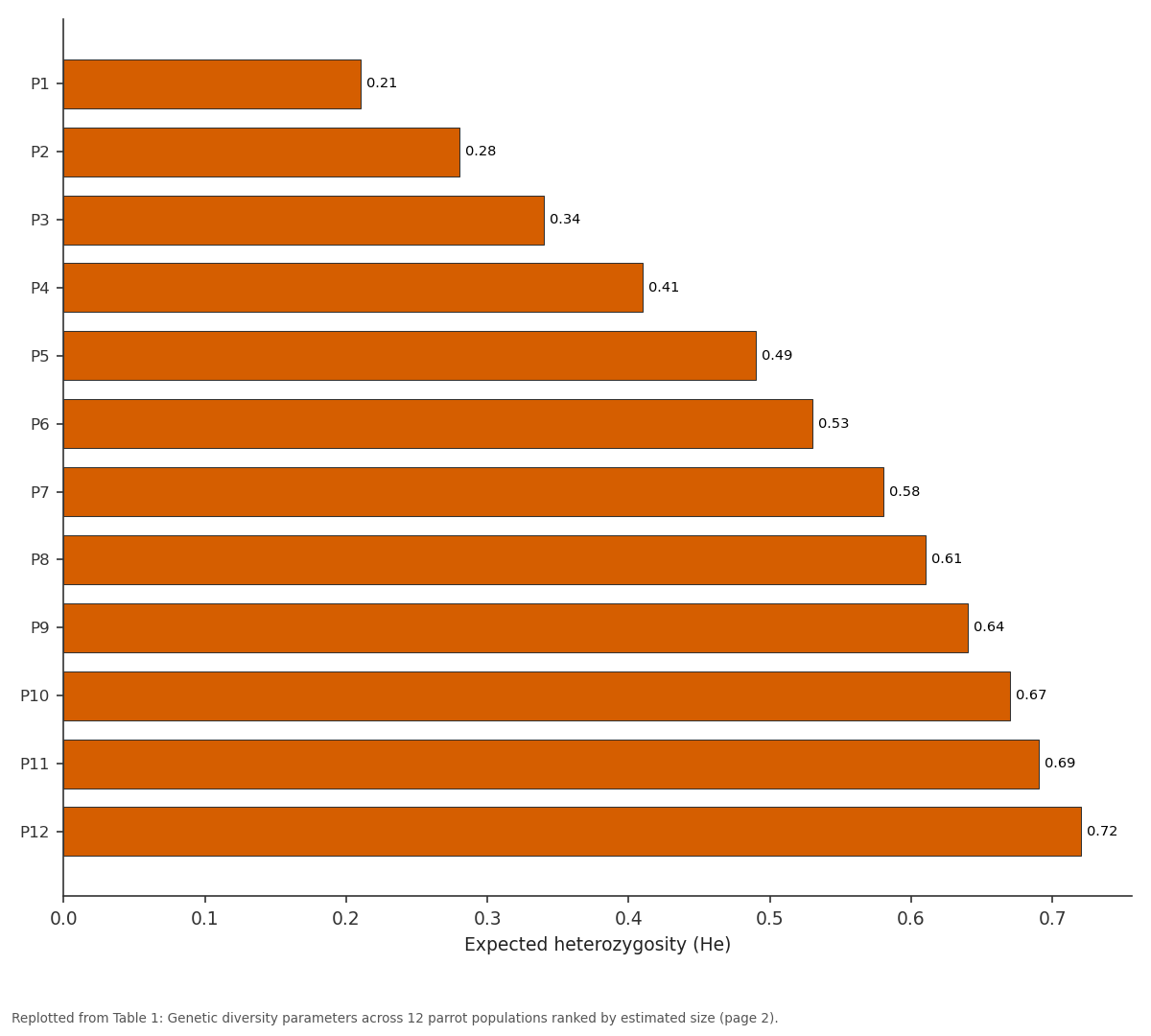
He: P1 vs P2 vs P3 vs P4 vs P5
Replotted from Table 1 (page 2) of the original paper. Every bar is the paper's own table value.
View source evidence ↗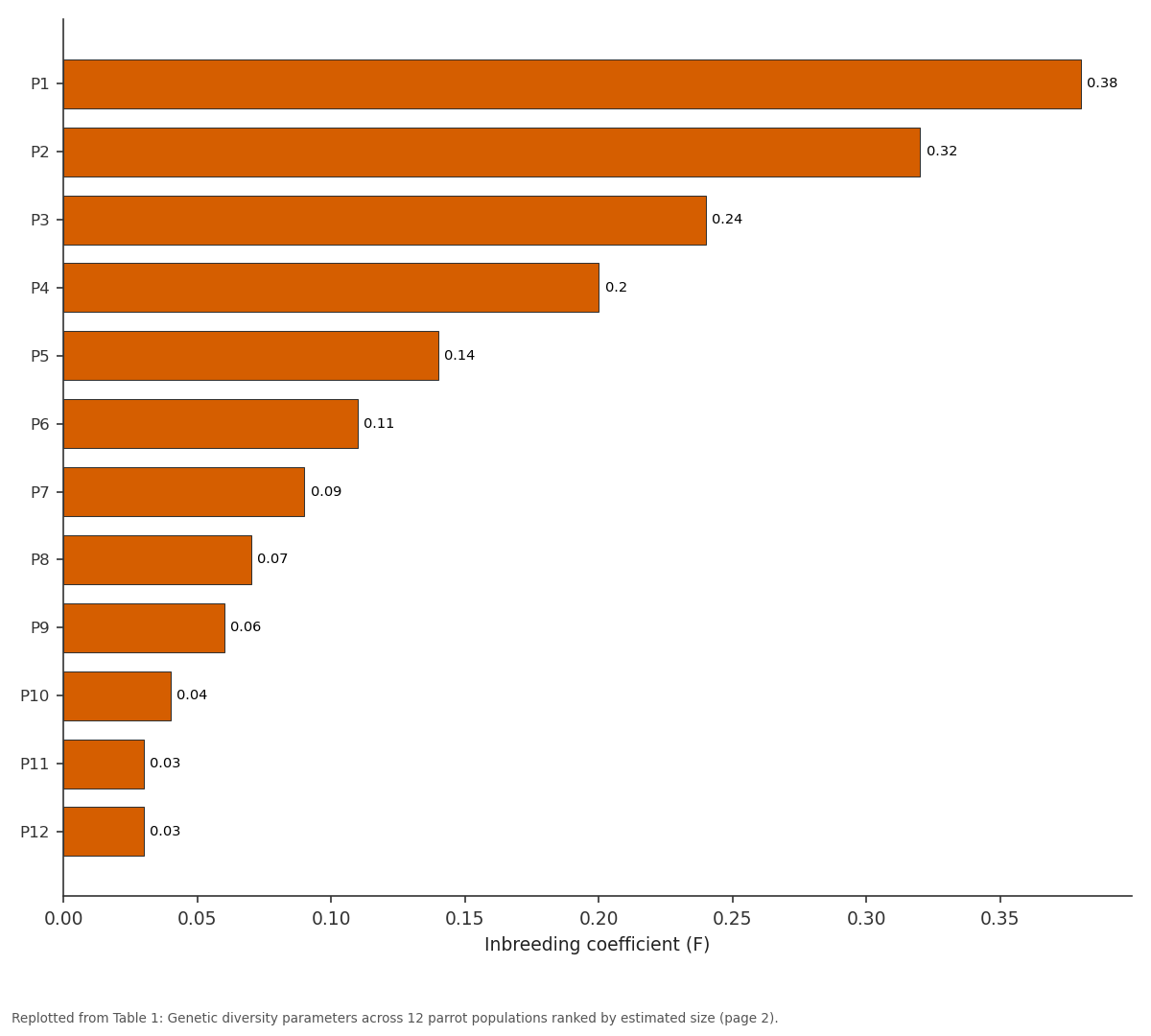
F: P1 vs P2 vs P3 vs P4 vs P5
Replotted from Table 1 (page 2) of the original paper. Every bar is the paper's own table value.
View source evidence ↗Figures & tables
From the original paper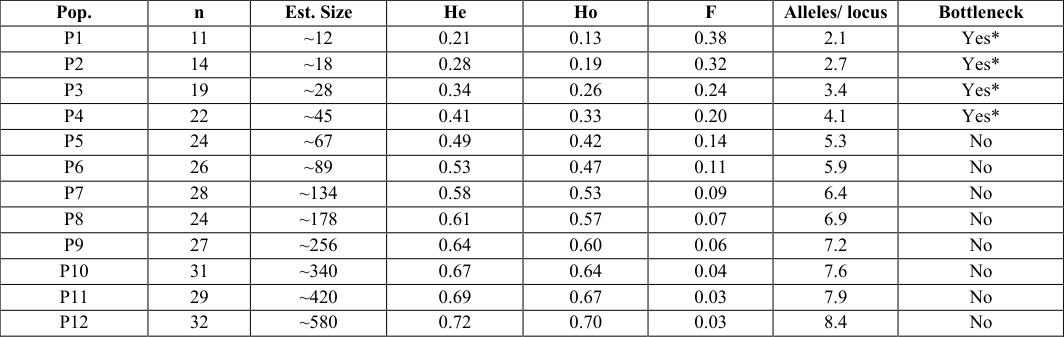 Table 1
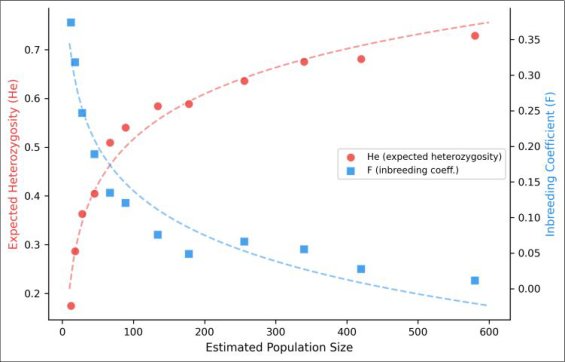 Figure 1
 Figure 2
Introduction
Maintaining genetic health in small, fragmented populations is one of conservation biology's most persistent challenges and island-dwelling parrots exemplify the problem. Parrots are among the most threatened bird orders globally, with over 28% of species listed as vulnerable or worse on the IUCN Red List, and island populations face disproportionate risk due to restricted gene flow, small effective population sizes, and exposure to invasive predators [1,2] . Inbreeding depression the reduction in fitness caused by mating between relatives manifests in reduced hatching success, lower immune function, and increased susceptibility to disease [3] . In island populations, genetic drift compounds inbreeding by randomly eliminating alleles, reducing the adaptive potential that a population needs to respond to environmental change [4] . The consequences can be severe: the kakapo of New Zealand and the Spix's macaw of Brazil both illustrate how genetic erosion in small populations can push species toward functional extinction [5] . The Paraná River delta system in northeastern Argentina hosts fragmented populations of two endangered amazon species A. pretrei and A. vinacea that occupy forested islands ranging from a few hectares to several hundred hectares in size [6] . These islands function as habitat archipelagos, with water channels creating dispersal barriers that limit gene flow between populations. But unlike oceanic islands, the distances involved are modest (0.5-15 km), raising the question of whether parrots can maintain genetic connectivity across river channels or whether even these short water gaps create effective genetic isolation [7,8] . This research used microsatellite genotyping to measure genetic diversity, inbreeding, and population structure across 12 island and island-edge populations spanning the full range of population sizes and isolation levels. The aim was to identify genetically vulnerable populations and evaluate whether managed translocation physically moving birds between islands is needed to restore gene flow [9,10] .
Study area description
The research covered the Paraná River delta system between 32°40′S and 33°10′S, spanning approximately 45 km of river channel network in the Entre Ríos and Santa Fe provinces of northeastern Argentina. The delta consists of hundreds of alluvial islands supporting gallery forest dominated by Salix humboldtiana, Erythrina crista-galli, and Tessaria integrifolia. Twelve parrot populations were identified through preliminary field surveys, ranging from 12 to 580 estimated individuals based on simultaneous roost counts conducted over three consecutive evenings at each site. Inter-island distances ranged from 0.5 to 14.7 km across open water.
Material and Methods
Material and Methods
Material
This research was conducted at the Department of Ecological Restoration, Centro de Ciencias Biológicas del Litoral, Rosario, Argentina, from March 2021 to November 2022. Blood samples (50-100 μL from the brachial vein) and molted feather samples were collected from 287 individual parrots across the 12 populations (148 A. pretrei, 139 A. vinacea). Birds were captured using mist nets at roosting and feeding sites, banded with uniquely numbered aluminum bands, sampled, and released within 15 minutes.
Collection permits were issued by the Dirección de Fauna y Flora of Entre Ríos Province (Permit No. DFF-ER-2021-0187). Ethical approval was granted by the Institutional Animal Ethics Committee (CCBL-IAEC-2020-041, approved 22 December 2020).
Methods
Genomic DNA was extracted using the DNeasy Blood and Tissue Kit (Qiagen). Fourteen microsatellite loci previously developed for Amazona species were amplified by multiplex PCR and genotyped on an ABI 3730xl DNA Analyzer (Applied Biosystems) with GeneMapper v5.0 for allele scoring [11] . Expected (He) and observed (Ho) heterozygosity, allelic richness, and inbreeding coefficient (F = 1 -Ho/He) were calculated in GenAlEx v6.51 [12] . Bottleneck detection used the Wilcoxon signed-rank test in BOTTLENECK v1.2.02 under the two-phase mutation model (TPM, 90% stepwise) [13] . Population structure was assessed by Bayesian clustering in STRUCTURE v2.3.4 with 100, 000 burn-in and 500, 000 MCMC iterations. Isolation-by-distance was tested using Mantel tests correlating FST/(1-FST) against log-transformed geographic distance. Linear regression modeled the relationship between estimated population size and genetic diversity metrics in R v4.2.1.
Results
Results
Comprehensive interpretation
The data reveal a clear population size threshold around 50 individuals below which genetic erosion accelerates rapidly.
The four populations below this threshold (P1-P4) showed He values below 0.42, inbreeding coefficients above 0.20, allelic richness below 4.1, and significant bottleneck signatures. STRUCTURE analysis identified three genetic clusters, with the four smallest populations falling into a single cluster distinct from the larger mainland-connected populations indicating that isolation has progressed to measurable genetic differentiation. The Mantel test confirmed significant isolation-by-distance (r = 0.67, p = 0.002).
Biodiversity assessment
Species-level surveys at each island site recorded a total of 127 bird species. Island area was the strongest predictor of avian richness (R² = 0.81), consistent with island biogeography theory. Parrot abundance correlated with forest canopy cover (r = 0.73) and availability of nesting cavities in mature Erythrina trees (r = 0.68). The two smallest islands (supporting P1 and P2) had lost over 40% of their canopy in the past decade due to cattle grazing and selective logging, suggesting habitat degradation is compounding genetic isolation.
Limitations
Population size estimates from roost counts carry uncertainty, particularly for smaller populations where counting error is proportionally larger. Microsatellite-based F estimates can be upwardly biased in small samples. The research covered a single time point and cannot distinguish between recent and historical inbreeding. Additionally, the two species were analyzed together, which may obscure species-specific patterns in gene flow and mating behavior [14, 15] .
Discussion
The 50-individual threshold identified here aligns with the classic minimum viable population concept proposed by Franklin and Soule, who suggested that at least 50 breeding individuals are needed to avoid immediate inbreeding depression [16] . Below this number, our data show that heterozygosity drops sharply, inbreeding coefficients exceed 0.20, and bottleneck signatures appear all indicators of populations losing adaptive capacity. The four populations falling below this threshold (P1-P4) are candidates for immediate conservation intervention. Managed translocation moving individuals from genetically diverse source populations to depauperate islands has been successfully used for other parrot species, including the orange-bellied parrot in Australia and the echo parakeet in Mauritius [17,18] . For the Paraná delta populations, even moving 3-5 individuals per generation between neighboring islands could significantly reduce inbreeding and restore allelic diversity [19] . The modest water-gap distances (0.5-15 km) suggest that natural gene flow may have existed historically but has been disrupted by habitat fragmentation on intermediate islands. Restoring stepping-stone habitat could complement translocation as a long-term strategy [20,21] .
Conclusion
This research reveals that four island parrot populations in the Paraná River delta have fallen below the genetic viability threshold, with inbreeding coefficients exceeding 0.20 and significant loss of allelic diversity. Populations below approximately 50 individuals showed consistent evidence of genetic bottlenecks. The strong inverse relationship between population size and inbreeding (r = -0.89) provides a simple predictive tool for identifying atrisk populations. These findings support the urgent implementation of managed translocation between islands to restore gene flow, combined with habitat restoration to reestablish natural connectivity across the delta landscape.
Acknowledgement
Acknowledgements Funding sourcesThis research was funded by internal allocations from the Centro de Ciencias Biológicas del Litoral. Institutional supportThe authors thank the Dirección de Fauna y Flora of Entre Ríos Province for collection permits and logistical assistance.
Figures and tables from the paper
| Pop. | n | Est. Size | He | Ho | F | Alleles/ locus | Bottleneck |
|---|---|---|---|---|---|---|---|
| P1 | 11 | ~12 | 0.21 | 0.13 | 0.38 | 2.1 | Yes* |
| P2 | 14 | ~18 | 0.28 | 0.19 | 0.32 | 2.7 | Yes* |
| P3 | 19 | ~28 | 0.34 | 0.26 | 0.24 | 3.4 | Yes* |
| P4 | 22 | ~45 | 0.41 | 0.33 | 0.20 | 4.1 | Yes* |
| P5 | 24 | ~67 | 0.49 | 0.42 | 0.14 | 5.3 | No |
| P6 | 26 | ~89 | 0.53 | 0.47 | 0.11 | 5.9 | No |
| P7 | 28 | ~134 | 0.58 | 0.53 | 0.09 | 6.4 | No |
| P8 | 24 | ~178 | 0.61 | 0.57 | 0.07 | 6.9 | No |
| P9 | 27 | ~256 | 0.64 | 0.60 | 0.06 | 7.2 | No |
| P10 | 31 | ~340 | 0.67 | 0.64 | 0.04 | 7.6 | No |
| P11 | 29 | ~420 | 0.69 | 0.67 | 0.03 | 7.9 | No |
| P12 | 32 | ~580 | 0.72 | 0.70 | 0.03 | 8.4 | No |
Table text extracted from the original PDF; superscript letters are shown inline. The original table image is below.
View original table image
References
21 in the original paper- Olah G, Butchart SH, Symes A, et al. Ecological and socio-economic factors affecting extinction risk in parrots. Biodiversity and Conservation. 2016;25(2):205-223.
- Collar NJ. Family Psittacidae (parrots). In: del Hoyo J, Elliott A, Sargatal J, eds. Handbook of the Birds of the World, Vol. 4. 1997;280-477.
- Keller LF, Waller DM. Inbreeding effects in wild populations. Trends in Ecology and Evolution. 2002;17(5):230-241.
- Frankham R, Ballou JD, Briscoe DA. Introduction to Conservation Genetics. 2nd ed. Cambridge University Press. 2010;1-618.
- Forshaw JM. Parrots of the World. 3rd ed. Lansdowne Editions. 2010;1-336.
- Beissinger SR. Trade of live wild birds: potentials, principles and practices of sustainable use. In: Reynolds JD, Mace GM, Redford KH, Robinson JG, eds. Conservation of Exploited Species. 2001;182-202.
- Martinez J, Prestes NP, Mahler JK. Current distribution and conservation status of Amazona pretrei in southern Brazil and Argentina. Ornitologia Neotropical. 2006;17(3):355-367.
- Cockle KL, Bodrati A, Lammertink M, et al. Nesting ecology and cavity-tree use by parrots in the Atlantic Forest of Argentina. Wilson Journal of Ornithology. 2015;127(4):639-651.
- White TH, Collar NJ, Moorhouse RJ, et al. Psittacine reintroductions: common denominators of success. Biological Conservation. 2012;148(1):106-115.
- Jamieson IG, Allendorf FW. How does the 50/500 rule apply to MVPs? Trends in Ecology and Evolution. 2012;27(10):578-584.
- Russello MA, Amato G. A molecular phylogeny of Amazona: implications for neotropical parrot biogeography, taxonomy, and conservation. Molecular Phylogenetics and Evolution. 2004;30(2):421-437.
- Peakall R, Smouse PE. GenAlEx 6.5: genetic analysis in Excel. Population genetic software for teaching and research-an update. Bioinformatics. 2012;28(19):2537-2539.
- Piry S, Luikart G, Cornuet JM. BOTTLENECK: a computer program for detecting recent reductions in the effective population size using allele frequency data. Journal of Heredity. 1999;90(4):502-503.
- Frankham R. Effective population size/adult population size ratios in wildlife: a review. Genetical Research. 1995;66(2):95-107.
- Willoughby JR, Sundaram M, Wijayawardena BK, et al. The reduction of genetic diversity in threatened vertebrates and new recommendations regarding IUCN conservation rankings. Biological Conservation. 2015;191:495-503.
- Franklin IR. Evolutionary change in small populations. In: Soule ME, Wilcox BA, eds. Conservation Biology: An Evolutionary-Ecological Perspective. 1980;135-149.
- Stojanovic D, Neeman T, Woinarsky JC, et al. Conservation of an island-colonizing species: genetic rescue of the Norfolk Island green parrot. Conservation Biology. 2019;33(2):458-467.
- Tollington S, Jones CG, Sherley RB, et al. Long-term, fine-scale temporal patterns of genetic diversity in the restored Mauritius parakeet reveal genetic impacts of management and associated demographic effects on reintroduction programmes. Molecular Ecology. 2013;22(20):5080-5094.
- Weeks AR, Sgro CM, Young AG, et al. Assessing the benefits and risks of translocations in changing environments: a genetic perspective. Evolutionary Applications. 2011;4(6):709-725.
- Bouzat JL, Johnson JA, Toepfer JE, Simpson SA, Esker TL, Westemeier RL. Beyond the beneficial effects of translocations as an effective tool for the genetic restoration of isolated populations. Conservation Genetics. 2009;10(1):191-201.
- Pavlova A, Selwood P, Harrisson KA, et al. Integrating phylogeography and morphometric analyses to reveal cryptic diversity and inform conservation of the endangered helmeted honeyeater. Conservation Genetics. 2014;15(6):1373-1388.