
Research article · 2025 · Full text
International Journal of Biology SciencesSoil seed bank composition and regeneration potential in disturbed tropical dry forests
Volume 7(10) · Pages 212–215 · DOI: 10.33545/26649926.2025.v7.i10c.792 ↗
Research areasEcology and Vegetation Dynamics StudiesSeed Germination and PhysiologySeedling growth and survival studies
Abstract
Author-writtenTropical dry forests rank among the most threatened terrestrial ecosystems globally, yet their capacity for self-repair after disturbance depends heavily on what lies buried in the soil. The seed bank is the hidden reservoir from which regeneration begins once canopy removal, fire, or grazing ceases. This research assessed the composition, density, and vertical distribution of the soil seed bank across four disturbance categories in a tropical dry forest fragment near Manila, Philippines. Soil samples were collected from 48 plots at three depth intervals (0-5, 5-10, and 10-15 cm) during both wet and dry seasons between May 2023 and March 2024. Samples were spread in a greenhouse and monitored for seedling emergence over 16 weeks. A total of 8,741 seedlings representing 83 species germinated, with grasses and herbaceous pioneers dominating heavily disturbed plots (72.4% of germinants) and woody species more common in undisturbed forest soils (38.7%). Seed density ranged from 347 seeds/m² in undisturbed forest to 1,024 seeds/m² in heavily disturbed areas, but species richness showed the opposite pattern. The top 0-5 cm layer held 64.3% of all viable seeds. Seasonal comparison revealed 31% higher germination from wet-season samples than dry-season collections. These results indicate that while disturbed tropical dry forests retain a seed bank capable of initiating recovery, the dominance of ruderal species suggests that passive regeneration alone may not restore original tree composition. Active planting of native tree species alongside natural seed bank recruitment would likely accelerate recovery toward a more structurally complete forest.
Summary
Source-checkedPlain-language reading of the full paper, prepared with AI and checked against the text. Each point links to the authors' own words.
Why it matters
- Tropical dry forests are among the world's most threatened terrestrial ecosystems, and their ability to recover from disturbance depends on the soil seed bank. View evidence ↗
- There is a regional data gap regarding seed banks in Philippine dry forests, as most Southeast Asian research has focused on Myanmar and Thailand. View evidence ↗
What they did
- The study was conducted in a 230-hectare dry forest fragment in Bataan, located about 85 km northwest of Manila at elevations between 40 and 160 m. View evidence ↗
- The researchers categorized disturbance into four levels based on canopy cover: undisturbed (>80%), lightly disturbed (60-80%), moderately disturbed (30-60%), and heavily disturbed (<30%). View evidence ↗
- Between May 2023 and March 2024, soil cores (7.5 cm diameter) were taken from 48 plots (12 per category) at depths of 0-5, 5-10, and 10-15 cm. View evidence ↗
- Pooled soil samples were spread in greenhouse trays over sterile vermiculite and monitored for seedling emergence and identification weekly for 16 weeks. View evidence ↗
What they found
- Seed density increased significantly with disturbance intensity, ranging from 347 seeds/m² in undisturbed forests to 1,024 seeds/m² in heavily disturbed areas, primarily due to more grass and herbaceous seeds. View evidence ↗
- Species richness decreased as disturbance increased, with the highest richness in the 0-5 cm layer of undisturbed forests (22 species) and the lowest in heavily disturbed plots (13 species). View evidence ↗
- The proportion of woody species in the top soil layer decreased from 38.7% in undisturbed areas to 8.4% in heavily disturbed areas. View evidence ↗
- The majority of viable seeds were found in the shallowest soil layer (0-5 cm), which contained 64.3% of all seeds, compared to 24.8% in the 5-10 cm layer and 10.9% in the 10-15 cm layer. View evidence ↗
- Samples collected during the wet season produced 31% more seedlings than those from the dry season, particularly among small-seeded pioneer species. View evidence ↗
- Undisturbed and heavily disturbed plots shared fewer than a third of their seed bank species, with a Sørensen similarity index of only 0.28. View evidence ↗
- Heavily disturbed soils were dominated by aggressive invasive species: Imperata cylindrica (92% of plots), Chromolaena odorata (83%), and Lantana camara (71%). View evidence ↗
What it means
- The authors conclude that while the seed bank can provide quick ground cover, it is unlikely to restore the original native tree composition without active intervention. View evidence ↗
- The authors recommend that conservation managers use enrichment planting of native trees and invasive species control to support natural regeneration. View evidence ↗
- Because over 64% of viable seeds are in the top 5 cm of soil, the authors advise against deep plowing or topsoil removal. View evidence ↗
Visual summary
3 visualsIllustrations explain the paper; charts are replotted from the paper's own table values.
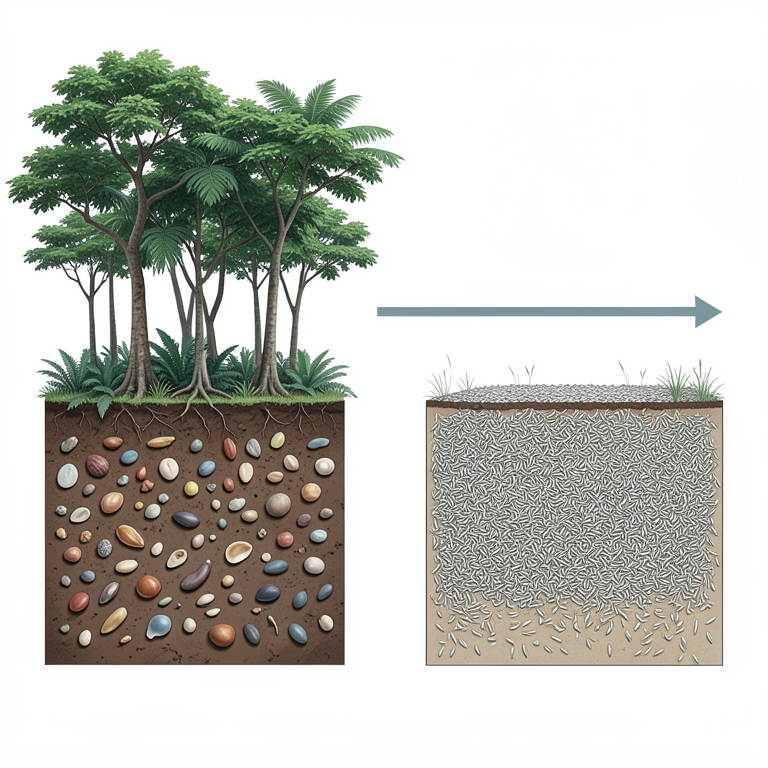
Disturbance vs. Seed Bank Quality
AI-generated conceptual illustration (Tropical dry forest soil profiles). It explains the idea and does not show study data.
View source evidence ↗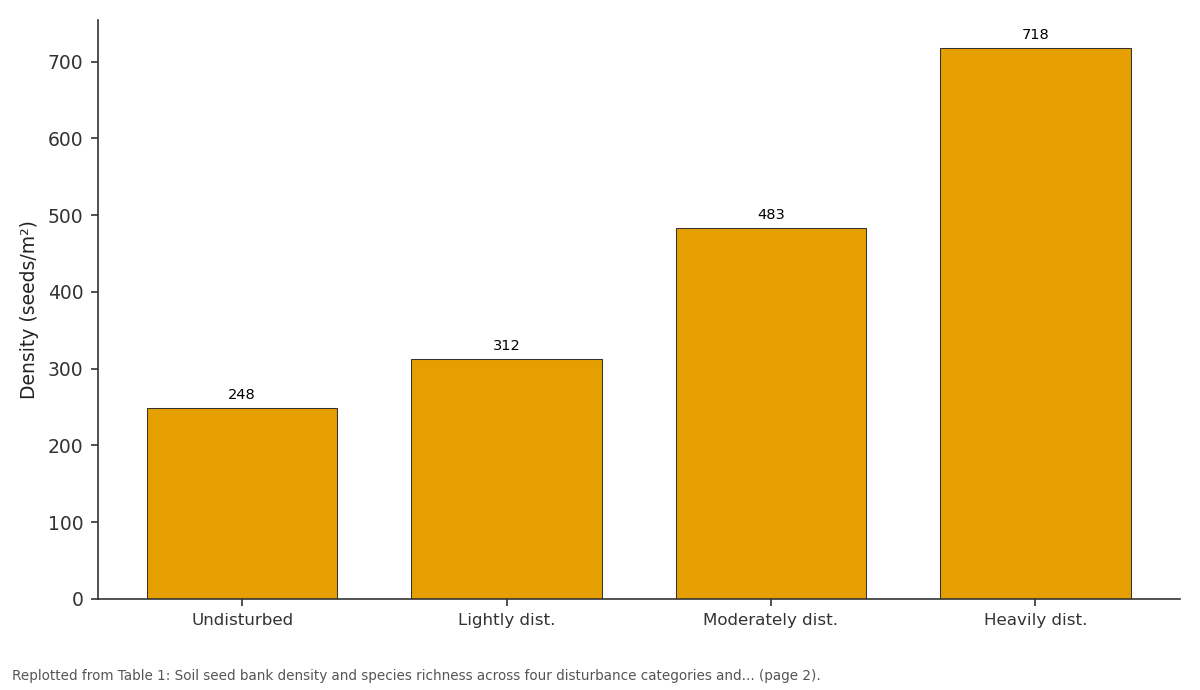
Density: Undisturbed vs Lightly dist. vs Moderately dist. vs Heavily dist.
Replotted from Table 1 (page 2) of the original paper. Every bar is the paper's own table value.
View source evidence ↗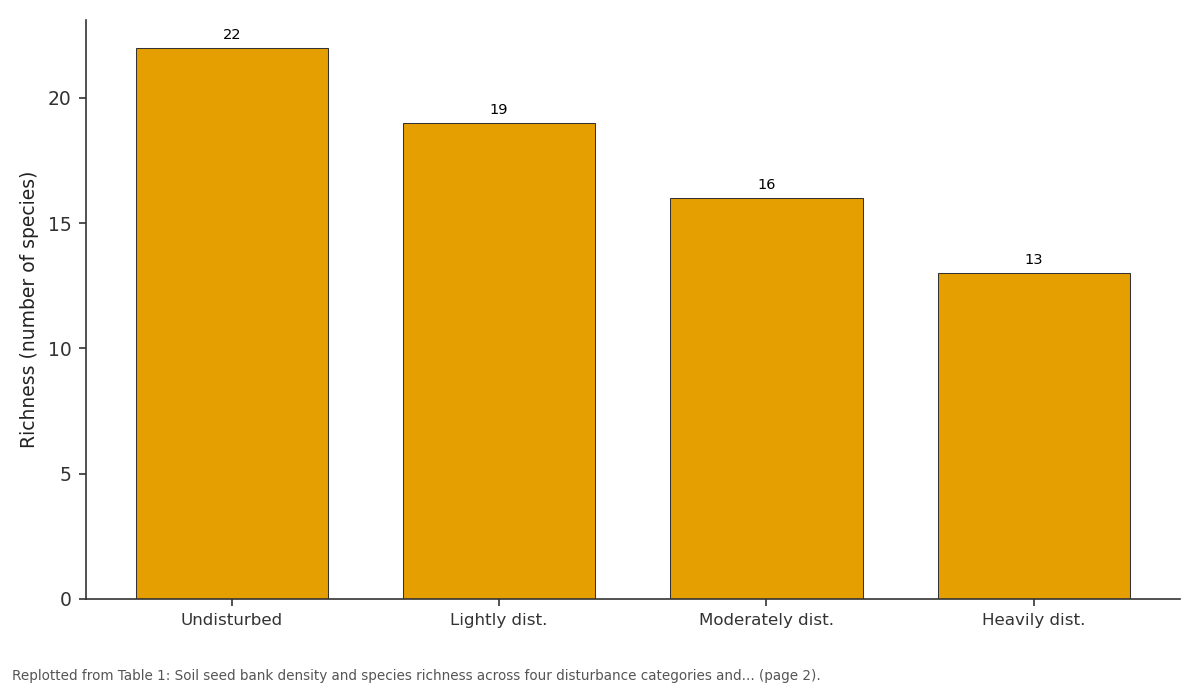
Richness: Undisturbed vs Lightly dist. vs Moderately dist. vs Heavily dist.
Replotted from Table 1 (page 2) of the original paper. Every bar is the paper's own table value.
View source evidence ↗Figures & tables
From the original paper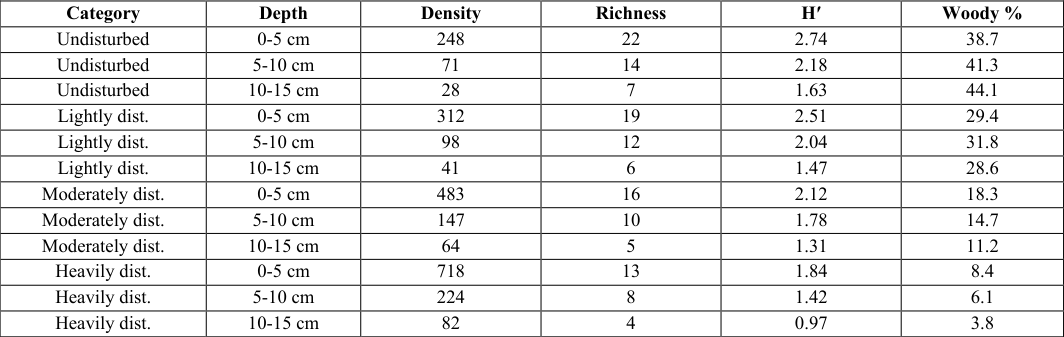 Table 1
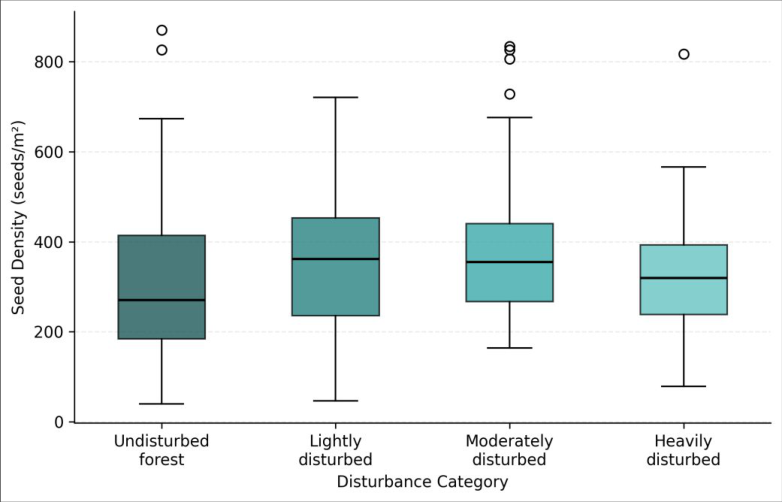 Figure 1
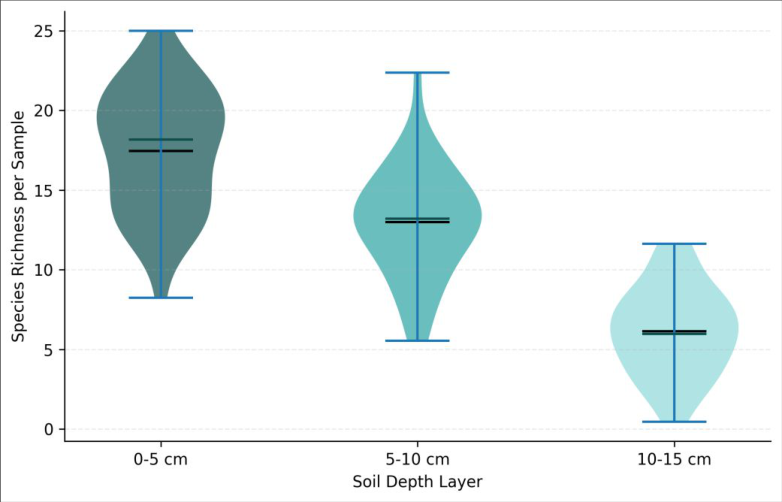 Figure 2
Introduction
A soil seed bank is the pool of viable but ungerminated seeds present in the soil at any given moment, and it represents the first line of ecological defense when vegetation above ground is damaged or destroyed [1] . In tropical dry forests, where up to six months of annual drought already impose strong selective filters on plant establishment, the seed bank takes on added importance because seedlings must emerge and anchor themselves before the next dry season arrives [2] . The Philippines lost an estimated 93% of its original dry forest cover during the twentieth century to agriculture, fuelwood harvesting, and urban expansion [3] . Remaining fragments are under continued pressure from edge effects, invasive species, and periodic burning. Whether these remnants can bounce back after disturbance stops depends largely on what seeds survive in the soil and whether those seeds belong to species capable of rebuilding forest structure [4] . Previous seed bank research in Southeast Asian dry forests has focused mainly on Thailand and Myanmar, with very little data from the Philippine archipelago [5] . The few Philippine surveys available examined lowland dipterocarp forests rather than the seasonally dry formations found on western Luzon and the Visayas. And because seed bank composition shifts with disturbance intensity pioneer species increase while shade-tolerant trees decline findings from undisturbed forests cannot simply be extrapolated to degraded sites [6] . This research was designed to fill that regional gap. We sampled the soil seed bank across four disturbance levels in a 230-hectare dry forest fragment, recorded germination over 16 weeks in a greenhouse, and compared wet-season versus dry-season seed bank composition. Our questions were: c) What proportion of the seed bank consists of woody species capable of contributing to canopy regeneration [7] ?
Study area description
Study area description
Methods
In the greenhouse, each pooled soil sample was spread to a depth of 2 cm over a 3 cm layer of sterile vermiculite in plastic germination trays (35 × 25 cm). Trays were watered daily to field capacity and maintained under natural light with shade cloth reducing irradiance by 30%. Emerging seedlings were counted and identified weekly for 16 weeks.
Seedlings that could not be identified at the cotyledon stage were transplanted and grown until diagnostic features appeared. Control trays filled with sterile vermiculite only were included to check for greenhouse contamination; fewer than 4 seedlings appeared in controls across all batches [8] . Species were classified into life-form categories: grasses, herbaceous forbs, woody pioneers, and woody non-pioneers. Seed density was expressed as seeds/m² by extrapolating core area. Species richness, Shannon diversity (H′), and
Sørensen similarity between disturbance classes were calculated. Differences in seed density and richness among disturbance levels and depths were tested with two-way ANOVA followed by Tukey HSD in R v4.3.2 [9] .
Seasonal Variations
Wet-season collections (July 2023) coincided with the peak fruiting period of most canopy tree species in the fragment, while dry-season collections (February 2024) followed five months of negligible rainfall. Mean soil moisture at the time of wet-season sampling was 34.8% (gravimetric), compared with 11.2% during the dry-season campaign. Temperature in the top 5 cm averaged 26.1°C in July and 28.7°C in February. These contrasting conditions allowed assessment of whether seed viability and composition differ between the two seasonal extremes. Seed density increased with disturbance intensity (F₃,₄₄ = 24.7, p<0.001), driven by a proliferation of grass and herbaceous forb seeds in open areas. But species richness moved in the opposite direction, peaking in undisturbed forest (22 species in the 0-5 cm layer) and declining to 13 species in heavily disturbed plots. The proportion of woody species in the seed bank dropped from 38.7% in undisturbed to 8.4% in heavily disturbed top-layer samples. Depth stratification was consistent across all categories: the 0-5 cm layer contained 64.3% of all viable seeds, the 5-10 cm layer held 24.8%, and the 10-15 cm layer accounted for 10.9%. Wet-season samples produced 31% more seedlings than dry-season samples overall, with the difference most pronounced for small-seeded pioneer species. Sørensen similarity between undisturbed and heavily disturbed plots was only 0.28, indicating that the two extremes share fewer than a third of their seed bank species. The most frequently encountered species in heavily disturbed soils were Imperata cylindrica (present in 92% of plots), Chromolaena odorata (83%), and Lantana camara (71%) all aggressive invaders that suppress native seedling establishment [10] .
Results
Results
Discussion
The inverse relationship between seed density and species richness across disturbance levels is a pattern reported in
International Journal of Biology Sciences https://www.biologyjournal.net tropical dry forests elsewhere but hadn't been documented for the Philippines before this research [4] . High seed densities in disturbed areas largely reflect the prolific output of a few ruderal species rather than a diverse seed rain. Imperata cylindrica alone accounted for 34% of all germinants in heavily disturbed plots, and its rhizomatous growth habit means that even a modest seed bank presence can translate into rapid ground coverage that shades out slower-growing tree seedlings [11] . The near-absence of woody non-pioneer species from the seed bank of disturbed areas (3.8-8.4%) is concerning for natural regeneration prospects. Most large-seeded tropical dry forest trees have transient seed banks that lose viability within weeks of dispersal [12] . Once the parent trees are removed, the soil reservoir of their seeds is quickly exhausted. This means that passive recovery in heavily disturbed plots would likely stall at a grass-dominated or scrub stage unless seed sources are reintroduced through planting or by attracting frugivorous dispersers from nearby intact forest. The 31% seasonal difference in germination highlights a methodological point: single-season seed bank surveys may substantially underestimate true diversity. Seeds of some species require specific cues such as fluctuating temperatures or smoke chemicals that only arise during or shortly after the dry season [13] . Combining wet-and dryseason sampling, as we did here, gives a more complete inventory.
Conclusion
This research showed that disturbed tropical dry forests in the Philippines retain a numerically large but compositionally impoverished soil seed bank dominated by invasive grasses and herbaceous pioneers. While this reservoir can initiate rapid ground cover after disturbance, it is unlikely to restore native tree composition without active intervention. Conservation managers working in Philippine dry forest fragments should consider enrichment planting of native tree species alongside invasive species control to complement natural seed bank recruitment. The finding that over 64% of viable seeds sit in the top 5 cm of soil also argues against management practices such as deep plowing or topsoil removal that would destroy this shallow regeneration layer.
Figures and tables from the paper
| Category | Depth | Density | Richness | H′ | Woody % |
|---|---|---|---|---|---|
| Undisturbed | 0-5 cm | 248 | 22 | 2.74 | 38.7 |
| Undisturbed | 5-10 cm | 71 | 14 | 2.18 | 41.3 |
| Undisturbed | 10-15 cm | 28 | 7 | 1.63 | 44.1 |
| Lightly dist. | 0-5 cm | 312 | 19 | 2.51 | 29.4 |
| Lightly dist. | 5-10 cm | 98 | 12 | 2.04 | 31.8 |
| Lightly dist. | 10-15 cm | 41 | 6 | 1.47 | 28.6 |
| Moderately dist. | 0-5 cm | 483 | 16 | 2.12 | 18.3 |
| Moderately dist. | 5-10 cm | 147 | 10 | 1.78 | 14.7 |
| Moderately dist. | 10-15 cm | 64 | 5 | 1.31 | 11.2 |
| Heavily dist. | 0-5 cm | 718 | 13 | 1.84 | 8.4 |
| Heavily dist. | 5-10 cm | 224 | 8 | 1.42 | 6.1 |
| Heavily dist. | 10-15 cm | 82 | 4 | 0.97 | 3.8 |
Table text extracted from the original PDF; superscript letters are shown inline. The original table image is below.
View original table image
References
15 in the original paper- Thompson K, Grime JP. Seasonal variation in the seed banks of herbaceous species in ten contrasting habitats. Journal of Ecology. 1979;67(3):893-921.
- Vieira DLM, Scariot A. Principles of natural regeneration of tropical dry forests for restoration. Restoration Ecology. 2006;14(1):11-20.
- Kummer DM. Deforestation in the postwar Philippines. Geography Research Forum. 1992;12:1-18.
- Garwood NC. Tropical soil seed banks: a review. In: Leck MA, Parker VT, Simpson RL, eds. Ecology of Soil Seed Banks. Academic Press; 1989:149-209.
- Marod D, Kutintara U, Yarwudhi C, Tanaka H, Nakashizuka T. Structural dynamics of a natural mixed deciduous forest in western Thailand. Journal of Vegetation Science. 1999;10(6):777-786.
- Dalling JW, Swaine MD, Garwood NC. Dispersal patterns and seed bank dynamics of pioneer trees in moist tropical forest. Ecology. 1998;79(2):564-578.
- Ceccon E, Huante P, Rincon E. Abiotic factors influencing tropical dry forests regeneration. Brazilian Archives of Biology and Technology. 2006;49(2):305312.
- Ter Heerdt GNJ, Verweij GL, Bekker RM, Bakker JP. An improved method for seed-bank analysis: seedling emergence after removing the soil by sieving. Functional Ecology. 1996;10(1):144-151.
- R Core Team. R: a language and environment for statistical computing. Vienna: R Foundation for Statistical Computing. 2023.
- Swamy V, Pinedo-Vasquez M. Secondary forest seed banks in the Amazon region. Biotropica. 2014;46(2):226-235.
- MacDonald GE. Cogongrass (Imperata cylindrica): biology, ecology, and management. Critical Reviews in Plant Sciences. 2004;23(5):367-380.
- Shen Y, Liu W, Baskin JM, Baskin CC, Cao M. Persistent soil seed banks of 14 species from a tropical rain forest of southwest China. Seed Science Research. 2006;16(2):151-157.
- Baskin CC, Baskin JM. Seeds: Ecology, Biogeography, and Evolution of Dormancy and Germination. 2nd ed. San Diego: Academic Press. 2014.
- Janzen DH. Management of habitat fragments in a tropical dry forest: growth. Annals of the Missouri Botanical Garden. 1988;75(1):105-116.
- Powers JS, Becknell JM, Irving J, Perez-Aviles D. Diversity and structure of regenerating tropical dry forests in Costa Rica. Forest Ecology and Management. 2009;258(6):959-970.