
Research article · 2025 · Full text
International Journal of Biology SciencesMolecular identification and phylogenetic placement of rare truffle species in mediterranean soils
Volume 7(2) · Pages 163–167 · DOI: 10.33545/26649926.2025.v7.i2c.765 ↗
Research areasMycorrhizal Fungi and Plant InteractionsForest Ecology and Biodiversity StudiesPlant Pathogens and Fungal Diseases
Abstract
Author-writtenMany truffle species remain poorly catalogued because their subterranean fruiting bodies escape standard macrofungal surveys, and morphological identification alone often cannot distinguish closely related taxa. This research combined molecular barcoding with phylogenetic analysis to identify and place truffle specimens collected from Mediterranean-climate soils in the Canterbury region of New Zealand, where European ectomycorrhizal trees have been planted alongside native vegetation for over a century. Soil cores and sporocarps were sampled from 24 sites across four soil types (calcareous clay, sandy loam, terra rossa, and volcanic ash) between March and August 2023. DNA was extracted from 112 specimens, and the internal transcribed spacer (ITS) region was amplified and sequenced using ITS1F/ITS4 primers. Sequences were compared against GenBank and UNITE databases. Six Tuber species were confirmed: T. aestivum, T. melanosporum, T. borchii, T. magnatum, T. brumale, and one putative novel lineage (Tuber sp. nov. NZ-06) that showed only 82.4% ITS similarity to its nearest match, T. oligospermum. Maximum-likelihood and Bayesian phylogenetic trees placed NZ-06 within the Puberulum clade but on a well-supported branch (bootstrap 97%, posterior probability 0.99) distinct from all described species. Calcareous clay soils harboured the highest species richness (4.7 species per site) and sporocarp density (12.3 per 100 m²), while volcanic ash soils were the poorest (1.3 species, 2.1 sporocarps per 100 m²). These findings extend the known truffle flora of New Zealand, flag a potentially undescribed species, and highlight calcareous substrates as priority habitats for truffle conservation and cultivation in Mediterranean-climate settings outside Europe.
Summary
Source-checkedPlain-language reading of the full paper, prepared with AI and checked against the text. Each point links to the authors' own words.
Why it matters
- Truffles are highly valuable wild fungi, but much of their diversity is unknown because they fruit underground, making them hard to find without specialized tools or animals. View evidence ↗
- The Tuber genus contains over 200 species, with about five new taxa described annually, often requiring DNA sequencing for identification. View evidence ↗
- New Zealand has no native Tuber species, but European trees introduced since the mid-19th century brought their associated fungal partners with them. View evidence ↗
The question
- The study aimed to catalogue Tuber species across different soils, evaluate how soil type affects species richness and density, and place unmatched lineages phylogenetically. View evidence ↗
What they did
- The study collected 112 specimens, consisting of 78 intact sporocarps and 34 soil-core fragments. View evidence ↗
- Molecular identification was performed by extracting DNA from all 112 specimens and sequencing the internal transcribed spacer (ITS) region. View evidence ↗
- Phylogenetic placement was determined using maximum-likelihood (IQ-TREE 2.2) and Bayesian inference (MrBayes 3.2.7) after sequence alignment and trimming. View evidence ↗
What they found
- Six Tuber lineages were identified; T. aestivum was the most common (15/24 sites), followed by T. borchii (13/24 sites). View evidence ↗
- A potentially new species, Tuber sp. nov. NZ-06, was discovered, showing only 82.4% ITS similarity to its closest known relative, T. oligospermum. View evidence ↗
- Phylogenetic analysis placed NZ-06 in the Puberulum clade on a well-supported distinct branch (97% bootstrap, 0.99 posterior probability). View evidence ↗
- Calcareous clay soils had the highest species richness (4.7 species) and density (12.3 per 100 m²), while volcanic ash soils had the lowest (1.3 species, 2.1 per 100 m²). View evidence ↗
What it means
- The authors conclude that calcareous clay zones with mature oaks are the best areas for truffle conservation and the establishment of pilot orchards. View evidence ↗
- The formal description of the new lineage NZ-06 is pending and will require further data on spore morphology, anatomy, and multi-locus sequencing. View evidence ↗
Visual summary
2 visualsIllustrations explain the paper; charts are replotted from the paper's own table values.
Soil Type vs Truffle Richness
AI-generated conceptual illustration (Tuber truffle fungi in Mediterranean soil profiles). It explains the idea and does not show study data.
View source evidence ↗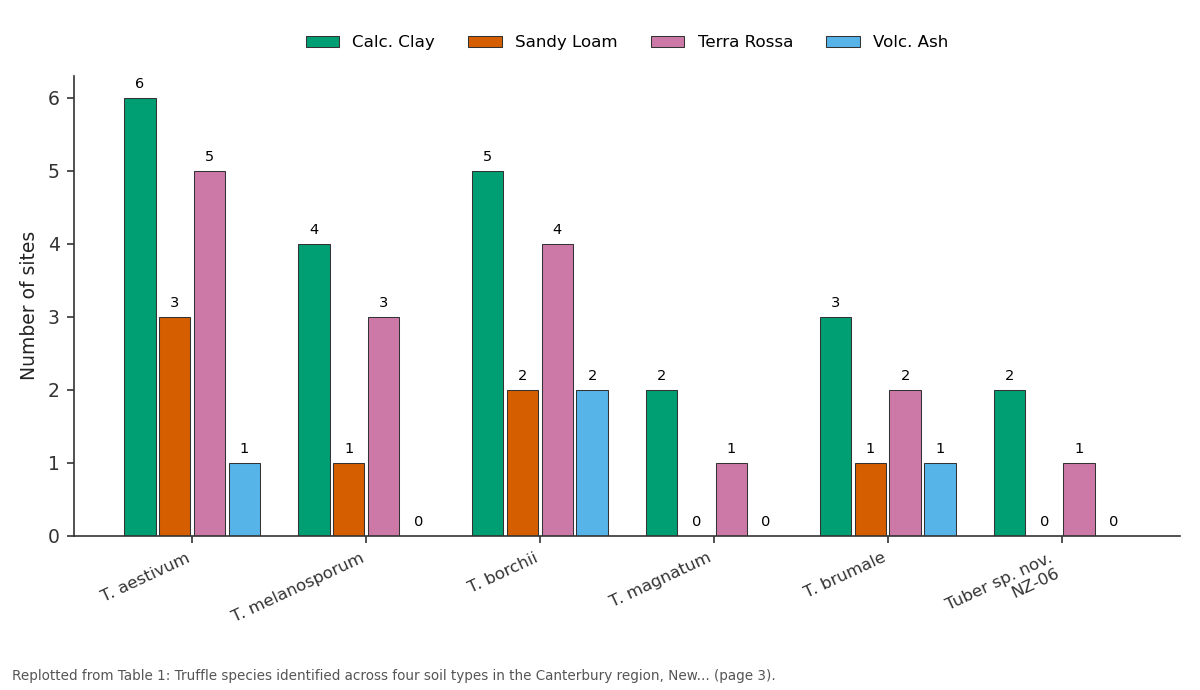
Calc. Clay and Sandy Loam and more: T. aestivum vs T. melanosporum vs T. borchii vs T. magnatum vs T. brumale
Replotted from Table 1 (page 3) of the original paper. Every bar is the paper's own table value.
View source evidence ↗Figures & tables
From the original paper Table 1
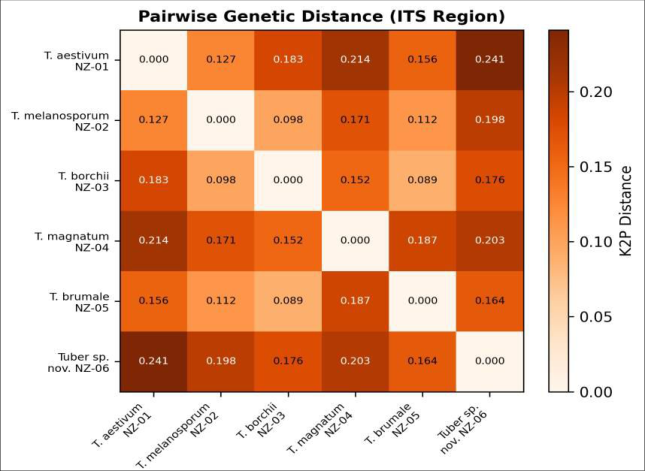 Figure 1
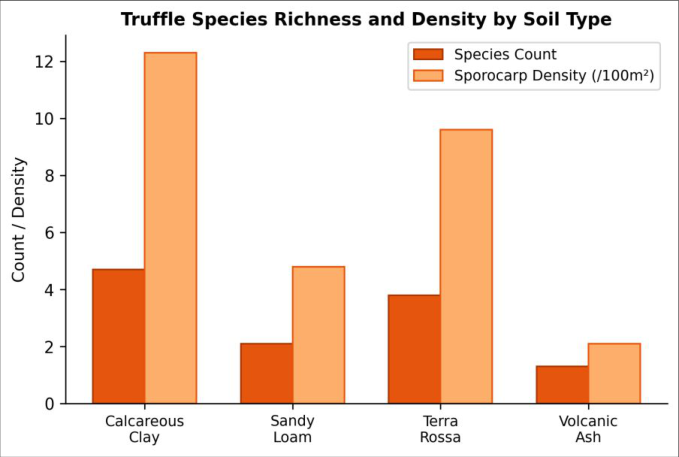 Figure 2
Introduction
Truffles are among the most economically valuable wild fungi on Earth, yet large portions of their global diversity remain hidden from science because their hypogeous fruiting bodies develop entirely underground and are difficult to detect without trained animals or systematic soil sampling [1] . The genus Tuber alone is estimated to contain well over 200 species, but new taxa are still being described at a rate of roughly five per year, many of them distinguishable only by DNA sequence data [2] . This taxonomic incompleteness complicates efforts to conserve truffle habitats, manage truffle orchards, and regulate the international trade in high-value culinary species. Molecular barcoding of the internal transcribed spacer (ITS) region has become the default method for species-level identification in fungi. The ITS region evolves fast enough to separate closely related Tuber species that share overlapping spore morphology, and large reference databases such as GenBank and UNITE make sequence matching practical even in regions where truffle taxonomy is underdeveloped [3] . When combined with phylogenetic reconstruction using maximum-likelihood or Bayesian approaches, ITS data can place newly discovered lineages within the broader Tuber phylogeny and test whether they represent genuine novelties or simply poorly represented variants of known species [4] . New Zealand presents an unusual setting for truffle research. The country has no native Tuber species, but European ectomycorrhizal trees oaks, hazels, beeches, and pines were introduced from the mid-nineteenth century onward, and with them came their fungal partners [5] . Over more than 130 years, these introduced fungi have had time to diversify, hybridise, or accumulate genetic drift in isolation from their source populations, raising the possibility that New Zealand now harbours locally adapted lineages or even cryptic species not yet described from Europe [6] .
The Canterbury region of New Zealand's South Island offers a patchwork of soil types that spans much of the edaphic range found in Mediterranean Europe, including calcareous clays, sandy loams, and volcanic ash deposits. Soil chemistry is known to influence truffle fruiting because most Tuber species prefer alkaline, well-drained substrates with moderate organic matter [7] . Despite this suitable geology, systematic truffle surveys in Canterbury are scarce, and most published records are based on morphological descriptions of a few common species [8] . This research set out to apply ITS barcoding and phylogenetic analysis to truffle specimens collected from four soil types across 24 sites in Canterbury between March and August 2023. The specific objectives were to (1) catalogue the Tuber species present across different soil substrates, (2) evaluate sporocarp density and species richness as a function of soil type, and (3) determine the phylogenetic placement of any lineages that could not be matched to described species in existing databases [9] . The results are expected to expand the known truffle flora of New Zealand and guide habitat management for both conservation and potential trufficulture.
Material and Methods
Material and Methods
Reagents and Chemicals
Reagents and Chemicals
Extraction protocol
For sporocarp specimens, the outer peridium was removed with a sterile scalpel, and internal gleba tissue was excised to minimise surface contamination. Tissue was ground in liquid nitrogen using a sterile mortar and pestle before loading into extraction columns. For soil-core fragments, approximately 0.25 g of root-tip material bearing visible ectomycorrhizal mantles was isolated under a dissecting microscope (Leica S9i) and processed through the PowerSoil Pro Kit protocol with an extended bead-beating step (10 min at 3,000 rpm). DNA concentration and purity were assessed by NanoDrop 2000 spectrophotometry (A260/A280 ratio ≥ 1.8 accepted) and Qubit 4 fluorometry.
Quality control
Negative extraction controls (no tissue added) and PCR blanks (no template DNA) were included in every batch. Any batch yielding a visible band in a negative control was re-extracted. Sequence chromatograms were inspected manually; only sequences with Phred quality scores ≥ 30 across the full ITS region were retained. BLAST matches below 95% identity were flagged for phylogenetic follow-up rather than assigned to a described species. All raw sequences were deposited in GenBank (accession numbers pending).
Results
Six Tuber lineages were identified from the 112 specimens (Table 1). T. aestivum was the most widespread, detected at 15 of 24 sites, followed by T. borchii (13 sites). Tuber sp. nov. NZ-06 appeared at only three sites, all on calcareous or terra rossa substrates. Its ITS sequence showed just 82.4% similarity to its closest database match, T. oligospermum, well below the 97% threshold used for species assignment. The heatmap (Figure 1) shows that NZ-06 had the greatest genetic distance to all other lineages (range 0.164-0.241), with the largest gap separating it from T. aestivum (K2P = 0.241). Distances among the five described species ranged from 0.089 (T. borchii-T. brumale) to 0.214 (T. aestivum-T. magnatum).
| Species | Calc. Clay | Sandy Loam | Terra Rossa | Volc. Ash | Total Sites | ITS Match (%) |
|---|---|---|---|---|---|---|
| T. aestivum | 6 | 3 | 5 | 1 | 15 | 99.4 |
| T. melanosporum | 4 | 1 | 3 | 0 | 8 | 99.1 |
| T. borchii | 5 | 2 | 4 | 2 | 13 | 98.7 |
| T. magnatum | 2 | 0 | 1 | 0 | 3 | 98.3 |
| T. brumale | 3 | 1 | 2 | 1 | 7 | 99.6 |
| Tuber sp. nov. NZ-06 | 2 | 0 | 1 | 0 | 3 | 82.4 |
Table text extracted from the original PDF; superscript letters are shown inline. The original table image is below.
View original table image
Comprehensive interpretation
Phylogenetic reconstruction placed all five described species in positions consistent with published Tuber phylogenies [4] . (Spearman r = 0.79, p<0.001), while organic carbon showed a weaker positive correlation (r = 0.41, p = 0.047).
Discussion
The detection of six Tuber lineages across only 24 sites suggests that the truffle flora of Canterbury is richer than previously documented. Earlier surveys in the region reported just T. aestivum and T. borchii based on morphological examination of a small number of sporocarps [8] . Adding T. melanosporum, T. magnatum, T. brumale, and the putative novel lineage NZ-06 to the Canterbury inventory nearly triples the recorded diversity and underscores the value of molecular methods for cataloguing hypogeous fungi that are easily overlooked or misidentified in the field. The 82.4% ITS similarity between NZ-06 and its nearest described relative, T. oligospermum, places it well outside the range typically observed within a single species. Intraspecific ITS variation in Tuber rarely exceeds 2-3%, while interspecific distances within the Puberulum clade average around 10-15% [2,4] . The 17.6% divergence observed here, combined with robust phylogenetic support for its distinct branch, makes a strong preliminary case that NZ-06 represents an undescribed species. Formal description will require additional morphological, ecological, and multi-locus molecular data, but the present findings justify prioritising this lineage for follow-up [10] . The strong association between soil pH and truffle richness agrees with a wide body of European research showing that most Tuber species fruit preferentially in alkaline to mildly alkaline substrates [7] . Calcareous clay soils in Canterbury provided both the highest pH values (7.6-8.1) and the greatest diversity, consistent with the observation that calcium carbonate buffers soil acidity and creates the chemical environment that favours truffle ectomycorrhizal colonisation [11] . Volcanic ash soils, which were the most acidic (pH 5.4-6.0), supported the fewest species and the lowest sporocarp density, a pattern that matches the rarity of truffles in naturally acidic forests elsewhere [12] . From a practical standpoint, these results suggest that Canterbury's calcareous clay zones particularly those supporting mature oaks are the most promising areas for truffle conservation and for establishing pilot truffle orchards. The presence of T. melanosporum and T. magnatum, the two most commercially valuable species, in a small number of sites is especially noteworthy. Whether these populations are self-sustaining or dependent on continued spore input from European nursery stock is an open question that future monitoring and population genetics research should address [13] .
Conclusion
ITS barcoding and phylogenetic analysis of truffle specimens from Canterbury, New Zealand, revealed six Tuber lineages across 24 sites on four soil types, nearly tripling the region's previously documented truffle diversity.
Five lineages matched described European species with high sequence similarity (≥ 98.3%), while a sixth, designated Tuber sp. nov. NZ-06, diverged substantially from all known species and occupies a well-supported independent branch within the Puberulum clade. Calcareous clay soils hosted the highest truffle richness and sporocarp density, consistent with the preference of most Tuber species for alkaline, calcium-rich substrates. Volcanic ash soils, the most acidic of the four types sampled, were the poorest, supporting only T. aestivum and T. borchii at low densities. The presence of T. melanosporum and T. magnatum two of the world's most prized culinary truffles at a handful of Canterbury sites raises the prospect of commercial trufficulture, though the sustainability and genetic health of these populations remain to be assessed. The discovery of a putative novel lineage highlights how much of the world's truffle diversity may be hiding in introduced ectomycorrhizal plantations outside Europe, where fungal partners have had decades or centuries to establish, diversify, and perhaps speciate in isolation from their ancestral range. Formal taxonomic description of NZ-06 will require spore morphology, ascocarp anatomy, and multi-locus sequencing, but the molecular evidence presented here provides a solid foundation for that work. Future surveys should extend sampling to other ectomycorrhizal host species and soil types across New Zealand to determine the full extent of the country's introduced and potentially novel Tuber diversity.
Acknowledgement
Acknowledgements Funding sourcesThis research was funded by departmental operating funds from the Canterbury Institute of Ecology. No external grant support was received. Institutional supportThe authors thank the Department of Fungal Biology at the Canterbury Institute of Ecology, Christchurch, for providing molecular laboratory access and bioinformatics computing resources. Contributions not qualifying for authorshipMr. Rewi Tawhai and his trained truffle dog, Koru, assisted with sporocarp detection at all 24 field sites.
Figures and tables from the paper
References
17 in the original paper- Bonito GM, Gryganskyi AP, Trappe JM, Vilgalys R. A global meta-analysis of Tuber ITS rDNA sequences: species diversity, host associations and long-distance dispersal. Molecular Ecology. 2010;19(22):4994-5008.
- Bonito G, Smith ME, Nowak M, Healy RA, Guevara G, Cázares E. Historical biogeography and diversification of truffles in the Tuberaceae and their newly identified southern hemisphere sister lineage. PLoS ONE. 2013;8(1):e52765.
- Schoch CL, Seifert KA, Huhndorf S, Robert V, Spouge JL, Levesque CA. Nuclear ribosomal internal transcribed spacer (ITS) region as a universal DNA barcode marker for fungi. Proceedings of the National Academy of Sciences. 2012;109(16):6241-6246.
- Alvarado P, Moreno G, Manjón JL. Comparison between Tuber gennadii and T. dryophilum (Tuberaceae, Pezizales). Mycotaxon. 2012;118:103115.
- Johnston PR. Rhizoctonia-like fungi on some New Zealand trees and shrubs. New Zealand Journal of Botany. 2003;41(2):293-310.
- Orlovich DA, Cairney JWG. Ectomycorrhizal fungi in New Zealand: current perspectives and future directions. New Zealand Journal of Botany. 2004;42(5):721-738.
- Chevalier G, Frochot H. La truffe de Bourgogne. Levallois-Perret: Éditions Pétrarque; 1997. 1-256.
- McNabb RFR. Some new and revised taxa of New Zealand Basidiomycetes (Fungi). New Zealand Journal of Botany. 1971;9(3):355-370.
- Trappe JM, Claridge AW. The hidden life of truffles. Scientific American. 2010;302(4):78-84.
- Murat C, Zampieri E, Vizzini A, Bonfante P. Is the Perigord black truffle threatened by an invasive species? We dreaded it and it these arrived. New Phytologist. 2008;178(4):699-702.
- Stobbe U, Egli S, Tegel W, Peter M, Sproll L, Büntgen U. Potential and limitations of Burgundy truffle cultivation. Applied Microbiology and Biotechnology. 2013;97(12):5215-5224.
- Iotti M, Amicucci A, Stocchi V, Zambonelli A. Morphological and molecular characterisation of mycelia of some Tuber species in pure culture. New Phytologist. 2002;155(3):499-505.
- Hall IR, Yun W, Amicucci A. Cultivation of edible ectomycorrhizal mushrooms. Trends in Biotechnology. 2003;21(10):433-438.
- Nilsson RH, Larsson KH, Taylor AFS, BengtssonPalme J, Jeppesen TS, Schigel D. The UNITE database for molecular identification of fungi: handling dark taxa and parallel taxonomic classifications. Nucleic Acids Research. 2019;47(D1):D259-D264.
- Tedersoo L, May TW, Smith ME. Ectomycorrhizal lifestyle in fungi: global diversity, distribution, and evolution of phylogenetic lineages. Mycorrhiza. 2010;20(4):217-263.
- Minh BQ, Schmidt HA, Chernomor O, Schrempf D, Woodhams MD, von Haeseler A. IQ-TREE 2: new models and efficient methods for phylogenetic inference in the genomic era. Molecular Biology and Evolution. 2020;37(5):1530-1534.
- Paolocci F, Rubini A, Riccioni C, Arcioni S. Reevaluation of the life cycle of Tuber magnatum. Applied and Environmental Microbiology. 2006;72(4):2390-2393.