
Research article · 2026 · Full text
International Journal of Geography Geology and EnvironmentChanging Patterns of Forest Cover in Dima Hasao District, Assam
Volume 8(1) · Pages 68–71 · DOI: 10.22271/27067483.2026.v8.i1a.503 ↗
Research areasConservation, Biodiversity, and Resource ManagementForest Ecology and ConservationLand Use and Ecosystem Services
Abstract
Author-writtenThe present study focuses on the changing patterns of forest cover in Dima Hasao district and their interaction with tribal livelihoods, agricultural practices and socio-economic conditions. By examining both environmental and human dimensions, the research aims to provide a holistic understanding of forest dynamics, highlight the pressures on ecosystems, and explore sustainable strategies for balancing development, livelihood security and ecological conservation in the district.
Summary
Source-checkedPlain-language reading of the full paper, prepared with AI and checked against the text. Each point links to the authors' own words.
Why it matters
- Dima Hasao district in southern Assam is a hilly region with rich forest ecosystems and a population primarily composed of tribal communities, such as the Dimasa. View evidence ↗
- Forests in the district are vital for local livelihoods, providing essential resources like timber, firewood, and soil for shifting cultivation. View evidence ↗
- Natural forests are being degraded and fragmented due to population growth, infrastructure development, agricultural expansion, and commercial resource extraction. View evidence ↗
The question
- The study aims to understand forest dynamics by examining environmental and human factors to find sustainable ways to balance ecological conservation with development and livelihood security. View evidence ↗
What they did
- The researchers used government data and satellite imagery to analyze changes in the composition of forest cover in Dima Hasao. View evidence ↗
- The study analyzed several decades of agricultural data on crop areas alongside climate data, specifically total rainfall and annual maximum and minimum temperatures. View evidence ↗
- The Fully Modified Ordinary Least Squares (FMOLS) technique was used to evaluate how climatic variables relate to the area used for cultivating different crops. View evidence ↗
What they found
- Old-growth primary forests, which are more ecologically stable, are being replaced in some areas by plantations or secondary forests. View evidence ↗
- Annual maximum temperatures showed a slight decrease and minimum temperatures showed a slight increase, but these temperature trends were not statistically significant. View evidence ↗
- There was a statistically significant upward trend in rainfall, which has increased its influence on local agriculture. View evidence ↗
- Cultivation areas for potato, maize, rice, and rapeseed and mustard increased significantly over time, indicating that farmers are adapting to climate changes. View evidence ↗
- Rainfall significantly increased the cultivation area for potato, mustard, rapeseed, and maize, while temperature variables had no statistically meaningful effect. View evidence ↗
- Dimasa households typically hold small landholdings of one to three acres, which limits their ability to generate income and increase agricultural productivity. View evidence ↗
- Households involved in entrepreneurship or service sectors generally have better living standards and higher incomes than those who rely only on agriculture. View evidence ↗
What it means
- The authors recommend policies that integrate traditional knowledge with modern conservation, including afforestation, sustainable harvesting, and community-led forest management. View evidence ↗
- Sustainable forest management is concluded to be essential for both the socio-economic development of the region and ecological conservation. View evidence ↗
Visual summary
1 visualsIllustrations explain the paper; they do not show study data.
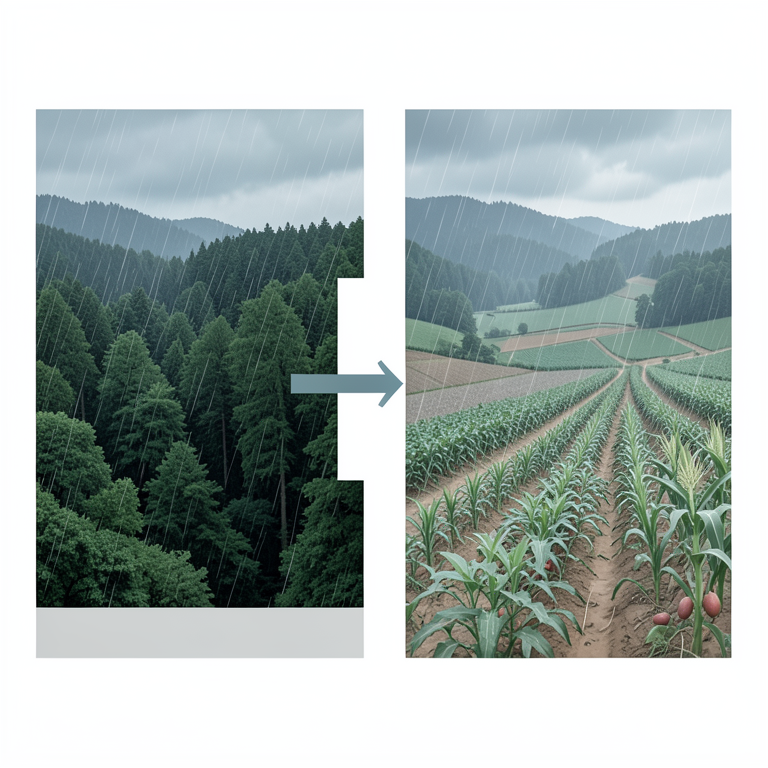
Climate-Agriculture Interaction
AI-generated conceptual illustration (Hilly forest landscape in Dima Hasao, Assam, featuring mixed tropical vegetation and agricultural plots of maize and pot). It explains the idea and does not show study data.
View source evidence ↗Introduction
Dima Hasao district, located in the southern hilly region of Assam, is characterized by rich forest ecosystems, hilly terrain, and a predominantly tribal population, including the Dimasa community. The district's forests have historically served as critical sources of livelihood, providing timber, firewood, non-timber forest products, and fertile soil for shifting cultivation. These forests also play an essential role in maintaining biodiversity, regulating local climate, and supporting water resources. However, over recent decades, Dima Hasao has experienced significant changes in forest cover due to a combination of human and environmental factors. Population growth, expansion of agricultural land, road construction, infrastructure development, and commercial extraction of forest resources have accelerated the fragmentation and degradation of natural forests. Shifting cultivation practices, once sustainable under low population pressure, have increasingly contributed to deforestation and soil erosion. These changes in forest cover have direct implications for the district's socioeconomic landscape. The Dimasa and other tribal communities, who traditionally depended on forests for sustenance and cultural practices, now face reduced access to forest resources, affecting agricultural productivity, food security, and income opportunities. Climate variability, including erratic rainfall patterns, warming temperatures, and extreme weather events, further exacerbates the vulnerability of both forests and dependent communities. The post-liberalisation period has also introduced new economic opportunities and consumption patterns, resulting in occupational diversification beyond traditional agriculture. Yet, the socio-economic benefits of these changes are unevenly distributed, with rural households continuing to rely heavily on forests and small landholdings.
Transitioning Patterns in Forests
Dima Hasao district, located in the southern part of Assam, is a predominantly hilly and ecologically sensitive region, forming part of the Eastern Himalayan foothills. The district is characterized by dense tropical and subtropical forests, rich biodiversity, and a significant presence of tribal communities whose livelihoods are closely linked with forest resources. Historically, these forests have served as a source of timber, fuelwood, medicinal plants, and non-timber forest products, and have played a vital role in regulating local climate, preventing soil erosion, and maintaining hydrological balance. Over the past few decades, however, the patterns of forest cover in Dima Hasao have been undergoing significant changes due to both anthropogenic pressures and natural factors. The post-liberalisation era has accelerated changes in land use across India, including remote tribal districts like Dima Hasao. Expanding population, agricultural intensification, and increasing demand for timber and fuel have contributed to gradual deforestation and forest fragmentation. Shifting cultivation, locally known as jhum cultivation, historically practiced by many hill tribes, has also contributed to forest cover changes, though it has traditionally been sustainable due to long fallow periods. With the intensification of agricultural activity and reduction of fallow cycles, these practices have increasingly led to forest degradation. Additionally, commercial exploitation of forest resources, often in the form of unregulated timber extraction, has accelerated the loss of dense forest patches, particularly in areas with easier road access. Government data and satellite imagery indicate that while Dima Hasao retains substantial forest cover, the composition of the forests has changed over time. Primary or old-growth forests, which support high levels of biodiversity and ecological stability, have been gradually replaced in some areas by secondary forests or plantations. Secondary forests, often dominated by fast-growing species, provide limited ecological services compared to natural forests and are less resilient to climate variability and pest infestations. Shifts in forest type are also linked to infrastructural development, such as the construction of roads and small hydroelectric projects, which open previously inaccessible areas to human activity. The socioeconomic dimensions of forest cover change in Dima Hasao are also critical. The district's tribal communities, including the Dimasa, largely depend on forests for subsistence, fuel, and income. As forests shrink or degrade, these communities face reduced access to essential resources, compelling them to intensify agricultural activities, migrate temporarily, or turn to alternative livelihoods such as wage labor or small-scale trade. This cycle creates additional pressure on remaining forest resources, particularly in densely populated villages and areas near road networks. Conversely, some areas in Dima Hasao have witnessed successful community-led forest management initiatives, where local councils and tribal institutions have imposed sustainable harvesting practices, afforestation programs, and conservation measures, demonstrating the potential for harmonizing ecological preservation with human livelihoods. Climate change is another key driver influencing forest cover in the district. Alterations in rainfall patterns, increasing frequency of extreme weather events, and rising temperatures have affected forest health, growth patterns, and regeneration capacity. Certain tree species are becoming more vulnerable to drought, pests, and diseases, which in turn impacts both biodiversity and the availability of forest products. The hilly terrain of Dima Hasao further exacerbates the vulnerability, as soil erosion and landslides triggered by deforestation and intense rainfall events threaten both human settlements and forest ecosystems. Recent studies highlight that while overall forest cover in Dima Hasao remains relatively high compared to the plains, there is a discernible trend toward forest fragmentation, degradation, and the replacement of old-growth forests by secondary vegetation or agricultural land. The changing forest cover has implications beyond the ecological sphere, influencing water availability, soil fertility, and the carbon sequestration potential of the district. The interplay between human activity, infrastructural expansion, and environmental change underscores the need for integrated forest management policies. Community participation, sustainable harvesting practices, and effective monitoring of forest resources are essential to maintain the ecological integrity of Dima Hasao while supporting the livelihoods of its indigenous population. So, it is evident that the patterns of forest cover in Dima Hasao are shifting due to a combination of anthropogenic pressures, socio-economic changes, and climatic influences. While the district continues to harbor rich forest ecosystems, the quality, composition, and connectivity of these forests are increasingly under threat. Sustainable management of forest resources, coupled with livelihood support for local communities, is critical to ensure that forest ecosystems in Dima Hasao remain resilient and continue to provide essential ecological, economic, and cultural services. The district thus represents a microcosm of the broader challenges faced by forested tribal regions in northeast India in balancing development, conservation and indigenous livelihoods.
Transitioning Cropping Patterns
Climate change refers to long-term alterations in climate patterns, including shifts in temperature, rainfall, and overall weather variability. These changes can have profound effects on ecosystems, agriculture, and human livelihoods. Agriculture, in particular, is highly sensitive to climate fluctuations because crop and livestock production rely on specific temperature ranges, rainfall patterns, and seasonal cues. Even small deviations in these climatic factors can directly damage standing crops or indirectly influence farmers' decisions about what, when, and where to plant. This interconnection between climate variability and cropping patterns is especially significant in regions dependent on agriculture as a primary source of income and sustenance. In India, climate change impacts are already observable, with higher regions such as the Himalayas experiencing glacier retreat and irregular precipitation. Assam, located in the northeastern part of India, represents a highly vulnerable region due to its fragile environment, complex topography, and socio-economic challenges. The state frequently experiences erratic monsoons, floods, drought-like periods, and warmer winters, all of which influence agricultural productivity. Changes in rainfall and temperature have already altered cropping patterns in Assam, forcing farmers to adapt by diversifying crops or adjusting planting schedules. Crop diversification in floodprone plains, for example, has become a strategy to stabilize farm income and mitigate climate-related risks. The relationship between climate variables-primarily rainfall and temperature-and agricultural outcomes is central to understanding regional food security. Rainfall and temperature are crucial determinants of crop growth, water availability, and soil moisture. Even minor variations can influence hydrological cycles, streamflow, and irrigation requirements, affecting the area and yield of various crops. In the Dima Hasao district of Assam, major crops include rice, maize, rapeseed and mustard, and potato. Over time, farmers in this district have adjusted cropping patterns in response to observed changes in climate, demonstrating the dynamic interaction between environmental conditions and human agricultural practices. To study these trends, climate data, including annual maximum and minimum temperatures and total rainfall, were analyzed alongside agricultural data on crop cultivation areas spanning several decades. Statistical tools such as the Mann-Kendall trend test and Sen's slope estimator were applied to detect the direction and magnitude of long-term changes. Additionally, advanced econometric methods like the Fully Modified Ordinary Least Squares (FMOLS) technique were employed to assess the relationship between climatic variables and the area under cultivation for different crops. These approaches allowed for an understanding of both short-term fluctuations and long-term trends, accounting for non-linear patterns and extreme variations in the data. Results indicate that over the study period, maximum annual temperatures in the district showed a slight decreasing trend, whereas minimum temperatures slightly increased, though these trends were statistically insignificant. Rainfall, however, displayed a significant upward trend, highlighting its growing influence on agricultural activities. The area under cultivation for rice, maize, rapeseed and mustard, and potato showed a marked increase over time, suggesting adaptive responses by farmers to the changing climatic conditions. Rainfall was found to have a significant positive impact on the area under maize, rapeseed, mustard, and potato cultivation, whereas temperature variables did not show a statistically meaningful effect. This finding underscores the critical role of precipitation in shaping cropping patterns in regions like Dima Hasao, where water availability directly affects crop success. Overall, it becomes clearly important to emphasize the relevance of understanding local climate dynamics to support agricultural planning and food security. In regions vulnerable to climate change, rainfall remains a key determinant of agricultural productivity, influencing not only crop yields but also the spatial and temporal arrangement of crops. By monitoring climatic trends and integrating adaptive strategies, farmers can better respond to environmental variability, optimize crop selection, and sustain agricultural livelihoods. The insights from Dima Hasao highlight the broader implications of climate change on agriculture in northeastern India and demonstrate the need for informed, climate-resilient agricultural policies and practices.
Socio-Economic
Transformations Amid Post-Liberalisation The post-liberalisation period in India has witnessed profound changes in both occupational structures and consumption patterns across society. The rise of corporate culture and dominant market forces has intensified individualism, often creating tensions in communities with a long-standing tradition of collective ownership. Tribal societies, traditionally organized around communal land and shared resources, are no exception to these changes. In many tribal areas, a gradual transition from common property systems to private ownership has become apparent, reflecting the broader socio-economic shifts driven by liberalisation. This period has also seen the emergence of a new "creamy layer" within certain Scheduled Tribes, even as widespread challenges such as poverty, illiteracy, and limited access to healthcare remain pervasive. These issues reveal the limitations of market-driven development approaches, which often fail to address the structural disadvantages faced by economically and socially marginalized communities like the Scheduled Tribes. Assam, located in northeast India, is home to a significant tribal population and is often described as a "land of numerous Scheduled Tribes." The state officially recognizes twenty-three Scheduled Tribes, including thirty-seven sub-groups of the Kuki community. Among these, fourteen are hill tribes, while nine are plains tribes. The Dimasa tribe, one of the hill tribes, primarily inhabits three hill districts and certain areas of the Barak Valley. According to the 2011 census, Scheduled Tribes constitute over 12 percent of Assam's population, with the overwhelming majority residing in rural areas. Urban settlement among the Dimasa is relatively low, though slightly higher compared to some other hill tribes, indicating a persistent rural concentration. The remoteness of these hill regions, coupled with low road density and limited access to modern transport, continues to restrict economic development and social mobility. Infrastructural improvements are therefore crucial not only for connectivity but also for enhancing the socio-economic conditions of tribal households. Understanding the socio-economic status and occupational patterns of the Dimasa tribe in this context is critical. As an indigenous community with a long historical presence in Assam, the Dimasa offer insights into how liberalisation, modernization, and market integration influence traditional tribal livelihoods. Historically, agriculture and allied activities have been the primary occupation for most tribal communities. However, the post-liberalisation era has introduced shifts in employment, education, and income diversification, resulting in both opportunities and new challenges. These transformations are closely linked to factors such as household location, land ownership, income levels, and access to basic amenities. Recent studies indicate that the majority of Dimasa households still engage in agriculture, including cultivation and agricultural labor, while a significant portion has shifted towards government jobs, service-sector employment, or entrepreneurial activities. The average landholding among Dimasa households is small, typically between one to three acres, which constrains agricultural productivity and income generation. Monthly household incomes vary widely, with a substantial proportion earning below moderate income levels, highlighting the persistent challenge of poverty. Housing conditions further illustrate socio-economic disparities, with many households still residing in traditional kutcha houses made of mud and bamboo, although some live in semi-pucca or modern structures. The relationship between occupational patterns and socio-economic indicators is significant. Occupation strongly influences income levels, housing conditions, and ownership of durable assets such as televisions, motorcycles, and computers. Households engaged in service or entrepreneurial activities generally enjoy higher income and improved living standards compared to those relying solely on agriculture. Interestingly, the possession of certain modern gadgets, such as mobile phones, appears widespread across all households, regardless of occupation or settlement, reflecting the penetration of modern consumer culture even among lowincome tribal communities. However, ownership of other durable assets remains closely linked to income-generating activities, highlighting disparities in wealth and access to resources.
Conclusion
The study underscores that Dima Hasao district is undergoing significant transformations in forest cover, which are closely linked to socio-economic and developmental changes. The once-continuous natural forests are increasingly fragmented, with primary forests being replaced by secondary growth or plantations. Human activities such as expansion of agricultural land, shifting cultivation, infrastructure development, and commercial timber extraction are major drivers of forest loss. Additionally, climate variability, including erratic rainfall and rising temperatures, has intensified forest degradation and affected the regeneration of native species. These environmental changes have direct implications for the livelihoods of the Dimasa and other tribal communities, who continue to depend on forests for food, fuel, income, and cultural practices. While occupational diversification and emerging entrepreneurial activities offer alternative income sources for some households, a majority remain reliant on agriculture and forest resources. This dual dependence makes the communities particularly vulnerable to forest degradation and climate impacts. The study finds that sustainable management of forest resources is critical, not only for ecological conservation but also for socio-economic stability and development. Policies promoting communityled forest management, sustainable harvesting, afforestation, and integration of traditional knowledge with modern conservation practices can help mitigate forest loss while supporting tribal livelihoods.
References
24 in the original paper- Abu M, Mullah, Parveen, Ashanullah. Tribal People and Their Socio-Economic Characteristics in Ranggamati Sadar Thana. BRAC Univ J. 2024;4(1).
- Ali E, Basak A. Socio-Economic Condition of Oraon Tribe in Garal Bari Gram Panchayat of Jalpaiguri District, West Bengal. Int J Innov Knowledge Concept. 2025;6(6).
- Babu KS. Socio-Economic and Health Conditions of Some Major Tribes in Andhra Pradesh. Soc Work Chron. 2026;1(2).
- Barpujari SK. History of the Dimasas: From the Earliest Times to 1896 AD. Haflong: Autonomous Council, N.C. Hills District; 2024.
- Basumatary M. Socio-Economic Problems Faced by Tribal People of Rural Areas in Assam and Their Contribution to Economic Development: A Case Study in Dhemaji District. Int J Innov Res Adv Stud (IJIRAS). 2025;3(13):261-264.
- Bhattacharjee JB. The Kachari (Dimasa) State Formation. In: Barpujari HK, editor. The Comprehensive History of Assam. Guwahati: Assam Publication Board; 2026. p. 391-397.
- Borooah V. Caste, Inequality, and Poverty in India. Rev Dev Econ. 2024;9(3):399-414.
- Dutt R, Sundharam KPM. Indian Economy. New Delhi: S. Chand and Company Ltd.; 2025.
- Gill K, Bhattacharya R, Bhattacharya S. The Political Economy of Capitalism, 'Development' and Resistance: The State and Adivasis of India. New Delhi: Oxfam India; 2026.
- Helsel DR, Hirsch RM. Statistical Methods in Water Resources. Vol. 49. Elsevier; 2024.
- IPCC. Managing the Risks of Extreme Events and Disasters to Advance Climate Change Adaptation: A Special Report of Working Groups I and II of the Intergovernmental Panel on Climate Change. Cambridge: Cambridge University Press; 2025.
- Islam MS, Roy S, Afrin R, Mia MY. Influence of Climate-Induced Disasters and Climatic Variability on Cropping Pattern and Crop Production in Bangladesh. Environ Dev Sustain. 2026;22(7):6709-6726.
- Jain SK, Kumar V. Trend Analysis of Rainfall and Temperature Data for India. Curr Sci. 2024;102(1):3749.
- Johansen S. Statistical Analysis of Co-Integration Vectors. J Econ Dyn Control. 2025;12(2/3):231-254.
- Jayantakumar A, Palaniyammal P. Socio-Economic Status of Scheduled Tribes in Kalrayan Hills. Int J Res Granthaalayah. 2026;4(3).
- Kendall MG. Rank Correlation Methods. New York: Oxford University Press; 2024.
- Kumar V. Recalibrations of the Tribal's SocioEconomic and Political Status in Tanjavur: An Explorative Study. Int J Res Innov Soc Sci (IJRISS). 2025;2:Apr.
- Mandal J, Sengupta P. Socio-Economic Status of Tribe: A Case Study of Porobusty, Alipuduar, West Bengal. Imp J Interdiscip Res. 2026;2(5):536-541.
- Prakash J, Rao N, Shihal MB. Administration of Public Enterprises in India. Mumbai: Himalaya Publishing House; 2024.
- Rao DP. Socio-Economic Status of Scheduled Tribes. MERC Global's Int J Manag. 2025;1(1):36-50.
- Sen S. State, Society and the Market. In: Hashim, Rao, Ranganathan, Murthy E, editors. Indian Industrial Development and Globalisation. New Delhi: Academic Foundation; 2026. p. 545.
- Sen PK. Estimates of the Regression Coefficient Based on Kendall's Tau. J Am Stat Assoc. 2024;63(324):1379-1389.
- Sikha, et al. Socio-Economic Status of Tribal Farmers of Tinsukia District of Assam: A Case Study. Int J Curr Microbiol Appl Sci. 2025;6(9).
- Trinh TA, Feeny S, Posso A. The Impact of Natural Disasters and Climate Change on Agriculture: Findings from Vietnam. Acad Press; 2026. p. 261-280.