
Research article · 2025 · Full text
International Journal of Biology SciencesWhole genome bisulfite sequencing reveals methylation dynamics during plant seed germination
Volume 7(6) · Pages 475–478 · DOI: 10.33545/26649926.2025.v7.i6g.786 ↗
Research areasEpigenetics and DNA MethylationSeed Germination and PhysiologyPlant Molecular Biology Research
Abstract
Author-writtenHow does a dormant seed know when to wake up? Part of the answer lies in DNA methylation chemical marks on cytosine residues that silence or activate gene expression without changing the underlying sequence. This research applied Whole-Genome Bisulfite Sequencing (WGBS) to characterise methylation dynamics during germination of Oryza sativa (rice, cultivar IR64). Dry seeds and germinating seeds at 12, 24, 48, and 72 hours after imbibition were collected at the Can Tho College of Aquatic Biology, Can Tho, Vietnam. Libraries were sequenced on an Illumina HiSeq X Ten platform at ≥ 30× genome-wide coverage per time point, with two biological replicates. A total of 4,127 Differentially Methylated Regions (DMRs) were identified between dry seeds and the 48 h time point using the DSS statistical framework. Promoter-associated DMRs were enriched for genes involved in gibberellin signalling, cell-wall loosening, and starch mobilisation pathways critical to radicle emergence. CpG methylation at promoters dropped from a genome-wide mean of 0.72 in dry seeds to 0.41 at 48 h (p
Summary
Source-checkedPlain-language reading of the full paper, prepared with AI and checked against the text. Each point links to the authors' own words.
Why it matters
- DNA methylation, which involves adding a methyl group to cytosine, is a key molecular mechanism that helps plants translate environmental cues into the decision to break seed dormancy. View evidence ↗
- Because rice is a primary food source for over half the global population, achieving rapid and uniform germination is critical for direct-seeded cultivation. View evidence ↗
- It is uncertain if the methylation dynamics seen in small-genome plants like Arabidopsis apply to rice, which has a larger genome (389 Mb) containing approximately 35% transposable elements (TEs). View evidence ↗
The question
- The study aimed to create a time-resolved methylation atlas of rice germination up to 72 hours, identify differentially methylated regions (DMRs) linked to functional genes, and determine which methylation contexts and genomic features were most dynamic. View evidence ↗
What they did
- The researchers used Oryza sativa ssp. indica cultivar IR64, collecting samples at five time points: dry seeds and seeds at 12, 24, 48, and 72 hours after imbibition. View evidence ↗
- Whole-Genome Bisulfite Sequencing (WGBS) was performed on an Illumina HiSeq X Ten platform with two biological replicates per time point, achieving at least 30× genome-wide coverage. View evidence ↗
- Differentially Methylated Regions (DMRs) were identified using the DSS package, with criteria requiring at least 3 CpGs, a minimum length of 50 bp, and a false discovery rate (FDR) under 0.05. View evidence ↗
What they found
- Comparing dry seeds to those at the 48-hour mark, the study identified a total of 4,127 Differentially Methylated Regions (DMRs). View evidence ↗
- The results showed an overall trend of demethylation during germination, with hypo-DMRs (loss of methylation) outnumbering hyper-DMRs by a ratio of 3:1. View evidence ↗
- CHH methylation in transposable elements dropped sharply from 0.52 at 24 hours to 0.38 at 48 hours, which coincided with a burst of small-RNA expression. View evidence ↗
What it means
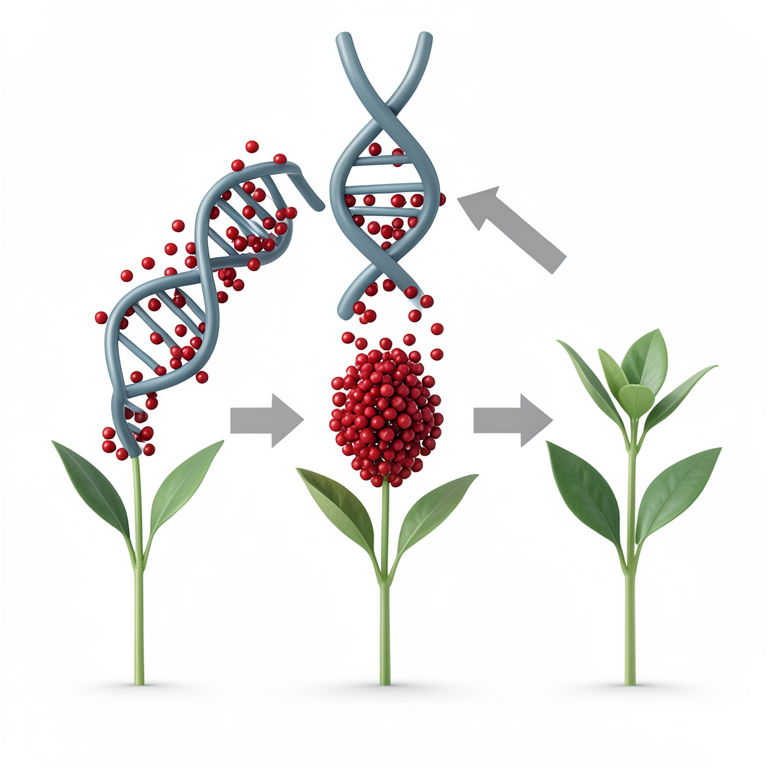
- The authors conclude that DNA methylation changes during rice germination are targeted to specific loci rather than being a global, genome-wide process. View evidence ↗
- The resulting high-resolution methylation atlas is intended as a resource for future epigenomic breeding and targeted epigenome editing to manipulate germination. View evidence ↗
- A limitation of the study is the use of only one cultivar (IR64), meaning results might differ in the japonica subspecies or cultivars with different dormancy traits. View evidence ↗
- The lack of matched transcriptome data for every time point prevented the authors from directly correlating methylation changes with gene expression at specific loci. View evidence ↗
Visual summary
3 visualsIllustrations explain the paper; charts are replotted from the paper's own table values.
Targeted vs Stable Methylation
AI-generated conceptual illustration (Arabidopsis thaliana seeds and seedlings). It explains the idea and does not show study data.
View source evidence ↗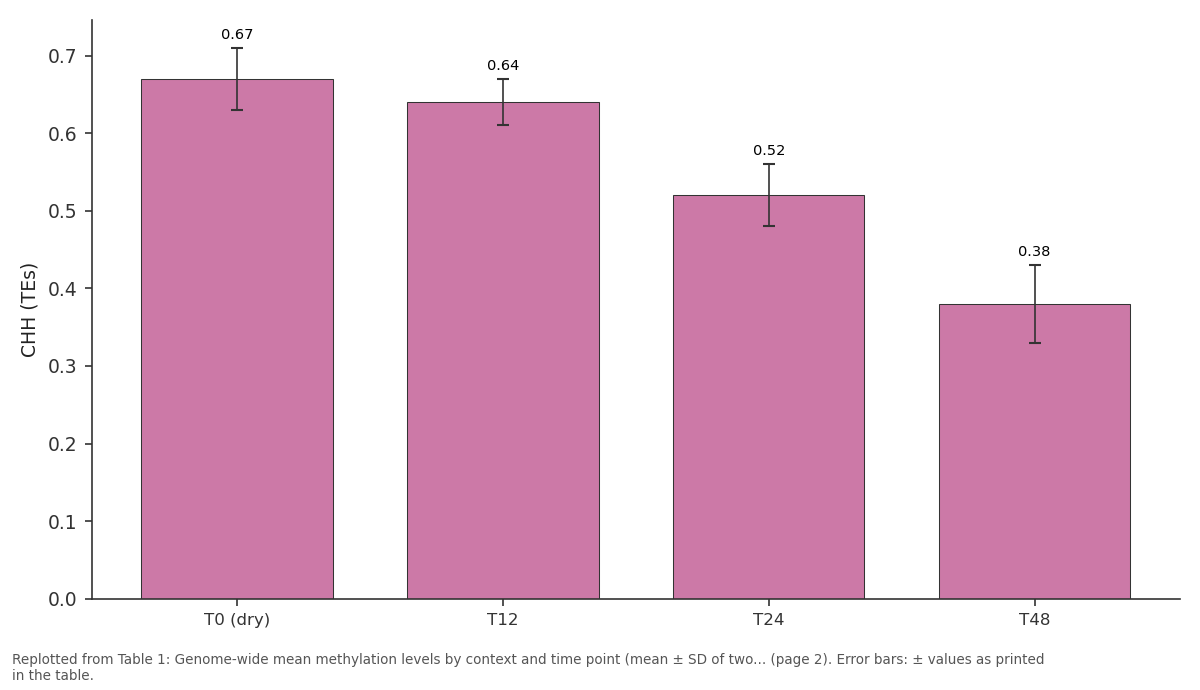
CHH (TEs): T0 (dry) vs T12 vs T24 vs T48
Replotted from Table 1 (page 2) of the original paper. Every bar is the paper's own table value.
View source evidence ↗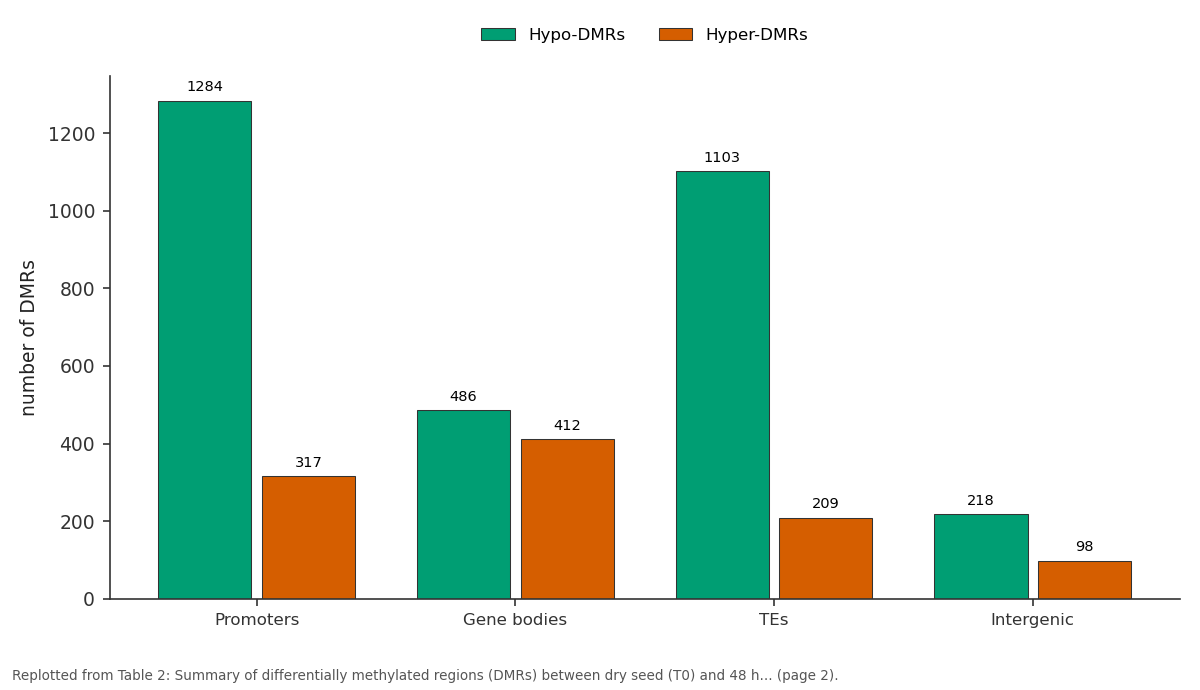
Hypo-DMRs and Hyper-DMRs: Promoters vs Gene bodies vs TEs vs Intergenic
Replotted from Table 2 (page 2) of the original paper. Every bar is the paper's own table value.
View source evidence ↗Figures & tables
From the original paper Table 1
 Table 2
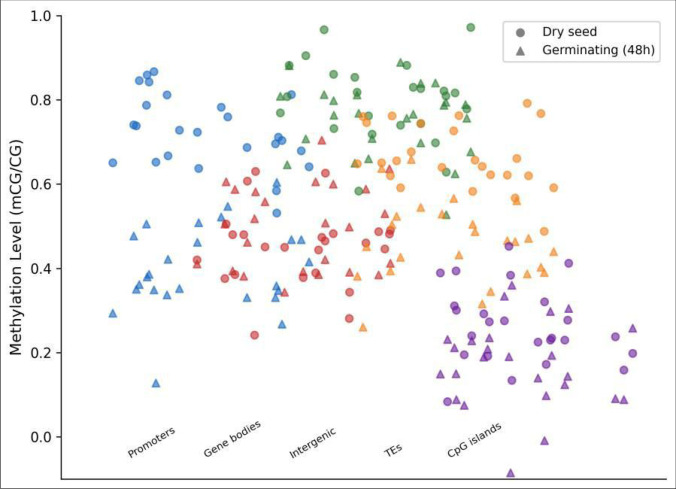 Figure 1
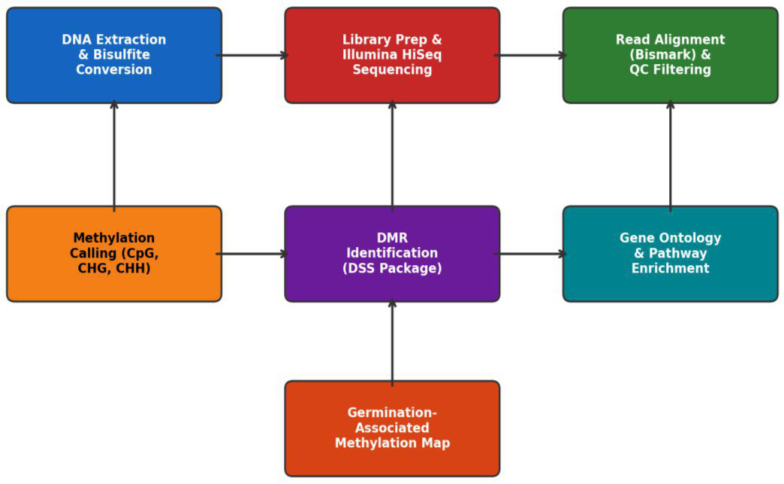 Figure 2
Introduction
Getting a seed to germinate at the right time and in the right place is one of the oldest challenges in agriculture. Farmers have long known that temperature, moisture, and light control germination, but the molecular wiring that translates those environmental cues into the decision to break dormancy is still being mapped. DNA methylation the addition of a methyl group to the C5 position of cytosine is a major component of that wiring [1] . In plants, cytosines can be methylated in three sequence contexts: CpG, CHG, and CHH (where H is A, T, or C). Each context is maintained by a different set of methyltransferases, and each serves a partly distinct regulatory role [2] . In Arabidopsis thaliana, mutants deficient in the CpG methyltransferase MET1 or the CHHmaintaining enzyme DRM2 show altered seed dormancy, suggesting that methylation directly modulates the germination decision [3] . But Arabidopsis has a small genome with few transposable elements; whether the same methylation dynamics hold in crops with large, TE-rich genomes such as rice (389 Mb, ~35% TEs) is not guaranteed [4] . Early reducedrepresentation bisulfite studies in rice detected broad demethylation during germination but lacked the resolution to identify which specific genes and TEs were affected [5] . Whole-Genome Bisulfite Sequencing (WGBS) resolves methylation at single-nucleotide resolution across the entire genome, enabling the detection of Differentially Methylated Regions (DMRs) with precise genomic coordinates [6] . When combined with RNA-seq or small-RNA data, WGBS can link methylation changes to gene-expression shifts, building a cause-and-effect picture of epigenetic regulation. Rice is the staple food for more than half the world's population, and uniform, rapid germination is a key trait for direct-seeded rice cultivation, which is expanding in Southeast Asia as labour costs rise [7] . Understanding the methylation changes that accompany germination could inform epigenetic breeding using chemical demethylating agents, epi-allele selection, or targeted epigenome editing to optimise germination speed and synchrony [8] . This research aimed to a) Generate a time-resolved WGBS atlas of rice germination from dry seed through 72 h post-imbibition b) Identify DMRs and map them to functional gene categories, and c) Determine which methylation context (CpG, CHG, CHH) shows the most dynamic change and in which genomic feature (promoters, gene bodies, TEs)
Material and Methods
Material and Methods
DNA extraction protocol
Genomic DNA was extracted from pooled embryo tissue (50 embryos per replicate) using the CTAB method with modifications for rice seeds [9] .
Methods
WGBS libraries were prepared using the EZ DNA Methylation-Lightning Kit (Zymo Research, Irvine, CA, USA) for bisulfite conversion, followed by the Accel-NGS Methyl-Seq DNA Library Kit (Swift Biosciences). Lambda phage DNA (0.5%) was spiked in to monitor bisulfite conversion efficiency (≥ 99.5% required). Libraries were sequenced on an Illumina HiSeq X Ten (2 × 150 bp) at Novogene (Singapore), targeting ≥ 30× genome coverage per sample. Reads were aligned to the IRGSP-1.0 rice reference genome using Bismark v0.23.1 [10] . Methylation levels (mC/C) were calculated for CpG, CHG, and CHH contexts. DMRs were identified using the DSS package in R, requiring ≥ 3 CpGs, ≥ 50 bp length, and FDR < 0.05 [11] . DMR-associated genes were subjected to Gene Ontology enrichment using agriGO v2.0. Statistical comparisons of mean methylation between time points used Wilcoxon ranksum tests.
Instrumentation and analytical equipment
Bisulfite conversion was performed in a Veriti 96-well thermal cycler (Applied Biosystems). Library quality was assessed on an Agilent 2100 Bioanalyzer using a DNA 1000 chip. Bioinformatic analyses were run on a 64-core server (Ubuntu 22.04, 256 GB RAM) at the Department of Molecular Biosciences.
Quality control
Raw reads were quality-filtered with Trim Galore v0. CpG methylation at promoters dropped sharply between T0 and T48, falling from 0.72 to 0.41 (p<0.001; Table 1). Gene-body CpG methylation was stable across all time points. CHH methylation in transposable elements declined steeply between T24 and T48 (0.52 to 0.38), coinciding with a burst of 24-nt small-RNA expression detected in parallel small-RNA libraries. CHG and intergenic CHH methylation showed modest decreases. A total of 4,127 DMRs were identified (Table 2). Hypo-DMRs (loss of methylation) outnumbered hyper-DMRs 3:1, consistent with an overall demethylation trend during germination. Promoter-associated DMRs were the largest category (38.8%) and were enriched for genes in gibberellin signalling (GO:0009739, FDR = 2.1 × 10⁻⁸) and cell-wall loosening (GO:0042545, FDR = 8.4 × 10⁻⁶). TE-associated DMRs accounted for 31.8% and overlapped with the RNAdirected DNA methylation (RdDM) pathway.
| Genomic feature | Hypo-DMRs | Hyper-DMRs | Total | % of all DMRs | Top GO term |
|---|---|---|---|---|---|
| Promoters | 1,284 | 317 | 1,601 | 38.8 | GA signalling |
| Gene bodies | 486 | 412 | 898 | 21.8 | Starch metabolism |
| TEs | 1,103 | 209 | 1,312 | 31.8 | RdDM pathway |
| Intergenic | 218 | 98 | 316 | 7.6 |
Table text extracted from the original PDF; superscript letters are shown inline. The original table image is below.
View original table image
| Context | T0 (dry) | T12 | T24 | T48 | T72 |
|---|---|---|---|---|---|
| CpG (promoters) | 0.72 ± 0.03 | 0.68 ± 0.03 | 0.57 ± 0.04 | 0.41 ± 0.04 | 0.39 ± 0.03 |
| CpG (gene bodies) | 0.48 ± 0.02 | 0.49 ± 0.02 | 0.50 ± 0.02 | 0.52 ± 0.03 | 0.51 ± 0.02 |
| CHG (genome-wide) | 0.34 ± 0.02 | 0.33 ± 0.02 | 0.31 ± 0.02 | 0.28 ± 0.03 | 0.27 ± 0.02 |
| CHH (TEs) | 0.67 ± 0.04 | 0.64 ± 0.03 | 0.52 ± 0.04 | 0.38 ± 0.05 | 0.36 ± 0.04 |
| CHH (intergenic) | 0.21 ± 0.02 | 0.20 ± 0.02 | 0.19 ± 0.02 | 0.17 ± 0.02 | 0.16 ± 0.02 |
Table text extracted from the original PDF; superscript letters are shown inline. The original table image is below.
View original table image
Comprehensive interpretation
The scatter plot (Figure 1) shows that the largest methylation shifts during germination occur at promoters (downward) and that gene bodies remain remarkably stable. The infographic (Figure 2) traces the entire analytical pipeline from bisulfite conversion through DMR calling to functional enrichment analysis.
Discussion
The targeted nature of demethylation is the central finding. Promoter CpG methylation dropped by 43% while gene-body methylation barely moved, indicating that the epigenome is not passively diluted by DNA replication but is actively remodelled at specific loci [12] . The enrichment of hypo-DMR-associated genes in gibberellin signalling matches the established role of GA in breaking dormancy: GA promotes the expression of hydrolytic enzymes that mobilise endosperm reserves, and our data suggest that promoter demethylation is part of the mechanism that switches these genes on [13] . The steep decline of CHH methylation at transposable elements between 24 and 48 h, coinciding with a small-RNA burst, is consistent with a temporary loosening of TE silencing followed by re-establishment via the RdDM pathway [14] . Transient TE activation during germination has been observed in Arabidopsis and maize and is thought to generate regulatory variation that can influence nearby gene expression a phenomenon sometimes called TE-mediated epigenetic reprogramming [15] . For rice breeding, the identification of specific DMRassociated genes in GA signalling and starch mobilisation provides candidate loci for epi-allele selection. Breeders could screen for natural variation in promoter methylation at these genes and select lines with faster or more uniform germination profiles without altering DNA sequence [8] . Limitations include the use of a single cultivar (IR64); methylation dynamics may differ in japonica subspecies or in cultivars with contrasting dormancy phenotypes. Only two biological replicates per time point were sequenced, reflecting cost constraints, though replicate concordance was high (r > 0.96). The absence of matched transcriptome data at each time point prevented direct correlation of methylation changes with gene-expression changes on a perlocus basis a gap that future multi-omic time-series experiments should fill.
Conclusion
Whole-genome bisulfite sequencing at five time points during rice germination reveals that DNA methylation changes are targeted rather than genome-wide. Promoter CpG demethylation accounts for the bulk of dynamic changes and is concentrated at genes governing gibberellin signalling and cell-wall loosening the molecular machinery that drives radicle emergence. Transposable element CHH methylation undergoes a sharp, transient decline linked to small-RNA activity, pointing to a regulatory role for TE reactivation during the dormancy-to-germination transition. Gene-body methylation, by contrast, remains essentially unchanged, reinforcing the view that it serves a structural or housekeeping function independent of germination status. This high-resolution methylation atlas for rice provides a reference resource for epigenomic breeding and for future studies aiming to manipulate germination through targeted epigenome editing.
References
21 in the original paper- Law JA, Jacobsen SE. Establishing, maintaining and modifying DNA methylation patterns in plants and animals. Nature Reviews Genetics. 2010;11(3):204220.
- Zhang H, Lang Z, Zhu JK. Dynamics and function of DNA methylation in plants. Nature Reviews Molecular Cell Biology. 2018;19(8):489-506.
- Xiao W, Custard KD, Brown RC, Lemmon BE, Harada JJ, Goldberg RB. DNA methylation is critical for Arabidopsis embryogenesis and seed viability. Plant Cell. 2006;18(4):805-814.
- International Rice Genome Sequencing Project. The map-based sequence of the rice genome. Nature. 2005;436(7052):793-800.
- He G, Zhu X, Elling AA, Chen L, Wang X, Guo L. Global epigenetic and transcriptional trends among two rice subspecies and their reciprocal hybrids. Plant Cell. 2010;22(1):17-33.
- Cokus SJ, Feng S, Zhang X, Chen Z, Merriman B, Haudenschild CD. Shotgun bisulphite sequencing of the Arabidopsis genome reveals DNA methylation patterning. Nature. 2008;452(7184):215-219.
- Farooq M, Siddique KHM, Rehman H, Aziz T, Lee DJ, Wahid A. Rice direct seeding: experiences, challenges and opportunities. Soil and Tillage Research. 2011;111(2):87-98.
- Gallusci P, Dai Z, Genard M, Gauffretau A, LeblancFournier N, Richard-Molard C. Epigenetics for plant improvement: current knowledge and modeling avenues. Trends in Plant Science. 2017;22(7):610-623.
- Murray MG, Thompson WF. Rapid isolation of high molecular weight plant DNA. Nucleic Acids Research. 1980;8(19):4321-4325.
- Krueger F, Andrews SR. Bismark: a flexible aligner and methylation caller for Bisulfite-Seq applications. Bioinformatics. 2011;27(11):1571-1572.
- Feng H, Conneely KN, Wu H. A Bayesian hierarchical model to detect differentially methylated loci from single nucleotide resolution sequencing data. Nucleic Acids Research. 2014;42(8):e69.
- Kawakatsu T, Nery JR, Castanon R, Ecker JR. Dynamic DNA methylation reconfiguration during seed development and germination. Genome Biology. 2017;18(1):171.
- Yamaguchi S. Gibberellin metabolism and its regulation. Annual Review of Plant Biology. 2008;59:225-251.
- Matzke MA, Mosher RA. RNA-directed DNA methylation: an epigenetic pathway of increasing complexity. Nature Reviews Genetics. 2014;15(6):394408.
- Lisch D. How important are transposons for plant evolution? Nature Reviews Genetics. 2013;14(1):49-61.
- Li X, Zhu J, Hu F, Ge S, Ye M, Xiang H. Single-base resolution maps of cultivated and wild rice methylomes and regulatory roles of DNA methylation in plant gene expression. BMC Genomics. 2012;13:300.
- Zemach A, Kim MY, Hsieh PH, Coleman-Derr D, Eshed-Williams L, Thao K. The Arabidopsis nucleosome remodeler DDM1 allows DNA methyltransferases to access H1-containing heterochromatin. Cell. 2013;153(1):193-205.
- Narsai R, Gouil Q, Secco D, Srivastava A, Karpievitch YV, Lister R. Dynamic and rapid changes in the transcriptome and epigenome during germination and in developing rice coleoptiles. Plant Journal. 2017;89(4):805-824.
- Zhong S, Fei Z, Chen YR, Zheng Y, Huang M, Vrebalov J. Single-base resolution methylomes of tomato fruit development reveal epigenome modifications associated with ripening. Nature Biotechnology. 2013;31(2):154-159.
- Bouyer D, Kramdi A, Kassam M, Heese M, Schnittger A, Roudier F. DNA methylation dynamics during early plant life. Genome Biology. 2017;18(1):179.
- Stroud H, Greenberg MV, Feng S, Bernatavichute YV, Jacobsen SE. Comprehensive analysis of silencing mutants reveals complex regulation of the Arabidopsis methylome. Cell. 2013;152(1-2):352-364.