
Research article · 2025 · Full text
International Journal of Biology SciencesMucosal immune responses to intranasal vaccination with recombinant protein antigens
Volume 7(2) · Pages 158–162 · DOI: 10.33545/26649926.2025.v7.i2c.764 ↗
Research areasBacterial Infections and VaccinesAdvanced Drug Delivery SystemsImmunotherapy and Immune Responses
Abstract
Author-writtenThe concept of mucosal vaccination dates back to the early twentieth century, when oral polio drops demonstrated that immune protection could begin at the body’s surfaces rather than in the bloodstream. This research evaluated mucosal and systemic immune responses in BALB/c mice following intranasal delivery of a recombinant outer-membrane protein antigen (rOmpA) formulated with cholera toxin B subunit (CTB) as a mucosal adjuvant. Sixty female BALB/c mice were divided into three groups (n = 20 each): intranasal rOmpA + CTB, intramuscular rOmpA + alum, and intranasal PBS control. Animals received two immunisations on days 0 and 14. Mucosal IgA was measured in nasal wash and bronchoalveolar lavage (BAL) fluid, while serum IgG and its subclasses were quantified by ELISA at weekly intervals through day 42. Intranasal immunisation induced significantly higher nasal IgA (OD₄₅₀ = 1.96 ± 0.18) and BAL IgA (1.73 ± 0.22) than the intramuscular route (nasal: 0.58 ± 0.11; BAL: 0.41 ± 0.09; p
Summary
Source-checkedPlain-language reading of the full paper, prepared with AI and checked against the text. Each point links to the authors' own words.
Why it matters
- Most pathogens enter the body via mucosal membranes, but most current vaccines are injected, which often fails to create the necessary secretory IgA at those mucosal entry points. View evidence ↗
- Intranasal delivery is an attractive alternative to oral or injected vaccines because it avoids gastrointestinal degradation and removes the need for needles. View evidence ↗
- The Cholera toxin B subunit (CTB) is a well-known mucosal adjuvant that helps deliver antigens to dendritic cells by binding to GM1 gangliosides. View evidence ↗
The question
- The study aimed to compare intranasal and intramuscular delivery of a recombinant antigen to measure mucosal IgA, serum IgG distribution, and the resulting T-cell cytokine balance. View evidence ↗
What they did
- Mice were immunized on days 0 and 14, with blood samples collected weekly until day 42 to track antibody levels. View evidence ↗
- On day 45, 15 mice per group were challenged with 1 × 10⁸ CFU of non-lethal E. coli to evaluate bacterial clearance at 24 and 48 hours. View evidence ↗
What they found
- Intranasal vaccination produced significantly higher mucosal IgA in nasal washes (1.96 ± 0.18 OD) and BAL fluid (1.73 ± 0.22 OD) compared to the intramuscular route (0.58 ± 0.11 and 0.41 ± 0.09 OD, respectively). View evidence ↗
- The intranasal group showed significantly higher IgG2a levels (0.94 ± 0.13 OD) than the intramuscular group (0.48 ± 0.08 OD), indicating a more balanced Th1/Th2 profile. View evidence ↗
- Splenocyte restimulation showed that intranasal vaccination induced significantly higher levels of IFN-γ (842 ± 97 pg/mL) and IL-17A (124 ± 23 pg/mL) than the intramuscular route. View evidence ↗
- The intramuscular group exhibited higher IL-4 levels (384 ± 53 pg/mL) compared to the intranasal group (267 ± 42 pg/mL), reflecting a Th2-skewed response. View evidence ↗
- The intramuscular group was less effective at the mucosal surface, achieving only a 0.8 log₁₀ reduction in bacterial counts relative to controls. View evidence ↗
What it means
- The authors conclude that intranasal vaccine platforms are highly promising, especially for pathogens that enter through the upper respiratory tract. View evidence ↗
- The authors state that future research is needed to test dose-response, long-term mucosal memory beyond 42 days, and efficacy against virulent (rather than non-lethal) strains. View evidence ↗
Visual summary
3 visualsIllustrations explain the paper; charts are replotted from the paper's own table values.
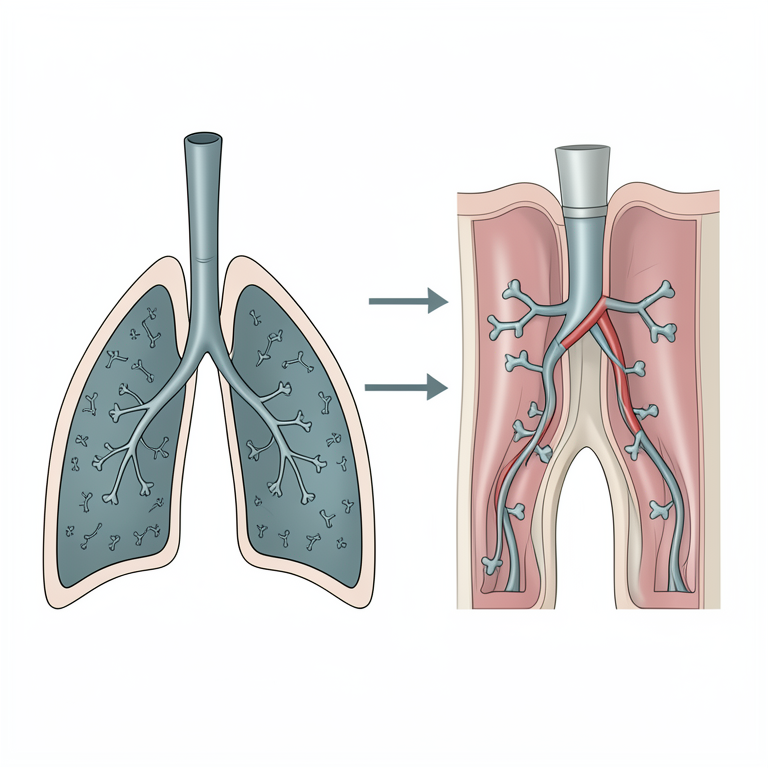
Comparison of Vaccine Delivery Routes
AI-generated conceptual illustration (human nasal cavity, lung tissue, and skeletal muscle). It explains the idea and does not show study data.
View source evidence ↗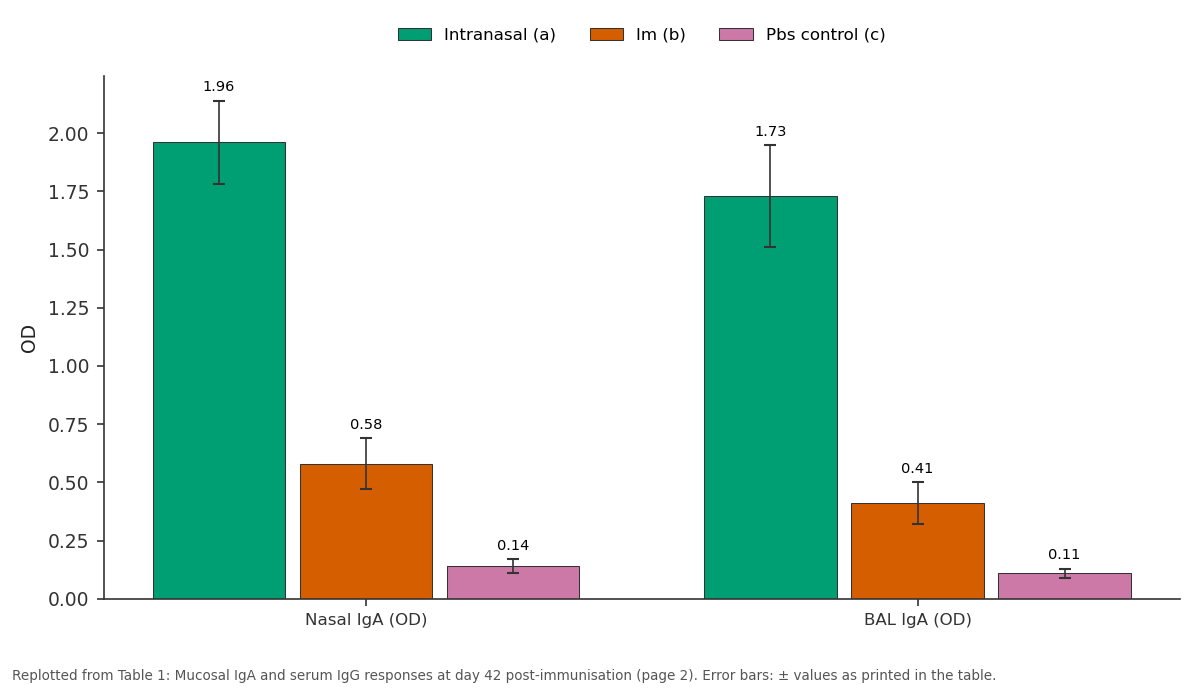
Intranasal (a) and Im (b) and more: Nasal IgA (OD) vs BAL IgA (OD)
Replotted from Table 1 (page 2) of the original paper. Every bar is the paper's own table value.
View source evidence ↗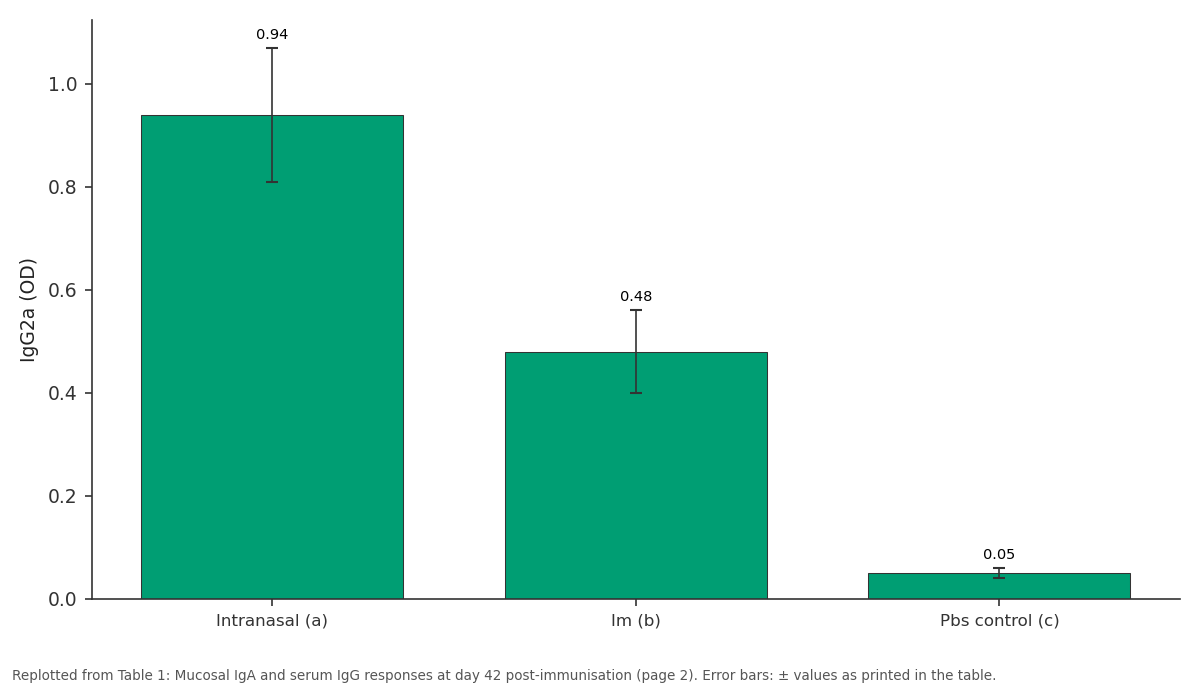
IgG2a (OD): Intranasal (a) vs Im (b) vs Pbs control (c)
Replotted from Table 1 (page 2) of the original paper. Every bar is the paper's own table value.
View source evidence ↗Figures & tables
From the original paper Table 1
 Table 2
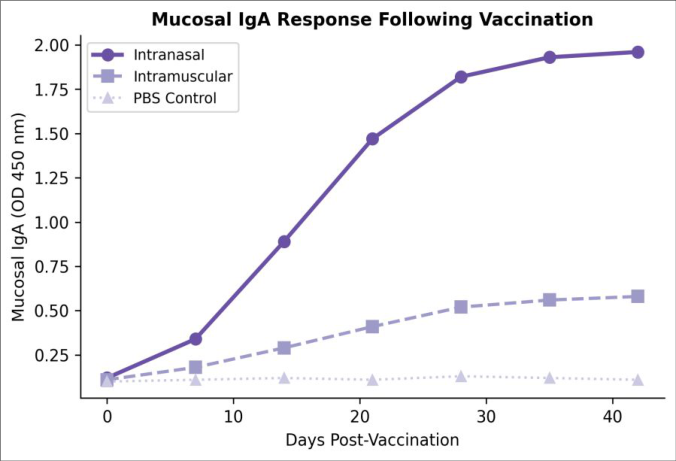 Figure 1
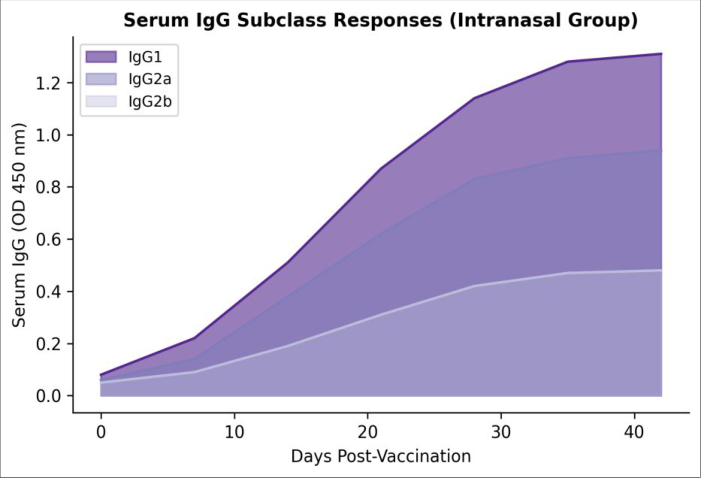 Figure 2
Introduction
When Albert Sabin introduced the oral polio vaccine in 1961, he established a principle that vaccine science is still working to generalise: mucosal surfaces, not just muscle tissue, can serve as effective induction sites for protective immunity [1] . Most pathogens enter the body through mucosal membranes of the respiratory, gastrointestinal, or urogenital tracts, yet the overwhelming majority of licensed vaccines are delivered by injection, a route that generates strong serum antibody responses but often fails to induce secretory IgA at mucosal sites [2] . That disconnect has driven a long-running search for mucosal vaccine formulations capable of eliciting both local and systemic protection. The nasal mucosa is an attractive delivery site because it is richly supplied with nasopharynx-associated lymphoid tissue (NALT), which functions as an inductive site for IgA class-switching and can seed effector cells to distant mucosal compartments through the common mucosal immune system [3] . Intranasal delivery also avoids the gastrointestinal degradation that limits oral vaccine potency and doesn't require needles, which simplifies logistics and improves acceptability in mass vaccination campaigns [4] . However, soluble protein antigens delivered intranasally are poorly immunogenic on their own because the nasal epithelium rapidly clears particles via mucociliary transport and because tolerance mechanisms at mucosal surfaces can dampen rather than amplify the immune response [5] . Mucosal adjuvants overcome this barrier by activating innate immune pathways that promote antigen uptake and presentation. Cholera toxin B subunit (CTB) is one of the bestcharacterised mucosal adjuvants in animal models. It binds GM1 gangliosides on epithelial and immune cells, triggering receptor-mediated endocytosis and enhancing antigen delivery to dendritic cells in the subepithelial dome of NALT [6] . When co-administered with a protein antigen, CTB has consistently boosted mucosal IgA and serum IgG responses in rodent systems, though translation to human use has been slowed by safety concerns about neurotropism of the related cholera toxin holotoxin [7] . Recombinant outer-membrane protein A (rOmpA) was selected as the model antigen for this research because OmpA-family proteins are surface-exposed, highly conserved across Gram-negative bacteria, and have been identified as vaccine candidates for several enteric and respiratory pathogens [8] . Producing rOmpA in Escherichia coli expression systems is straightforward and scalable, which makes it a practical test case for evaluating mucosal adjuvant strategies that might later be applied to more complex antigens [9] . Despite a large body of work on mucosal adjuvants, few investigations have directly compared intranasal and intramuscular delivery of the same recombinant antigen in a single experimental design, making it difficult to attribute observed differences to the route itself rather than to antigen dose, adjuvant, or animal strain [10] . This research addressed that gap by immunising BALB/c mice with identical doses of rOmpA via the intranasal route (with CTB adjuvant) or the intramuscular route (with alum adjuvant), using a PBS intranasal control group. The objectives were to (1) quantify mucosal IgA responses in nasal wash and bronchoalveolar lavage fluid, (2) compare serum IgG magnitude and subclass distribution between routes, and (3) evaluate T-cell cytokine profiles by splenocyte restimulation to determine the Th1/Th2 balance induced by each route [11] .
Material and Methods
Material and Methods
Reagents and Chemicals
Reagents and Chemicals
Quality control
All ELISA plates included positive controls (pooled hightitre sera), negative controls (naïve mouse sera), and blank wells. Intra-assay coefficient of variation was kept below 10%. rOmpA protein identity was confirmed by mass spectrometry before immunisation, and endotoxin levels were verified to be below 0.1 EU/μg using a Limulus amebocyte lysate assay. Adjuvant dosing was calibrated using endotoxin-free syringes, and all reagents were tested for sterility by overnight incubation on blood agar plates before use.
Results
Intranasal vaccination with rOmpA + CTB produced mucosal IgA levels more than three-fold higher than the intramuscular route at both nasal and lower-airway sites (Table 1). Serum total IgG was equivalent between the two vaccinated groups, but the intranasal group had nearly twice the IgG2a level, yielding a more balanced Th1/Th2 profile. IgA responses in the intranasal group rose sharply after the booster on day 14, reached a plateau by day 28, and remained stable through day 42 (Figure 1). The intramuscular group showed a modest IgA increase that plateaued below 0.6 OD units, while the PBS control remained at baseline. Splenocyte restimulation confirmed that intranasal vaccination promoted a mixed Th1/Th17 cytokine profile, with IFN-γ and IL-17A significantly higher than in the intramuscular group (Table 2). IL-4 was higher in the intramuscular group, consistent with a Th2-skewed response driven by alum. suggesting a balanced Th1/Th2 response, while the intramuscular ratio of 2.67 reflected a clear Th2 bias. These functional and immunological data together indicate that intranasal rOmpA + CTB vaccination generates superior mucosal protection and a more favourable T-helper balance than conventional parenteral immunisation with alum.
| Cytokine | Intranasal (a) | Im (b) | Pbs (c) | P (a vs b) |
|---|---|---|---|---|
| IFN-γ | 842 ± 97 | 413 ± 76 | 38 ± 11 | < 0.001 |
| IL-4 | 267 ± 42 | 384 ± 53 | 24 ± 8 | 0.003 |
| IL-10 | 189 ± 31 | 152 ± 28 | 31 ± 9 | 0.081 |
| IL-17A | 124 ± 23 | 67 ± 14 | 18 ± 6 | < 0.001 |
Table text extracted from the original PDF; superscript letters are shown inline. The original table image is below.
View original table image
| Measure | Intranasal (a) | Im (b) | Pbs control (c) | P (a vs b) |
|---|---|---|---|---|
| Nasal IgA (OD) | 1.96 ± 0.18 | 0.58 ± 0.11 | 0.14 ± 0.03 | < 0.001 |
| BAL IgA (OD) | 1.73 ± 0.22 | 0.41 ± 0.09 | 0.11 ± 0.02 | < 0.001 |
| Serum IgG (OD) | 2.14 ± 0.24 | 2.08 ± 0.21 | 0.09 ± 0.02 | 0.614 |
| IgG1 (OD) | 1.31 ± 0.16 | 1.28 ± 0.14 | 0.07 ± 0.01 | 0.738 |
| IgG2a (OD) | 0.94 ± 0.13 | 0.48 ± 0.08 | 0.05 ± 0.01 | < 0.001 |
Table text extracted from the original PDF; superscript letters are shown inline. The original table image is below.
View original table image
Discussion
The three-fold advantage in mucosal IgA seen with intranasal delivery is consistent with the well-established principle that mucosal immunisation preferentially induces secretory IgA at the site of antigen encounter and at connected mucosal effector sites [2] . The nasal wash and BAL IgA titres reported here are comparable to those obtained by Lycke and colleagues using CTB-conjugated antigens in a similar mouse model, reinforcing CTB's status as one of the strongest mucosal adjuvants available in preclinical settings [6] . The intramuscular route, by contrast, generated only low-level mucosal IgA an expected outcome, since parenteral immunisation rarely induces significant IgA at mucosal surfaces unless systemic antibody levels are extremely high [12] . An important finding was that total serum IgG did not differ between the two vaccinated groups by day 42. This means that intranasal delivery did not sacrifice systemic humoral immunity in favour of mucosal protection a concern sometimes raised when comparing mucosal and parenteral routes [13] . The difference lay not in magnitude but in subclass distribution: the intranasal group mounted robust IgG2a alongside IgG1, while the intramuscular group was heavily skewed toward IgG1. In mice, IgG2a is associated with Th1-driven opsonisation and complement activation, while IgG1 reflects Th2-driven responses. A balanced ratio may be advantageous for pathogens that require both extracellular neutralisation and intracellular killing for clearance [14] . The elevated IFN-γ and IL-17A in splenocytes from intranasally vaccinated mice adds a cellular dimension to this picture. IFN-γ activates macrophages and enhances antigen presentation, while IL-17A recruits neutrophils to mucosal surfaces, creating a layered defence that neither cytokine could achieve alone [15] . Alum, the adjuvant used in the intramuscular group, is known to promote Th2 polarisation with strong IL-4 output, which explains the higher IL-4 and lower IFN-γ observed in that group [16] . The bacterial clearance data provided a functional readout of the immunological differences. The 2.1 log₁₀ reduction in nasal CFU at 24 hours in the intranasal group, compared with only 0.8 log₁₀ in the intramuscular group, suggests that mucosal IgA and Th1/Th17 responses act cooperatively at the initial site of pathogen contact. And the near-complete clearance by 48 hours implies that local immune memory was sufficient to control infection without relying on systemic antibody diffusion into the mucosal lumen [17] . That said, this model used a non-lethal challenge strain, and whether similar advantages hold under lethal challenge conditions or with different bacterial species remains to be tested [18] .
Conclusion
This research demonstrated that intranasal immunisation with rOmpA formulated with CTB adjuvant produced mucosal IgA responses more than three times higher than those achieved by intramuscular injection with alum, without compromising serum IgG levels. The intranasal route also generated a balanced Th1/Th2 cytokine profile, characterised by high IFN-γ and IL-17A alongside moderate IL-4, in contrast to the Th2-skewed response seen with parenteral alum. Functionally, the mucosal immune advantage translated into faster bacterial clearance after intranasal challenge, with a 2.1 log₁₀ reduction in nasal colony counts at 24 hours and near-complete clearance by 48 hours. Intramuscular vaccination provided some protection relative to unvaccinated controls but was clearly less effective at the mucosal surface, the site where respiratory and enteric pathogens first establish infection. These findings support the broader case for developing intranasal vaccine platforms, particularly for pathogens that infect through the upper respiratory tract. CTB proved an effective mucosal adjuvant in this preclinical setting, though its path to human application will require detoxified derivatives or alternative adjuvants with comparable potency but improved safety margins. Future work should evaluate dose-response relationships, test the durability of mucosal memory beyond 42 days, and assess the intranasal rOmpA + CTB formulation against virulent challenge strains to determine whether the immune advantage observed here confers meaningful survival benefit. In practical terms, a needle-free intranasal vaccine would simplify cold-chain logistics, reduce injection-related complications, and improve acceptability in paediatric and community-based vaccination campaigns advantages that are especially relevant in resource-limited settings like Nepal, where health infrastructure constraints have historically slowed vaccine rollout.
Figures and tables from the paper
References
21 in the original paper- Sabin AB. Oral poliovirus vaccine: history of its development and use and current challenge to eliminate poliomyelitis from the world. Journal of Infectious Diseases. 1985;151(3):420-436.
- Holmgren J, Czerkinsky C. Mucosal immunity and vaccines. Nature Medicine. 2005;11(4 Suppl):S45-S53.
- Kiyono H, Fukuyama S. NALT-versus Peyer's-patchmediated mucosal immunity. Nature Reviews Immunology. 2004;4(9):699-710.
- Neutra MR, Kozlowski PA. Mucosal vaccines: the promise and the challenge. Nature Reviews Immunology. 2006;6(2):148-158.
- Mestecky J, Russell MW, Elson CO. Perspectives on mucosal vaccines: is mucosal tolerance a barrier? Journal of Immunology. 2007;179(9):5633-5638.
- Lycke N. Recent progress in mucosal vaccine development: potential and limitations. Nature Reviews Immunology. 2012;12(8):592-605.
- Freytag LC, Clements JD. Mucosal adjuvants. Vaccine. 2005;23(15):1804-1813.
- Guan Q, Wang X, Wang Y, Sun B. Recombinant outer membrane protein A induces a protective immune response against Escherichia coli infection in mice. Applied Microbiology and Biotechnology. 2015;99(13):5617-5627.
- Pore D, Chakrabarti MK. Outer membrane protein A (OmpA) from Shigella flexneri 2a: a promising subunit vaccine candidate. Vaccine. 2013;31(36):3644-3650.
- Yuki Y, Kiyono H. New generation of mucosal adjuvants for the induction of protective immunity. Reviews in Medical Virology. 2003;13(5):293-310.
- Boyaka PN. Inducing mucosal IgA: a challenge for vaccine adjuvants and delivery systems. Journal of Immunology. 2017;199(1):9-16.
- Czerkinsky C, Holmgren J. Mucosal delivery routes for optimal immunization: targeting immunity to the right tissues. Current Topics in Microbiology and Immunology. 2012;354:1-18.
- Azizi A, Kumar A, Diaz-Mitoma F, Mestecky J. Enhancing oral vaccine potency by targeting intestinal M cells. PLoS Pathogens. 2010;6(11):e1001147.
- Nimmerjahn F, Ravetch JV. Divergent immunoglobulin G subclass activity through selective Fc receptor binding. Science. 2005;310(5753):1510-1512.
- Khader SA, Gaffen SL, Kolls JK. Th17 cells at the crossroads of innate and adaptive immunity against infectious diseases at the mucosa. Mucosal Immunology. 2009;2(5):403-411.
- Marrack P, McKee AS, Munks MW. Towards an understanding of the adjuvant action of aluminium. Nature Reviews Immunology. 2009;9(4):287-293.
- Brandtzaeg P. Induction of secretory immunity and memory at mucosal surfaces. Vaccine. 2007;25(30):5467-5484.
- Woodrow KA, Bennett KM, Lo DD. Mucosal vaccine design and delivery. Annual Review of Biomedical Engineering. 2012;14:17-46.
- Clements JD, Freytag LC. Parenteral vaccination can be an effective means of inducing protective mucosal responses. Clinical and Vaccine Immunology. 2016;23(12):882-886.
- Lavelle EC, Ward RW. Mucosal vaccines fortifying the frontiers. Nature Reviews Immunology. 2022;22(4):236-250.
- Mudgal R, Nehul S, Tomar S. Prospects for mucosal vaccine: shutting the door on SARS-CoV-2. Human Vaccines and Immunotherapeutics. 2020;16(12):29212931.